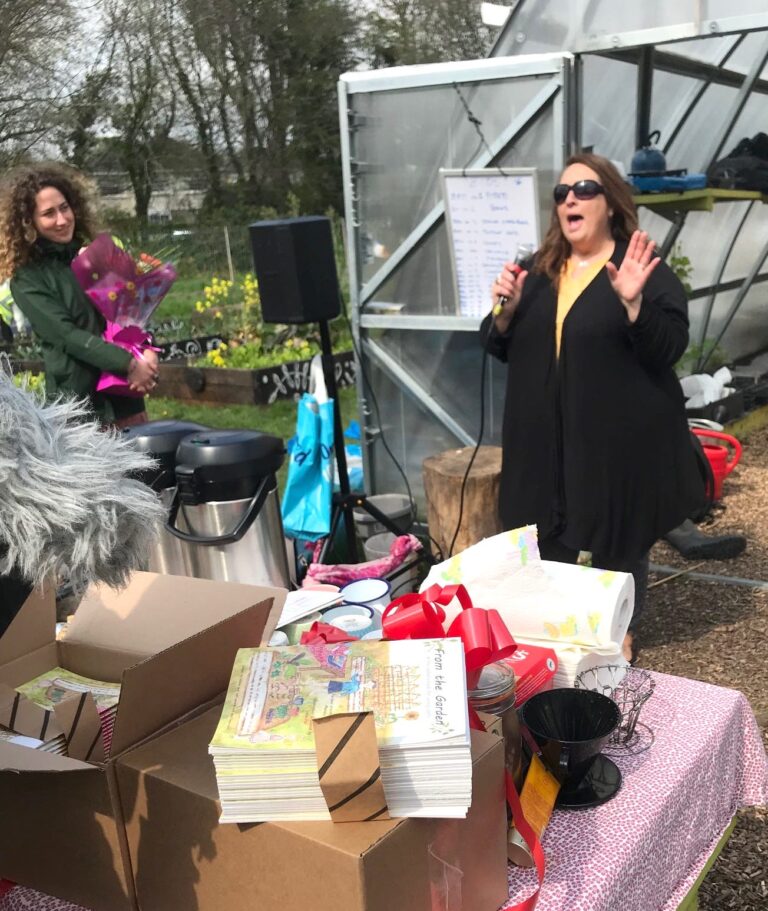
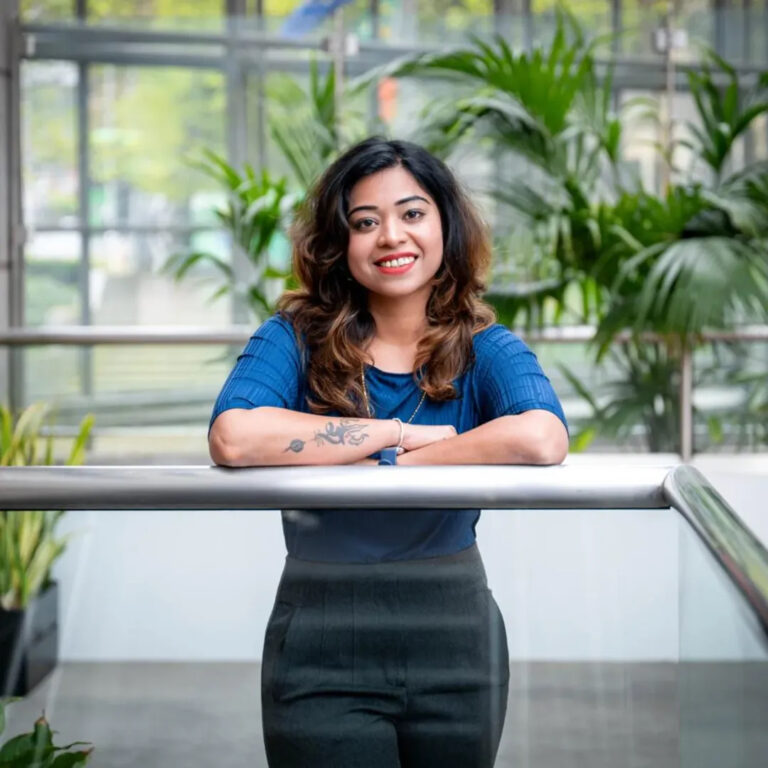
Mandie first became involved as she needed an outlet for herself while busy as a carer to her parents:
“Just after Covid I had given up my job as a chef to look after my parents. I was kind of hanging around the house for most of the day, after my parents had their breakfast I’d be waiting for the lunch and then the dinner,” she said.
One of Mandie’s friends worked as a social prescriber and she put her in touch with Maria Young, Green Spaces for Health co-ordinator.
“I’m big into gardening and Maria said I’d fall right in, that I could tip away during the days.”
And so she did.
“It was me time, when I was looking after sick people all day, it was something I could get away and do for myself.”
She was also pleased to get involved with in a project that could help restore the social fabric of her area, right after the pandemic.
“Covid took chunks out of people. The community garden gave people a chance to meet each other, which had been gone for years. I was all about getting the community back up and running again.”
Since 2022, the Togher Community Garden has given her and many other people a huge, ongoing boost.
“It’s a pity you can’t bottle it and sell it, it’s unreal. It’s so good for people. We have this guy from Chile, he’s in his thirties. When he arrived last summer he had a really bad stammer, he was so anxious. He was moving out of his rented house, had tools and he wanted to know if we wanted them. Now, a year later he’s a different man altogether. He’s confident, he looks forward to coming down every Saturday and doing work. We’d always have work for him to do.
“A lot of people have mental health issues, and they want to get back into the world. We have teenagers coming with special needs. I kind of take them under my wing. I’d say we have nearly 90 people coming, from every walk of life,” she said.
The Community Garden is also helping to integrate people in an area that has had its challenges.
“Last Saturday, we had 11 nationalities around one table (each day concludes with a light lunch). It’s absolutely amazing what it has done for the community. A lot of new houses have been built in our area, there are people from different nationalities who would never have mixed or known their neighbours.”
She feels she could have fallen into a depression if she didn’t have the Community Garden, having suffered a number of tragedies.
“My mother, my brother and my sister all died in the space of four months. I threw myself into the Garden, helping everyone else helped me in turn. My Dad passed away a few weeks ago too. If I didn’t have it, I probably wouldn’t have gotten out of the bed. It was perfect for me, I could put my energy into helping everyone. I love it, I’d be there seven days a week because it’s right on my doorstep,” she said.
Maria Young says community gardens are really flourishing on Leeside now. “There’s hardly a parish in the city without one now. It has been terrific, very positive for all the communities.”
Maria feels knowledge learned in the gardens is spreading out around the city. “Many of the houses built in Cork in the ‘50s and ‘60s would have had fairly nice sized gardens for people to grow food, that was the expectation and people are starting to do that. It is really rippling out. A number of primary schools came to us and they now have their own gardens,” she said.
Now all councils must include the following in their development plan, according to the Act:
“Prepare a strategy for the creation, improvement and preservation of sustainable places and communities” which includes “the reservation of land for use and cultivation as allotments and prescribed community gardens and the regulation, promotion, facilitation or control of the provision of land for that use”.
Community Gardens Ireland, a fully voluntary network, played a starring role in ensuring community gardening was covered by the Act. (Allotments were already covered by legislation since 1926).
As Molly Garvey of Community Gardens Ireland, writing on Linkedin, said: “Now it’s in law, and it’s up to community groups to make it known to their councils that this is something they are looking for.”
“This is for anyone who wants to give food growing a go with other people. Local councils are a resource to support this, from land access, to facilities (water, leaf mulch), to funding. However, not all councils are the same at the moment, and not all councils have supporting food growing in their sights.
“That’s why we at Community Gardens Ireland thought that it would be good to give them a wee push. All councils are required to create development plans on a rolling basis. These development plans are guided by the Planning and Development Act. We thought community gardening support should be a requirement, so we got it added into law,” said Molly.
“We need to provide for community-managed spaces alongside our new housing sites so that our houses can become homes and our homes can become neighbourhoods. Community Gardens and allotments are one of the many ways of doing this,” she added.
According to a 2020 Local Government Management agency report, eight local authorities in Ireland did not provide any allotments or community gardens.
This year, on April 26, President Michael D. Higgins called directly for more community gardening:
“While it is heartening to see interest in community growing projects increase in recent years, it is a matter of some concern that Ireland currently offers one of the lowest levels of provision for allotments and community gardens in Europe.
“Community gardens, allotments, neighbourhood plots, and shared growing spaces are not only places of cultivation, they also contribute in real and measurable ways to the United Nation Sustainable Development Goals, advancing sustainability, social cohesion, health, and food security,” he wrote.
Official definition of community gardening
Ireland agreed last year on an official definition of community gardening.
The Planning and Development Act 2024 now defines a “community garden” as meaning “an area of land that— (a) is let or available for letting from a local authority to members of the local community for collective gardening purposes, and (b) is used or intended for use— (i) wholly or mainly for either or both of the following: (I) the production of vegetables or fruit mainly for consumption by members of the local community; (II) the propagation of plants for environmental or decorative purposes in the local community, and (ii) otherwise than for profit.”
Source: page 127 of the new planning Act. Allotments are also defined on the same page.
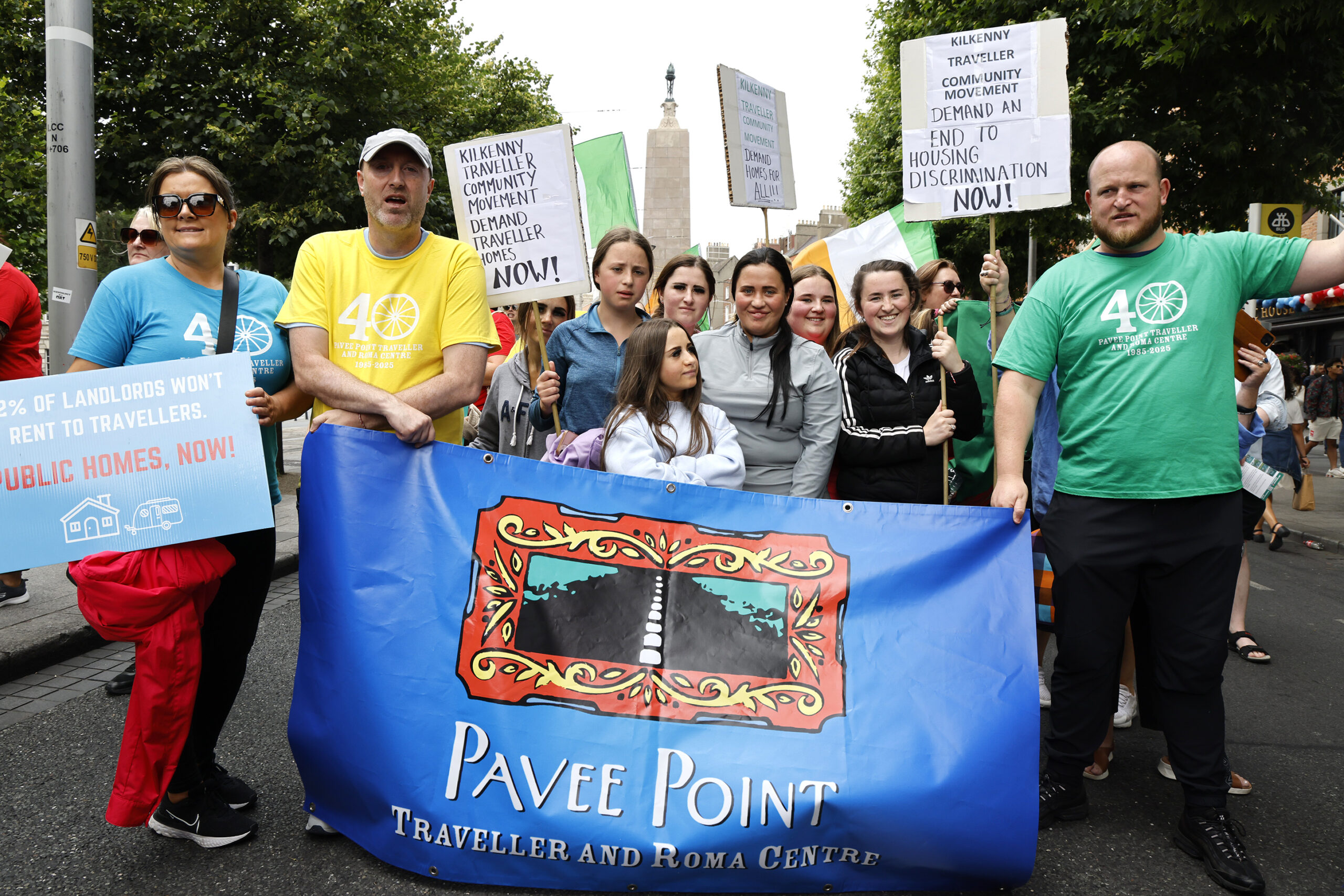
“We are heading towards more equality among migrants, Travellers, Irish, non-Irish, blended families, foster families, children in care, because they’re now all equally deprived and suffering,” she said.
“We have had a 300% increase in the last five years of children going into care. A 500% increase of migrant children and Traveller children going into care. So, we are breaking up families and the state is having to deal with that,” she said, speaking at the Social Inclusion Forum 2025 which was held on May 8 in Croke Park.
“Children in care are the most vulnerable children you can imagine. They are really suffering and you need to do more,” she appealed.
Forum disappointment
Voices from the floor indicated a loss of patience with the government. Things are worse now than they were in 2007, said one speaker pointing to the number of babies being born into homelessness in Dublin in 2025.
“I was one of the unfortunate people who were so excited when you sent out that huge survey on the cost of disabilities. I helped over 180 people to fill it in, me and other volunteers,” she recalled.
“And then we were told, we’re actually going to support people with disabilities, to give them an opportunity to participate, to contribute and actually have a real existence.
“We were given that little bit of hope, and then nothing happened, nothing changed. There is no real vision for what you’re going to do, because the poverty trap is entirely created by the state, and this is part of the problem.
“We’ve got the highest number of babies born into homelessness just down the road.
“I don’t see the change, I don’t see the vision. I look forward to having a report, but I’ve been coming to these since 2007, and it’s worse now than it was in 2007. I’m probably one of many who’s really disappointed,” they said.
Islander’s message on week of tragedy
In the same week that an islander lost his life on a pier on Clare Island, Megan O’Malley travelled from the island to Dublin to deliver a call at the forum for better infrastructure to make life safer and less isolated for all living on Ireland’s offshore islands.
She said, “During winter we put our lives at risk every day trying to get out to get food, water, baby’s nappies, new clothes, school items, everything.
“We know all too well what it’s like to be isolated and not be able to get the services in in time when they’re needed in an emergency,” she added.
End discrimination in state services
Kathleen O’Connor works as a primary healthcare co-ordinator in Co. Wicklow and is appalled at the lack of progress. She said, “Travellers are living in substandard accommodations, ten years after the Carrickmines tragedy that took the lives of ten of our people from our community.”
She highlighted poor pay and conditions in the sector and a lack of pension support for some staff. Traveller primary healthcare workers and their communities face daily racism and discrimination, including “a lot of barriers” against Travellers seeking to access services.
“It’s very hard as Travellers to go into a service even and then to go in and being discriminated against which makes it even harder. So we do try to work with that as well but that’s what we’re facing every day,” she said.
Guest speaker’s gratitude for community work
Guest speaker, author and lecturer Katriona O’Sullivan, said, “Poverty and inequality robs you of connection. And that is something that we all deserve to have.”
“I grew up in a home where both of my parents were heroin addicts. I woke up every single day hungry and not just for food. I hungered for a hug, for someone to teach me how to regulate myself, for someone to tell me that I was worth more.”
She went on to describe support she received from, among others, a community worker called Joe and it made a difference.
“He guided me towards the two really important things that changed my life, therapy and education,” she said, adding that good policies and support services can help people to rise above poverty.
Hailing from Dublin’s inner city, he also interestingly gave personal insights into his own challenging upbringing in a poor neighbourhood where many of his classmates end up behind bars or dead. His talk followed a tearful account of her own upbringing surrounded by poverty and drugs by author Katriona O’Sullivan. He noted that while he also grew up in poverty, his family escaped the added pain of drug addiction.
“I was born and raised in north inner city Dublin. I went to school where there were 54 lads in the class; 51 of them ended up in Mountjoy and I was one of them who didn’t. The reason I didn’t end up in Mountjoy is because my parents weren’t drug addicts and my mother in particular placed an awful lot of store in education.
“And although she was involved, she had a profound disability (and) I and my sister spent an awful lot of time caring for her.
“So I know what disability is. I know what child caring is – she could do one thing: She made sure we did our homework and she helped us do that homework and she told us, get educated and get out.
“So I know, I have a background, I have an understanding, as do an awful lot of other senior civil servants if you speak to them. Don’t assume that we don’t know what it takes to be a carer, or what it means to be a person with a disability,” he said.
He asked attendees to be open-minded: “Sometimes when people talk, they talk in an ‘us’ and ‘them’ scenario. It’s not us and them, it’s us together,” he said.
Stories embolden us
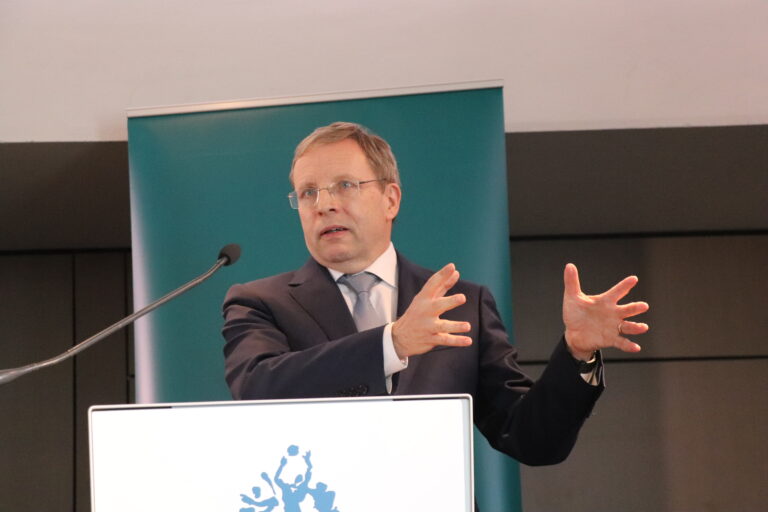
He said social inclusion “is good for the economy” and is also about “respect”: “It’s about parity of esteem, it’s about aspiration, opportunity. It’s about love, security, connection. The data doesn’t tell us that, but your stories tell us that.
“And that’s what emboldens us, and what energizes us, and what encourages us to go and make the case on your behalf for the changes that need to be made,” he said. Looking at national statistics, while he could show that measures to tackle poverty had been partly successful, he acknowledged that if you were poor today you could not feel the benefit of a statistical curve upwards.
“The fact that consistent poverty has reduced from nearly 10% to 5% in six years is of little comfort to the person who’s in that 5%. If you’re one of that 5%, your experience of consistent poverty is 100%.
“The averages are great, but they hide the individual stories. And we’ve got to be aware of that,” he said.
Nonetheless, deprivation rates between 2014 and 2024 have “more or less halved (and) the risk of poverty has more or less halved,” he said.
New efforts to reach the hardest-to-reach people were promised. Giving examples of ideas that came through the SIF – such as free school dinners – he spoke of the continuing usefulness of the forum and the impact that community workers have.
He noted that as poverty rates come down, making further progress required fresh approaches. He said we should be “100% focused” on tackling discrimination. Also, we should view expenditure on social inclusion as an investment, not a cost.
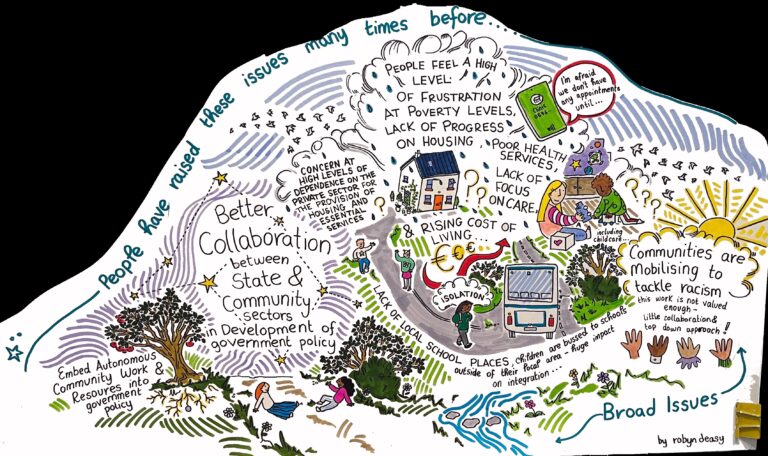
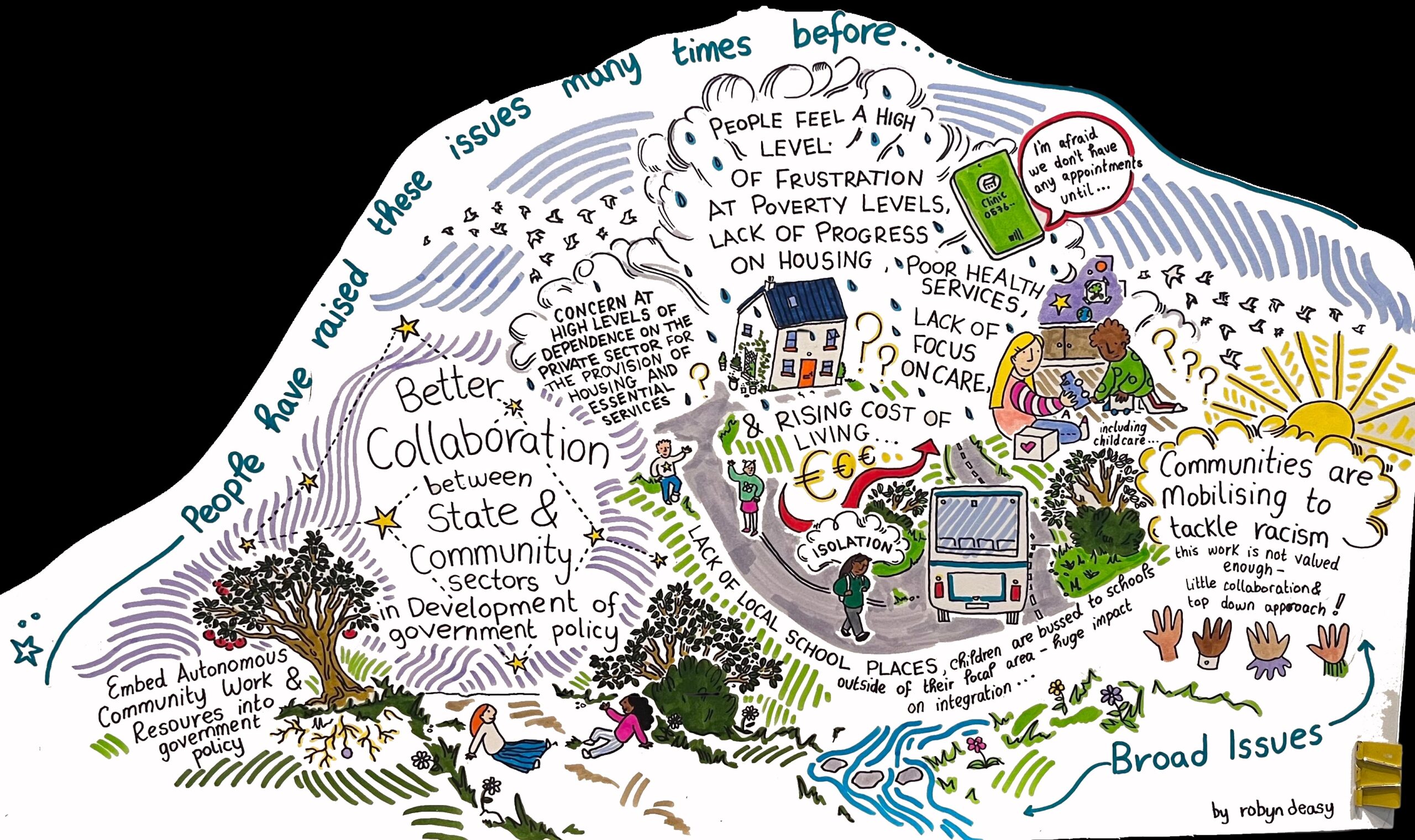
The forum was held to bring the state and civil society together and to hear what community groups see and what they recommend to reduce poverty.
Forum disappointment
• SIF 2025 illustration by Robyn Deasy.
Voices from the floor indicated a loss of patience with the government. Things are worse now than they were in 2007, said one speaker pointing to the number of babies being born into homelessness in Dublin in 2025.
“I was one of the unfortunate people who were so excited when you sent out that huge survey on the cost of disabilities. I helped over 180 people to fill it in, me and other volunteers,” she recalled.
“And then we were told, we’re actually going to support people with disabilities, to give them an opportunity to participate, to contribute and actually have a real existence.
“We were given that little bit of hope, and then nothing happened, nothing changed. There is no real vision for what you’re going to do, because the poverty trap is entirely created by the state, and this is part of the problem.
“We’ve got the highest number of babies born into homelessness just down the road.
“I don’t see the change, I don’t see the vision. I look forward to having a report, but I’ve been coming to these since 2007, and it’s worse now than it was in 2007. I’m probably one of many who’s really disappointed,” they said.
Islander’s message on week of tragedy
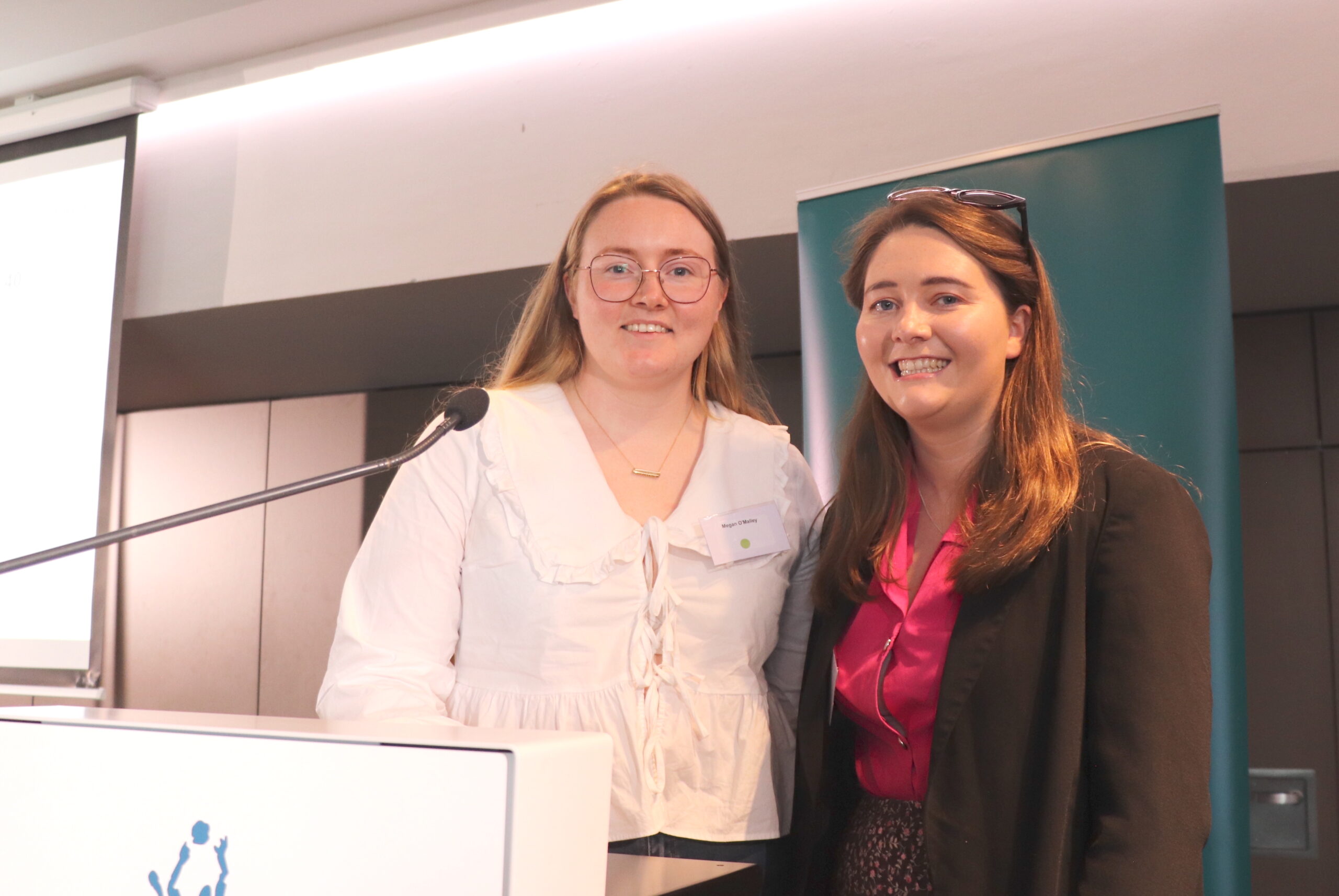
• Megan O’Malley, Clare Island CDP and Chloe Ní Mháille, Community Work Ireland.
In the same week that an islander lost his life on a pier on Clare Island, Megan O’Malley travelled from the island to Dublin to deliver a call at the forum for better infrastructure to make life safer and less isolated for all living on Ireland’s offshore islands.
She said, “During winter we put our lives at risk every day trying to get out to get food, water, baby’s nappies, new clothes, school items, everything.
“We know all too well what it’s like to be isolated and not be able to get the services in in time when they’re needed in an emergency,” she added.
End discrimination in state services
Kathleen O’Connor works as a primary healthcare co-ordinator in Co. Wicklow and is appalled at the lack of progress. She said, “Travellers are living in substandard accommodations, ten years after the Carrickmines tragedy that took the lives of ten of our people from our community.”
She highlighted poor pay and conditions in the sector and a lack of pension support for some staff.
Traveller primary healthcare workers and their communities face daily racism and discrimination, including “a lot of barriers” against Travellers seeking to access services.
“It’s very hard as Travellers to go into a service even and then to go in and being discriminated against which makes it even harder. So we do try to work with that as well but that’s what we’re facing every day,” she said.
Two things changed my life
Guest speaker, author and lecturer Katrina O’Sullivan, said, “Poverty and inequality robs you of connection. And that is something that we all deserve to have.”
“You do not expect someone like me to end up here. If you go back 30 years, I’m 16, 17, I am living in a homeless hostel in Birmingham. I have a baby. He’s nearly one. I am completely welfare dependent. I left school a year before with no qualifications at age 15. Terrified and alone, no family support,” she recalled.
“I grew up in a home where both of my parents were heroin addicts. I woke up every single day hungry and not just for food. I hungered for a hug, for someone to teach me how to regulate myself, for someone to tell me that I was worth more.”
She went on to describe support she received from, among others, a community worker called Joe and it made a difference.
“He guided me towards the two really important things that changed my life, therapy and education,” she said, adding that good policies and support services can help people to rise above poverty.
“They offered me free education, rent assistance, free child care and therapy. All of them were connected. I didn’t have to trade anything off.”
The theme of this year’s SIF was ‘Reflecting on the Past and Informing the Future of the Roadmap for Social Inclusion.’
“It was kind of a circuitous route. I didn’t get up one morning and decide I want to do a degree in community development,” she said.
Today, she is driven by the experience of having seen people unfairly treated because of their social status or ethnic background. Respect, dignity, solidarity and support are important to her – and all whom she works with.
She believes staff in Local Development Companies (LDCs) have much more to offer than is realised.
“Where we have added value is by being able to tap into frontline staff of two and a half to three thousand. That’s the number of people we have on the ground nationwide,” she said.
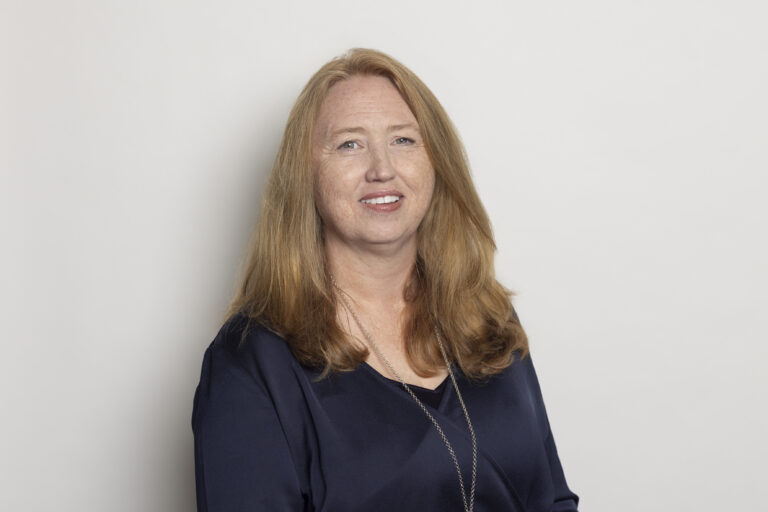
Having served for over three years as CEO of the Local Development Companies Network (formerly the Irish Local Development Network) we thought it timely to interview her.
There are currently 46 LDCs that are members of the network and three other LDCs whom she hopes will soon rejoin the group.
Just prior to joining the network, its member companies made an impression nationally during the pandemic by responding swiftly and astutely to local needs across the country.
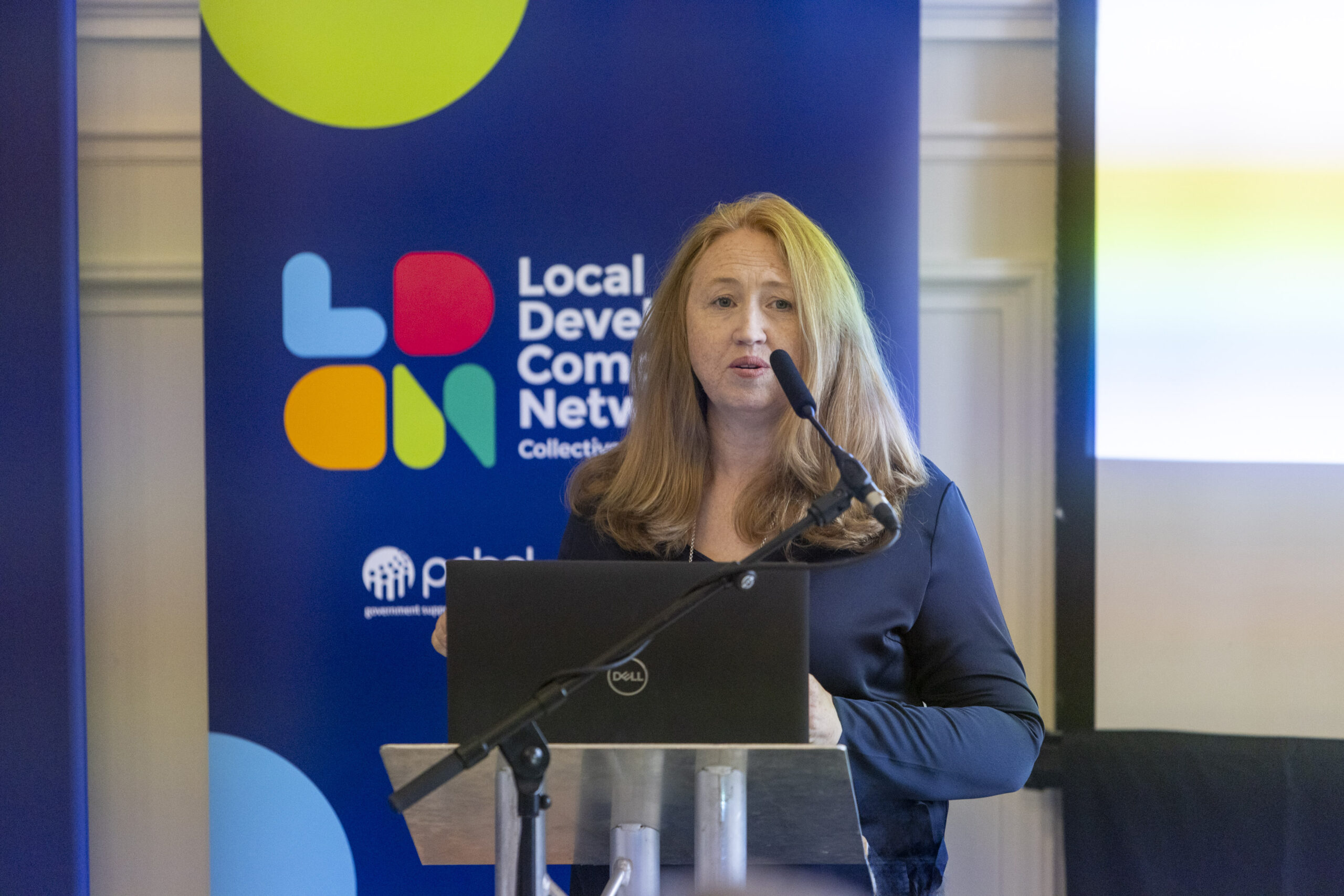
• Carol speaking earlier this year with the newly rebranded LDCN (formerly the ILDN) logo in the background.
During Carol’s tenure, network staff numbers expanded from two to six personnel and LDCs were to the forefront at community level responding to the arrival of refugees from Ukraine and more recently responding to the impact of the hurricane-like Storm Eyown.
In the normal day-to-day, they help to bring dozens of national programmes to life at local level, while nationally the network is represented on over 40 national groups and forums, including across a range of government departments.
“We take that representation seriously. We see it as an honour and a privilege and we use it responsibly,” said Carol.
“We’re very member-led. The network is highly equitable, very transparent, and everybody gets access to all of the information. And we operate by community development principles. I believe that makes us an effective network. We live our values,” she said.
However, I began by asking Carol how her own upbringing might have prepared her for working in social inclusion, human rights and community development.
Now living in Galway, she was born and grew up in Cabra, Dublin, the last of eight children.
“Like a lot of families there at that time money was always an issue. However, I had no idea that we all lived in poverty until my circle expanded when I made new friends in secondary school. They didn’t live the way we did. Their streets were different, their houses were different, the things they did were different. That didn’t turn me into an activist, but I did note that it was different.
Another influence was her mother Doreen who was “pretty active in the community”.
“More importantly, she had strong principles around fairness, around helping those worse off, around giving whatever you could give. And around speaking out – my mam had no fear, no fear at all and that was a lesson for us. She used to always say to us, ‘You’re better than no one, and no one is better than you’. If you had a view, you said your view.”
• LDCN staff members as of June, 2025: Catherine Lane and Hussain (Behtaash) Bakhshi, co-ordinator and administrator respectively of the Community Connection Project, Carol Baumann, CEO, Michelle Mullally, programmes, impact and communications officer, Conall Greaney, finance and admin officer, and Philip O’Donnell, research, policy and rural affairs officer.
“I was lucky”
Looking back she realises how lucky she was:
“My brothers and sisters all finished school aged 14 or 15, and not because they necessarily wanted to leave school, but that’s just how it was. I was lucky being the last one, because I was allowed stay in school and I ended up doing a business degree.
“I often think a business degree is a working class degree. It looks like a trade, it has a skill set to it, it has a vocation set to it. I remember somebody telling me their brother was doing arts and I asked was he good at drawing, because I didn’t know what an arts degree was. That’s how out of the loop I was.
She completed her degree and “was absolutely certain I did not want to go into banking or accountancy” and instead she began teaching in a school where some of the pupils were experiencing high levels of deprivation.
“I remember I was supposed to be teaching budgeting to a group of kids who lived in a block of flats and all of the examples – saving to buy a car, a holiday or a house – meant absolutely nothing to them.
“And I became more interested in them than in the subjects that I was teaching. I could see that their life chances and their life expectations and their aspirations were already so limited,” she said.
She then moved abroad and found work on European programmes for young people who dropped out of school early and for women returning to education, and on coming home to Ireland, she found a job in local development.
Appalled at disrespect towards people struggling
She gave examples of unfair treatment of people struggling to get over structural barriers that still irk her to this day. Parents called one day to a local development company she worked for, looking for help to get their sons into secondary school because they wanted them to be able to read and write. The family were Travellers.
“They were given the run-around. Absolutely blatant racism dressed up as, ‘Ah, your kids would be better here’ and ‘Your kids might be better there’. I remember feeling how disingenuous it was. All the man wanted was for his kids to be able to read and write, it really wasn’t a huge amount to ask for,” Carol recalled.
She had similar stories to tell about teenage girls becoming pregnant and being unsupported.
“Their opportunities to stay at school, to do anything else to build a decent life for themselves and their kids, really disappeared,” she said.
Carol worked for a long time in the Money Advice and Budgeting Service (MABS) which provided “incredible support” and she was appalled that clients were discriminated against in wider society.
“They were sometimes portrayed as having been the architects of their own demise, that in some way they were inept, they were feckless or they were undisciplined. I found that hugely offensive.
“The clients we supported were people who managed exceptionally well on very little. They had very little money and walked a tightrope every day with no safety net.
“A crisis would tip them over: Somebody getting sick, a washing machine breaking down, a young fella needing new shoes, things that they just weren’t able to put money by for, and they would end up then in a spiral that they’d find very difficult to get out of.
“And yet there seemed to be little respect for them. That experience taught me huge respect for people who were forced to live with so very little. And that lesson stayed with me. And it’s always driven me in respect of the policy work and the advocacy work that we’ve been involved in.”
Proud times
She recalled proud times.
“I worked for a few years with a domestic abuse service and we opened a new refuge. It was much more than a building, we built a new client-centred service where we accepted no compromise in regards to the quality of the service. I remember when we started, thinking we’ll never get what we want, but we did, and it was a moment of great pride for me and colleagues that what we built was second to none.
“The service is still there to this day,” she added.
Solidarity in us as a people
She enjoys working in a country with “a very long tradition of community”.
“It is a really important part of our fabric. It’s part of our DNA. We know the need to help each other. We know what it is to recognise when something systemically is wrong and we’re good at saying it.
“Look at how we rally around in times of crisis, or a tragedy, or even if you look at the GAA. Those things help form the fabric of communities, they give people a sense of place, a sense of identity, a sense of mutual responsibility.
“And maybe there’s a bit of religion in that as well, the way people say, ‘Oh, there but for the grace of God’. But there is a real sense of solidarity in us as a people, we don’t tend to turn a blind eye. In other countries I’ve lived in, that’s different,” she said.
Asked who or what is really impressive in creating social change through bottom-up community action, she replied, “Small local groups with people who feel passionately about an issue. They’re the people who create social change, not big anonymous entities.”
Values V. Pay
Regarding work in the community and voluntary sector, she decries short term contracts and low pay.
“How long can you rely on people staying in the work because they’re values-driven? It’s not fair, it’s exploitative. The work has got to pay. Nobody’s going to get rich working in community, but they should be able to at least achieve a reasonable standard of living.
“It’s not in keeping with the statements that are often made about how important the community and voluntary sector is. If it’s that important, please invest.”
Best government programmes for communities?
Carol said the Social Inclusion and Community Activation Programme (SICAP) was the most important government programme for communities at present.
“It has evolved over the years, and is a very effective programme. But I’m a bit concerned that SICAP risks becoming quite bureaucratic. It’s something the stakeholders are aware of.”
She said the newish Empowering Communities Programme is “fabulous”.
“It’s just community development. It is very like programmes I’d have known in the ‘90s, where you had very small area-based work, where you were meeting with people, listening to them and, more importantly – when they told you what they needed and wanted in their area, working with them to deliver it. That’s what Empowering Communities does. I’d like to see it expanded.”
LEADER
She believes the LEADER programme “definitely needs more resourcing”.
“LEADER is critical in our communities. Its community-led approach is about allowing people deciding what they want to achieve in their own community. It is a very respectful and democratic way of working, and much more valuable than any kind of imposition from a remote department or agency,” she said.
LEADER funding relates to what is available at European level (as well as what’s available nationally) and I put it to her that EU funds may be redirected towards defence spending.
“Defence isn’t only about weaponry and armaments. Defence is also about food safety, it’s about resilience in communities, so that’s also a valid form of defence.
“Nationally, we all need resilient communities whether rural or urban,” she said.
National issues
“A local development company exists to work on developing local solutions to local problems, but some local problems are not caused locally and cannot be solved locally, they’re systemic, they are policy-based, and they need to be amplified and they need to be elevated to a national forum, and that’s why the network is required.
“We’re member-led and I’m very proud that the network is in a very good place. I was fortunate enough to follow in the footsteps of my predecessors Brian Carty and Joe Saunders. They both took the network very far along a particular road. The network is vibrant and relevant and doing great work and it’s recognised.
Carol’s Top Two tips
“Never give up, ever. Never stop banging the drum. The first part of advocay is telling the story. And that’s why a magazine like Changing Ireland is so important – you’ve got to tell the story. And you have to tell the story truthfully and loudly. You have to keep drawing attention to it and never allow yourself to be rubbed off.
“Keep your eye on the prize and do not let up until you get there.
“The second thing is to look for allies and remember that you may well find them in places that you don’t expect. That has served me well, entering every engagement expecting to find an ally even though rationale might tell me I’m not going to,” said Carol.
The views expressed here by Carol are in a personal capacity and not as CEO of the LDCN.
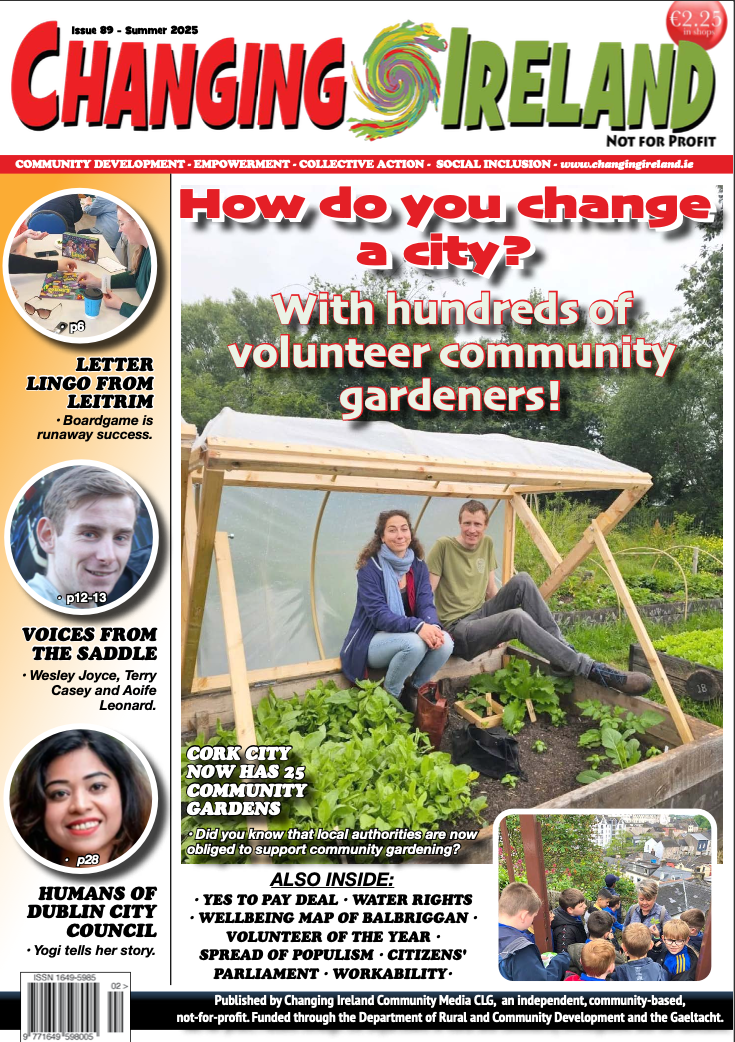
READ OUR FULL SUMMER EDITION HERE – CLICK IMAGE TO OPEN (SAFELY):
“It’s a two year undergraduate diploma aimed at people already active in their communities. In a lot of communities people would be involved in several different organisations, you’d have the usual suspects involved in lots of things,” said Eileen.
The course consists of eight modules with much of the second year focused on a community based project.
“There’s a lot of group work, learning by experience. There are essays and lectures, but the vast majority of it is group work. It’s quite imaginative in how things are taught and assessed,” says Eileen.
She feels it really helps to further develop the potential of people already invested in their communities.
“What CWELL does is enhance what people have already. Some people find it really transformative and they find it affirming. We have a rule in class that you can’t say ‘only’ or ‘just’ because the students who are attracted to CWELL sometimes don’t realise how much community experience they have and the level of skills they have. I think CWELL helps to bring that out as well as giving them new skills and knowledge.”
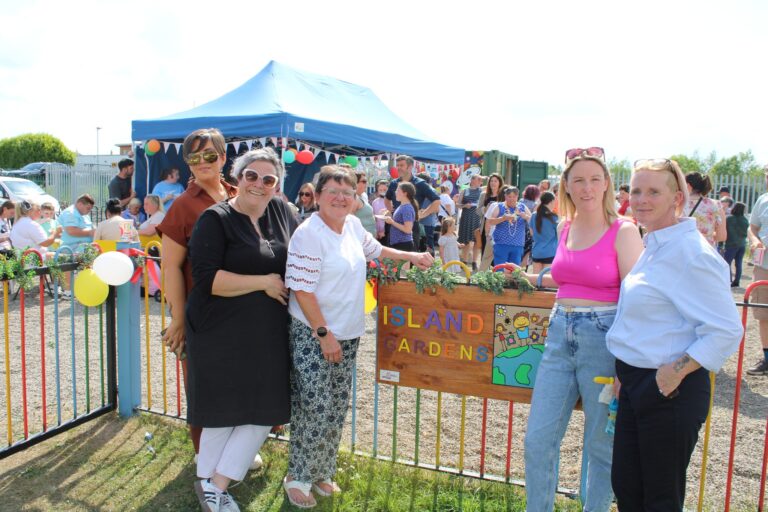
An example of the kind of projects that CWELL students engaged on this year was one with residents on King’s Island, Limerick, to revive a community garden. The Island Gardens project involved collaboration with community gardener Rebecca Hussey, Limerick Civic Trust, Limerick Growing Communities, Sláintecare Healthy Communities, and the PAUL Partnership’s Empowering Communities project and it aimed to develop a welcoming and inclusive space for everyone. Our main photo shows CWELL students – left to right – Caroline O’Connell, Debra Franklin, Jacinta Kelly and Debbie Bourke – with community worker Mary Hughes (2nd left) at the launch of the Island Gardens project.
• CWELL graduate Jackie Condon is a leading member of the editorial team that publishes CWELL’s magazine.
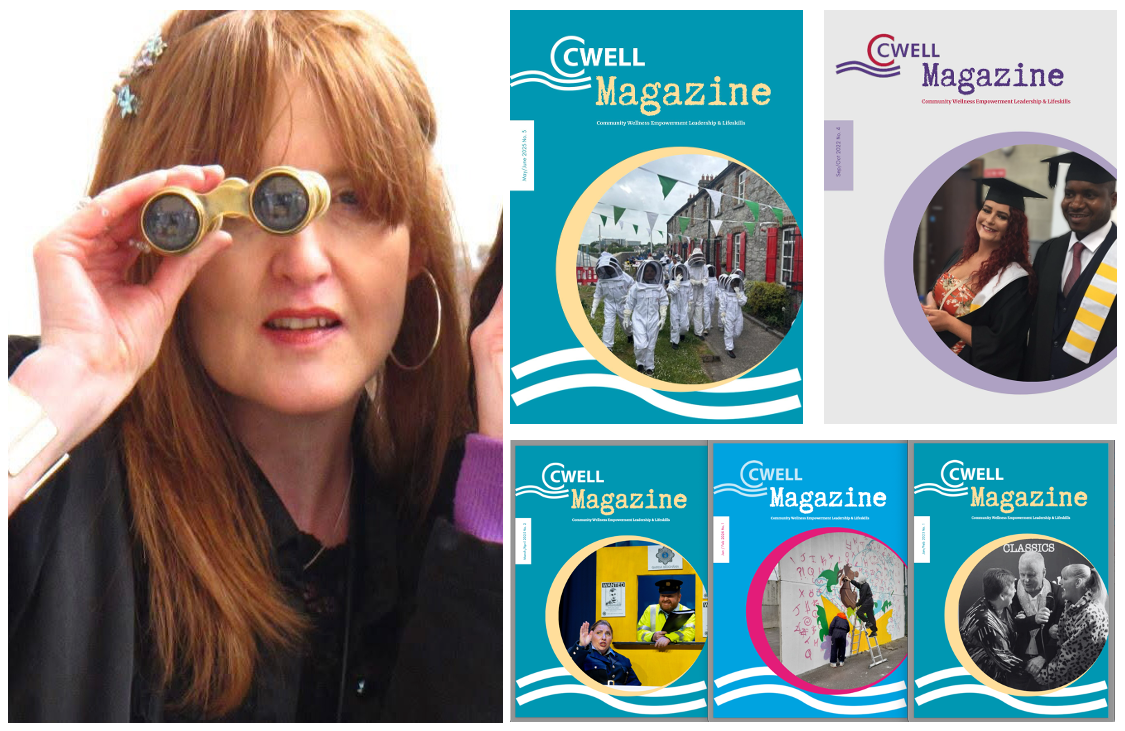
CWELL has its own magazine* and graduate Jackie Condon is heavily involved in getting it to print every two months.
“I’m part of the editorial team with Tracey Gleeson. Maura (Adshead) is the programme director and Eileen is also involved in it. I’d be the main reporter and really I’m a conduit for community workers to showcase things that are going on in their communities. I am also the envoy that goes out and asks if they would like to have what they are doing featured in a magazine.
“There are an awful lot of people doing a lot of hard work behind the scenes and it very much goes unrecognised. It’s nice for the groups to have a voice. Also, students can contribute if there is anything going on in their area. It’s my job to pull it all together,” she says of the publication.
Jackie loves to see the energy and commitment of the various community groups in the area: “It is both humbling and encouraging to see all of the positive work going on throughout Limerick.”
‘CWELL Magazine’ is distributed across Limerick city and Jackie says the most important thing is telling people’s stories in a positive way.
“I just want to do justice to the people about whom I do the features. Once they’re happy about how they have been portrayed and their voice is heard, then my job is done.”
The most recent edition featured a women’s shed, a men’s shed, green electricity, model railway building, and the performance of a play which made the front cover. Called ‘Club 27’ the play was written by CWELL student Sharon Brommel who was studying two courses at once: She wrote the play while also attending a script writing course.
“The community is a big part of this project as I combine the two things I enjoy most, working with people and writing,” Sharon told CWELL Magazine.
MAIN PHOTO CAPTION: CWELL students Caroline O’Connell, Debra Franklin, Jacinta Kelly and Debbie Bourke with Mary Hughes (a community worker with the Empowering Communities Programme – 2nd left) at the launch of their community project Island Gardens.
It was created by Hungarian Peter Varga who moved to Dublin aged 19. He is an author, photographer and creator of the social media phenomenon, Humans of Dublin.
Among those featured is Yoga (Yogi) Lakshmi Chandrasekhar – see our main photo – who is a research officer with Dublin Region Homeless Executive. She says she learned hard work faraway from Dublin.
“I grew up in Tamil Nadu, India, raised by parents that were important in shaping the person I am today, but my grandfather was the one that took it a few steps further. He was a proud public servant and I used to spend a lot of time with him as a child. He taught me the values of hard work and integrity before I could even write my own name. By the time I was ten, I was his professional partner, helping him with pension paperwork for villagers. While other kids played, I was writing official letters – and people even paid me for my work. Talking about positive child labour.”
She said that something inside her “clicked’ when a friend mentioned moving to Ireland, and working for the Council changed her life in very positive ways.
“When I got the job at Dublin City Council, it became more than just work. It became my sanctuary. My first boss in Dublin City Council, Jamie, didn’t see me as ‘just an intern’. He treated me as someone with potential, even before I saw it in myself. He pushed me to take up space I had once been afraid to claim.”
Also featured is James Bradley (pictured above) who works in housing, community services and regeneration.
James grew up facing severe learning issues:
“I was born with congenital hydrocephalus, a condition that made learning incredibly difficult. Growing up in Ireland in the late 70s, I was labelled a ‘slow learner’, bullied, sidelined, and told I’d never amount to anything. School was a daily struggle. I was mocked and physically and verbally abused. By 15, I had barely started secondary school and felt completely defeated. The Rehabilitation Board deemed me “unsuitable” for further education.”
However, Preston College in England offered support for people with the challenges he faced, and he went from strength to strength there, becoming a very educated man.
“Each success was a victory over those who had written me off. The journey wasn’t smooth, but I never stopped pushing forward,” he said.
He has now had a 25 year career with the local authority.
“I found my place in Dublin City Council. I rose from a clerical officer to a staff officer role, working in Claims and Housing, where analytical thinking became my strength. I have good friends and a job I love. My greatest asset is persistence. I focus on what I can do and not what I can’t. A learning disability doesn’t limit your potential. Lack of self-belief does.”
Speaking about the exhibition, Peter Varga said, “Behind every large organisation, there are people like you and me, with lives just as complex, challenging, and layered. We often forget this when we’re navigating policies, processes, or public services.
“Empathy has the power to shift how we see institutions (and) this project is my way of saying: look closer. There’s always a human story behind the work,” he said.
While the exhibition was open to staff only, ‘Changing Ireland’ got a look in and you can see and read four more accounts from staff who told their stories on Humans of Dublin’s Facebook and Instagram pages.
Dunshaughlin Community Centre manager Gerry O’Connor, delighted with a recent award win, contacted Changing Ireland on behalf of the centre which is now 100% self-sufficient in terms of energy usage, between the hours of 8am to 6pm.
The centre – 25 years in operation – is open for over 100 hours per week and offers a community gym, sports hall, dance studios and a community hub. It also provides the PE facilities for the adjacent Dunshaughlin Community College during school term.
As it expanded over the years, it also sought to reduce its energy usage, starting back in 2012 when, with support from Meath Partnership, it hired consultants to conduct an energy audit.
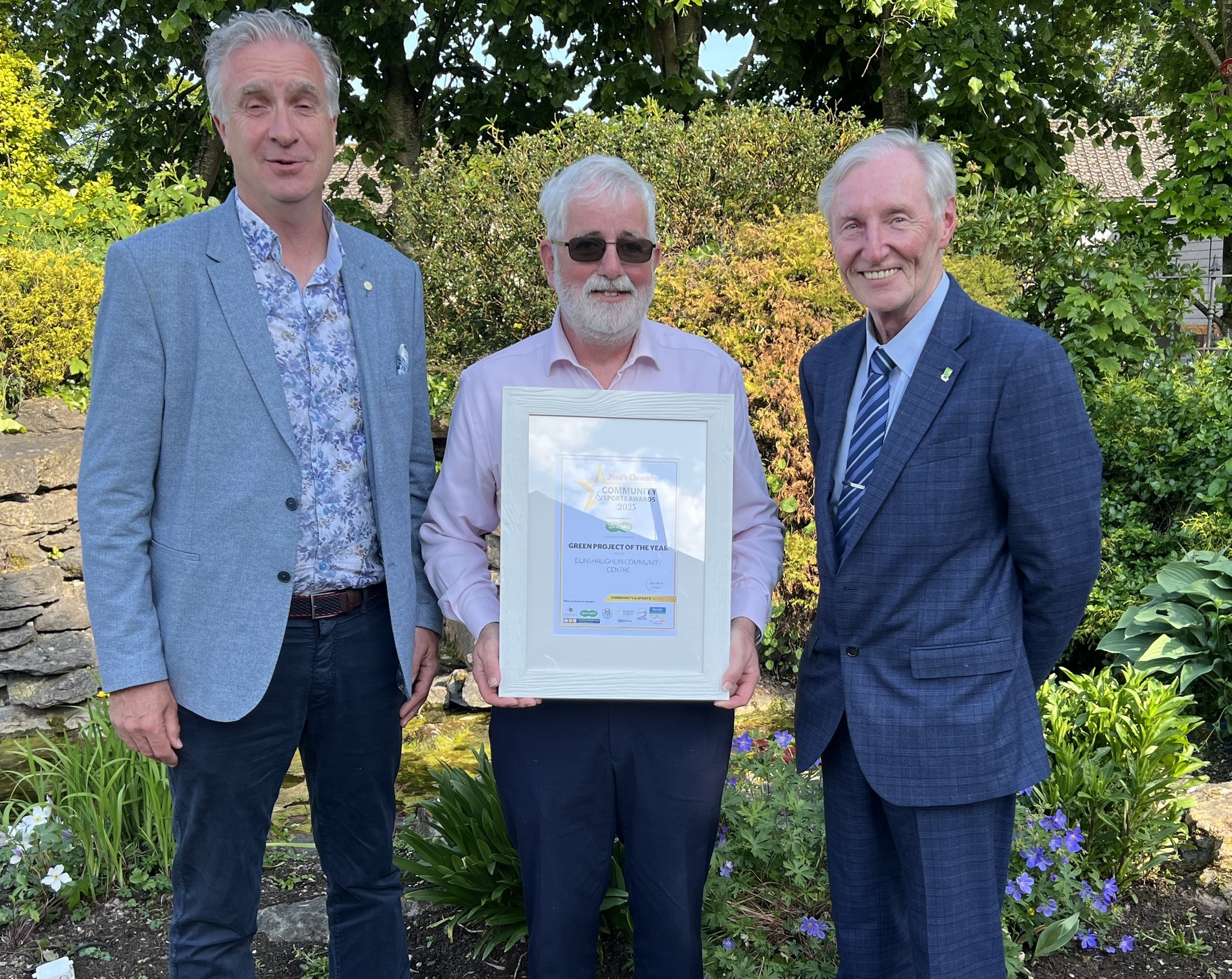
• Dunshaughlin Community Centre was delighted to win the Meath Chronicle’s Green Project of the Year Award. Pictured: John Irwin, board member, Oliver McKenna, chairperson, and centre manager (Cllr) Gerry O’Connor.
“The subsequent report quantified our annual electricity usage at 80mw and gave a list of recommended actions to reduce this usage and to reduce our CO2 emissions. The Centre at the time was open 80 hours per week,” said Gerry who also serves as a county councillor.
“Over the years we have used these recommendations as finance allowed to reduce our usage. We implemented measures such as LED lighting, sensor lighting in seldom used areas, switching off sockets / screens, gym equipment, and so on, at close of business,” he said.
“In 2023 we conducted another energy survey. We were now opened for 100 hours and had added a 2000 square foot extension. The measures we had implemented had worked, with our energy usage reduced to 64mw per annum.
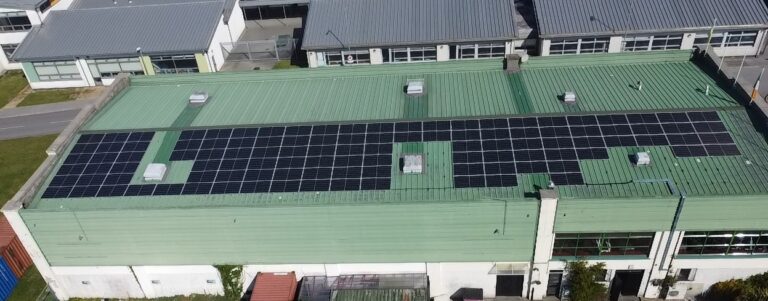
“We applied for the Climate Action Fund through Meath County Council last year and were granted funding for 110 Solar Panels and a 50kw three phase inverter. These have now been installed, and we are 100% self-sufficient currently from 8am until 6pm, with excess energy being exported back to the grid. The system will reduce our emissions further by 14 tonne of CO2 and our energy costs by €14k per annum,” said Cllr. O’Connor.
The centre was formally recognised for its efforts at the Meath Chronicle Community and Sports Awards held on May 22, winning the Green Project of the Year Award.
Dunshaughlin Community Centre is supported by the Department of Rural and Community Development and the Gaeltacht, through Pobal which administers the Community Services Programme and the Community Centre Investment Fund.
The centre was opened in 2000 by President Mary McAleese and will be celebrating 25 years of supporting the local community this October.
“This has never been more important than now as misinformation, disinformation, alternative facts and radical polarisation of society are on the rise,” said Jude McInerney, who co-ordinated the project along with colleagues Dr Rosemary Day and Kathy Cush.
Next year, two Irish participants (pictured above) will travel to Brussels to join concerned citizens from other countries while presenting their chief recommendations to MEPs and members of the European Commission.
The EU is involved because some of the resolutions, if adopted, will require international regulation and legislation.
Among the resolutions are a call to oblige large online platforms to reinstate fact checking and to provide simple, effective routes for citizens to report factual errors and have corrections made in a timely fashion.
Other recommendations made in Limerick are for local and national politicians to consider and will be presented to Limerick City and County Council and to the Oireachtas Joint Committee on Arts, Media, Communications, Culture and Sport in the autumn.
The citizens’ parliament recommends for example the establishment of town hall style engagement events along with more opportunities for journalists to quiz politicians in public settings.
“The media are the only way for citizens to find out what is really happening in the locations of power and the National Citizens’ Parliament has called for Ireland’s media regulator, Coimisiún na Meán (CnM) to establish regional committees with accessible representatives so that citizens can easily avail of the services they provide to the public,” said Jude.
The parliament also wants CnM “to raise the awareness and capacity of people to find their way in the abundance of media that surrounds us every day. In short, they are calling for media literacy for school children and for adults of all ages and stages,” said Jude.
The citizens’ parliaments are a key element of the project. Mary I College also reached out to media professionals for their views, interviewing editors and journalists from print media, radio, and television. Jude said, “All of the Irish media will have been contacted at some stage by this project to take part, through interviews or surveys.”
Changing Ireland was among those glad to contribute on a day dedicated to hearing voices representing minority communities. Speakers who addressed the parliament that day included lecturer Dr Sindy Joyce, a member of President Michael D Higgins’ Council of State and a powerful advocate for fellow Travellers. The parliament also heard from Dr Lylian Fotabong who conducted PhD research on the question ‘How are Africans portrayed in Irish media?’.
The National Citizens’ Parliament of Ireland was funded by the EU through their HORIZON scheme as part of a three year research project called MeDeMap – short for Mapping Media for Democracy. While most countries’ citizens’ parliaments were held in their capital cities, Ireland stood out for having a regional city host the project.
Our main photo shows Con Cronin, Moya Ni Cheallaigh and Niall Mahon at Mary Immaculate College Limerick.
“Let us communicate in a language people can understand,” she began. “Language that my parents, family and the media can understand.”
She urged organisations to speak about rights, dignity and inclusion as these things everyone understands.
“Let’s celebrate our successes,” she said. “We need to tell our stories, to talk about improving lives, to talk about the impact we have in communities.
“Let us co-create – this is when we come to the table as different but equal partners. Nobody at that table holds the position of power.
“We want commitment to sustainable funding for our critical work. We cannot continue where the funding does not meet the full cost of service delivery. It can be done. RTÉ hit the jackpot, they got multi-annual sustainable funding. RTÉ took a gamble, there was shock and outrage, political commentary and embarrassment. We’d like to skip all those parts and get to the part where there’s a commitment,” she said to chuckles all around.
She rounded off by reminding everyone present, including Minister of State Jerry Buttimer, “The C&V sector is massive. In 2024, over €10billion was spent in our sector. The road ahead is scary, but it is ours to walk, and to walk together.”
The Wheel’s summit was held on May 28 in Croke Park, Dublin.
Alexandrina Najmowicz, secretary general of the European Civil Society Forum, replied:
“Well, while people are in competition for rights, for access to basic rights and dignity, this puts our democracy at risk because trust in institutions is at risk.
“What we need is to be able to trust (and) to do that, we need dialogue among us, we need to (talk) with the increasingly polarised communities, and we definitely need to (talk) with institutions so that we can change the current policies.”
Elaine Teague, CEO of the Disability Federation of Ireland, said, “I would bring certainty around funding requirements, because then we can deliver to the people that we support, we can deliver on our commitment to our communities.”
Irish Times journalist Emmet Malone, a guest speaker, said, “I don’t understand why there are certain elements of the Community and Voluntary sector that are not run by the state.”
He said it was great that small organisations and community groups are flexible, because communities would otherwise be “waiting an endless amount of time for state supports”.
If he had a magic wand he would “divide the sector into stuff that should be run by the state and take that into the state sector and I would properly fund the rest of it over the long term.”
The Wheel’s summit was held on May 28 in Croke Park, Dublin.
The audience at The Wheel’s summit held in Croke Park on May 28 asked: How can we strengthen our advocacy, particularly when people are still afraid to stand up, even in a healthy democracy, and especially when there are pressing and urgent issues, like the situation in Gaza, where there has not been enough action?
Alexandrina Najmowicz, secretary general of the European Civil Society Forum, replied by urging service providers to connect with groups protesting on the streets. She said:
“There are diverse organisations that play roles inside civil society. We have advocacy groups, human rights defenders, service providers, and bold actors that are taking to the streets and organising social movements. I think all these forms are complementary. I think they need more connection.
“In my network, for example, we pay a lot of attention of connecting traditional forms of organisation of civil society with unorganised groups like social movements.
“I think it’s really important to have both, you know, issue work and to stay strong within the silos, but also have a more systemic approach. Because I think the most important thing is to keep our ability to bring change, not to constantly be running to cope with the changes happening around us. And in order to do so, we really need to be better organised, and in solidarity among ourselves,” she said.
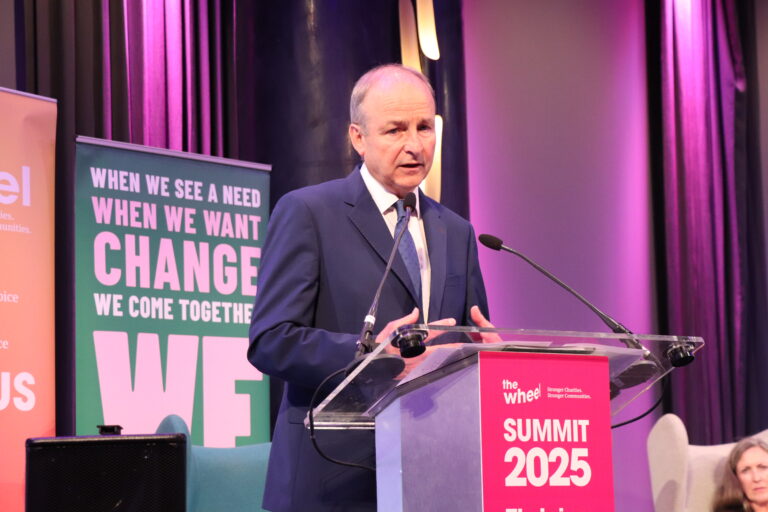
The Taoiseach, Micheál Martin, began his speech to nearly 600 attendees, many of them volunteers, attending The Wheel’s Summit in Croke Park, on May 28, by speaking about volunteers working in Gaza.
“I’ve listened a lot in recent times to medical volunteers who work with various organisations (such as) Médecins Sans Frontières and others,” he said. “Their testimony has been heart-rending.”
He said the conditions the surgeons were operating brought home “the barbaric nature of the war that Israel is waging on the people of Gaza.”
“And I think it’s one of the most noble things to do in the world, is to be a volunteer in such circumstances. Volunteers with UN agencies, or volunteers with various non-governmental organisations who are doing their best to provide the basic necessities of life.
“Many (volunteers) have been murdered in pursuit of their duties on the Red Crescent side, and we should remember them, and we should be very conscious of the enormous sacrifices they and their families are making, which speaks to the value of community and volunteerism,” he said.
On challenges facing communities here, the Taoiseach acknowledged the crucial role played by community organisations during earlier crises – such as when the pandemic struck, when Russia began its full-scale war against Ukraine and community groups here reacted swiftly to welcome refugees fleeing that war and others.
Response to Storm Eowyn
He recalled hurricane-like Storm Eowyn earlier this year and said the Government planned to develop a system to better resource local community networks for future extreme weather events.
“It was a storm like no other in terms of the degree of isolation it created very, very quickly – in terms of absence of electricity, absence of water, but also connection in terms of the mobile system and so on, and that sense of isolation created huge issues. And again different organisations on the ground came together to become a focal point for many people,” he said.
“We will witness more extreme storms (and) we have to build up our infrastructural resilience. On top of that, we have to build up, what we might term a voluntary community resilience as well, that’s sufficiently resourced, and that’s something that we’re going to continue to work on,” he said.
Future plans
The Taoiseach pointed to plans to invest €1 billion over the next ten years in the Shared Island Fund – which seeks to harness the full potential of the Good Friday Agreement to enhance cooperation, connection and mutual understanding on the island and engage with all communities and traditions.
He said: “It’s the people-to-people connections I’m very interested in, community-to-community, non-political.”
He also spoke about key priorities of the Government, including disability supports, access to school places, tackling child poverty and supporting the well-being of young people. “In the forthcoming budget I will be focusing on a very specific and targeted response to the issues of child poverty,” he said.
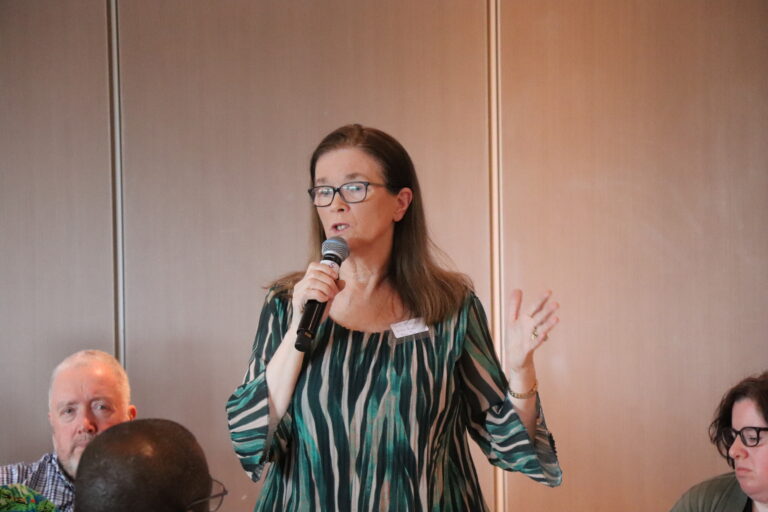
Liz Dunne, Bray Family Resource Centre, gave the views from workshops held in advance of the Social Inclusion Forum, held in Croke Park, Dublin, in May. She focused on older people saying, “For the first time in history, we have older people who are actually finding themselves homeless. They can’t afford to pay the rent.”
From what she and others were seeing more older people are now dependent on food banks.
“They are the people who should be enjoying the fruits of their labour, after all those years of work, and they’re reduced to putting their hand out.
“It’s like food banks have become mainstream,” she added.
The cost of a shopping basket has shot up in recent years, along with utilities, and pension increases did not match inflation. She wanted to see the state pension increased again and called for mandatory retirement to be abolished.
“People are now finding that they can’t afford to live on a pension. They need to be allowed to choose to work for longer.
“Women are doubly at risk of poverty, because a lot of women would have gone back to work maybe later in life, maybe not worked at all,” she added.
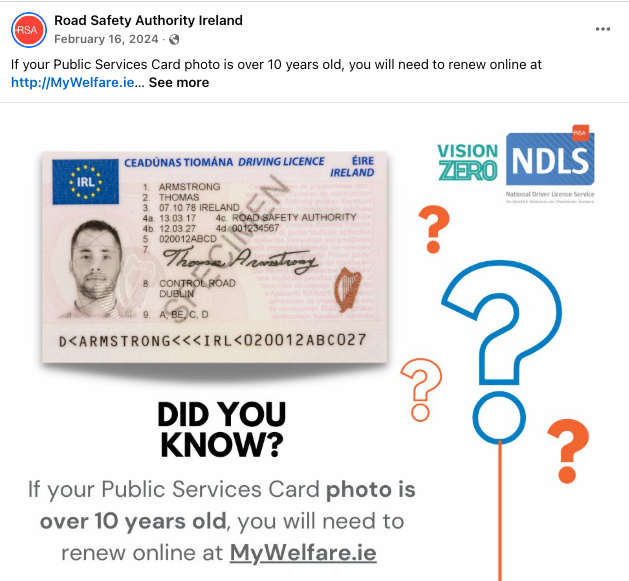
• It is unhelpful to push people solely towards online services. In person or postal or by-phone alternatives should also be offered and advertised.
Liz said that older people – indeed everyone – should be able to access services in person or online, or both, but not exclusively online.
“People are excluded by having to go online to do everything. Think about someone that’s 60, 70, 80, and all of a sudden they’ve got to go fill in forms – online. I struggled with that myself. It is one huge barrier for them. They need to have people that can actually talk and not machines.
“It puts them at risk, because they’re going into shops and post offices and places like that to get people, members of staff, to help them to do what they need to do. It’s very unfair,” she said. “What people are saying is that they want more face to face services,” said Liz.
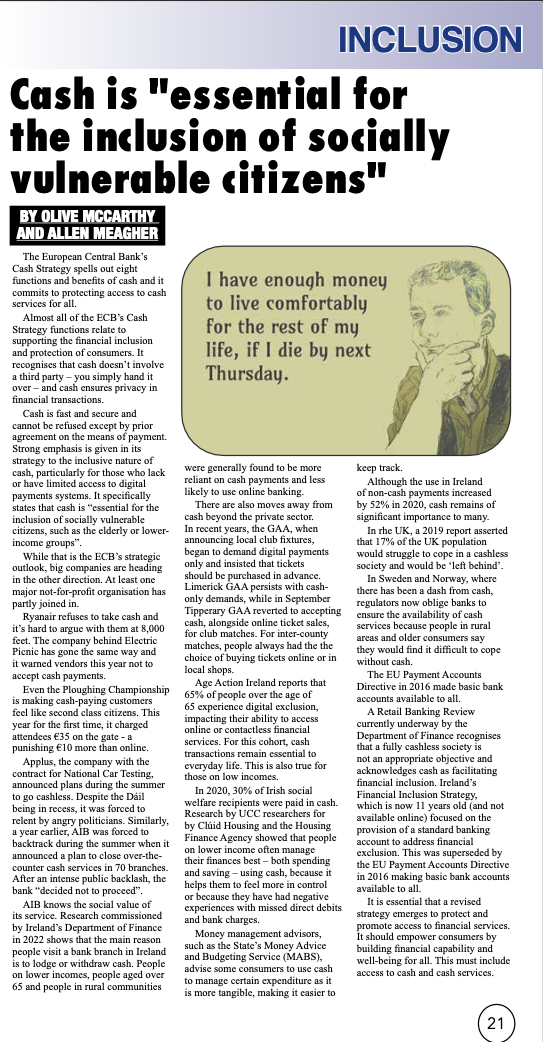
• In Issue 82, in Autumn 2023, we reported on how – Cash is “essential for the inclusion of socially vulnerable citizens”.
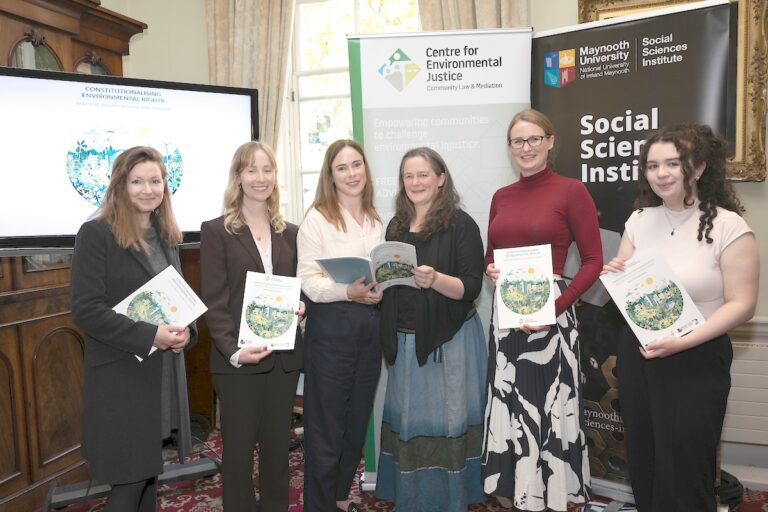
“There is no charge for people availing of our services, but the services are primarily targeted at those impacted by disadvantage and inequality,” said Elizabeth Devine policy and communications manager.
Clodagh Daly is the centre’s manager and she outlined why there was a need for the environmental justice service.
“We (had) people coming to our clinics whose health was being impacted by air pollution for example. We (had) people come in whose homes were repeatedly flooded and they could no longer get insurance. We realised that there was a gap in meeting that legal need and that’s why we set up the centre,” she said.
Environmental issues are becoming much more prevalent and the CEJ now employs four staff to give communities support.
“There are so many issues that people are presenting to the clinic with. So many people can’t afford their energy bills and about a third of the country’s population struggle to pay their heat and electricity bills. People are struggling with lack of access to green space, children who don’t have parks or playgrounds nearby. Poor housing conditions, water quality in urban as well as rural areas. (Some) people are dealing with severe water pollution. There are all those kinds of issues,” said Clodagh.
The CEJ is currently at work on two major cases relating to climate justice.
One is challenging the Climate Action Plan 2023, that’s a core plank of the Irish Government’s climate policy. The case was due to be heard at the Court of Appeal this summer. At stake is the argument that the Government has not published a sufficiently detailed Climate Action Plan. For instance, it is not clear from the plan how emissions will actually fall in line with our legally binding carbon budgets.
“The reason that we are involved in that case is that the longer that reductions in emissions are delayed, reductions consistent with the legally binding carbon budgets that the Government have agreed to, the more difficult they will become. The policy response might become abrupt, forceful and disorderly, and we won’t be able to have that just transition and the consultation required with communities,” said Clodagh
The CEJ is involved in the case representing Friends of the Irish Environment as their client.
“The other case that we’re taking is against the Climate Action Plan 2024, in which some of the same issues persist. So we decided to challenge that as well,” she said.
“We’re challenging it because it doesn’t detail how emissions will fall in line with Ireland’s carbon budgets. We’re also claiming that as a result there is an infringement of fundamental rights under the Irish Constitution, the European Convention on Human Rights and the EU Charter of fundamental rights. In that case we are acting as the client for the first time in our history and we are joined in that by a grandfather, a youth climate activist and a child, represented by their mother. It’s a really exciting case.”
Anyone is welcome to consult with the CEJ to see if their issue comes within its remit.
The centre has offices in Coolock and Limerick, but is open to enquiries countrywide.
“Anyone can avail of our clinics,” said Clodagh. “We offer clinics in person every fortnight or you can access them by phone or by Zoom, whatever is suitable for people. There’s no query too big or small. Basically, a clinic is a meeting with a solicitor which will usually last for 20 too 40 minutes and people can book a follow up consultation if needed.”
She feels the centre will become even busier in the near future.
“I think there is a real need for it,” said Clodagh.
Environmental justice seeks to protect people from the impacts of climate change and other environmental harms. It seeks to ensure the fair treatment and meaningful involvement of all people in the development, implementation and enforcement of environmental laws, regulations and policies.
Communities who experience disadvantage or marginalisation are often more vulnerable to climate injustice.
Environmental harms can include:
• Health concerns from air or water pollution.
• Illegal dumping/ littering.
• The burning of private waste.
• Homes at risk of flooding.
• Flooding or lack of flooding infrastructure in high-risk areas.
• Poor housing conditions (cold, damp).
• Poor sanitation or poor access to clean water.
• Lack of access to green space, parks etc.
• Noise pollution.
• Energy costs and access to retrofitting schemes or fuel allowance.
• Pollution of lakes, rivers and marine life.
• Inadequate traffic/ cycling infrastructure.
• Dereliction.
• Biodiversity loss.
• Mining, coal extraction and fracking gas.
• Difficulty accessing information on environmental issues.