– What about our communities, our project, our volunteer management, our jobs? – How will the merger will take place between CDPs and Partnerships? – When will it happen? These are among the questions that are dealt with on our new blog.
Check it out and add YOUR COMMENTS.
I’m looking for critical, practical, positive comments. Of course, being positive about Community Development does not necessarily mean you have to respond positively to the Minister’s proposals, but be realistic at the same time.
The announcement was made on Friday (Sept 18th) by Minister of State (MOS) John Curran at a Community and Voluntary Forum conference in Co. Cavan, although details on the plan were not given.
‘Changing Ireland’ has requested an interview with the MOS on questions that arise from the announcement.
In his speech in Cavan, he said:
“I am seeking improved alignment and focus across the range of programmes for which I have responsibility in the Department of Community, Rural and Gaeltacht Affairs. In this regard, I have been giving particular attention to the redesign of the Local Development Social Inclusion and the Community Development Programmes.
“I have to say that I am not convinced that two separate programmes and two separate delivery structures is the best way to serve the community. In the current economic climate, the case for a single focussed effective programme is, in my view, indisputable and I will be fighting for resources for the measures covered by the programmes on this basis in the context of the 2010 Budget.”
An accompanying press release, which described the process in terms of the “integration” of the 2 programmes, quoted MOS Curran as saying: “We will continue to do everything we can to improve efficiency and prioritise the provision of frontline services to those who need them the most. One single, focussed programme will ensure that services will be more streamlined and will best serve those who use them.
“We are currently undertaking a thorough review of the Community Development Programme and will shortly have a full report on the findings and recommendations that arise from that review.
“Programme redesign work by the Centre for Effective Services is underway. Overall, we are preparing for a roll-out of a single, redesigned programme in 2010, in the context of the budgetary position.”
John Curran is the Minister of State for the National Drugs Strategy and Community Affairs at the Department of Community, Rural and Gaeltacht Affairs. He is from Clondalkin in Dublin.
The National Community Development Forum held a meeting prior to the march and discussed the pressure on volunteers, the latest (CES) review of the Programme and related issues. More details in the next post.
Well done to SIPTU and to everyone involved in the march. Many projects are now starting to engage regionally in lobbying their politicians. The CDP cuts will be raised in Dail questions very shortly and more regional/local protests are on the way.
Every tabloid magazine in the known universe has published articles this year about “getting through” the downturn/depression. Here are our ideas for non-profit organisations. More ideas welcome. Please leave your comments/suggestions below: 1) Instead of paying an organisation for providing a trainer for a day, barter with them and offer a day’s training (in something your group/staff/volunteers are expert in) by way of payment. 2) If you’re with the ESB, change electricity supplier and save 10% – 13% per annum. 3) If you’re renting a premises, you can and should negotiate a reduction in rent with your landlord. 4) Remember email is free. It wasn’t around a bit over a decade ago. 5) You can text for free via the internet (eg www.vodafone.ie). Very handy for getting a message out to a group of people. 6) If you need to print something, you’ll save anything up to 20% by going green. ‘Changing Ireland’ changed over to vegetable inks and recycled paper last Autumn. 7) Bye-bye to paying people mad money to put a few pages of a website together for your organisation. There are companies nowadays offering ready-to-go websites (the layout is pre-set, you just add in your content) for a tenner a year and upwards. Tip – There are free websites too, but they’re a bit of hassle and very basic. Alternatively, set up a blog (a form of mini-website). It’s totally free and much easier than you think. 8) Seek out volunteers to do jobs. You need to support volunteers properly, for it to be beneficial for everyone. Log onto www.boardmatch.ie or have a think with your colleagues and make a few calls.
POST US A COMMENT. YOU CAN BE ANONYMOUS IF YOU PREFER.
Irish Rural Link (IRL) has published a 27-page critique of Bord Snip’s “sinister” proposals. The 300-member organisation says one of the report’s main weaknesses is that it “hides the fact that cuts across a number of departments may impact on the same individual.” Two-thirds of Ireland’s poor live in rural Ireland. IRL said Bord Snip showed “disregard” for community groups, adding that “the lack of consideration for the community and voluntary element of work countering social exclusion is one of the most sinister underlying themes.” It drew attention to “ignorance” in the report where it seeks to disband the Department of Community, Rural and Gaeltacht Affairs. As IRL point out, 40% of the population live in rural areas. “The Report (also) fails to acknowledge that community and voluntary organisations deliver essential social services in areas such as education, mental health, disabilities and welfare for very vulnerable people,” say the Westmeath-based organisation. In dissecting the report, IRL cross-tabulate the cuts proposed to various lines of Government spending. One of the most alarming threats to rural communities is to the Rural Transport Programme. IRL’s board is seeking a meeting with the Taoiseach and Minister for Finance as soon as possible. To download the report, visit: www.irishrurallink.ie
Community spirit is alive and well in Ireland, according to a report by the Central Statistics Office (CSO) that makes minced meat of the widely held view that community spirit and volunteering declined during the boom years.
The report echoes views expressed to ‘Changing Ireland’ last year by a Volunteer Centres Ireland spokesperson saying volunteering had not gone into decline.
The CSO statistics show, on average, almost two-thirds of people in the Republic of Ireland regularly took part in voluntary or community activities.
Nonetheless, there remains a crisis in community participation levels in disadvantaged areas, particularly among those with low education, the unemployed, people in poor health, immigrants and older people.
Irish Times reporter Carl O’Brien lifted the story from the doldrums of a statistical report to give it the front-page treatment. He reports that “community ties seem particularly healthy” and says the CSO figures challenge the belief that the boom years eroded community spirit.
As most of Galway celebrated the City’s arts festival, an Irish Times news report yesterday highlighted the work of one of Galway city’s CDPs – the Galway Traveller Movement – to stand with the community against cultural oppression. While thousands of people planned parties, some families faced eviction.
A report launched two years ago by the Galway Traveller Movement found people were very proud to be Travellers, despite the discrimination they face.
BACKGROUND INFO
We re-publish here a photo (by Derek Speirs) from an exhibition held at that time by Galway Travellers Movement. It features Margaret and Nora Delaney. The full news on the ‘Galway Traveller Movement Baseline Report’ launch is available at: https://changingireland.ie/archive.html) Previous ‘Changing Ireland’ news reports over the years catalogue the work of the Galway Travellers Movement to stand up with the community against oppression.
The Irish Examiner’s lead front page story, in their edition dated Tuesday July 7th, has highlight the fear felt in Civil Society in Ireland – by groups representing and involving the poor and needy – to speak up and be heard. To read the story, click here for the IRISH EXAMINER
Volunteers, workers and SIPTU mounted a successful campaign to have cuts to Community Employment Schemes reversed. At a time of rising unemployment, the Schemes need to be expanded if anything. €10m was due to be cut. Thankfully, the CE schemes will survive for now. Read the full story in the Irish Times report
David Connolly, Siptu’s Community Branch President, debated the decline in support for communities from Government with Minister of State John Curran, on June 11th on RTE’s Prime Time. Click here to watch (may require broadband).
We’re glad you could join us! We started adding video to our website this year. Now Changing Ireland has a blog for news as it happens. Our blog highlights news relating to the Community & Voluntary Sector. We will highlight mainstream media reports, NGO news releases, community-related events and so on. Your comments are welcome. Also, we will post new journalism and original interviews from ‘Changing Ireland’ in the blog, prior to publication in ‘Changing Ireland’ proper. The print magazine remains a core part of our work as it reaches well over 10,000 readers.
You can subscribe to this blog, to get a notification every time we post a new story.
No, I’m not discriminating against you because you’re a divorced, Protestant, bi-sexual female Traveller with a disability. We just don’t allow anyone of your socio-economic class into this pub! And anyway, didn’t you vote no in the Nice Referendum and do time for stopping bin lorries? So, no, no and no!
It could make for a good joke, but the truth is that people can be discriminated against because of their class, for holding political opinions or because they have had a criminal conviction. And there is nothing under the Equality Act 2002 to protect them, yet.
However, the Equality Authority, has recommended to government that these categories be added to nine grounds already covered by law (protection against discrimination on the basis of age, gender, disability, race, membership of the Traveller Community, marital status, family status, sexual orientation or religion).
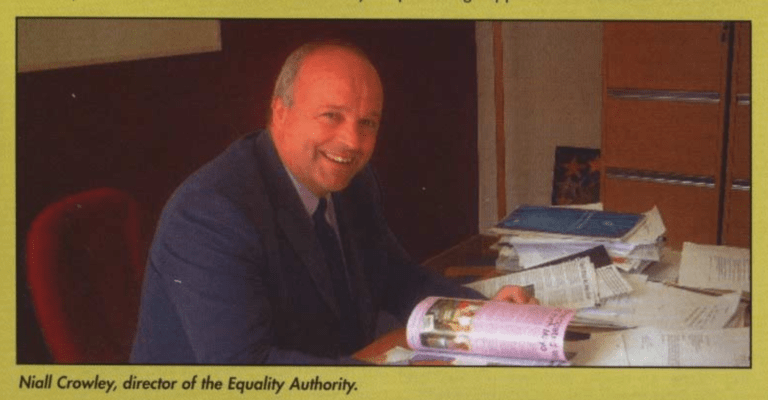
“One of the biggest gaps we have is the lack of equal status legislation for socio-economic groups. It is apparent to us from reports and research that in education, employment, accommodation, discrimination is being experienced by people on the basis of their socio-economic status,” said Niall Crowley, director of the Equality Authority.
“We have recommended it, but it’s a political decision,” he added.
Could such new laws, if introduced, lead to a social revolution?
“It would lead to significant change. It’s about new groups having a say in how decisions are made, having access to resources and having a standing in society they currently don’t have. These would all be radical changes; they are very necessary changes, clearly for the people themselves, but also for an effective society. All of society would benefit from those changes and from a wider participation in society from those who are currently excluded.”
To enact a law banning socio-economic (or class) discrimination would be “a practical, pragmatic response to the experiences people are having. Their experiences that run counter to political goals already established. For example, why invest significantly in labour-market programmes targeting working class people if we are willing to allow discrimination at the point-of-entry to the workplace?
“So, it’s not an ideological shift, it’s about a coherence in policy goals. It’s the same with people who have criminal convictions. For example, there are some very good programmes developed by the Department of Justice to assist people in the transition from prison-life to living in the wider society. And why invest in those programmes if you are going to allow people discriminate against people because they have had a criminal conviction? The whole investment can collapse because of the incoherence,” argued Mr. Crowley.