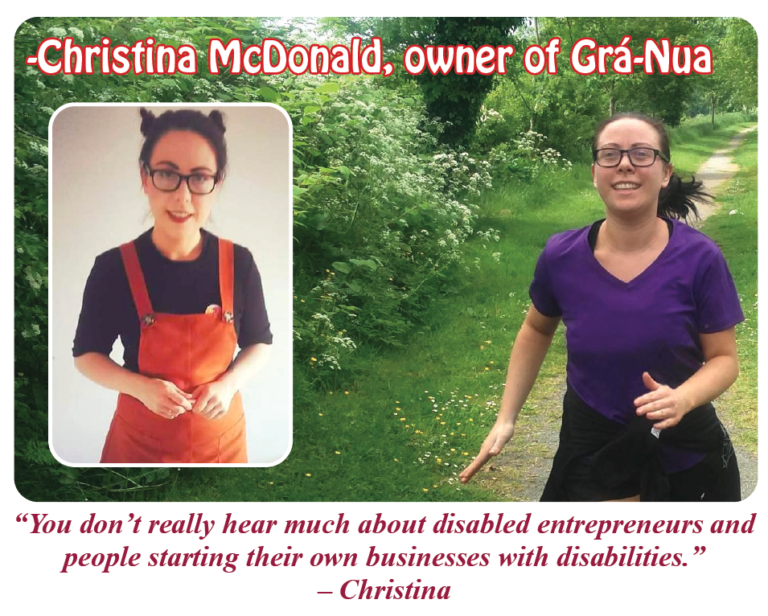
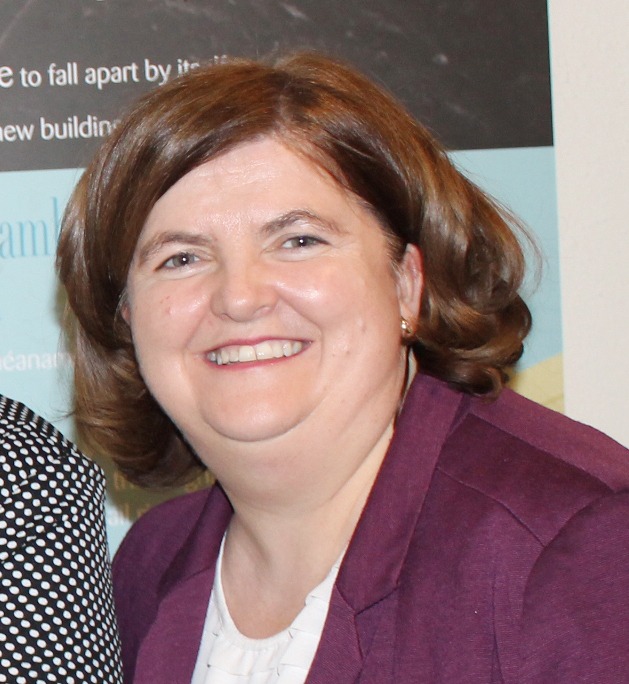
Christina McDonald completed the 2021 course with a business plan for selling women’s fashion online. She share how the course led to her starting “Grá-Nua” / granua.
“I was diagnosed with MS in 2016. I was working two jobs and I found myself becoming disabled overnight.
“I kind of feel like in Ireland the system is a bit flawed, especially for adults with disabilities. If you’re on social welfare they push you to get a job; when you’re on disability, they don’t. After I got married my disability got cut to 70 euro a week. I can’t live off that.
“Over the past two years there hasn’t been much employment opportunities for people with disabilities. I’m not able to work a physical job, or the Monday to Friday, 9-5. I thought, ‘I’m going to work for me, I want to do something I’m passionate about, and I’m going to be my own boss.’
“The course was great, I’ve never had an opportunity like this before. I wouldn’t have gotten this information anywhere else. There is no other course like this in the country. Whether you’re going to start a business or not, [Professor Cooney] gave us tools to understand how. This course will open your eyes to what you need to think about and the step-by-step process in developing the business plan.
“One of the main things [I came away with] is confidence. You don’t really hear much about disabled entrepreneurs and people starting their own businesses with disabilities. With the guest speakers, all of the entrepreneurs were people with disabilities who faced the same struggles. It really gave me the confidence to say, ‘Well if they did it, so can I.’
“Just go for it!” she advised. “You have nothing to lose. You might as well take matters into your own hands. If you’re passionate about starting a business, don’t let a disability stop you from achieving what you want.”
The first course ran for 12 weeks of lectures and 4 more weeks to complete a business plan and present it to a panel of funding advisors. The course includes lectures, guest speakers looking at the entrepreneurial topic of the week and successful entrepreneurs with disabilities.
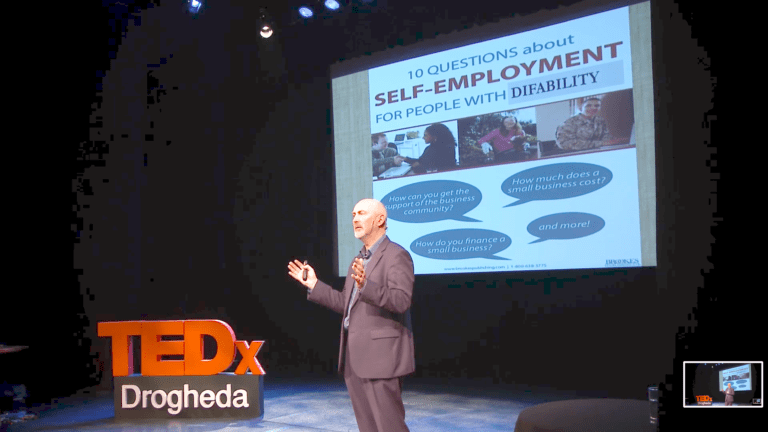
“By having people within the community talk about their challenges and be open and honest about the issues they face and how they overcame them, it turns out for many that was the most impactful part of the programme,” said Professor Thomas M. Cooney, professor of Entrepreneurship at TU Dublin and the module co-ordinator. “It made them believe it was possible.”
Sponsored by Pobal and supported by the Open Doors Initiative, the twenty participants did not have to pay for the module and were allocated a business mentor from their Local Enterprise Offices for one-on-one support.
Participants could choose how much they wanted to utilise the programme’s scope, whether just to develop their business idea, complete their business plan in order to receive 5 ECTS credits, or pitch to a panel of industry professionals.
Accessibility was key to the success of the course. “Online really works because it enabled participation from across the country,” said Cooney, citing how participants joined in from ten counties.
• Prof. Thomas Cooney.
“There was a huge geographical spread that wouldn’t be possible in person,” said Cooney.
Recorded lectures allowed participants to rewatch lectures if they had any health conflicts on lecture day or wanted to freshen up on the lesson.
“We need to get the message out that self-employment is a real option”
– Thomas Cooney.
Identifying the challenges
In his 2020 paper* titled ‘Entrepreneurship for People with Disabilities in Ireland’, Professor Cooney highlighted how specific challenges arise for people with disabilities beyond the normal obstacles of entrepreneurship, reasoning why tailored support for people with disabilities is necessary.
Challenges identified through international research (quoted in Cooney’s 2020 paper) included:
– Disinterest / discrimination / lack of understanding by personnel in lending institutions and business support services.
– Difficulties in obtaining start-up capital due to poor credit ratings (often caused by low income employment or unemployment).
– A lack of role models.
– Loss of income received through social welfare (although in Ireland’s case the Back to Work Enterprise Allowance negates this challenge for the first two years).
– Lack of access to appropriate support or training not tailored to their individual needs.
Previous tailored support was limited in Ireland, partly due to the inaccessibility of location-based initiatives, or the lack of targeted funding and supports for those living with disabilities.
“This work cannot be about delivering courses alone,” said Cooney. “We’ve got to change the conversation around labour market activation for people with disabilities to be more than just ‘getting a job’. We’ve got to include self employment as part of the conversation, and to ensure that welfare supports enable that to happen rather than be a barrier to it.”
Success to be repeated
By the close of the 2021 course:
• 11 of the 20 participants achieved the academic accreditation of 5 credits.
• 7 students made presentations to a panel of banking and investment professionals for advice on funding.
Cooney expects a half-dozen businesses to start up from the plans devised during the programme.
Damien English, Minister of State at the Department of Enterprise, Trade and Employment, told the department in February that a post-course survey “was hugely positive” and Enterprise Ireland plans to deliver diversity and inclusion training for Local Enterprise Office staff this year to help staff “understand the needs of all entrepreneurs seeking assistance.”
Due to receiving 38 applications for its first iteration, a repeated course was anticipated from the beginning. Professor Cooney confirmed the course has secured an undisclosed-sponsor to deliver the programme over the next three years, starting this September.
“We need to get the message out that self-employment is a real option,” said Cooney.
The application process for the Self-Employment for People with Disabilities 2022 course is expected to open in June. In the meantime, those interested can email Professor Cooney with any questions they have about the course.
E: thomas.cooney@tudublin.ie * Professor Cooney’s paper ‘Entrepreneurship for People with Disabilities in Ireland’ (16 pages) is available online.
Lisheens House, a children and adolescent counselling service, is moving onto the main street of Skibbereen. The charity has purchased a building on North Street in hopes the visibility and larger space will improve their in-demand efforts.
“By having a presence in the town and by people seeing it, they’ll associate it: if I need help, that’s where I can go,” said Mick Kearns, co-founder of Lisheens House along with Noreen Murphy. Kearns believes the building will make a big difference in addressing the long-term mental effects of the pandemic: “We’re preempting the surge that’s going to be there, and having a dedicated centre will meet that increased demand.”
Last September, Lisheens House received a €140,000 loan from Clann Credo Community Loan Finance for the new location. On Facebook, Murphy called the new centre a “testament” to the community spirit in West Cork.
After two years as a one-room operation, Lisheens House – West Cork’s first independent, dedicated child and adolescent counselling centre – opened on Ilen Street in 2016. Its name commemorates the house Noreen Murphy built with her husband Donal before he died of suicide in 2007.
The centre in Skibbereen includes counselling rooms, art and movement therapy spaces, and a second-hand furniture shop. The counselling service does not receive government funding and is primarily supported by furniture sales, and otherwise by personal fundraisers, such as a donation in lieu of wedding favours.
Kearns likens the community support of the charity to a boomerang.
“By giving us their odds and ends, the public ends up getting a building back that’s there to be used,” he said. “It’s a true example of how communities can effect change, and just another example of a sustainable community enterprise where if people support you, it actually stays in the community. Once the building is finished, the penny will drop that each of them who supported us contributed towards this being there.”
• Founders Mick Kearns and Noreen Murphy.
Increasing demand to preempt a crisis
“In January (2021) we would have seen a doubling, even tripling, in demand in some weeks,” said Kearns. “Normally we’d expect to field about ten calls a week—that went to 30 calls a week in early January.”
He connects this rise to that of the Covid case numbers. The overwhelming prompt: uncertainty.
After the lockdown of March 2020, the charity employed two additional play therapists to share the load of counselling originally placed on one. These counsellors practice primarily off-premises, but Kearns plans for the new building to house the majority of future sessions. “Younger children, they need a kind of stimuli,” said Kearns. “So we’ll customize the rooms to make them appropriate for younger people to feel comfortable. It’s conducive to them opening up and developing a relationship with the therapist.”
Lisheens House offers its free counselling service to children as young as seven.
“As a community-centred organization we don’t say no to anyone,” said Kearns. “The age profile of people looking for help, unfortunately, is lowering.”
Kearns believes Lisheens and other independent services take on a large load unaddressed by Child and Adolescent Mental Health Services (CAMHS) under the HSE.
“There’s huge waiting lists and staffing problems that compound the waiting lists,”said Kearns.
Last July, Newstalk reported 2,559 children on the waiting list, with 250 waiting over 12 months according to Freedom of Information Figures. The ‘Irish Examiner’ reported a 7% drop in waiting list numbers last August, but data was incomplete due to the cyberattack on the HSE. The HSE told the Examiner 94.9% of young people were seen within 12 months in community CAMHS services as of August.
“The hardest thing is to reach out,” said Kearns. “If you did reach out and are told, ‘Sorry you have to wait,’ it’s a real slap in the face.”
• Lisheens House and Wellness Centre is a a community-centered mental health service in West Cork.
CAMHS provides the assessment and treatment for under-18s and their families experiencing mental health difficulties once referred by their GP. The majority of adolescents are treated through Community CAMHS, or outpatient methods, which can include meetings with professionals such as psychiatrists, psychologists, nurses, social workers, occupational therapists and speech & language therapists.
The ‘Medical Independent’ reported last September that, although some 99 disciplinary CAMHS teams were planned in a 2006 policy document, there were only 72 community teams in place around the country.
“Accessibility is vitally important,” said Kearns. “All expert opinion of that service is that it’s really not fit for purpose in its current existance.”
As Cork and Kerry held the highest share of children on waiting lists from late 2020 to mid-2021, Lisheens House is in a position to fulfill their mission of de-urbanising mental health care.
“We’d envisage instead of people going towards urban areas, they’d migrate to where services are available,” said Kearns.
The Irish Hospital Consultants Association (IHCA) shared its criticism of the government’s budgeting for mental health services in August when launching its Mental Health pre-budget 2022 submission. It commented that while the budget of €1,114.1 million for 2021 is higher than in 2009, “given the population growth since then, the current mental health budget is actually €2,000 per 1,000 population below the spend 13 years ago.”
A total of €1.149 billion has been allocated to mental health in Budget 2022. Minister of State for Mental Health and Older People, Mary Butler, announced the funding of two new CAMHS telehubs in a push to provide more alternative out-of-hours mental health support services.
What communities can achieve
Community-run charities are a community among themselves, sharing goals and strategies in fundraising and outreach. Lisheens House depended on the advice of TalkToTom in Gorey to get started, and is providing guidance to Open Arms Kerry as they grow. The collaboration between mental health charities leads to strategies that work and are easily transferable.
“Keep it simple,” Kearns advises. “You’re not going to fix everything, but you can make a difference.”
Lisheens House looks forward to the possibility of fulfilling what CAMHS cannot in West Cork, and at an equivalent standard of practice. “We’re quite anxious that this will be comparable with best standards,” said Kearns. “We’re adamant that it will be held up as a beacon of how communities can actually – once they pull together in support of social enterprise – get results that show what it can do.”
New outlets in Clonakilty & Bandon
Since opening its used furniture shop in Skibbereen, Lisheens House has added two more outlets in Clonakilty and Bandon. The shops are now all branded as Lisheens House Homeware and Furniture.
The charity hopes that, as the new furniture shops bring in revenue, new support services will follow to these locations. The idea is that income derived in each town will be re-invested in that town.
Donations of furniture are welcome (call 086-4066348).
W: https://lisheenshouse.ie/
Twitter: @lisheenshouse
Also on Facebook.
Helpline: 023 888 8888.
The Sligo Traveller Support Group hosted a Facebook Live panel recently to discuss the accommodation and homelessness crisis in Ireland, especially the challenges facing the Traveller community.
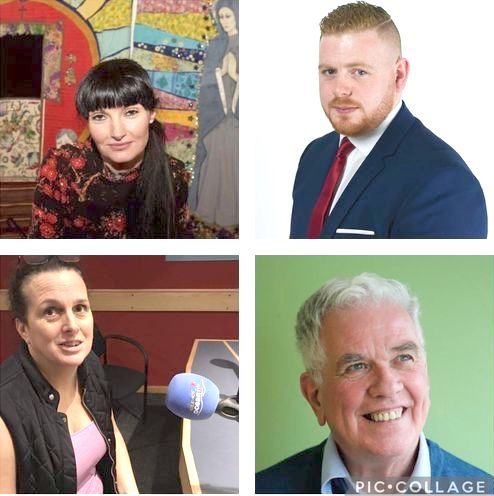
Speakers on the panel included Bernadette Maughan, manager of Sligo Traveller Support Group; TJ Hogan, political outreach worker with Mincéirs Whiden; Rose Marie Maughan, national traveller accommodation policy officer with the Irish Traveller Movement; and Fr Peter McVerry, founder of the Peter McVerry Trust.
Determining the number of Travellers experiencing homelessness is the first barrier. “In the collection of homeless data, there is currently no ethnic identifier…there needs to be,” said Rose Marie Maughan at the February 24 event.
She shared figures collected by the Cork-Kerry Regional Traveller Accommodation Working Group in 2018, that showed approximately 85% of Traveller families in the southwest would come under the EU’s definition of homeless. For national homeless data, Travellers are estimated to make up 20%, even though the group only accounts for one percent of the total population.
Government bodies do not recognise situations such as overcrowded accommodation or couch surfing under the banner of homelessness. Hence it is unclear how many people are actually homeless.
“These stats are way beyond a crisis point,” said Rose Marie. “It seems that only when the housing crisis and homeless crisis has impacted on others, now Travellers have a voice within that. I think we need to reflect on that.”
He connected the rise of tourism in Ireland in the ’70s and ’80s with a “huge uproar to civilise this type of people,” pushing Travellers towards city limits in an “out of sight, out of mind” strategy.
TJ Hogan and Fr Peter McVerry provided the historical contexts for the current crisis of homelessness in the Traveller community.
“The hard reality within Ireland at the moment is Travellers were first taken off the roads,” said Hogan. He connected the rise of tourism in Ireland in the ’70s and ’80s with a “huge uproar to civilise this type of people,” pushing Travellers towards city limits in an “out of sight, out of mind” strategy.
McVerry connected the homeless crisis to the breakdown in socal house building.
“Government and local authorities reduced their building of social housing and pushed everybody who needed housing on the private sector…it can’t cope,” said McVerry.
He cited a drop in annual council house construction from 6,900 in 1985, to 75 in 2015.
Bernadette added that in the national budgets given to local authorities, more money goes to the Housing Assistance Payment (HAP) and Rental Acccomodation Scheme (RAS) than to social house building.
Moving to a more personal note, Bernadette shared anecdotes of Traveller families surviving in desperate living situations. One family is living for more than two decades without running water in Mayo. Another family with many children was restricted to a 20-foot trailer. She claims although the relevant government departments have money available to provide help to families in these circumstances, local authorities sometimes block progress. And while every local authority may have a homeless action team, Bernadette believes they do not want Travellers represented.
The disconnect between the local councils and the national government was exemplified last year in an investigation by the Ombudsman for Children at Spring Lane halting site in Cork City. The office reported “overcrowding and serious risks on the site for children” and overall failures “to comply with and implement the minimum requirements of the Traveller Accommodation Programme.” Cork City Council disagreed with the report, and noted various challenges delaying work.
Bernadette, in agreement with the other speakers, called for “an action-based campaign” so that Travellers are seen to stand up and are taken heed of.
Each member indicated the need to call on other marginalised groups to action against accommodation failures, such as refugees or asylum seekers in direct provision.
”Housing policy and housing for all should be a constitutional right,” said Hogan, saying the first step should be the government declaring a national emergency on accommodation.
Previous government initiatives included providing 3,100 units of accommodation for Travellers by the year 2000. By 2005, 900 housing units and approximately 600 Traveller-specific units were provided.
FLASHBACK TO 2002
‘Changing Ireland’ covered protests by the Traveller community and allies in 2002. In our fourth issue, we joined a thousand protestors on the steps of the Department of the Environment and Local Government objecting to legislation allowing for the jailing and/or fining of those camping illegally and the confiscation of their homes.
– Inclusive nature of event contributed to success
– Every employer we spoke to found suitable people
– Organisers used online survey to prepare attendees
Refugees Olya Marymtseva and Olena Syniuenchko are both staying at the nearby Earl of Desmond Hotel and served as translators on the day. Olya is one of the first Ukrainians to get a full-time job here. She is now employed by Kerry Education and Training Board.
“Hope is what we got from today. I saw job interviews take place in front of my eyes. And I was sitting on the floor with a laptop working for Kerry ETB,” she said.
Olena Syniuenchko came here at the end of March and Monday marked her first day doing paid work in Ireland.
“I’ve been speaking on behalf of the Ukrainian community and today I’m being paid to be a translator,” she said. “I’ve lots of qualifications to be honest. I’m looking for something in project management and business analysis in the IT sphere, but I’ve also got a masters in international law. Today was super-useful. People are so happy to be here and look into all the job opportunities.”
The refugees from Ukraine and other countries and members of the general public met 30 employers at the event which was organised by North East West Kerry Development (NEWKD) in collaboration with the Kerry Chambers.
‘Changing Ireland’ was present to see the stands with hundreds of jobs on offer in technology, office admin, accounts, hospitality, food production, tourism, health and more.
Event co-coordinator Lisa O’Flaherty, who works with NEWKD’s ‘Moving On’ employment project, said they used software to prepare people for the event – so they knew in advance roughly what people were seeking, or whether they preferred training or education to employment.
Jennifer O’Sullivan, whose work with young people who are unemployed is supported through the Social Inclusion and Community Activation Programme, was delighted the event attracted a diverse group of people.
“Our work is very much about equality and it was great to have such an inclusive event. We organised buses and translators for Ukrainian refugees and it was great to be able to connect them with employers,” she said. Asylum-seekers and refugees living in a nearby Direct Provision centre were able to walk to the venue.
As Jennifer said, “NEWKD are part of the Kerry Community Response Forum facilitated by Kerry County Council which is supporting Ukrainian refugees. They are anxious to work and work is a key part of integrating into society.”
Online webinars, including about employment rights, are to follow the jobs fair.
Breda Flaherty, HR manager with Dairymaster said her farm technology company was doing well and had 30 to 40 vacancies.
“We’re very proud of our moo-monitor which is a fitbit for a cow,” she said, listing vacancies in engineering, software, welding and much more.
“Our international sales manager is Ukrainian and we translated our list of vacancies into Ukrainian and we received a substantial number of applications,” she said. She also met refugees staying in the Earl of Desmond Hotel and her company is willing to train people who are interested in working for her company.
Breda, who served until recently on the board of NEWKD, was very impressed as a business person by the event: “It’s by far the best jobs fair I’ve been at and I’ve been to a lot in my time – in Dublin, Cork, Limerick and so on. This was the best set up. There was a great flow of people all day who were genuinely interested in the positions.”
Jane O’Loghlen, owner of Bridge Place Dental Practice, was “shocked” to meet the very people with a particular skill-set that she was looking for.
She said, “I got to meet face-to-face with lots of prospective employees. It was really beneficial to have that one-to-one conversation.” She expects to hire some of the people she met at the jobs fair.
From a job-hunter’s point of view, It was also great to get that face-to-face. Lisa O’Flaherty normally works with NEWKD’s ‘Moving On’ employment project and was the lead organiser. She said:
“People really appreciated the opportunity to talk face to face with employers. It can be difficult to make a direct connection with an employer so we were happy to be able to remove some of the barriers.”
The organiser included a ‘Careers Clinic’ in the jobs fair so local organisations could help people with their CVs and give advice on progression opportunities
Among the employer stands were a couple of recruitment companies. Staff from FRS recruitment also market an app called ‘Gettheshifts’ which offers hourly shifts working in hospitality, offices, cleaning, industry and marketing. They currently have shift work coming up at big music events in Killarney.
Sam Driver, with FRS in Cork, said they were able to match some of the refugees who were better able to speak English with positions and they can proceed to submit CVs for those roles. He said other refugees they met who face the language barrier were “more suitable” for roles with ‘Get-the-shifts’.
Aoife Mortell, also with FRS in Cork, said, “I don’t think anybody passed our desk without dropping their name or email address.”
Nathan Adams from FRS in Dublin said it was great meeting people face-to-face, having a chat and “seeing where people are at in their life right now and where they want to go.”
The organisers used technology to link with the refugees in advance of the event.
Said Lisa O’Flaherty: “We sent them a link asking them what work they did at home and what would they like to do here. We asked: ‘Are you looking for work?’ and if you answered ‘No’ you were brought to another part online. If they answered ‘Yes’ it led them on to other work questions.”
Rob Carey, social inclusion manager with NEWKD, said: “We were reacting to a need. Through work by my colleagues and others, it became apparent the Ukrainian refugees are very anxious to work. We wondered was it a bit too soon, but they have a big desire to get employed. They see it as a way to integrate into society and to get their own place.”
“We are going to do follow-ups with people who didn’t get what they wanted today,” he said. Prior to going through data collected on the day – they both estimated that between 40% and 50% of attendees at the jobs fair were refugees or asylum-seekers.
Lisa Fingleton, who also works with NEWKD’s ‘Moving On’ project, interviewed and filmed employers about their recruitment needs and this footage will be made available in a webinar over the coming weeks.
“There are still opportunities for those who couldn’t attend on the day,” she said.
A further online event is being organised to introduce people to employment rights in Ireland. Follow @movingonkerry on Instagram or NEWKD’s Facebook page for updates.
The jobs fair was funded through NEWKD’s ‘Moving On’ employment project and the Social Inclusion and Community Activation Programme (SICAP). Moving On is co-funded by the Irish Government and the European Social Fund as part of the ESF Programme for Employability, Inclusion and Learning (PEIL) 2014-2022.
Accolades have been heaped on two local celebrities – Limerick city couple Margaret and Billy Grehan who have coached youngsters for over 40 years. They brought national fame to Granville Park where they have lived for most of their lives. Billy is now 82 years of age and the couple still turn out to support local teams.
As Pat Hannon, one of their fans put it, “People tend to pay compliments to great people after they have passed on” whereas he wanted to “acknowledge their contribution” while they are both alive and well.
His online tribute sparked a flurry of responses thanking the super-duo who led many a youth team to victory on the soccer pitch.
Here, Margaret and Billy’s grandchild Brooke Grehan (while on placement with ‘Changing Ireland’) interviews them about: why they volunteered, the difference it made, and female participation in sports:
Margaret and Billy have been resident in Granville Park, Limerick, for well over 40 years. They are best known for their devotion to their club Granville Rangers FC which they helped to found in 1975. I interviewed them about the joy of coaching, clashes with the Gardai, the difficulties clubs today face regarding volunteers and rising participation of females in soccer.
Asked why people should become coaches, Billy said, “I’ll tell you why I did it. I wanted to give back to the children under me what I got when I was growing up from my coaches and to be able to pass my knowledge onto them.”
Funnily enough, Billy and Margaret never had any difficulty getting people to volunteer with Granville Rangers, but transport was a real issue.
Billy said, “Granville was never short of volunteers. We had two people for every team. But only two of us had cars and we had to drive them around everywhere.”
• Billy and Margaret’s once white Hillman Avenger had a black roof that was sprayed orange to match the club colours. The car was centre stage as seen here in a celebration of another win. “It was always an adventure going into town in this car,” recalled son Margaret and Billy’s son Tony.
“I had thirteen one time hanging out of my car, bringing them home from a match, and the guards above at Childers Road stopped us. ‘Where are ye going?’ one of them roared at us. Luckily, one of our team managers was a guard and he was a great lad. He got on the phone and rang the guard who’d stopped us and he says, ‘Listen here! I know this man you’re after stopping and do no more about it. He’s taking children off the road.’”
As Brian Hinchy (one of those who joined in paying tribute this week) said, “Legends don’t come along too often but when two come at the same time that is to be cherished.”
• Granville Rangers FC players and coaches marching in Limerick’s St. Patrick’s Day Parade in 2022.
Did Granville Rangers improve the community?
The pair agreed, “It did”. Margaret continued: ‘We had sports days, different tournaments with different estates. and it occupied the children and they weren’t hanging around the streets. Most evenings we’d meet up, so it helped in that sense”
B: ‘When we were on the estates, all the children and all parents got involved and then they were all above in the hall. The Church hall every Sunday night, playing the Match of the Day music, all dressed up in their colours and playing. We had great tournaments”
M: “They were all 5-a-side and all called different English teams; Liverpool, Man United, Man City and all that. And it ran for weeks and then it went to quarter finals, semi finals and finals.”
B: “And all the parents were there – it was great.”
M: “A brilliant atmosphere.”
• Above: Billy Grehan with silverware in 2020. John Quinlivan from Limerick said, “Billy saw us through the good and the bad times which is what sport is all about. They don’t make Billys like they used to.”How many girls’ soccer teams were there in limerick back then?
B: “Jesus there were very few wasn’t there?”
M: “Girls soccer is only there in the last 20 years that’s all. There was no competition for girls soccer there was only community games and almost every parish would have a girls soccer team in community games.”
Is there a Granville Rangers girls soccer team?
M: “Yes, just since last year.”
What are the main challenges for getting more females into soccer today?
M: “I think the main challenge is trying to get the parents involved as well – that’s the difficult thing. Most parents are working different shifts. But they’re making progress with the girls teams now.”
In your opinion is there a lack of interest in girls’ sports teams?
M: “Not so much now, there was I think in earlier stages but then the girls started playing with the boys up to U12. So that helped getting the girls involved in that but now they have their own age groups. And they’re making big progress now, I think most clubs have a girls soccer team or more than one with different age groups. So it has come on a lot.”
• The glamorous couple in 2019.
NATIONAL TARGETS FOR GIRLS IN SOCCER
– FAI wants 50,000 more female players by 2025
• FAI board member Ursula Scully. Source: FAI.
The Football Association of Ireland (FAI) aims to increase the number of female players by 50,000 (and increase the number of male players by 28,500) by 2025, bringing the total number of soccer players in the ROI to 300,000.
The association’s current strategy also seeks to have 40% female representation across the FAI board, its general assembly and committees by end of 2023.
In recent years, the association has begun running female-only coaching courses and leadership training programmes for women. FAI board member Ursula Scully, from Nenagh, Co. Tipperary, said participation rates by females are improving and it’s something she has witnessed at local level.
She reported to the FAI: “For example, during my time involved we went from running girls’ leagues within my local league at U12s, U14s and U16s to now running leagues at every age group from U10s up to U18s.”
Last year, on International Womens’ Day (March 8th) last year, she said of female participation, “A clear pathway where players can progress to the very highest levels in the game is vital. “
“Participation is key to the game. Growing the game at the grassroots level through schools and clubs exposes more girls to the game and provides them with more opportunities to play longer and more competitively,” she said.
Ultimately, Ms. Scully wants to see a professional national soccer league for women established and “participation levels in the grassroots game that match that of the boys and men”.
– New appointees also announced recently to Pobal board
The announcement was made yesterday by Minister Heather Humphreys.
A UCD graduate, she previously served as an assistant secretary at the Department of Housing, Local Government and Heritage. She held responsibility for policy areas such as local government, fire and emergency management, homelessness, regeneration, community and rural development.
• Mary Hurley pictured at an event in Roscrea in 2015 when she worked with the Department of the Environment, Community and Local Government. Pic by Ben Panter, Changing Ireland.
A statement issued by the Department stated, “Over the course of her career, Ms Hurley has worked across a number of departments, including the Department of Arts, Heritage and the Gaeltacht, where she played a key role in the 1916 commemorations.”
It added: “Ms Hurley was appointed to the position of Secretary General following an open competition run by the Public Appointments Service and the Top Level Appointments Committee.”
Minister Humphreys said she was looking forward to working with Ms Hurley: “Mary has gained a wealth of experience across the public service and I have no doubt she will make a significant contribution to her role as Secretary General.”
Ms. Hurley was preceded by Kevin McCarthy who, in January, was appointed Secretary General of the Department of Children, Equality, Disability, Integration and Youth.
* * * * * *
Six new recent appointments to Pobal’s board
In mid-February, Minister Humphreys announced six new members of Pobal’s board, namely: Dr. Breda McTaggartt, John Curran (not the former minister), Niall Garvey, Derville Brennan, Sean Sheridan and Pat Bennett.
Pobal works with the Department of Rural and Community Development, among other government departments, to support social inclusion and local and community development – delivering around 40 programmes, schemes and services on behalf of five government departments and other bodies. In 2021 it distributed €765 million to local and national community organisations.
Niall Garvey is CEO of Muintir na Tíre. Dr. Breda McTaggart is the head of the Department of Social Sciences in IT Sligo. John Curran is the manager of Donegal Volunteer Centre. Sean Sheridan is a retired public servant who spent most of his career with Donegal Co Co. Pat Bennett, now retired from a HSE chief officer post, previously served as the head of the Family Support Agency.
The board’s chairperson is Rosarii Mannion.
Pobal’s full board membership details are listed on its website: www.pobal.ie
Said Minister O’Brien: “We see the best of ourselves when the need is greatest and I am sure we will get through another crisis with collaboration and spirit.”
He recalled how during the pandemic, the community call initiative “leveraged successful collaboration between local authorities and community and voluntary groups to provide structure and focus to communities wishing to assist at a time of crisis”.
The online meeting discussed the “immediate, practical measures to be put in place and the important tasks of welcoming and integrating the new arrivals into our communities over time”.
SPIRIT
Speaking on the eve of St. Patrick’s Day and the public holiday on Friday in memory of all who died in Ireland from Covid and in tribute to all who made sacrifices during the pandemic, the Minister pledged the Government’s support facing into this new crisis.
Calling today for the kind of spirit shown during Covid, he said:
“My commitment to you is that we will do all we can to support you in what you are doing. I remember clearly how we worked together during COVID, how the Community and Voluntary Sector, local and national government and Public Participation Networks joined forces and did what needed to be done.”
ATTENDEES
The Minister, who previously worked supporting refugees, said of the war, “There is universal revulsion and the realisation that in whatever way we can respond, we must respond.”
Attendees at this first discussion session included the CEOs of Local Development Companies, chief officers and chairpersons of Local Community Development Committees, managers of Volunteer Centres, and representatives from Volunteer Ireland, the Irish Local Development Network and other groups in the Community and Voluntary Sectors.
COMMUNITY CALL
The first ‘Community Call’ was announced on April 2nd, 2020, within a week of Ireland going into full lockdown when Covid-19 hit. The call was described at the time by then-Tanaiste Simon Coveney as “an unprecedented mobilisation of both state and voluntary resources to combat the effects of Covid-19.”
It proved effective and those working behind the scenes recently collated information on what worked best, just in case another crisis was to arise. As communities, families, individuals and the State prepare for the arrival of up to 100,000 refugees, that experience will prove helpful.
Support at community level for people in distress is often spontaneous and local groups move more speedily than large regional or national organisations. Over the long term, however, a ‘Community Call’ style of response promises structured support from government for communities and agencies dealing with the new challenges.
EXPERIENCE
The country has gained some experience over the years taking in relatively small numbers of asylum-seekers and formally receognised refugees. In this instance, those arriving will have automatic refugee status and will be able to access work, education, health and other services as if citizens.
As Minister O’Brien said on March 4, “We’ve got experience doing this. And we’ve got a public and a government that’s committed to doing it right as well and we’re going to do the best we can.”
While government departments with responsibility for education, justice, health and social welfare have been to the fore in responding to the arrival of refugees, the Department of Rural and Community Development – and all those in civil society that it supports – will soon begin to also play a crucial role.
In a statement issued this evening, the Department of Rural and Community Development said, “Intensive work has been underway across Government over the past two weeks preparing a humanitarian response… There is also a clear need to co-ordinate the community and voluntary sector response and to start focussing on the integration supports and social supports which will be needed for this population in the medium and longer term.”
“Today’s meeting was timely in the context of the Government’s work to ensure that local capacity, resources and knowledge are brought to bear on the overall humanitarian response.
“Government is working closely with Local Authorities to ensure a well-co-ordinated and seamless approach. This will provide a structure to draw fully on the capability, know-how and reach of the Community and Voluntary Sector.”
“As those fleeing war arrive into the country, and as the integration process happens, they will need a range of services such as information on rights and entitlements, and linkages to relevant agencies locally. Supports will also need to be identified and co-ordinated around Childcare, Housing, Schools, GP registration, English classes, etc,” it said.
EXPERIENCE GAINED HOSTING REFUGEES THROUGH THE SOCIAL INCLUSION AND COMMUNITY ACTIVATION PROGRAMME – A LONG READ:
This is certainly the case based on our experience.
Facebook (now called Meta) relies chiefly on artificial intelligence to govern who sees what (rather than investing more in humans to adjudicate). This could adversely affect civil society groups.
• ABOVE: Cultúr in Navan provides English language and other supports to migrants, asylum seekers and refugees. The project is run entirely by migrants themselves and is supported through the Social Inclusion and Community Activation Programme. Cultúr was one of seven organisations chosen last year to be part of the €1m Community Development Pilot Programme.
Last week, ‘Changing Ireland’ spent 9 hours visiting 10 fantastic community groups in Co. Meath, spread over two days. Outside of print, how do you best summarise that? In photos, text and video, shared with your online audience.
We chose clips from the hours of talks, chat and touring and shrunk the visits to 1min 17secs. This was for immediate broadcast and thankfully, like other publications, we have thousands of social media followers.
• ABOVE: Around 25 people gathered on Tuesday, Feb 1st, in Trim Family Resource Centre (FRC) to welcome Minister Joe O’Brien. The FRC is a locally based family support and community development project that empowers families and the community to identify their own needs and explore solutions to best address these. They called for more support from government.
Paying for a Facebook “boost”
Most of our content is positive, grassroots journalism, often including critical insights from people who know the issues through living with them and seeking solutions.
However, we know the social media companies’ algorithms are stacked against us. They are in the business of making money.
It’s no secret they do this to encourage you to spend money to promote your posts (in this case community news from Co. Meath).
Occasionally, we view a good news story as worth the payment for a Facebook “boost”.
This was one of those times; social activities in Ireland are just getting back to near normal after Covid and the community groups we met epitomised the energy, enthusiasm and optimism at grassroots level nationwide.
But Facebook have changed the rules.
What happened when we went to pay?
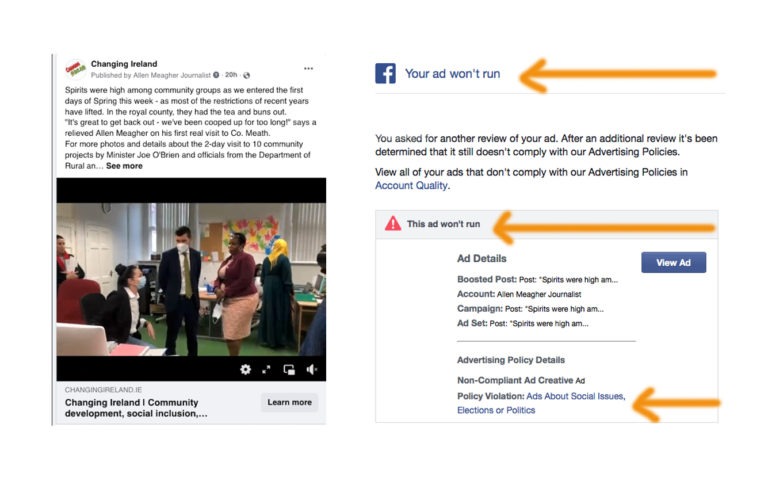
We paid €12 to Facebook on the promise of thousands of views (we have 1,958 followers, but FB had suppressed views so only 13 people saw the video). Well, I thought – Facebook does rule the roost, but at least money talks.
However, unlike all previous times, the “boost” was surprisingly rejected. I “appealed” as Facebook call it and this too was rejected (by an AI judge). The rejection email was headed “Your ad won’t run” and it further emphasised “This ad won’t run” beside a traffic alert sign.
The proposed boost was a “policy violation” because it was “about social issues, elections or politics.”
After appealing, there was nowhere left to go.*
What was in the video that was so bad?
People in the video are heard talking about family wellbeing, about “mental health”, “representing migrants”, “success” and “solutions”. Most of the audio is overlaid with music. It was a cheery, volunteer-focused video to lift people’s spirits.
Is this so awful?
Perhaps I tripped up by referring in an earlier related post to volunteers and “activists”.
Who knows the mind of an AI programme?
About the visit
The occasion was the visit by a minister – in this case the Minister of State for Rural and Community Development, Joe O’Brien. He was accompanied by locally-based Minister of State at the Department of Enterprise, Trade and Employment, Damien English.
Visiting Trim Family Resource Cente, Minister O’Brien is heard in the video saying, “It’s an impressive operation for sure here.”
And that’s all you hear in the video from the ministers.
What’s so special that’s happening in Co. Meath?
Ministers O’Brien and English listened to criticisms and helpful suggestions to improve the government’s delivery of support to marginalised people and to the community groups that seek to empower those very people.
They visited a volunteer-led group (SoSad in Navan) and heard directly from people who received treatment for depression and who told us of friends dying by suicide who may not have died if they had known more about the very services everyone present is determined to promote.
• ABOVE: Lee MacMalidhe, volunteer, Marie Johnston, co-ordinator of SoSad Meath, Carol Murphy, general mgr of SoSad Ireland, and William ‘Handsome’ Johnston, volunteer.
They heard from Tus supervisors saying one year placements were not long enough. The Rural Social Scheme is nowhere near as good as it was when first launched in 2004 – it has drifted from the original idea to give small-time farmers an extra source of income while their valuable services are utilised for community good.
They met a dozen schoolchildren who once had a difficult, near-2 hour walk to and from school, encountering many obstacles along the way. They now have a bus service (even though they don’t live in a rural area and therefore didn’t qualify for the Dept of Education’s bus). The bus they travel on is part-funded through the Social Inclusion and Community Development Programme and attendance has shot up to 95%.
The ministers and his officials met a man with a helicopter in the field behind his house. After becoming unemployed, Capt. Aidan Garvey dreamed of a setting up a small business and with support from the Back to Work Enterprise Allowance Scheme he has established a helicopter training school.
• FLYING HIGH WITH THE BACK TO WORK EDUCATION ALLOWANCE: Meath Partnership staff – Michael Ludlow, CEO and colleague (name to follow), Ministers of State Joe O’Brien and Damien English, Capt. Aidan Garvey (centre) and Paul Geraghty, principal officer, Dept. of Rural and Community Development.
They heard people ask for a re-opening of the highly-regarded Community Services Programme – and that may well happen later this year, people were told.
And that’s just to mention half the projects visited.
Ministers’ visits are genuinely important
Visits such as these bring everyone together, something that’s more importance than ever after two years in a pandemic. They help to highlight the work by fabulous collectives led by volunteers. They shine a light on issues that marginalised people face and the solutions they identify and politicians value listening to people on the ground.
Communities welcome attention and encouragement
In Ireland, the role of senior politicians visiting community groups is an important one. They go to listen and to focus public attention on a group’s reason for existence and on their often life-changing if not vital work. While celebrities often get behind an issue, ministers and public representatives willingly get behind whole communities.
Promotion of these good news events is an essential component of these visits.
And this is the full-length Youtube version – 2mins 17secs:
Great to see community work first-hand
For example, speaking about his Meath visit, Minister O’Brien said it was “great to see first-hand” the work that communities are carrying out with support from the Departments of Rural and Community Development and Social Protection, among others.
“One job of Government is to support communities so that they can develop to become vibrant and inclusive,” he said. All the projects showed “the resourcefulness of local communities in identifying an issue and developing a plan to address it and enhance all aspects of the community.”
Community development is the antithesis to fascism
There were no controversial campaigns covered in the video report. It was generally about community development – the antithesis to fascism, to racism, to homophobia, to inequality, and to rampant consumerism. Community development is not about elections. It is about empowering people from the bottom-up through collective action. It encourages people to identify solutions to the challenges facing their communities and to seek social change.
Monolith’s monstrous footprint
We are tiny, but our message is important. However, Facebook has a near monopoly on who gets their message heard and if the company’s AI cannot adjudicate on content, clearly the company should employ more human beings (and pay them properly) to carry out reviews.
Facebook is a monolith and researchers have shown how it profits while undermining democracy. A monolith is defined as “a large powerful organisation that… does not consider the ideas or feelings of the people it affects”.
What is ‘Changing Ireland’?
While our publication is called ‘Changing Ireland’, it is the paid civil society and public service workers, volunteers and activists who are seeking to change Ireland. Our focus is on reporting how such groups fight injustice, discrimination and inequality to change society for the better, one community at a time, often in very effective ways. Community development is an inclusive and often slow process. It happens on the ground, behind the scenes, while crime, violence or hate receives the bulk of media and public attention.
Facebook is not a fickle business
If we were in the US and advertising a suppressor for a gun (I’ve read about them after US mass shootings) I’m sure Facebook would have no problem taking our money. Instead, we’re suppressed. The social media giant encourages you to pay, then is too stingy to employ enough humans to review paid posts when a non-profiit such as ours wants to pay.
Posting on Facebook and other social media platforms isn’t a fickle business – it’s pure business. But when they suppress the very people trying to combat the kind of hate that Facebook leaned on for super-profiteering, you wonder which way to go.
* If you dig, you’ll unearth links leading to a convoluted-looking, third appeal process. If anyone has explored this, I’m all ears. We also plan to recruit a social media specialist shortly.
Postscript – a previous encounter
‘Changing Ireland’ has a history with Facebook. I suspect it sent a representative to sit quietly in court and take notes during a landmark three-hour case involving us that was heard in Killarney, in 2011. Community workers and many others had been outraged to find hate pages with tens of thousands of followers on Facebook’s platform calling for Travellers to be shot and burned. The case was brought by brave community workers and determined Gardai based on evidence shared with community groups by this publication.
The case marked the first time in Ireland that anyone was prosecuted for hate-crime online. The accused admitted his guilt in court, but was given “a second chance” by the judge and was let go without conviction. Those who brought the case were disappointed as a conviction would have sent out a strong message.
Afterwards, despite the fact that three others creators of the Traveller hate-sites were identified, no further arrests were made or cases taken by the DPP, no doubt to Facebook’s relief. The company should arguably have also been in the dock that day, but the law has yet to evolve while campaigners continue to call for stronger hate-crime laws including for online content.
Until 2017, Beaufort College pupils from the far side of town who walked for nearly an hour each morning often arrived wet, tired and hungry. Students frequently missed days and some quit school early. Local councillors had sympathy for them, especially in winter weather on dark mornings, and supported calls for a dedicated bus service.
What began as a pilot scheme proved to be an overwhelmingly success. A school completion officer told us it had effectively achieved a 100% success rate. Previously, children from the Windtown area had an average school attendance rate of only 80%.
The students did not qualify for a Dept. of Education schoolbus, because their average walk of 4.5km through Navan’s busy urban terrain was 0.3km short of the guidelines.
Last year, when the service seemed to be in jeopardy during the pandemic, parents rallied and walked the bus-route with their children, successfully highlighting the need for it to receive continued funding and support. At that point, the Department of Rural and Community Development became involved.
Result: “It’s made them feel part of the school.”
When, on Monday, Feb 1st, the six students met Minister O’Brien for lunch in the offices of Meath County Council, they spoke about the value of the bus service.
“They were very clear they wanted to be in school and they wanted this transport service,” said school completion programme co-ordinator Christina Nestor. She hopes that funding for Windtown schoolbus (currently funded through the Dormant Accounts Fund) will be “ring-fenced” for the future.
• Christina Nestor, local School Completion Programme co-ordinator.
“The success for our young people is that they have consistent transport to school every day,” she said. They also now reach school everyday in time to join the breakfast club and they take part in the after-school homework club before taking the bus home.
“It’s made them feel special and feel part of the school community,” said Ms. Nestor.
O’Brien: “You’re setting a great example.”
During his visit, Minister O’Brien said, “I am delighted to meet these wonderful students here today who were fortunate to benefit from the Windtown Student Bus Service, funded by my Department. This bus service is a tremendous asset in the avoidance of school dropout and the successful completion of their secondary education. You are setting a great example for your peers, your family and other members of the community.”
• Minister Damien English, Meath Co Co Cathaoirleach Sean Drew, Minister Joe O’Brien and Cllr Yemi Adenuga.
School Completion officer: “It has been 100% successful.”
Ms. Nestor told us, “It has been 100% successful. When I say 95% attendance, the 5% (absent) may be due to young people who are sick or who have genuine reasons for their absence from school.”
“They are all very motivated,” she added.
Recalling the successful campaign last year for the service’s retention, she said, “The parents were extremely pro-active. They campaigned and they walked the distance and we got media coverage. It was very much the parents voice with our support as well, as school completion officers. We really were engaged in community development.”
• Local Links is a national service and is known in the Navan area as Flexilinks.
“We were chuffed. They had heard of the benefits of the bus project,” she said.
She thanked Minister O’Brien again for his support.
“I want to see the money ring-fenced,” she added.
• Taking the Flexibus to Beaufort College means pupils from the other side of town can reach school dry, in time for a breakfast and without having to miss homework club after school.
She had many people and agencies to thank, including the friendly bus drivers, Miriam McKenna from Flexibus (aka Local Link) which funded initial pilot, Fiona Fallon from Meath County Council, Cllr Eddie Fennessy, parents led by Mark O’Halloran, successive principals of Beaufort College, Enda Lydon Principal of Naomh Eoin in Windtown, and Meath CYPSC. She also thanked Cllr Yemi Adenuga and Navan-based Minister of State, Damien English, who were both present for the school pupils’ meeting with Minister O’Brien.
School Completion Prog.: “We need all the funding back”.
Looking to the future locally and nationally of the School Completion Programme, Ms. Nestor said, “We have four project workers, including myself, but we need a fifth person. In the recession, we lost 30% of our funding; we got 5% of that back last year, but we need all the funding back.”
The School Completion Programme, in Navan and across the State, is supported through the Delivering Equality of Opportunity in Schools (DEIS) Programme, funded by Tusla.
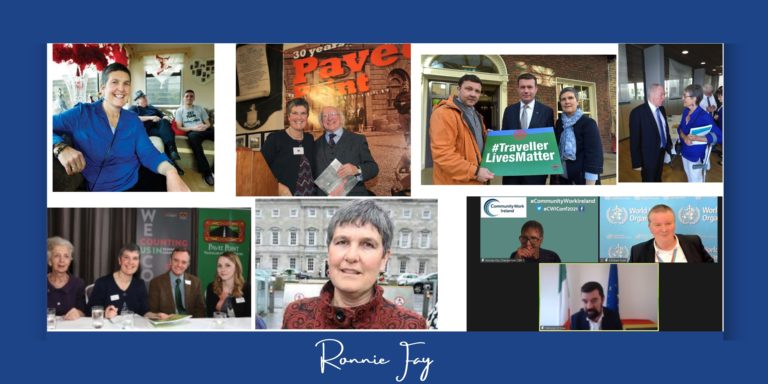
“It is with great sadness and sorrow that Pavee Point has to tell you of the untimely passing of Ronnie Fay our Co-Director. Our sympathies today go to Philip, her children Jonathan, Veronica and Patrick, her brother and sisters, including our much appreciated colleague Oonagh, and extended family members. They have lost a partner, mother, sibling and steadfast friend.
“Ronnie will be a huge loss for us, for all we work with and for all concerned with Traveller and Roma human rights here and everywhere. She gave her life to promoting equality and social justice and led Pavee Point’s work locally, nationally and internationally with courage and conviction even during the last two years of COVID and including when she was already unwell.
“Ronnie was also our colleague and friend, and friend to Travellers and Roma, and those who stand in solidarity with Travellers and Roma, throughout the country as the concerned messages of the past weeks again indicate. As a community worker she believed in solidarity and support for others and in participating actively in shaping our country’s responses and initiatives with marginalised communities. And she made time to be an active camogie, hurling and sports enthusiast. May she rest in peace.”
Ms. Fay was the chairperson of Community Work Ireland which has paid tribute to a colleague, supporter and friend:
“Throughout her life as a deeply committed community worker and feminist, Ronnie championed and led campaigns nationally and internationally for the rights of Travellers and Roma. She will be remembered for her decades long work with Pavee Point but her commitment to equality and rights permeated every part of her life.
“She was a leader in the community sector, always working in solidarity and bringing her intellect, commitment and experience to bear in a broad range of settings and on a wide range of issues affecting those who experience the highest levels of poverty, social exclusion and inequality in our society.
“Never one to shy from a challenge, Ronnie spoke truth to power yet firmly believed in the potential and possibility of collaboration, negotiation and honest dialogue with duty bearers.
“As an extremely active member of Community Work Ireland since 1984 and as our current Chair, she brought clarity, focus, guidance, constructive critique and direction to our work in a supportive and ever generous way.
“The community sector has lost a leader. It will leave a void that won’t easily – if ever – be filled, but we will strive to carry through Ronnie’s vision and desire for a country and a world that places human rights and social justice at their core.
“We extend out deep condolences to her husband Philip Watt, to her children, Veronica, Jonathan and Paddy, her brother and sisters, her colleagues in Pavee Point, to the Traveller community and to all who knew and loved Ronnie as we did. We will miss her deeply. Ní fheicimid a leithead arís.”
When the feeler was put out on Cape, 18 people immediately replied and Cléire Community Sponsorship Group, or Cuaisín, was formed in November 2020.
“The positive reaction was brilliant. It brought a section of us together to work on it, and it strengthened our little community group,” said Mary O’Driscoll, a founding member of the group.
Exceeding goals
The group’s first attempt at fundraising was hosting a virtual walk, totalling the distances participants walked locally into one trek from Cape to Damascus and back. But the real money-maker was a calendar. The 2022 calendars include island photos and “seanfhocal”, or words of wisdom, from the Cléire Béaloideas collection of 1940. Selling the €10 calendars from a handful of businesses on Cape and stores in Skibbereen, the group has exceeded their expectations.
“Our fund is flying up now,” said O’Driscoll. “It was totally sponsored so it is a total profit. We have enough now for two families.”
• Cape Clear’s calendar for 2022.
The group needed to raise a minimum of €10,000 to support one sponsored family; By the end of October they had €17,000 and can add on €2,000 in donations-in-kind. “I’m optimistic we’re going to get to €20,000,” said O’Driscoll.
Even though they originally planned for only one family unit, O’Driscoll said once they heard a sister of the parents was also in need, they had no qualms.
“When we put out the call on Whatsapp, ‘Would we agree for two families?’ within an hour they all said, ‘Yes, we’ll work it out, just say yes’.”
• This report was filed by journalist Hannah Ní Shúilleabháin, pictured here on Cape Clear island. Hannah took the photographs accompanying this report.
Giving back what Cape Clear got
“It is nice to think we’re sharing and giving back what was once given to us,” said O’Driscoll, referring to the resettlement program organized by Peter Robinson between 1823 and 1825. The British Government sponsored emigration as a form of relief and pacification for the south of Ireland after a period of civil unrest and a partial famine in 1822. Four Cape Clear families of farmers, recommended by their parish priest and Robinson, emigrated to Canada in 1825.
“It was lovely to think that they had gone in 1825, and we’re just returning the compliment to somebody else.”
For family & community
The Irish Refugee Protection Programme (IRPP) has accepted thousands of refugees since its creation in 2015, a majority of whom go through EU Relocations and UNHCR-led Resettlement. An alternative to these strands, Community Sponsorship Ireland enables local communities to do the groundwork of preparing for and welcoming refugees. A Regional Support Organisation (RSO) provides the training and support in preparation for receiving a family. Nasc, based in Cork, is the RSO for Cléire Community Sponsorship Group.
Cuaisín has been working alongside other community sponsorship groups through their preparation period. They completed online training with Cahersiveen, a community that’s pivoting to sponsorship since asylum-seekers there went on hunger strike, leading to the phased closing of that Direct Provision accommodation.
O’Driscoll believes Community Sponsorship Ireland is a superior alternative to the Direct Provision system for asylum seekers.
“I think it’s good that they come from where they are now directly to here, without going through any provision centre,” said O’Driscoll. “The fact that we have so much preparation to do, it means we know what we’re taking on and we understand the background of it, rather than having them hoist it upon a community without having a group in place to understand where they’re coming from and what to do for them.”
When they arrive
They don’t have a guarantee yet, but O’Driscoll said signs were pointing to an arrival in December or early in the new year. It’s likely IRPP would allocate a family to the island with a similar background: rural and farming.
“We’re an aging population, so we definitely need new blood here,” said Mary O’Driscoll.
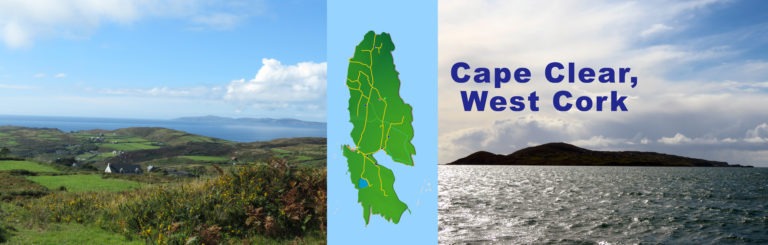
A big draw to take in a family is the guarantee of children for the primary school on the island, which currently has 5 students. A 50-minute ferry ride from Baltimore, the island has a year-round population of 110.
By the time training concluded in November, the group had compiled the family’s settlement plan, including contact details for key bodies, a plan of integration, information on State services enrollment, housing, language learning and more.
“I put a little notice on our Skibbereen Notice Board (Facebook group) looking for Arabic speakers, and I got an overwhelming response,” said O’Driscoll. “It’s just brilliant. People want to support us and help us when people get here, and are just dying to get involved.”
“Rising insurance renewal premiums are a concern to organisations of voluntary disability services because they have to take money from delivering services to pay increasing insurance cost,” said John Dolan, the Federation’s CEO.
• John Dolan, CEO of the Disability Federation of Ireland.
The DFI is the national support organisation for voluntary disability groups in Ireland. It is funded through HSE and member direct funding.
Peter Boland of the Alliance for Insurance Reform (AIR) welcomed DFI’s decision. He said: “It is frustrating that an organisation so focused on providing such essential services should feel the need to join our campaign.”
He called on the Government “to urgently accelerate the pace of insurance reform”.
Members of the lobby group for insurance reform now include:
Early Childhood Ireland, Volunteer Ireland, The Wheel, the Irish Charity Shops Association, Community Reuse Network Ireland, Galway County Public Participation Network (PPN), Sligo PPN, South Dublin County PPN and DFI.
Specifically, the Alliance wants the Government do the following:
– Seek additional underwriting capacity for the Irish market, including the voluntary sector, to improve competition and insure sectors that currently cannot get cover.
– Review and re-balance the “common duty of care” to require occupiers to take a duty of care that is reasonable, practical, and proportionate.
– Reform and strengthen the Personal Injuries Assessment Board.
– Insist that insurers deliver immediate reductions for delivered and planned reform.
The Alliance now claims through its membership of 46 civic and business organisations from across Ireland to represent over 700,000 employees, almost 600,000 volunteers and over 370,000 students. It promises to continue to highlight “the negative impact of persistently high premiums” while calling for “real reforms that will quickly reduce liability and motor insurance premiums to affordable levels”.
Interview with Olive McCarthy, UCC’s Centre for Co-operative Studies.
1. Name a favourite artist/performer?
Mario Rosenstock – I could listen to him anytime of the day or night.
2. What is the most recent book you read?
The only books I read nowadays are children’s books for my 7-year-old son. We’ve read the full series of Tom Gates’s books (by Liz Pichon). They’re hilarious.
3. What are you watching on tv?
I’m a big fan of Netflix, because you can press pause. I binged on The Queen’s Gambit – after 24 hours I had seen the full series.
4. Who is your favourite comedian/comedy?
Frasier – I have all the boxsets. It’s intellectually funny but down to earth.
5. Who are two of your all-time heroes?
John and Pat Hume, for obvious reasons. They regularly got bullets in the post and had to leave the house at short notice. She was very heroic behind him.
He also got the credit union movement going in Derry. He knew how to promote an idea, but he was also intuitive in knowing when it was time to step back and let people at it.
She was a teacher, so she was the chief breadwinner when he wasn’t earning money. She kept the whole show on the road in the background.
They came to UCC in 2005 to launch a book with us called ‘Helping Ourselves: Success Stories in Co-operative Business and Social Enterprise’. It was a privilege to meet them.
6. Name two social inclusion issues in Ireland today not getting the focus they deserve.
Firstly, Direct Provision and the conditions that we all but force people to live under without allowing them enough freedom. I joined the Sanctuary Runners initiative set up by Graham Clifford and became somewhat familiar with the issues they face, cramped conditions, an unhealthy environment…
Knowing people in DP through the running has changed my perspective. On a cold or wet morning, running equalises everyone.
• Cork Sanctuary Runners gear up for this year’s marathon. Pic courtesy of @SanctuaryRunner
Secondly, financial inclusion and exclusion. I’m on the board of MABS Support nationally – there’s a huge role in educating young people… financial resilience. We continue to have 10/15% of the population who suffer some kind of financial exclusion.
7. Is Community Development going to get stronger or weaker?
The more we see that there are dire needs, community development will come to the fore.
Communities will have to rally and deliver much-needed services, and that’s where the co-operative model really fits. The islands for example suffered from crises over the years and the communities there mobilised themselves.
The more we realise we all have something to contribute, the better.
8. We previously covered your report calling for legislation to regulate money-lending. Where are we now on that issue?
The cogs are in motion and the will is there to change it. It is moving in the right direction.
In early 2019, Pearse Doherty (SF) brought a bill forward to cap the rate charged by moneylenders at 36% APR. The Government itself has now (proposed) to cap the cost of credit at 1% per week – essentially up to a maximum of 48% flat interest. It sends a clear signal that a cap will be introduced.
This year, we made a submission to the Oireachtas that is undergoing legislative scrutiny at the moment.
9. What would help most for credit unions to reach their potential?
The biggest challenge credit unions have at the moment is the low level of lending, but put that aside. When you look at any co-op that is struggling throughout history, you can usually pinpoint it to one or other of the co-op principles that aren’t being implemented properly.
The principle of education, training and information is (not stressed enough). There’s an information deficit.
I take 4th year commerce students and when they start they don’t quite grasp the credit union model. By the end of that module they’ve all joined their Credit Union.
A lot of young people are into ethical approaches to doing business such as upcycling and people-based services. They’re telling me there‘s a real opportunity here for credit unions to reach out to that mindset among young people – that it’s not profit based, that when you borrow from a credit union it’s a very different kind of lending.
10. Your research on flaws in the ‘Buy Now-Pay Later’ sales pitches to consumers was published recently. Why are poorer people at risk?
The impulsive nature is the problem. If you miss a payment, eventually your debt could be passed onto a debt-collection agency and it’s largely unregulated.
The big issue for me is the habit. It’s too easy to buy stuff on credit without much by way of credit checks. For younger people, click this button and away you go. It gets them into bad habits. In my day, we had to save before buying. I felt huge pride buying my first bike aged 12. Having to save holds you back in terms of consumption. Buy-Now, Pay Later makes consumption too easy.
11. Why should people consider applying for courses provided by UCC’s Centre for Co-operative Studies?
UCC has the only centre like ours in the country.
We have very specialised masters programmes. We have an on-campus 12 months M.Sc. in co-ops, agri-food and sustainable development. Students spend seven months in the classroom and five doing research with businesses, projects or co-ops. It’s very applied and we get a lot of speakers in to give students the exposure to practice.
The placements they do are usually tailored to their interests and we’ve had students on placement, for example, with Change By Degrees (a social enterprise), the Quay Co-op, Carbery and FDC.
We normally do a lot of field trips – we were out last week to visit the zero-C farm in Carbery in West Cork which is 100% owned by four Irish milk co-operatives.
We have a range of scholarships to cover fees and stipends – just ask.
Another course we do is an online masters in co-operative & social enterprises. It attracts people working in the sector, looking for leadership development. It is tailored for those who are working full-time, volunteering, or who have caring responsibilities.
12. What other research are you and colleagues doing?
I’m researching energy efficiency in low-income households, particularly around retro-fitting, while my colleagues are currently carrying out research into agri-advice, men’s sheds, co-ops and elder care.
Thanks to development worker Damien Ahern for this report and also to local volunteer Deralee Collins for sharing her photographs:
• Author: Damien Ahern of West Limerick Resources.
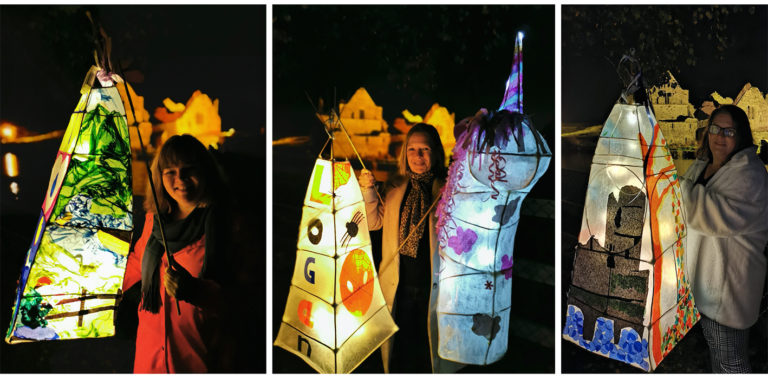
Askeaton came alive for ‘Féile Laindéir’ where brightly-coloured, uniquely-designed, environmentally-friendly Willow Lanterns were paraded up the River Deel and along it’s riverbank.
The spectacle resulted from a lantern making programme run over five weeks in Askeaton Community Centre. The theme for this year’s festival was ‘Lights on the River Deel’ which was individually interpreted by each participant. While it was held on a Friday night in October, the ripple effects from the project continue to resonate locally.
The Deel Art Group facilitated the lantern programme, with advice and guidance from illustrator and designer Rachael Grainger, supported by West Limerick Resources through the national SICAP* programme.
The Deel Art Group have earned a reputation, having led many community arts projects in the town – including a ‘Paint a Rock’ project, the recent ‘Arts of the Quay’ project and their famous Christmas Window Display.
Anita Guinane is the group’s chairperson. She said, “It was a hugely positive evening for the town, where a large crowd gathered to admire the lanterns, and to follow the parade up the river. As a new addition to this year’s festival, music was projected over a speaker, adding to the drama and spectacle of the evening. I am very proud of our members who delivered the programme and of the participants who amazed us with their talents.”
The Desmond Rowing Club, Askeaton-Ballysteen Ladies Gaelic Football Club and Askeaton-Ballysteen Community Council volunteered their services for the evening, ensuring a broad representation from the community – all working together for the enjoyment of the town.
Limerick Youth Service and Foróige members also took part in the festival. They provided materials and ran a workshop through West Limerick Resources, with SICAP support.
“The Deel Art Group is just one example of a number of community groups supported by the SICAP programme in West Limerick,” said Adrienne O’Connell, SICAP education and training co-ordinator.
“In building the art group’s capacity, it allows them to become a strategic player in delivering positive community development initiatives, while creating a creative space where individuals can come together and share skills and talents and form new friendships. In fact, the Deel Art Group has three new members as a result of this project and the very best of luck to them,” she said.
** SICAP stands for the Social Inclusion and Community Activation Programme.