From Donegal to Cork, both seasoned campaigners and new recruits have been attending vigils and demonstrations as news of the atrocities committed by Israeli forces in Gaza becomes more horrifying by the day.
The Ireland Palestine Solidarity Campaign (IPSC) and all of its regional branches have continued to hold vigils, marches and demonstrations to highlight the plight of the people of Gaza and call for an immediate ceasefire.
They have also continued their nationwide demonstrations at AXA offices as part of the ‘Boycott AXA’ campaign, calling on AXA Insurance to pull its investments in Israeli banks.
In December 2023, the Don’t Buy Into Occupation (DBIO) coalition reported that AXA had investments of US$19.5M in three Israeli banks that are financing the construction of illegal settlements in Palestine: Bank Hapoalim (US$9.99M), Leumi Bank (US$6M), Israel Discount Bank (US$3.4M).
In Galway, healthcare workers have been holding vigils each Tuesday between 7pm and 8pm outside University Hospital Galway in solidarity with their colleagues in Gaza.
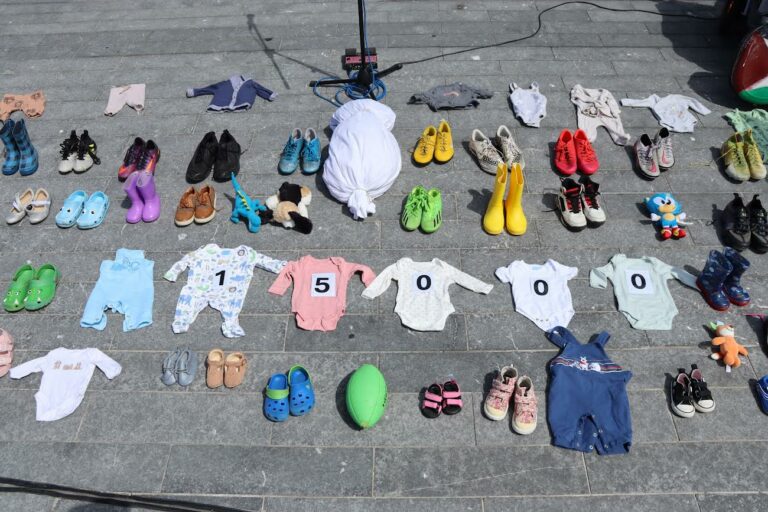
The Galway Palestine Solidarity Campaign held a vigil on June 8 to honour the murdered children of Palestine, one of eight such vigils that took place around Ireland.
The vigil at Droichead an Dochais beside Galway Cathedral was organised by the Irish Healthcare Workers for Palestine and the Galway branch of the Ireland Palestine Solidarity Campaign.
Members of Mothers Against Genocide put together a powerful display of children’s shoes and clothes, while two mothers held up a banner to illustrate how more than 15,000 children have been killed in Gaza since early October.
In Donegal on June 9, members of the Donegal, Inishowen, Derry and Mid Ulster branches of the IPSC gathered at the An Grianán of Aileach fort to show solidarity with Palestine and call for a ceasefire.
In May, the Waterford Congress of Trade Unions joined with alumni, staff, students, and IPSC members at South East Technological University (SETU). The group marched silently through the campus to the president’s office as part of their campaign calling on the university to cut all ties with Israeli organisations and educational institutions.
The South East IPSC also hold weekly vigils at the SETU campus. Members of the group in West Waterford have been holding a weekly flag wave on the Kilmacthomas Greenway Footbridge over the N25.
Clare IPSC have held weekly rallies in Ennis, and also held a free screening of the film ‘Where Olive Trees Weep’, about the struggles of the Palestinian people.
The ECP specifically targets area-based deprivation, identified by the Pobal HP Deprivation Index, through a community development approach.
The programme aims to empower local communities to craft their own response to area-based poverty, social exclusion and the resulting consequences, with the support of the relevant Local Community Development Committee (LCDC).
The new community engagement workers will be recruited for both areas to develop and facilitate relationships between community stakeholders, community groups and statutory agencies and structures.
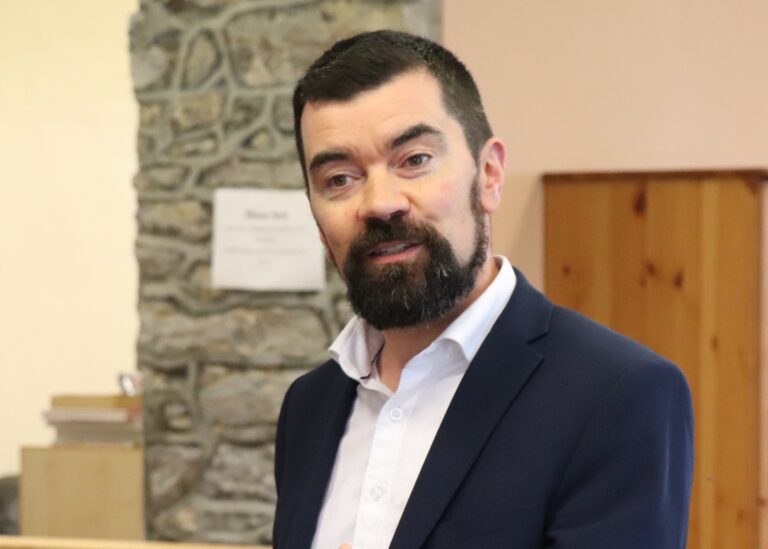
Minister for Community Development and Charities, Joe O’Brien made the announcement this week and said: “I strongly believe that each community knows best what its issues are and what its solutions are. The ECP is designed to do exactly as it says – empower communities to design its own community development approach to tackling the issues facing it.
“It supports communities in creating and implementing specialised community work responses to local concerns and particularly in areas of specific disadvantage and the resulting social exclusion.”
He continued: “The Community Engagement Worker will provide leadership in the community, developing and facilitating relationships between the local community and other relevant stakeholders at both local and national level. In addition they will be responsible for ensuring that the core work of the ECP is informed by and driven by the communities.”
A statement released by Northside Partnership this week said: “As an organisation, we recognise that members of our community hold different and sometimes opposing opinions on a range of matters. We welcome honest discourse to aid mutual understanding and cooperation for the good of the communities we serve, both existing and new.”
The organisation said it also wished to reiterate the points made in a statement in March of this year by the Northside Community Forum (of which it is a member).
That statement read: “We find ourselves working in a context in which global poverty and inequality is rising and services essential to addressing poverty and inequality in Ireland have been critically underfunded since the economic crash of 2008. Yet, Ireland is one of the few countries that has now generated a budget surplus.
“We are mindful that many people across our community have legitimate concerns regarding the lack of adequate investment in essential services including housing, health care, education and community facilities.
“We recognise that in a democracy citizens have a right to protest, but we are concerned when those protests seek to divide communities and target vulnerable human beings who, like so many Irish living abroad, wish to contribute to their new home and build a better life.
“There is no doubt that inequality and poverty are insidious and they can undermine democracy if left unchecked. We call on government to invest further in the work to address poverty and inequality and increase funding in the longer-term to essential community and voluntary services across the state.”
Minister of State for Community Development, Integration and Charities, Joe O’Brien announced a new project this week that will support the recruitment of up to 30 Community Link Workers.
The workers will be employed by local development companies under the Community Connection Project (CCP), which will receive funding of €3m over 2024 and 2025.
• ABOVE: Minister of State Joe O’Brien was interviewed by Changing Ireland on the day he announced 30 new community worker jobs. Part of the role of the new community workers will be to correct misinformation and to counter disinformation.
The new employees will engage with local communities across Ireland over an 18-month period with a view to helping communities respond to the arrival of International Protection Applicants.
Minister O’Brien said workers will help to “build community resilience against misinformation and prejudice by working with the local community before, during and after the arrival of International Protection Applicants”.
He told Changing Ireland: “It will help skill up the local community and give the community more resilience to defend itself against disinformation and misinformation around international protection applicants in particular.
“We found that it works well at community level if people can have conversations with community workers about the facts, rather than (us) taking a top down approach.
“We’re putting community workers in there to heal division and to make communities more resilient against misinformation and disinformation. Parallel to it we’ll have a piece of research ongoing that will gather good practice, gather what’s going well, but also gather any kind of policy issues for government as well,” he said.
He said the workers will be spread across the country “because every community needs to build up their resilience and their capacity to defend itself against disinformation and misinformation. But we will be looking at where there was a particularly large number of centres opened up or where there were particularly divisive issues.”
“I know the power of community work. I know what community workers have done in Ireland to help new people settle into a community,” he said. In that context, the new project is about doing protective work in communities that were “a little bit hurt and a little bit damaged over the last two years”, he said.
The workers will liaise closely with the Community Engagement Team of the Department of Children, Equality, Disability, Integration and Youth, along with other key stakeholders, including the Local Authority Integration Teams.
• ABOVE: Local development company representatives welcomed the announcement of the new Connecting Communities Project which will employ 30 community workers countrywide.
Changing Ireland sought a response from Carol Baumann, CEO of the Irish Local Development Network; Sabina Trench, CEO, South West Mayo Development Company; and Ryan Howard, CEO of South and East Cork Area Development.
While the project is only funded for 18 months, all three interviewees agreed that this is the start of something new in communicating with and listening to communities and that it may become a long-term funded programme.
Carol said: “We see this as a very positive step. Firstly, it recognises the scale of the challenge that communities up and down the country have been dealing with, so any new resources are welcome. Secondly, I think it’s an acknowledgement of the work and skills that exist in local development companies, in our network, and the work that they’ve been doing now for several decades.”
Sabina said, “Integration is something that the urban and rural companies are facing and addressing on a daily basis now across the country. The minister is recognising that and acknowledging, as Carol said, our work and our footprint in this area already.
“We’re facing into a future of new communities, that’s just the reality and we have a staff of nearly 14 people in South and West Mayo working in the area of integration. This person will add to that team enormously.
“It will also give us an opportunity to showcase our work and to address misinformation. Sometimes we’re afraid to shout from the rooftops about the really positive work that we’re doing. This lets us do that,” she added.
Ryan said: “I love the fact that it’s communications focused. I think the focus is actually really good. Local development companies and local communities have great stories to tell and need to get ahead of hateful conversations. We need to bring people into the conversation, let them be part of the story, and we’ve got to listen as well as talk, as well as share – and maybe we’ll get there.
We asked Ryan if 30 people for 18 months was enough.
“No! Take any one of our areas and put one person in there to try to deal with this communications challenge. It’s spreading fast in terms of the other side of this conversation and we really need to get ahead of this,” he said.
“On the other hand 18 months seems like the beginning of a programme. This is really a sizable start. The Minister had to go in and get that resource from somewhere and we will prove that it delivers value back to the back to the taxpayer,” he added.
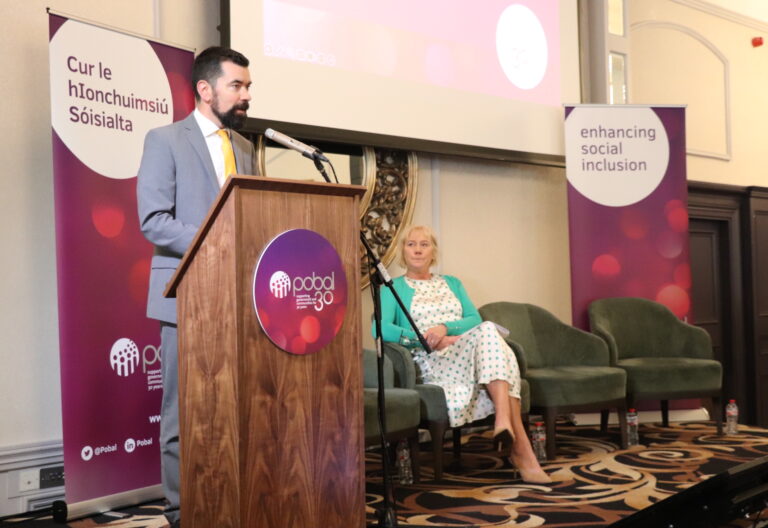
• Minister Joe O’Brien speaking at the Welcoming New Communities conference in Dublin Castle
Minister O’Brien also announced an additional €1m in funding for the continued delivery of social inclusion supports under SICAP to new arrivals for the remainder of 2024.
The Minister made the announcements at the Welcoming New Communities conference in Dublin Castle, which saw over 150 delegates from local development companies, the community and voluntary sector and national representative organisations attending.
• Carol Baumann and Michelle Mullally from the Irish Local Development Network and Terry Hyland of Cavan County Local Development in Dublin Castle. Photo by Allen Meagher.
Various organisations presented diverse examples of initiatives welcoming and supporting the integration of new communities, and discussed the challenges and barriers to integration efforts.
The purpose of the event was to provide opportunities for community organisations to discuss effective approaches, share best practice on tackling misinformation and to promote networking, knowledge sharing, understanding and appreciation of the variety of community based migrant integration initiatives being delivered.
• Minister of State Joe O’Brien and Robert Carey from North East West Kerry Development at the conference. Photo by Allen Meagher.
“My hope for today is that, in facilitating robust discussions on those questions, pinpointing initiatives that have been highly effective and identifying barriers and blockages to better implementation, we can collectively start to form new solutions to carry impactful integration and inclusivity initiatives forward into the future,” commented Minister O’Brien during the event.
“The value of having so many stakeholders in the room truly can’t be understated, as we engage and work together to tackle the challenges and support communities in welcoming and integrating new arrivals.
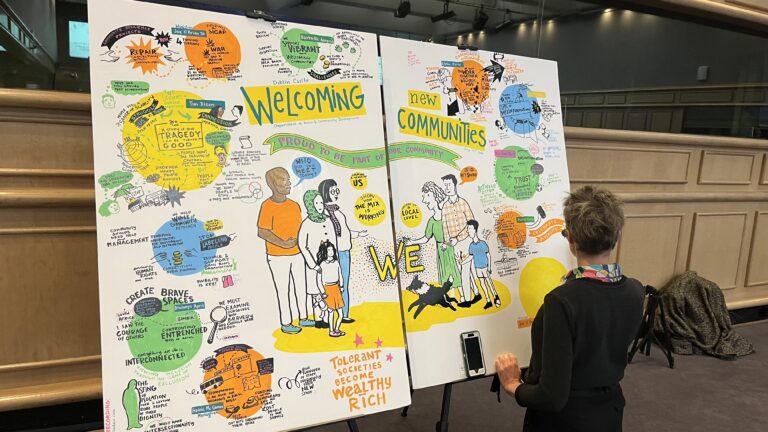
A photographic exhibition was held during the event. It was mounted by Changing Ireland in co-ordination with community groups across the country and featured dozens of stories and over a hundred photos highlighted the sector’s work with migrants and their lived experience in Irish communities.
• Allen Meagher, editor of Changing Ireland, and Rory MacGregor from the Department of Rural and Community Development beside the photographic exhibition held in Dublin Castle as part of the Welcoming New Communities Conference. Our thanks to all who submitted photographs and to the Irish Local Development Network for their assistance.
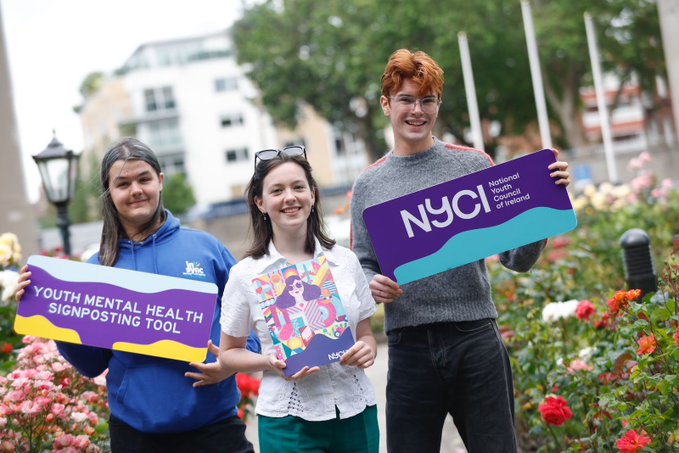
The new resource aims to bridge the gap in mental health support and ensure that young people can find the help they need quickly and efficiently.
The search engine allows users to simply select the issue affecting their mental health, or the mental health of the young person they are supporting, and the area in which they live, to find appropriate support services.
It contains information and contact details for supports for a range of issues including substance use, eating disorders and self harm.
It also highlights supports available for LGBT+ young people, migrant communities, and neurodivergent young people, among many others.
Minister of State for Mental Health and Older People Mary Butler said the development “marks a significant step forward in how we continue to support youth mental health in innovative ways”.
“Young people have embraced modern technology and receive a lot of their information from their phones and devices. It is crucial that young people have access to the right, appropriate supports when they need them, in an age of misinformation and disinformation. This signposting tool will play a vital role to ensure access to the many supports for youth mental health are highlighted and signposted and will also support their families,” she added
NYCI national youth health programme manager Rachael Traenor said the tool “showcases the wealth of good work already being carried out by youth workers and youth services to support young people’s mental health”.
She continued: “We are immensely proud of the collaborative work that has gone into developing this tool. It reflects our commitment to enhancing youth mental health support across Ireland. Our thanks go to all the organisations and individuals who have contributed to this important initiative.”
Click here to access the new Online Youth Mental Health Signposting Tool.
LAWPRO is a national shared service working on behalf of the 31 local authorities in Ireland coordinating efforts to achieve good water quality across the country.
Anthony Coleman, director of services at LAWPRO said: “We are delighted to once again invite community groups to organise a water-related event for Heritage Week. The theme of Heritage Week 2024 is ‘Connections, Routes & Network’, and our rivers play a big part in the connectivity of our island. In historic times they were networks for movement, trading and exploration.
“Water Heritage Day gives communities a fantastic opportunity to celebrate our heritage through water, whether it be hosting a river safari, a talk at the riverside, or launching a booklet on a local waterway. there are ample ways to get involved.”
Organisations are asked to consult with their local community water officer in advance of making an application. Their contact details are here: Communities Team – Local Authority Water Programme (lawaters.ie). The deadline for making an application is Tuesday, July 16.
Virginia Teehan, CEO of the Heritage Council commented: “Water Heritage Day continues to be a significant highlight during National Heritage Week every year, showcasing the creative and ingenious ways communities celebrate the impact of canals, lakes, rivers, and the sea on our local heritage.
“This year, particularly given the theme of ‘Connections, Routes, and Networks’, I am excited to see what kinds of events we see for Water Heritage Day. This LAWPRO grant scheme will enable people to explore and highlight our water-based connections, emphasising how vital they are to our natural heritage. It’s a wonderful opportunity for event organisers to avail of supports that will encourage them to dive into our shared history and appreciate the incredible resource our waters provide.”
LAWPRO works in partnership with the Heritage Council, and to run a Heritage Week event organisations are encouraged to register events on their website here: www.heritageweek.ie/get-involved/organise-an-event
Paddy and his wife Linda first came to Moyross in February, 1975, at an exciting time for residents. They moved into their new home in Cliona Park and 50 years later it’s still their home.
Moyross’s eight housing estates, built in the mid-1970s initially lacked services such as a school, a church, supermarkets, reliable public transport, a library and employment opportunities. However, the community had spirit and spark.
• Centre staff Nicole Hogan, Paddy Flannery (retired) and Karen Lynch.
Paddy – originally from Co. Galway – was a member of the committee that built the first community centre which opened in May, 1992. He was employed as a Community Employment supervisor in the centre in June, 1993, and he became manager of the centre in 1995. This came with responsibilities that went far beyond the centre’s front gate.
Paddy was a key member of the local ‘Moyross Partners’ umbrella group and became recognised nationally for being an action-orientated, optimistic and ambitious community leader and for being willing to speak up during difficult times.
He helped to bring people together and campaigned for the provision of vital services within the community. He helped to develop strong partnerships between local groups and state agencies to tackle issues facing the community.
• People from far and near who came to wish Paddy the best on his retirement.
At the retirement event today, MCEC chairperson Tony Lynch wished him the very best in retirement. He said:
“When Paddy became manager in 1995, we had five core staff and 74 more employees through Job Initiative (JI) and Community Employment (CE) schemes. What is remarkable is that today the company – rooted in the community – directly employs 50 people and there are 47 people on JI or CE. He leaves this organisation is in a strong position going forward.”
“Throughout the years, Moyross Community Enterprise Centre, under Paddy’s guidance, maintained a steady focus on doing what was best for Moyross. Regeneration proceeded, the potential for greater employment opportunities locally has improved, and stigmatisation of the area has decreased. It is a remarkable turnaround and Paddy has contributed to making Moyross a better place today,” he said.
• The Mayor of Limerick John Moran, Paddy Flannery and family members at his retirement celebrations.
At home, Paddy and Linda were involved in fostering children. Their children, now all adults, joined Paddy’s siblings and in-laws today in paying tribute to Paddy on his many years of services as centre manage, but also as a family man.
Today Paddy spent his last day in the job. He received presentations from various groups that his work had supported over the years, including from Moyross Youth Academy, and from Changing Ireland Community Media CLG which is based in the community centre.
Minister for Rural and Community Development, Heather Humphreys and Minister of State with responsibility for Community Development and Charities, Joe O’Brien, have this week announced €550,000 in funding for library supports.
The funding, under the Dormant Accounts Action Plan, will assist public libraries in reaching out to people with disabilities and other marginalised groups.
Funding of €400,000 has been approved to support the provision of assistive technologies such as hearing loops, electronic magnifiers and wayfinding tools. It will also help people with disabilities to access library services by providing wheelchair-accessible shelving, height-adjustable desks and seating.
Further funding of €150,000 has been approved to support the promotion of public libraries through the hosting of an Open Day in all libraries nationwide that will enable them to showcase what they offer to the public.
Minister Humphreys said: The projects that are being funded under this initiative will create a more welcoming, accessible and engaging library experience for thousands of people. This will put our libraries at the forefront of reaching out to all members of the community in which they serve – this is a key objective of the new library strategy ‘The Library is the Place’.
“This funding will make a huge difference to people’s lives by providing equipment to support our elderly people and people with disabilities. It will also build on the excellent projects which have been delivered over the past five years and will help our public libraries to continue to foster community well-being and build community cohesion in their role as community hubs.”
Minister O’Brien added: “I am delighted that the overall 2024 Dormant Accounts Action Plan will support 52 different measures across the country with a total value of €47.6m.
“I am particularly pleased that the assistive technology and furniture that will be supported by this funding will make our public library service more accessible to everyone in our communities.
“This equipment will support the hearing and visually impaired communities, the elderly and those with physical disabilities.”
The Ministers also thanked the local authorities and the library staff for their ongoing commitment and support to the public library service.
Minister of State at the Department of Rural and Community Development, Joe O’Brien has announced funding for 42 additional positions under the Community Services Programme (CSP).
A total of 32 organisations across Ireland are set to benefit from the investment, which will see approximately €1 million in additional funding allocated to the programme.
The CSP supports community-based organisations to provide local social, economic and environmental services through a social enterprise model.
It aims to tackle disadvantage by providing a co-funding contribution towards the cost of employing a manager and full-time equivalent (FTE) positions.
This announcement follows a call for additional funding requests to existing CSP services, which took place in September 2023.
The investment will result in an extra seven managers and 35 full time equivalent (FTE) positions being supported.
Minister O’Brien commented: “I am delighted to announce these additional posts for the Community Services Programme, and to extend the capacity of our CSP organisations to deliver vital services in our communities.”
“The organisations supported under the Community Services Programme provide a wealth of services to meet the needs of their communities, while also providing local employment and contributing to sustainable, inclusive and empowered communities. I am committed to continuing to support these organisations and am delighted to announce the funding for these additional posts.”
The Community Services Programme has evolved over recent years, and in line with emerging priorities, a new needs-based differential funding model was introduced from January 2023.
An increase in the funding contributions to CSP organisations was announced in December 2023, to help CSP organisations to implement the increased national minimum wage for all staff.
The CSP contribution supports organisations to meet local service gaps and provide access to services and facilities that would potentially otherwise be unavailable.
There are currently 449 community based services supported by the CSP through 429 organisations throughout the country.
Women’s Aid, a national organisation supporting victims and survivors of domestic abuse, today revealed that it has recorded the highest level of disclosures of domestic abuse in its 50-year history.
The Women’s Aid Annual Impact Report 2023 outlines 40,048 disclosures with its National Freephone Helpline and Regional Face-to-Face services during 28,638 contacts last year.
This represents an 18% increase on the previous year and the highest ever recorded by the organisation.
Women reported assaults with weapons, constant surveillance, and monitoring, relentless put downs and humiliations, the taking and sharing of intimate images online, complete control over all family finances, sexual assault, rape and being threatened with theirs or their children’s lives.
Impact of abuse
The impacts on these women were chilling and ranged from exhaustion, isolation, and hopelessness to serious injury, suffering miscarriages, poverty, feeling a loss of identity and suicide ideation, hypervigilance, and homelessness.
Sarah Benson, CEO (Chief Executive Officer) of Women’s Aid says: “The number and nature of the disclosures of abuse to our frontline services is utterly appalling. However, this is just the tip of the iceberg. One in four women in Ireland is subjected to domestic abuse and there are also so many children, families and whole communities also impacted.
“Fear, stigma, and self-blame due to the impact of the abuse – but also persisting social attitudes to domestic violence prevent victims from coming forward. So many victims-survivors lack the information or confidence to contact specialist services, and about one third will suffer in total isolation, telling nobody what is happening to them. We still have so much work to do to break this silence to encourage those in need to get the support they deserve. What we hear in our national and regional services is replicated across Ireland in local domestic abuse refuges and organisations.”
Ms. Benson continued: “Behind our harrowing statistics there are strong, resilient women who have taken a courageous step to share their story to our frontline services. We know that so many more women suffer alone, in silence and without specialist support.”
Coercive Control
The majority of the women disclosed that they were being subjected to and threatened with multiple forms of abuse at the same time, which constitutes coercive control by a current or former male intimate partner.
According to Women’s Aid, coercive control is “a persistent pattern of controlling, coercive and threatening behaviour including all or some forms of domestic abuse (emotional, physical, economic, sexual including threats) with the most devastating outcome being the loss of life”.
In addition to the Annual Impact Report 2023, Women’s Aid is also releasing research carried out with the pro bono support of Arthur Cox LLP which examines the charges and convictions arising from coercive control since the enactment of the new offence in 2019.
“The evidence presented to prove coercive control in the coercive control prosecutions shines a light on the horrendous range of abuse suffered by women at the hands of their current or former male intimate partners, often over lengthy periods. The testimony and comments by women powerfully show the harm and negative impact of coercive control on their lives, their children’s lives and the lives of their wider family and friends,” explained Ms Benson.
She continued: “In most of the cases included in this report, there is a strong assertion of the importance for women of being believed and supported throughout every stage of the legal process, particularly by specialist services and members of An Garda Síochána. It is important to remember that there are many cases where acute coercive control may not include physical violence but the impact on victims-survivors is nonetheless completely devastating.”
Zero Tolerance
Ms Benson added that Ireland needs to be “a society with zero tolerance of domestic abuse”, but to do so requires “ champions in our society to end abuse”.
“In government, in civil society, but also in our workplaces, communities, schools and homes. Only by changing our attitudes to male violence against women can we create an Ireland where women can feel safe and supported, now and in the future.”
Ms Benson pointed out that there have been many positive developments during Women’s Aid’s 50 years in operation, but noted that the organisation and society now face new challenges such as the use of the internet as a tool of abuse.
She concluded: “The government is in year three of the Third National Domestic Sexual and Gender Based Violence Strategy, which is structured around the four key components that will help truly eradicate male violence against women: prevention, protection, prosecution, and policy co-ordination.
“We recognise and welcome the establishment of CUAN – the dedicated Domestic, Sexual and Gender Based Violence Agency, the much-needed plans to improve to the family law system, the reviewing of school curriculum to include reference to consent and healthy relationships, the introduction of stalking and non-fatal strangulation legislation and the provision of statutory paid domestic violence leave for employees.
“There have been increased resources for vital specialist domestic violence services, but it must be acknowledged that this is coming from a baseline of historic neglect. This is all excellent progress, but there is still much to be done to ensure correct implementation and enforcement of all these measures. It will require focus, co-ordination and – crucially – continued investment from Government to see the ambitions of the Strategy fully implemented.”
Domestic abuse statistics contained in the 2023 report:
1,448 disclosures of sexual abuse
21,974 disclosures of emotional abuse
7,851 disclosures of physical abuse
4,297 disclosures of economic abuse
4,478 disclosures of abuse against children
9 women lost their lives in violence circumstances in 2023.
86% were abused by a current or former male intimate partner. An additional 9% of women were abused by a man who was not an intimate partner or ex-partner. 5% of women disclosed abuse by a female abuser.
Last year, 2,603 women in contact with the Women’s Aid National Freephone Helpline disclosed that they had contacted An Garda Síochána because of domestic abuse. 52% found the Gardaí helpful, while 48% found the Gardaí unhelpful.
1,068 women in contact with the National Freephone Helpline in 2023 said that they had applied for a Domestic Violence Order through the Family Law System. Most orders were granted (87%). 52% found the Family Law System ‘good/helpful/understanding’, while 48% noted their experience as ‘bad’.
A new round of €20 million in funding will support the upgrade and refurbishment of community centres across the country.
Under the Community Centres Investment Fund 2024, community organisations will be supported with grants of between €10,000 – €100,000 to develop and enhance their existing community facilities.
Minister for Rural and Community Development, Heather Humphreys said: “In good times and bad, our community centres provide the physical space for friends, neighbours and those who are socially isolated to come together.
“This funding is all about giving a helping hand to our local community groups to improve their own local community spaces.
“I am encouraging all local groups to consider how a grant could support them in developing their community facility. Whether it be to upgrade the kitchen, the provision of toilet facilities, or perhaps to carry out small renovation works – this funding is designed to support community groups to make the improvements they need in their Community Centre.”
The Community Centre Investment Fund is broken down into two categories of funding: Category 1 for small scale projects/improvements to facilities costing €10,000 – €25,000, and Category 2 for larger scale projects at a cost of €25,001 to €100,000.
The scheme will be delivered in conjunction with Pobal.
All applicants must register as ‘users’ on the online portal herein advance of the application process, which will open on July 29. The closing date for applications will be August 29.
There will be a number of online information events to assist potential applicants, the first of which will take place on Tuesday, June 25.
All materials to support applicants can be found at the Department of Rural and Community Development website here.
A national report published in April looking at the mental health of Ireland’s LGBT+ community found that there had been “a stark deterioration”. The report by Trinity College Dublin, conducted for LGBT+ youth organisation Belong To, reported that 77 per cent of the 14-18 year-olds surveyed had reported suicidal thoughts.
A total of 72 per cent said they had self-harmed, and 66 per cent said they experienced severe symptoms of anxiety. Half of the young people surveyed reported experiencing severe depression.
Against this backdrop, earlier this year, young people in Sligo Comhairle na nÓg created their award-winning project to raise awareness of the support services in their locality that LGBT+ teens can avail of. Their short animation ‘Here for You’ took home the Best Mental Health Initiative award at the 2024 Local Authority All Ireland Community and Council Awards.
The awards were announced in February by the Local Authority Members Association (LAMA) to celebrate communities and local authorities working together and to highlight work done within communities.
‘Here for You’ built upon work undertaken last year by Sligo Comhairle na nÓg in relation to the mental health of young people. Sligo County Council knew of this work and approached the local Comhairle to alert them to funding provided by the Department of Rural Community Development under the Dormant Accounts Fund for LGBTI+ organisations.
The funding of €15,000 enabled the procurement of Studio Meala, who also saw the value in the project and who were experienced with the needs of the LGBTI+ community. The result is a powerful short product for use on social media.
Confidence
Foróige youth officer, and former Sligo Comhairle na nÓg coordinator Tara Gavin said the Comhairle members discussed the possible funding at one of its regular meetings and thought it was a good idea.
“With Comhairle you normally have a certain topic to work on for the year. We actually had three: mental health, transport and youth facilities. We mostly talked about it under the mental health umbrella. And we do have some young people from the LGBT community on the Comhairle as well,” she said.
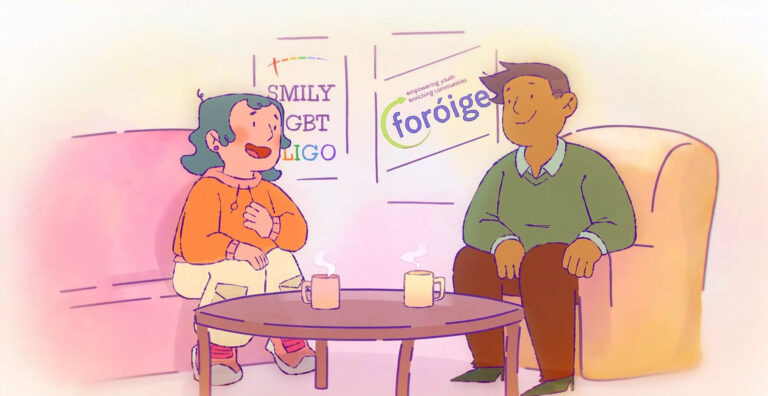
“All youth spaces in Sligo welcome young people from the LGBT+ community. But they were trying to pinpoint where exactly these young people can go to and feel safe,” continued Tara. “Foróige obviously is number one. There is a group next door called Smiley, which is an LGBT group. There’s loads of other places; we felt that all of these groups were very welcoming.
“It’s just that young people don’t know really where they are, or aren’t confident enough to just walk in and approach these places. So we wanted to raise awareness that these places are here, and they do welcome young people from the LGBT community.”
Brainstorming
After some brainstorming, the Comhairle members settled on the idea of an information video in the form of a short cartoon.
“We spoke to different animation studios around Ireland and we ended up picking one close to home; it’s in Boyle, so not far from Sligo,” revealed Tara. She said the Comhairle members enjoyed working with the animators, giving their views online on the content, music and colours, and seeing the animation come to life.
“Once upon a time it was just scribbles and pencil drawings, and then it got colour and then the music was added, so it was nice to see the journey. Then we wanted to add in the signposts for Strandhill and Rosses Point, and the local takeaway. We put a Sligo touch to it.
“In the video we don’t have exactly where Foróige or Smiley is, we just have a very general ‘Youth Services’. And once you walk into the building, all the youth services are welcoming.”
Local agencies such as Sligo County Council, ATU, Foróige, North Connaught Youth Service, and the Sligo-Leitrim Children and Young Peoples Services Committee all supported the project and helped to promote the animation.
There are currently 25 young people involved in Sligo’s Comhairle na nÓg. Their chosen topic for this year is vaping, drugs and alcohol misuse. Not content to sit on their laurels after winning a national award, Tara says the group already “have a few things up their sleeve” for 2024.
Sligo Comhairle na nÓg is one of 31 child and youth councils across the country. Their purpose is to give children and young people the opportunity to be involved in the development of local services and policies.
The purpose of the Dormant Account funding was to help provide services to LGBTI+ organisations nationwide, targeting marginalised people experiencing exclusion on account of their LGBTI+ identities. The Department’s call to action referred to research which shows that LGBTI+ individuals living in small towns and rural areas can be very isolated.
They want a dedicated senior manager appointed with powers to move regeneration forward, and they made this point forcefully today at a press briefing held in the area.
The community leaders are desperate to break the logjam, and they have written to the Irish Human Rights and Equality Commission complaining about repeated and “deliberate” delays by the State and Dublin City Council.
The flats were built in 1957 and are now in very poor condition. When residents move out or pass away the windows and doors are shuttered, which breaks the strong sense of community that has prevailed for decades.
It is a neighbourly and proud working class community that battles against disadvantage, say community leaders. Generations of families live together, providing vital support to each other.
However, community leaders today warned: “Housing conditions in the unregenerated estate include mould, damp, overcrowding and anti-social behaviour. The community is in danger of crumbling under the weight of this neglect. Ill health and mental health challenges are a feature of daily life.”
“Dolphin House and Park sits on 18.5 acres and comprises of 436 homes, made up of 392 flats in six blocks. It was promised a full regeneration over 20 years ago, but only a quarter was completed, leaving the majority in squalid conditions.”
– This was once a football pitch, until half of it was taken for development and the remainder let turn into waste ground
STATEMENT
Fergus Finlay and Una Lowry said: “For more than three years there has been an agreed masterplan to complete the regeneration.”
They added that the plan would provide more than 700 high quality social housing units “in the midst of an overwhelming housing crisis”.
Fergus, the well-known former head of Barnardos, is chair of Dolphin House Regeneration Board. Una, who serves as CEO of Dublin South City Partnership, is chair of Dolphin House Community Development Association.
In the wider area, they and others have identified other regeneration projects “all stuck in similar ways to us” that between them could contribute 2,500 new high quality social housing units.
“We have met the Minister for Housing who has told us that he finds these timelines indefensible. A Cabinet sub-committee meeting on December 16 last issued an instruction that the timelines were to be shortened.
“Every government minister and public representative to whom we have spoken has assured us that money is not the problem. Not a single one of them has said that the lack of progress is appropriate or defensible.
“Yet nothing has happened and conditions in the estate continue to deteriorate. Many longstanding families have given up hope in the regeneration process and are seeking to leave – we are witnessing the breakup of a community.
“On behalf of the community in Dolphin House we are today launching a Human Rights campaign against the broken promises of the State and Dublin City Council in regard to the regeneration of Dolphin.
“As a first step we have written to the Irish Human Rights and Equality Commission, asking them to initiate an enquiry under Section 35 of the Human Rights Act,” they revealed.
The Act provides for such an enquiry in a situation where there is a serious violation of human rights or equality of treatment obligations in respect of any group of citizens, or a systemic failure to comply with human rights.
“We have sought advice to be sure that that situation applies here,” added the community spokespeople.
• Photo courtesy of Dolphin House Community Centre from earlier this year.
“They have played a crucial role in strengthening connections, shared learning and mutual support amongst community and voluntary groups across Donegal,” said CEO Padraic Fingleton.
• Padraic Fingleton, CEO, DRCD. Photo by AM.
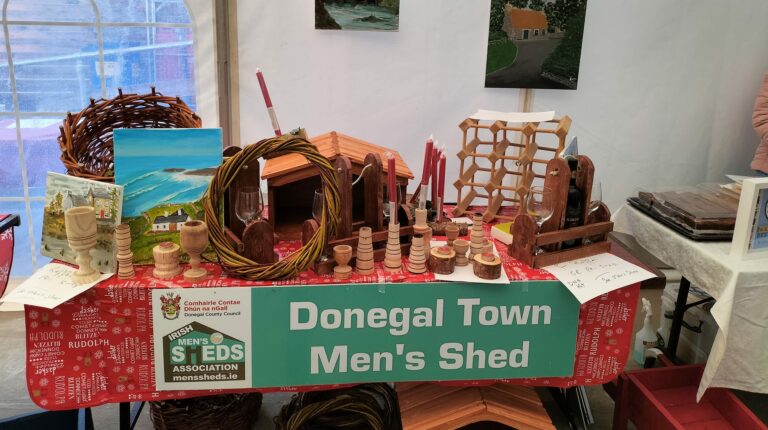
They include the Donegal Food Response Network, the Donegal Network of Men’s Sheds, the Day Care Centres Network and the Social Enterprise Network Donegal (SEND).
The Donegal Food Response Network engages in crucial work, and by working together the network has more power than groups working in silos.
The Men’s Sheds Network holds monthly meetings and events such as welding and horticulture demonstrations, a countywide summer engagement event, and a regional Irish Men Sheds Network gathering,
The Donegal Day Care Centre Network allocates resources in terms of staff and funding to address the needs of volunteer committee members in these centres.
The Social Enterprise Network Donegal (SEND) has a membership of 59 social enterprises and it serves as a platform for knowledge sharing and collaboration.
DLDC is also developing support hubs – physical space with additional supports – for emerging social entrepreneurs as they grow into independent social enterprises.
The Social Enterprise Incubator Hub model offers workshops, one-to-one mentoring, desk space and general office support. DLDC has collaborated with educational partners to deliver the mentoring in marketing, HR and finance.
The aim is to work with anyone with an idea through to operating as a fully-fledged social enterprise. Timeframes will be tailored to the specific social enterprise, typically spanning 12 to 18 months.
The first Social Enterprise Incubator Hub began operating in January and it will be replicated in May and September.
Greenways, Blueways, forest parks and cycling facilities across the country will receive funding as the Government pledges to focus on outdoor adventure tourism as the summer season approaches.
It will also assist with the establishment of new walking trails, as well as access points for kayaking, paddle-boarding, swimming and other water based activities
Minister for Rural and Community Development, Heather Humphreys said: “Our beautiful outdoors have never been more available to us than today. With the summer months upon us, now is the time to enjoy the wonderful amenities right on our doorstep.”
Among the projects being funded today include:
Belmullet Tidal Pool, Co Mayo: €295,974
Boyne Valley to Lakelands Greenway Enhancement, Co Meath: €200,000
Ardmore Beach Walkway, Co Waterford: €500,000
Durrus Coastal Walkway, Co Cork: €200,000
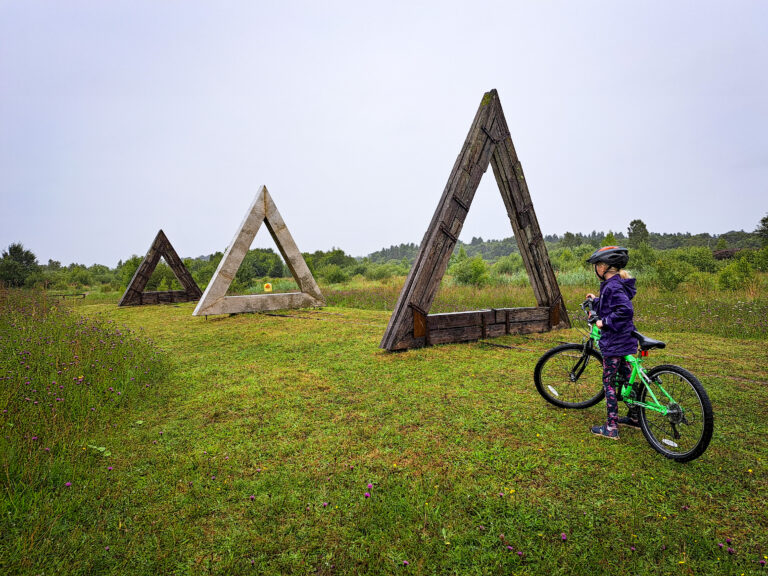
Lough Boora Discovery Park, Co Offaly: €500,000
Cliffs of Moher Coastal Walk, Co Clare: €500,000
Castlecomer Discovery Park Bike Trail – Co. Kilkenny: €500,000
The Ryder Cup Way – Co Limerick: €399,983
“The times of lock downs are thankfully behind us but those times gave us all an appreciation of what our stunning outdoors had to offer us for our mental and physical wellbeing.
“Our world class outdoor amenities continue to make rural Ireland the place to be for adventure tourists as well as those who appreciate a more sedate pace of life. These projects are spread throughout the country, so everyone can avail of the outdoors,” added Minister Humphreys.