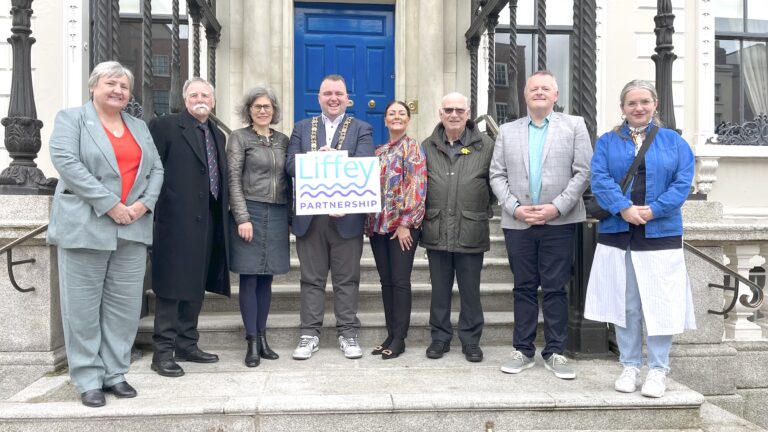
The Liffey Partnership is the new name for Ballyfermot/Chapelizod Partnership which was established in 1996 as a response to long term unemployment and poverty.
On April 29, then Lord Mayor of Dublin, Cllr Daithí de Róiste, formally launched the new name as well as the strategic plan to guide the Partnership’s work until the end of 2028.
Board chairperson Jennifer Courtney gave a remarkable speech at the launch which packed out the Mansion House’s main room.
As someone who grew up in Ballyfermot and who has lived in Cherry Orchard since 2001, she has personally experienced the Partnership’s empowering support.
“My journey to becoming chairperson started with myself availing of a basic office and admin course through the partnership which reignited my desire for learning.”
With a grant and emotional support from key members of the Partnership and the wider community she continued her education.
“One thing I knew deep in my heart was that I wanted to contribute to my daughters dreaming big and believing that they can be anything or do anything they wanted to do. Their socio-economic profile should not define them nor me.
“I began working and volunteering in the local community and now I am CEO of Belvedere Youth Club in the North East Inner City of Dublin, an area quite similar to Ballyfermot and Cherry Orchard,” she said.
When the partnership sought people to step forward for board roles she volunteered.
“I believe passionately in the work of the Partnership and how it keeps individuals and community groups at the heart of everything it does,” she said. Jennifer thanked staff and the families and community groups they work with.
Turning to Deirdre Kelly, Principal Officer of the Department of Rural and Community Development’s Social Inclusion and Communities Unit, she highlighted the Department’s role in supporting the partnership, in particular through the Social Inclusion Community Activation programme (SICAP):
“It is the key element that allows us to exist as an organisation and put our mission and values into programme actions.”
SICAP is the organisation’s “anchor programme” and “facilitates us to leverage about 20 other programmes for the community”.
She also thanked the Department for support through the Empowering Communities Programme and additional supports for the Cherry Orchard area.
“DRCD’s championing of community development values is key to what we do and long may your work continue,” she said.
She also thanked other funding departments and agencies, including the Department of Social Protection, the Department of Children, Equality, Disability, Integration and Youth, the EU, Tusla, the HSE, Dublin City Council, the CDETB, and philanthropic grants.
The Partnership – like the other 48 local development companies around the country – hosts and supports a range of programmes dedicated to employment, education, community, enterprise, parenting, health and wellbeing.
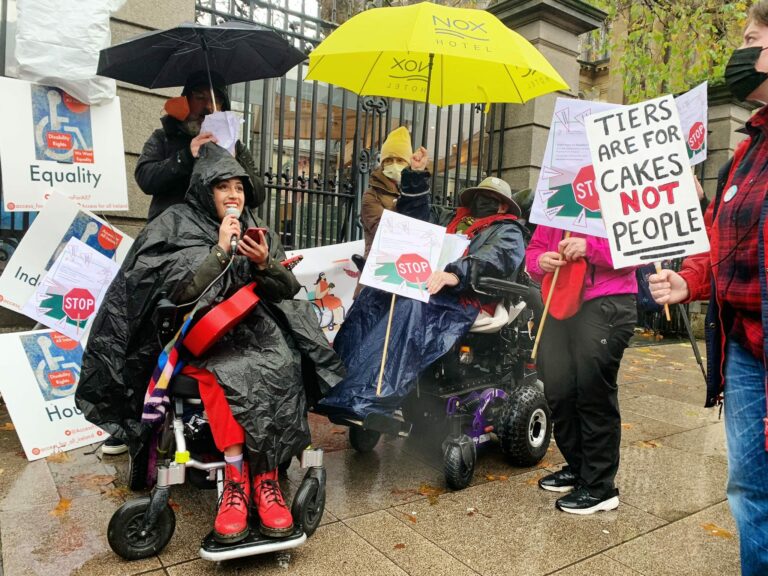
In late 2023, it proposed introducing a three-tiered payments system, which activists described as “discriminatory”.
The Personal Support Payment (PSP) was to have three tiers, or levels:
• Level 1: High support – Very low capacity to work.
• Level 2: Medium support – Low to moderate capacity to work.
• Level 3: Low support – Moderate to high capacity to work.
Persons on Tier 1 were to receive an increased payment, equivalent to the current State pension rate (€277.30 per week). Those on Tier 3 would receive the current Disability Allowance rate (€232.00) while those on Tier 2 were to receive an intermediary rate.
People on Tier 3 were to engage with the PES and take up reasonable offers of places in training and employment programmes, and employment opportunities appropriate to their capacity and circumstances. This proved to be the most controversial aspect of the proposals.
A spokesperson for Independent Living Movement Ireland (ILMI) said the tiered payments proposal “does not take into account how few accessible jobs there are currently for disabled people” and it ignored structural barriers.
The ILMI said that disabled people were “extremely unhappy” with how the Green Paper was developed and were upset that disabled people’s organisations were not consulted.
The Society of St Vincent De Paul said it had “grave concerns around the proposals”.
In withdrawing the Green Paper, Minister for Social Protection Heather Humphries, said, “As a Government, we now need to have a fresh look at how we can best support people with disabilities.”
Cabinet focus on disability
From a disability activist perspective, events have since moved onto a more positive footing. On being appointed Taoiseach, Simon Harris established a cabinet committee on children, education and disability “to break down silos and make change more quickly”. He spoke on his first day in office of “empowering people with disabilities”.
“We are determined to bring new coherence and faster progress on solving the issues that matter most to people with disabilities,” he said.
Among the advocacy groups seeking to be heard is Clare Leader Forum which calls on the Government to repeal the Disability Act introduced two decades ago. It says the Act “caused the waiting list and negated our rights. Repeal the Disability Act and give us our rights.”
Speaking at a TUS-organised seminar in Limerick recently, Dr Mary O’Shaughnessy, head of UCC’s Department of Food Business and Development, outlined why social enterprises are unique.
They emerge to fulfill local needs that are not met otherwise;
They have a strong local focus, often driven by a sense of community and anchored in community relations;
They combine a wide range of resources and networks.
She said rural social enterprises strengthen trust, solidarity and community cohesion: “However, there is sometimes a gap between policy discourse and actual support needed.”
Drawing on research she and colleagues have been involved in, she highlighted the wide-ranging impact of social enterprises. This includes empowering vulnerable social groups, giving them a voice, increasing their independence and promoting capacity building.
Social enterprises help society meet UN Sustainable Development Goals (SDGs) such as poverty reduction and food security (goals one and two).
They also help to achieve:
Sustainable and inclusive economic growth and decent work;
Social, political and economic inclusion of vulnerable groups;
and contribute to the construction of sustainable communities.
These latter three contribute to achieving SDGs 8, 10 and 11 respectively.
On the flip side, Mary said, “If it’s not done well it can erode goodwill and destroy the potential for social impact in a place.” She also pointed out, “Unrealistic expectations sometimes arise where supporters/backers expect the social innovators to solve all problems.”
Mary has co-authored a paper about rural social enterprises across Europe, available to read here.
For more, see https://changingireland.ie/learning-shared-from-erasmus-community-enterprise-project
Learning from across Europe about community enterprises, a subset of social enterprises, has been shared online for interested parties, following the completion of an Erasmus+ sponsored project called ComEnt.
Partners in six countries collaborated over two years to produce reports, case- studies (including 19 videos), learning materials and policy recommendations.
A course was held as part of the project and students who participated between September and December of last year received a Certificate in Community Enterprise (NFQ Level 8). The course aimed at enabling community workers, social innovators and mentors to better support social enterprises.
Five reports were produced, and the Irish report looks at social enterprise in practice, case-studies, and policy recommendations. There are also reports from Austria (in English), Bulgaria, Italy and Romania.
The Technological University of the Shannon (TUS) was the lead partner for the ComEnt project.
In 2019, Meath Partnership identified a “significant gap” in the community-based mental health and wellness services that were available.
The local development company pitched the idea of a ‘Wellness Hub’, to help people struggling with depression and anxiety to engage with their community, and to work on issues such as stress management and self-esteem.
The ‘Meath Wellness Hub – Closing the Loop on Social Inclusion’ project – to give it its full title – was launched after extensive research, including a needs assessment focused on SICAP target groups.
The initiative quickly proved invaluable to the local community, however the funding ceased on December 31, 2023 and was not renewed. It initially received funding through the Dormant Accounts Fund as a three-year pilot project covering 2020 to 2022, and this was extended for an additional year into 2023.
Under the new SICAP programme 2024-2028, Meath Partnership has introduced many of the same services under its Folláine programme, but has had to scale back the service due to lack of funding.
– Monica Nelson, social inclusion programmes manager, Meath Wellness Hub
SICAP and health
Monica Nelson, social inclusion programmes manager with Meath Partnership, told Changing Ireland: “Back in 2019, we saw a lot of the referrals we were getting from SICAP were for employment, education, or social engagement. But when we were meeting with them, we were discovering that mental health was a major issue; it was one of the biggest barriers they had.
“Meath is historically underfunded with SICAP. So we approached the Department to say: ‘This is coming up time and time again and we would love to be able to submit a programme that would support that’. The idea was to help people to make their appointments, sustain education, sustain their engagements in the community. Really it came from just the needs that we are seeing from our clients through SICAP, and unfortunately, mental health still seems to be a huge barrier.”
The current Folláine programme (Irish for wellness) helps prepare people for engaging in employment, education, or volunteering opportunities.
The community workers recognise the barriers relating to mental health that must be overcome before people can engage society, the world of work and education.
“So the first thing that we do is support them with that,” explained Monica.
“For example, the girls (Meath Partnership staff) may go into someone’s house, because they might be so anxious that they’re afraid to leave the house. Bit by bit they’ll get them to come out. It might just be to go for a coffee, or just go a little bit up the road, maybe sit on a park bench, then eventually they engage in one-to-one support, or intergroup work.”
The work involves supporting people to reintegrate into society and into employment or education.
“We do a lot of soft skills development, like personal effectiveness or even personal professional development. And we offer WRAP, the Wellness Recovery Action Plan. We have people trained to deliver that. We ensure the person has their own Wellness Recovery Action Plan, so that when they do get a job or whatever, they have a plan, because quite often when someone has a job, they forget to go for their walk, or forget that talk therapy is what kept them well. Having the plan, they can look back on it and remember how to stay well basically.”
She continued: “We offer WRAP and wellness workshops. That’s probably the biggest thing the Hub did, and Folláine will continue doing. We run a lot of workshops in second level schools, and also to various target groups. We tailor the workshops to whatever we see the need for in the community.”
“So beneficial”
The former Meath Wellness Hub had funding to employ two psychotherapists, enabling it to provide in-house counselling services.
Monica remarked: “The difference that the hub had that we don’t have in Folláine is the hub had two staff psychotherapists, and unfortunately that is not available now.”
Now, anyone in need of counselling must be referred to external services and Folláine is able to offer some financial support for people to get counselling if they need it.
She said that the Meath Wellness Hub received “fantastic feedback”.
“I was very, very disappointed that the pilot project ended and because it was so beneficial, that’s why we brought it in under SICAP. We don’t want to lose it,” she said.
Does she think there should be more wellness hubs around Ireland?
“Definitely. So many people contacted us to ask: ‘How did you come about? How did you get funded?’. The new SICAP programme started in January. So there may actually be other local development companies that have brought in a wellness support programme under SICAP, but there wasn’t any other one that had a specific hub for wellness.”
Hoarding a surprise
Surprisingly, one mental health issue in particular emerged as a major problem in Meath Partnership’s catchment area.
“We do a lot of house clearouts, and we do that under a clinical lead. We get a lot of hoarders; I didn’t know that was such a problem, but it is a huge problem. We get a huge amount of referrals for hoarding. We link in with the HSE team and collaborate with them. We wouldn’t just do a clearout when it is a hoarding issue; there is actually a need for a clinical lead, to say whether it should or should not happen.
“Again that would be funded under SICAP, whether we need a skip or whatever. We do that in collaboration with the HSE, or sometimes even the local authority depending on where the referral comes from,” Monica explained.
Homelessness
Sadly, but perhaps inevitably during a housing crisis, there is a large cohort of people seeking support from Folláine who are homeless, or at risk of losing their home.
Says Monica: “We get a lot of people that are living in danger of homelessness or are already in emergency accommodation. We work with them on their wellness while they’re going through that.
“Another aspect would be delivering wellness support to people living in accommodation centres (direct provision). You really start to see people’s mental health drop after even 90 days there.”
She said the support is very practical, ranging from providing yoga classes to sound baths.
“And we’ve done a lot of forest walks. We engage subcontractors as well to come in and do talks with people.”
All walks of life
Monica says the Folláine clients come from “all walks of life”.
“The target groups would generally fall under the same target groups that SICAP have, but in reality that’s so broad. For example, we had things like menopause support, because we were seeing so many women on a one-to-one basis saying they didn’t have anywhere to go, anyone to talk to about it.
“We don’t deal with major clinical mental health difficulties. It is really about anxiety, depression, and things that social support can help. (We work with) everyone, from migrants, young people in education, long term unemployed, people with disabilities, to older people. We can work with anyone aged 16 up.
“We get people who are working as well, and they are just finding life hard. We’re just giving them that little bit of support to get through the day,” concluded Monica.
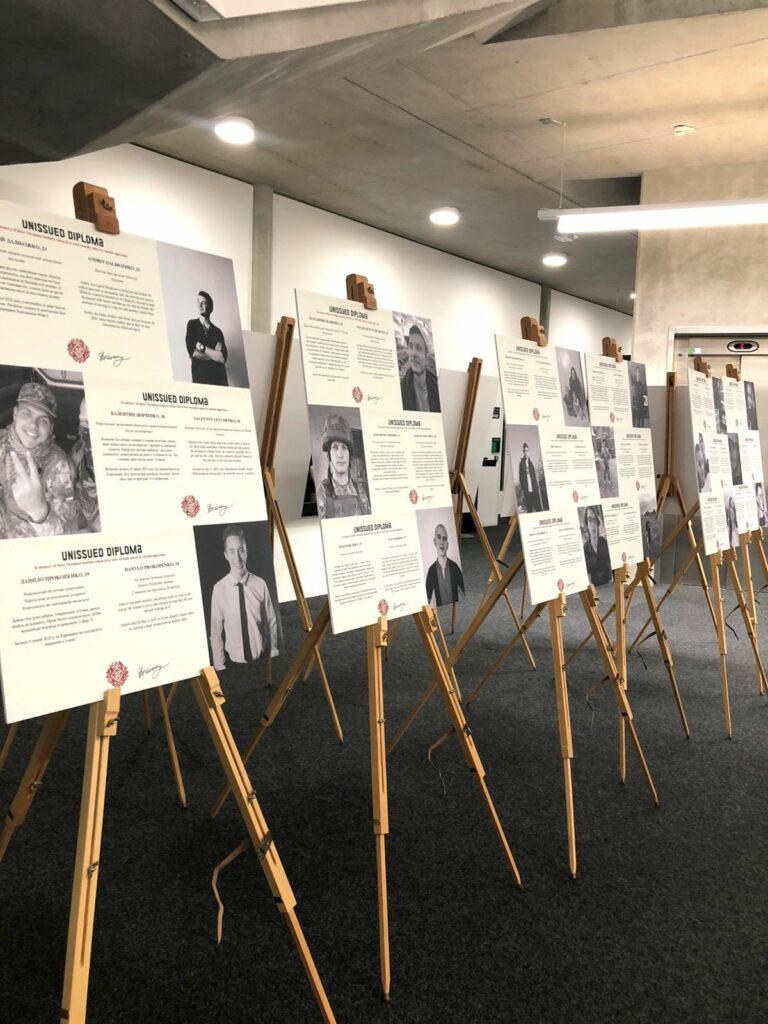
“Unissued Diplomas” honours the memory of Ukrainian students who will never graduate because their lives were taken by the Russian invasion.
“These are heart-breaking photos because these are diplomas that were issued for students who will never receive them,” says Olya Marynetseva, development worker with North East West Kerry Development (NEWKD). The exhibition was held recently in Kerry and Cork.
It shows unissued diplomas including photographs of 40 students who were killed either on the front lines or in their homes.
Last year, the exhibition was held on 110 university campuses in 24 countries.
Olya brought the exhibition to Kerry on behalf of NEWKD and in co-ordination with Michael Hall from Munster Technological University (MTU). It then moved on to Kilkenny.
Elsewhere, Tralee welcomed hundreds of students and accompanying parents from every county in Ireland to sit the Ukrainian version of the Leaving Certificate over the first two weeks in June.
North East West Kerry Development (NEWKD) liaised with the Department of Education in Ukraine to host the country’s National Multisubject Test (NMT) for 436 young Ukrainians living here.
Since the invasion, the Ukrainian Department of Education has facilitated Ukrainians to take the exam in the countries that they fled to and to date this has included Ireland. However, NEWKD development worker Olya Marynetseva realised that no venue had been organised for Ireland this year. She alerted Ukraine’s Department of Education to the issue and this led to Tralee becoming the venue for the tests in Ireland.
NEWKD staff underwent training prescribed by Ukraine’s education department regarding protocols to ensure the integrity of the exam. It was hosted by Munster Technological University on its Tralee campus.
A Co Kerry local development company has launched an online professional recognition guide to help Ukrainian refugees reconnect with their career choices. It will help people from career backgrounds as varied as law to hairdressing.
The online resource consists of advice in PDF and other formats, all accessible on Google Drive.
It gives Ukrainians information regarding how their qualifications are viewed by professional bodies in Ireland and what, if anything, they need to do to have their qualifications recognised in Ireland.
The guide was developed by Ukrainian support workers of North East West Kerry Development (NEWKD) in partnership with Kerry County Community Response Forum.
The guide applies only to those who received temporary protection under the EU Temporary Protection Directive. It has been shared with the Ukraine Civil Society Response Forum Ireland and with the Irish Local Development Network.
The resource has been accessed thousands of times. NEWKD’s folder of resources on Google Drive is available here.
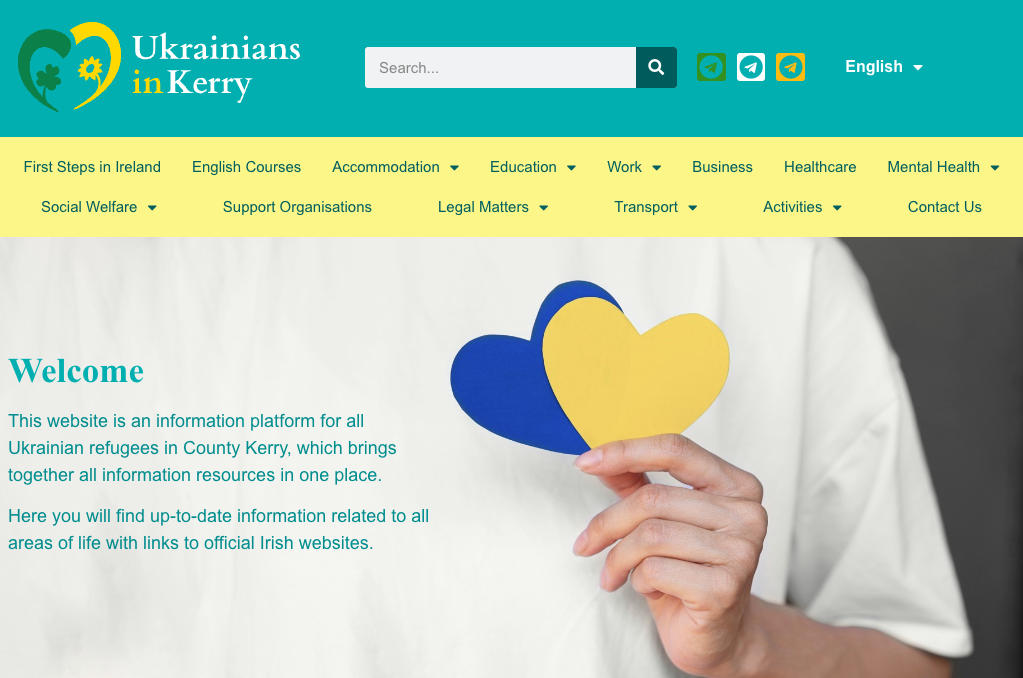
A one-stop-shop website for Ukrainians in Kerry explaining everything you need to know about Ireland has become so popular nationally that development workers are calling for it to be resourced long-term.
Many Ukrainians on first arrival here head to Boots, because they expect they’ll need good footwear for wintertime like at home. They are perplexed to find that Boots here is a pharmacy. They cannot rely on Google Translate.
Similarly, Ukrainians who want to buy an electronic device are puzzled when Google directs them towards Curry’s which they know as an Indian dish.
Rules around public services, from employment schemes to information on education, can also be confusing for people.
The website www.ukrainiansinkerry.ie links directly to government, public service and commercial websites of use to newcomers.
As well as helping Ukrainians, the site also reduced repeat queries to staff and released them to do more development work.
While the development worker who led this project is securely employed through the Social Inclusion and Community Activation Programme, funding for two team-mates has run out.
Olya Marynetseva from North East West Kerry Development says the website could be easily replicated in other counties. For more information, or to offer collaborative support, call Olya at 066 7180190, or email OlyaMaryntseva@newkd.ie.
Not all resources for Ukrainians in Co Kerry are online – Tralee Library now has a special bookshelf with links to libraries around the world.
The Ukrainian bookshelf is part of a global project by Ukraine’s First Lady, Olena Zelenska, which has seen 44,000 books displayed on 170 shelves in 37 countries and counting.
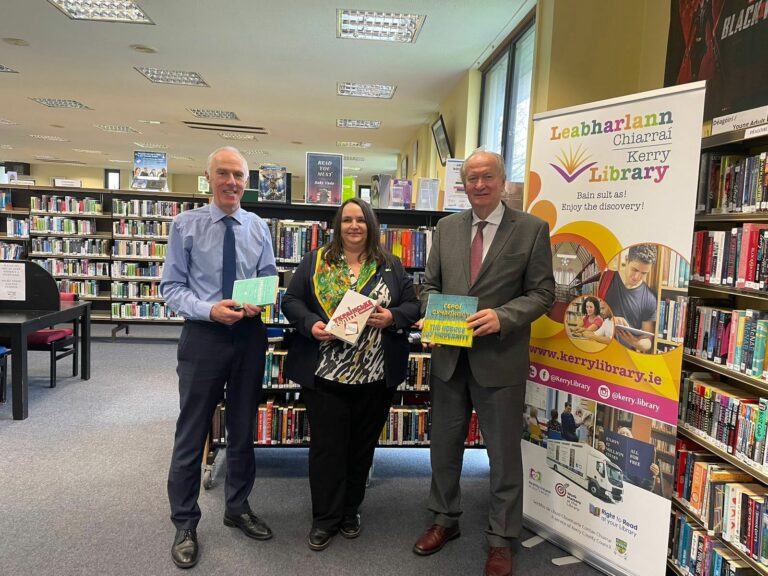
The Ukrainian Bookshelf in Kerry was officially launched by the Ambassador of Ukraine to Ireland, Larysa Gerasko, and the then Mayor of Kerry County Council Jim Finucane.
The idea is spreading within Ireland, with Ukrainian bookshelves in libraries in Dublin, Limerick and elsewhere.
Despite commitments to equality and human rights in the declaration of independence in 1916 and the constitution in 1937, many groups, including women, people with disabilities, people from the LGBTQ+ community, and the working class, found themselves excluded and treated as second class citizens.
Past discrimination
Examples of discrimination include the ways women and children were treated in Magdalene Laundries and Mother and Baby Homes – the last of which closed in 1996.
The degree of gender in equality was staggering, it was not a criminal act for women to be raped in marriage until 1990 and until 1976 the family home could be sold without the consent of the wife.
The act of homosexuality was illegal until 1993 and the LGBTQ+ community had to hide their real selves for fear of attacks or discrimination.
My father’s education only went as far as primary school as secondary education was fee paying and like many of his generation his family could not afford to send him. By the end of the 1960s only 36% were still at school at 16.
Contraception was illegal until 1979 and even after that contraceptives were only provided through pharmacies and you had to have a prescription. The Irish Family Planning Association was prosecuted for selling condoms through a record store in 1990, during an AIDS epidemic.
Progress
It is a great credit to Irish people and civil society in particular that, coming from a low base, Ireland has made great progress in the areas of equality and human rights over the last 30 years in particular.
There are many examples from employment law to equal status equality legislation, from same sex marriage to the repeal of the 8th amendment, the gender recognition act, policies to increase the participation of women in politics, the economy, society and sports.
The launch of free secondary education in 1967 removed barriers to education for thousands and greatly increased social mobility. Today, Ireland now has one of the highest secondary school completion rates in the world.
Economic rights gained in the forms of the minimum wage, pensions and sickness benefits are examples of progress, but as in all areas of equality and human rights there is still a lot of work to be done.
Current challenges
They say that every era has its massive blind spots; we may not see them, but our children will.
With that in mind, we should be alert to the fact that that at any particular time there are groups who are being discriminated against and not being full included due to prejudice at a societal or institutional levels.
These groups currently include families and children living in poverty, people seeking asylum, Travellers, people with disabilities and LGBTQ+.
A recent report shows that hate crime reported to the Gardaí increased by 12% between 2022 and 2023 with the most commonly reported motives being anti-race, anti-nationality and anti-sexual orientation.
The reality is that the equality and human rights concepts and legislation are, like democracy itself, relatively new. While many of us have benefited from progress to date we cannot take this for granted. At international level there has been a kickback against progress made by minority groups and we can see this in Poland, Germany, Spain, India, and the US.
While Ireland doesn’t have a strong history of right wingers in mainstream politics the degree to which a society succumbs to prejudice depends on many factors. One of these is current events.
Parties with anti-equality views, some with links to far rights groups outside of Ireland, contested the recent local and European elections. They are influenced by current affairs – increased migration, lack of key services, the high cost of living and the influence by international right wing groups.
So, Ireland has a challenge if its wants a society where the value and dignity of all individuals is respected and everyone has a real opportunity to thrive.
LDCs have a particular responsibility for equality and human rights. This is because of the types of programmes they deliver and because the core focus for LDCs is social inclusion and community development. Equality and human rights are foundational to both.
Take the Social Inclusion and Community Activation Programme (SICAP). Its guidelines state that: “The Public Sector Equality and Human Rights Duty is a statutory obligation for public bodies which requires them to promote equality and prevent discrimination.”
Public Sector Duty
The Public Sector Duty requires public bodies, including publicly-funded bodies, to work to:
Eliminate discrimination
Promote equality of opportunity
Protect human rights
For community workers this may sound like preaching to the converted, but the degree to which equality and human rights permeates the sector, I would suggest, varies considerably due to a variety of factors.
Variations in the implementation of the duty are perhaps even more pronounced in the public service and the Irish Human Rights and Equality Commission does not have the resources to monitor the implementation of the duty.
Opportunity
There are very few groups and arguably none at local level who have both the responsibility and the capacity to focus on equality and human rights. It can be challenging and is not always popular with all sections of our communities, but then pleasing everyone is not our key objective.
Change and culture
To better practice what we preach, what might change look like?
We need to have a clear plan and a culture from the top down that supports equality and human rights. It needs to be led by actions and requires a clear commitment and setting of standards.
Developing a Strategy
Equality policies and value statements are, as Americans say, a bit like motherhood and apple pie – most people do not disagree with them and will nod enthusiastically which is because they are banal, unchallenging. Such policies and value statements are of limited value unless they are underpinned by a plan with actions and expected outcomes. What gets measured gets done.
The overall ambition should be that an organisation delivers its work with an equality lens, that it looks at barriers and ensures that it has a strategy on equality and human rights. It cannot just strive to prevent discrimination; it should also seek to eliminate barriers.
Specifically, this could involve looking at areas such as:
Staffing
How diverse is the staff? (e.g. How can we encourage minorities?)
How can you ensure non-biased recruitment?
Do staff face barriers or inequalities based on their characteristics?
Corporate
How diverse are boards and how representative are they of the social inclusion target groups?
How inclusive is the organisation’s messaging and image?
Barriers
What barriers do service-users face when accessing services and how can these be reduced?
Walking the talk!
In North East West Kerry Development, we are completing an Equality and Human Rights strategy. The purpose is to apply an equality and human rights lens to our work and use it as a foundation for all our work. We’re going to try and walk the talk!
“I really can’t say enough about how much I enjoyed and learned from this experience of supervising Andrew’s work and from engaging with him from the time of his doctoral research,” she said.
“Andrew proposes a new approach to assess how the European Convention on Human Rights and Council of Europe as a whole can better serve the millions of people now located in so-called gray zones where significant protection gaps arise and there is limited access to justice,” she said.
Prof Mullally said his book was now “critically important” and she was not surprised when Cambridge University press “literally snapped it up”.
“When he submitted his doctoral thesis in November 2020 we couldn’t have imagined how urgent and timely the issues addressed would become – for the Council of Europe, for our system of multi-lateralism, for peace, democracy and human rights protection,” she said.
Less than 18 months after he submitted his thesis and began work on his book, Russia attempted to invade all of Ukraine and was subsequently ejected as a Council of Europe member.
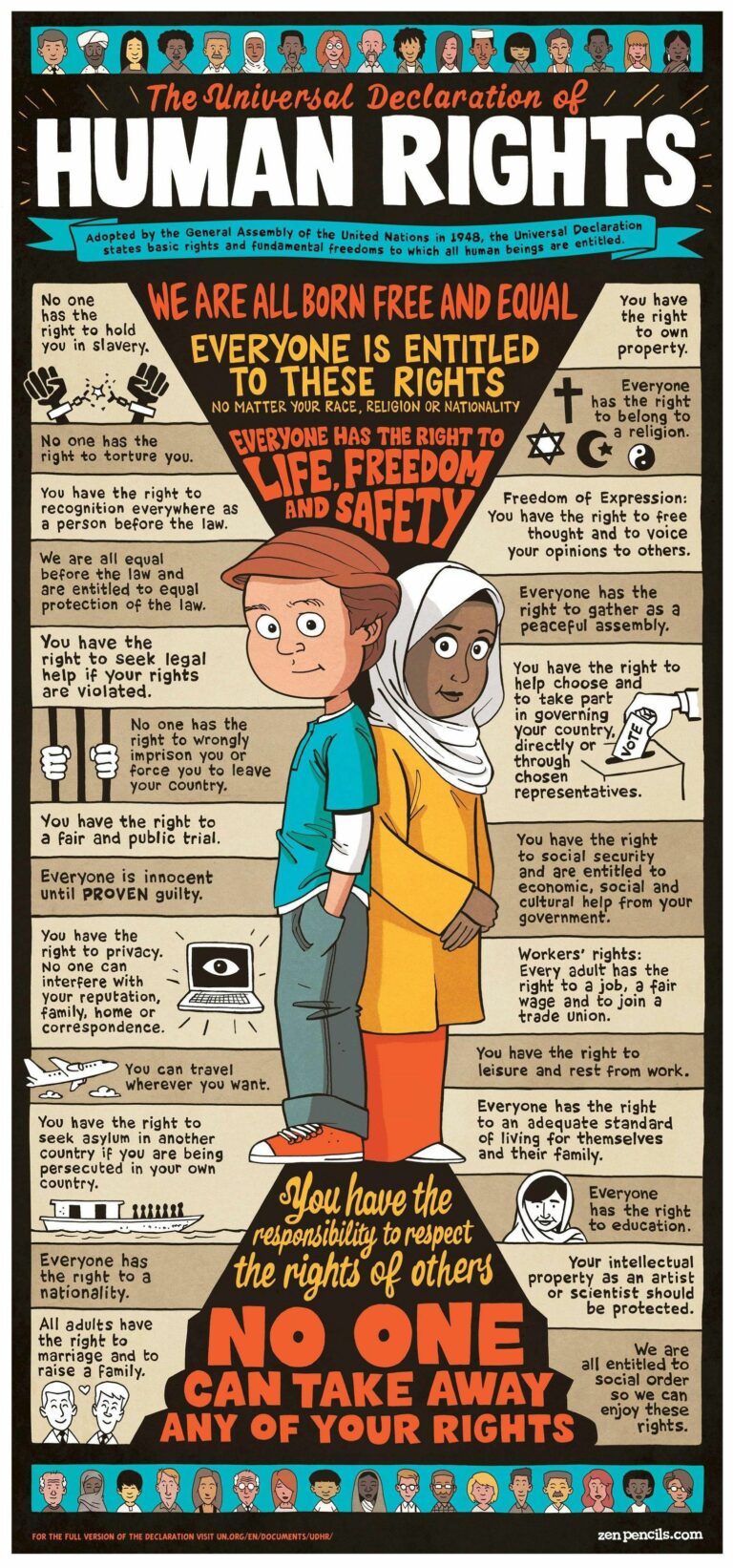
She noted that 2024 marks the 75th anniversary of the Council of Europe “and we have just marked 75 years of the universal Declaration of Human Rights at a time when the declarations of human rights as common standards of achievement of all peoples and all nations seem particularly hollow.”
She said now the potential of international law “to curtail the worst excesses of arbitrary force or to re-enforce even the core principle of humanity as a foundational principle of international humanitarian law and international human rights seems elusive.”
Andrew’s book – focused as it is on the Council of Europe and of the European Convention on Human Rights system and grey zones where human rights abuses happen often without detection, monitoring or a response – is well-timed.
She said the book is “informed by Andrew’s extensive professional and political experience at the heart of the Council of Europe and his earlier professional experience in post-conflict Kosovo (where he) experienced first-hand the complexities of transition to a just peace and democracy.”
“This professional experience, this practice experience, this experience at the heart of a politics of transition to peace and democracy shapes the analysis and the breath of this text,” she said.
“He presents an in-depth case study drawing on interviews with key stakeholders seeking to understand what we can learn from the Kosovo experience where Andrew spent many years.”
She said he presents potential lessons that can inform engagement with human rights gray zones “to ensure that they do not become for those within them black holes of human rights protection, holes of oblivion.”
While the book is an academic publication and won’t hit the Eason’s best-sellers list anytime soon, if you were to abbreviate Professor Mullally’s tribute you could say this book will ultimately save lives.
You can listen to Professor Mullally’s full speech on Changing Ireland’s YouTube channel here. Or watch our 25-minute recording of Andrew Forde’s launch speech on Changing Ireland’s YouTube channel where he summarises much of the work – for free – here.
For more on the book and its launch, see https://changingireland.ie/forde-calls-on-council-of-europe-to-respond-to-grey-zones.
Andrew Forde’s new book highlights how 10 million people in Europe live in “human rights grey zones” and it argues that their rights matter just as much as others across the continent.
He identifies at least nine such grey zones in Europe, including Transnistria, Nagorno-Karabakh, Northern Cyprus, Abkhazia, South Ossetia, Crimea and Kosovo. They are characterised by the common lack of full and unhindered access to Council of Europe (CoE) human rights monitoring and protection.
Andrew’s book – launched on May 20, in Dublin – puts it up to the CoE, where he worked for years in various roles, to do much more to protect human rights in grey zones, all the more important in a Europe where no country can be assured of peace.
We may be living in a post-peace era, but European institutions, particularly the CoE, must not let transgressors off just because human rights protection in disputed territories is seen as “too complex or politically sensitive to engage with”.
Andrew said his critics spurred him on. Believing that you cannot just dismiss the human rights of people living in fragile territories, the author corralled his research, thinking and career work for over a decade into this publication: ‘European Human Rights Grey Zones: The Council of Europe and Areas of Conflict’.
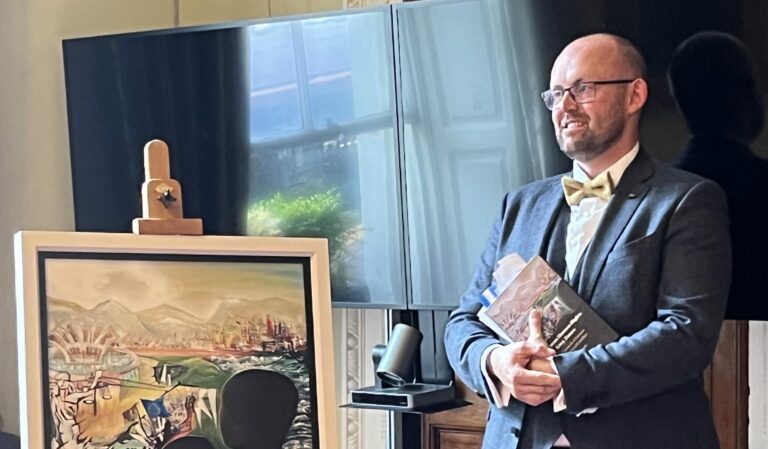
At the book launch, held in the Royal Irish Academy on Dawson Street, he admitted to the audience that his book was 13 years in the making.
“When I set out writing about this topic, it was described to me as being ‘niche’, ‘obscure’ and ‘peripheral’. Senior diplomats advised me to just accept these situations for what they are because they represent ‘an almost impossible problem’. I was even encouraged not to wake the bear for fear of offending someone. I found these reactions to be as offensive as they were short-sighted,” he said.
Cambridge University was eager to publish his work when the topic – once considered niche – became especially relevant after Russia attempted to invade all of Ukraine. His work is published in a personal capacity. At the launch, he expressed heartfelt gratitude to family, friends and colleagues, many of whom were present.
Relieved as he is to have his work published, Andrew has another book on the way, focused on Russia, the Council of Europe and the European Convention on Human Rights.
He is also changing career direction. After almost six years working as a Principal Officer in the Department of Rural and Community Development, where he led the rural regeneration unit and before that the social enterprise portfolio, Andrew is leaving the civil service to take up a new position lecturing in law and human rights at Dublin City University.
Note: ‘European Human Rights Grey Zones’ is pricey (approx. €110) as it is an academic publication.
You can watch our 25-minute recording of Andrew Forde’s launch speech on Changing Ireland’s YouTube channel where he summarises much of the work – for free here. Or see here for Professor Siobhán Mullally’s speech at Andrew Forde’s book launch. Read our article here for a summary of Prof Mullally’s speech.
“The Co-op has worked with migrants and new communities long before we had the current crisis, but we’ve had to create an emergency response programme – we call it our Refugee Support Project – over the last few years,” said Noel Wardick, Dublin City Community Co-op CEO.
While many migrants are professionals and are more than capable, he said others need the assistance of community workers employed by the Co-op through the Government’s Social Inclusion and Community Activation Programme (SICAP).
“We also have a project – funded through DCEDIY – to target vulnerable migrants who have fallen between the cracks. We called it Strength in Diversity because it goes to our deep belief and philosophy that the influx of migrants and new communities has enhanced every aspect of life in the inner city. It has brought colour, energy, dynamism and life back into parts of the city such as Parnell Street that were previously struggling and derelict.
“Very close to 50% of the inner city now declares itself as not born in Ireland. We’re like New York now. The multi-cultural aspect is the area’s defining characteristic.
“Go into any of the schools in the inner city. There’s not that many schools around the country that are 40% from one ethnic community that’s not white Irish,” he said.
Dublin’s inner city was one of the first places in the country to have a hotel contracted in early 2022 to accommodate Ukrainian refugees.
“I couldn’t believe it until I went down to see for myself and saw hundreds of Ukrainians queuing up outside. Then I knew that, wow, we have a situation on our hands.
“It went from that to having 23 centres in our SICAP catchment area housing Ukrainian refugees and IPAs. So when we hear of counties complaining when two centres open…well, we’re dealing with 23.
“We’ve been engaging with multi-culturalism for a very long time and we simply went into the centres and asked how can we help,” said Noel.
See here for more on Dublin City Community Co-op’s work with International Protection Applicants.
It grew in a matter of weeks, bringing international media to the capital to witness Ireland’s first refugee camp. The government wouldn’t call it that and they cleared the tents two days after the tv crews visited. In the meantime, Noel Wardick, CEO of Dublin City Community Co-op found himself catapulted into the media spotlight as he spoke up for the asylum-seekers and was interviewed by RTÉ, the BBC, Newstalk and the Irish Times.
All community workers prefer when vulnerable people can speak up for themselves, but the men living on the pavement were voiceless.
Making a difference
Speaking to Changing Ireland, Noel said: “It’s important to speak up. The advocacy work that staff and volunteers in the Co-op do is absolutely important. The refugees struggle in terms of advocacy. Language is an issue. We understand the levers to pull; they don’t. And they’re often very afraid to speak up, given where they are coming from.”
He believes community workers have everything it takes to make a huge difference.
“Show compassion and don’t be fearful about being a voice for those communities that might not have a voice and gradually help them have their own voice when the time arises,” he said.
“I can guarantee any community worker, once they bring their skills, principles and core values and human compassion to their work with migrants and refugees, you will be successful.
The work reminded him of his years with development agencies in far-flung refugee camps in Ethiopia, Uganda and Darfur. He says development workers here who have never travelled abroad already know enough to provide support: “Abject poverty is the same the world over.”
“You can be a great community worker with migrants. I worked overseas and in many ways it’s the same skillset me and my colleagues bring to our work in Dublin city.
“As you you learn to interact with people with different languages and cultures, you will make a huge contribution to those migrants’ lives. That is because whether people are from Darndale, or a rural farm, or Somalia, human beings know when another human being is showing them compassion.”
Sanitation
His experience did however help him highlight one aspect the Government may have underestimated – the critical importance in refugee camps, regardless of size, of water and sanitation. Even in a famine situation the provision of hygiene is more important than the provision of food.
“The top priority” in refugee camps overseas that host tens of thousands of people is “always sanitation and water”, said Noel. “People will die far more quickly from disease than from lack of food.”
That explains why the Co-op was pressurising the Irish government to fund the provision of toilets in Mount Street and why it remains a concern as new asylum seekers arrive into Dublin.
These people – as required by law – need basic facilities while their asylum claims are processed.
Tents on hill
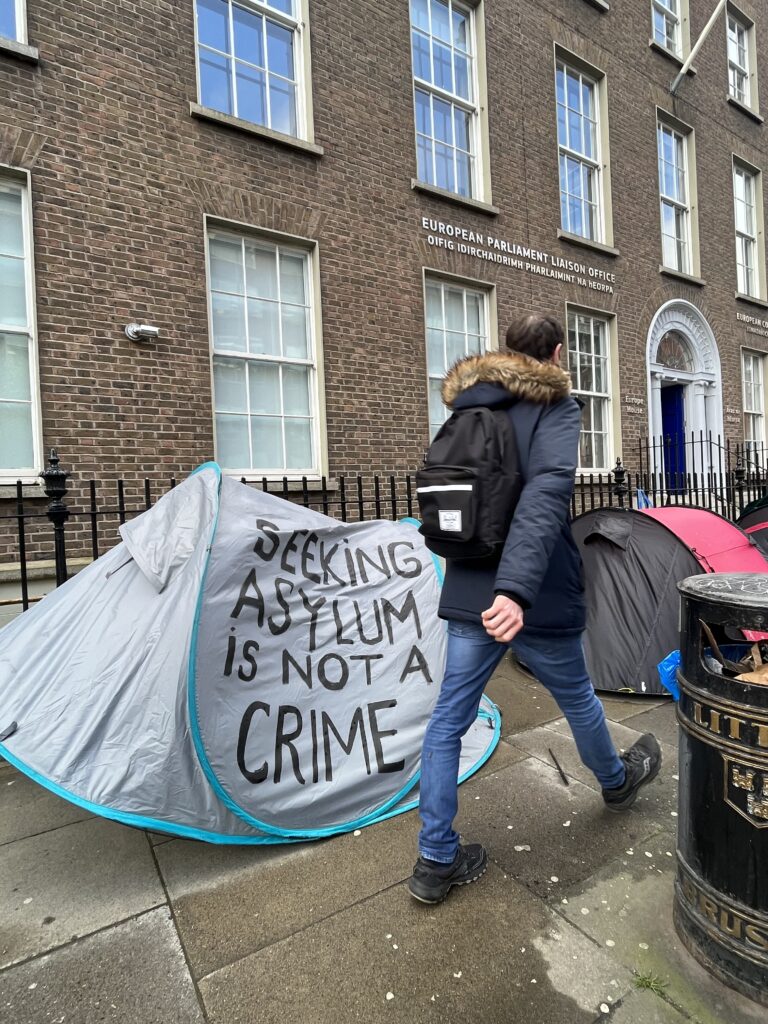
Changing Ireland toured the area on Monday, April 29, just as it was making international headlines. We called into the European Parliament’s Dublin office and spoke to staff there about the tents outside their door. Jack Moloney said they would not be issuing a comment and that he would prefer us to email him.
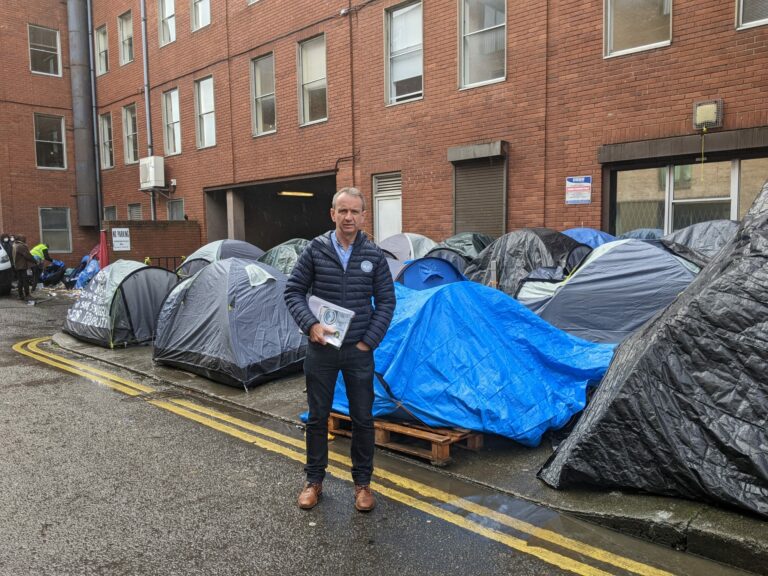
Outside, the tents stretched down Mount Street and around a block where the smell of urine under an archway was strong. Some tents were pitched on a hill to be close to the International Protection Office. How do you sleep at a 30 degree angle, I wondered.
We met a man with very little English getting a haircut on the street from an Irish volunteer. We met three men from Pakistan, none of whom spoke English. An English-speaking friend of theirs who had been in a tent on Dublin’s streets and has since been accommodated grew nervous when asked where his new accommodation was. He has been here six months. The men pressed their hands to their hearts in a sign of friendship, but communication beyond symbols was impossible.
Meanwhile, a camera crew from Britain strolled around in search of people with English accents who moved here fearful of being deported to Rwanda.
On Wednesday the authorities cleared the tented village, yet even after the tents were removed, new asylum seekers arrived with nowhere to stay but on the streets.
• Tents in April beneath an archway facing the International Protection Office. The archway served as an unofficial toilet.
Our duty
Local development companies are tasked with addressing and alleviating exclusion and poverty.
The plight of asylum-seekers “is recognised by one arm of Government, yet ignored by another”, continued Noel.
The Department of Rural and Community Development names “refugees” and “International Protection Applicants” as two of its 12 target groups under the Social Inclusion and Community Activation Programme (SICAP).
He said community workers maintain “cordial and professional” relations with government, “but it doesn’t stop us from putting pressure on the State to meet its obligations. When we complain, we are only doing our job.
“We’re not saying everyone has to stay, but we are saying they have to be treated humanely while they’re here,” said Noel.
Tackle poverty and exclusion
Noel asked: “Is there an ulterior motive to leaving people on the streets as a disincentive? It’s a view in our sector that the migration policy is as much about disincentives. It’s now a race to the bottom. No doubt some sections of the State aren’t disinclined to allow difficult situations to develop.”
“We’re busy enough trying to tackle existing poverty and when the State dumps poverty and exclusion on our doorstep, that’s problematic.”
He said it feels like he and colleagues are working for the fire brigade and “while one arm of the State is giving us water, the other is fuelling the fire.”
“The question is – and this requires a whole of government approach – How do we accommodate the flow of people into the country while we process their applications?
He believes that some working class communities have been expected to shoulder “absolutely disproportionate” responsibilities.
“And the State has been a terrible failure in relation to communications relating to the migrant situation. It has allowed rumour and counter-rumour and has not been pro-active. The Government is driven by populist views,” he said.
Some are nervous about criticising the State. “There is a chill factor for groups funded by the State. But sometimes, it helps officials for us to speak out…. This runs counter to the idea of not speaking out because of a fear that you’ll have your funding cut,” he said.
In Noel’s opinion, irregular migration and the arrival of refugees into Ireland is now a permanent feature of our society.
“My view is that migration is the same as climate change – it’s with us now, forever. This is a permanent feature of our landscape, so the question is how do we manage it.”
In the meantime, society has become more racist. “With human nature, it’s easier to turn on, or pick on, a person than a policy. It’s harder to get worked up about policy. People say, ‘It’s the effin’ Somalis coming in, it’s their fault’. So, they protest about Somalis coming in, but they wouldn’t have protested in the last couple of years about the lack of creche places or GPs. The lack of services provides people with a rod to beat the government. It’s absolute manna from heaven for the far right. If it wasn’t for the appalling housing crisis the far right would be out on the fringe,” said Noel.
While some politicians take advantage and promote disinformation, Noel pointed out that community workers are there to communicate, advocate and highlight the fact that asylum-seekers are human beings deserving of compassion. They are also there to remind the State that it is required by law to show humanity.
See here for more on Dublin City Community Co-op’s work with new communities in inner city Dublin.
Established in 2021, the Youghal Blue and Green Community Network (YBGCN) has approximately 50 member groups including local schools, GAA clubs, active retirement and Tidy Towns groups. They meet monthly through a mixture of online and in-person meetings, as well as ‘walk and talks’ in the local area.
The idea for the network grew from discussions between Youghal’s long-established community group Cumann na Daoine and the Department of Rural and Community Development on how to incorporate climate action into their work.
The resulting community-driven initiative works to promote sustainability and protect Youghal’s natural and cultural heritage.
TOGETHER
Maria Power, the Youghal network’s manager, told Changing Ireland: “We thought the whole notion of climate change is so big, how could we tackle it? So the idea was to work with others and take on actions together.
“It’s very much about climate action focused on three pillars: coast, environment, and energy. We look at everything from coastal erosion to sand dunes, to flooding and rising sea levels. So we have a blue agenda, as well as a green one. Then the approach is to engage the community in that change.”
REPRESENTATION
Gráinne Furey, community climate action worker with the network added: “The plan is that eventually the whole community will be represented. It’s doable. We have two and a half staff, and we have some resources, department funders, as well as backing from the Tomar Trust. They’re a philanthropic trust. So we’re lucky we have some core resources and core staff to do the work.”
The work also demands patience and perseverance. Even if the network wants to plant a tree it can be complicated – if it’s not on private ground, it means engaging with the local authority.
“Projects can take a year or two of research, applying for funding, getting the funding, and then permissions,” said Gráinne.
– Maria Power., manager of YBGCN. Photo: Taste Waterford on FB
WALKSHOPS AND RISING SEA LEVELS
One of the network’s current projects, ‘Pathways to Community Climate Resilience’ uses a creative approach to get the community talking about climate change and flooding.
The project received funding last year through Creative Ireland and has engaged three artists to focus on flooding, rising sea levels, and how that affects the community and biodiversity.
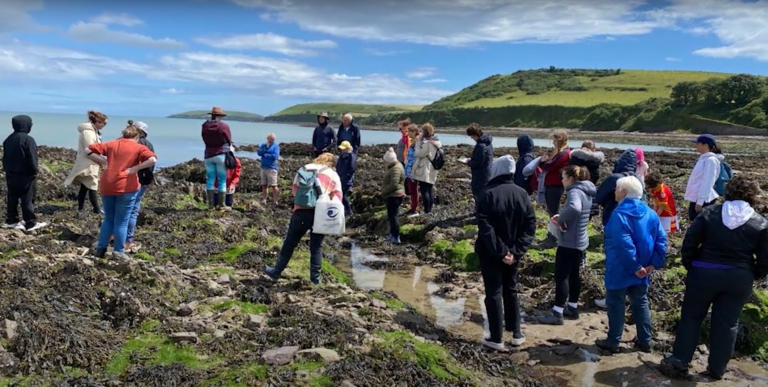
“Along the way, we’re meeting different community groups with what we call ‘walkshops’ and workshops. At the end of this project, we hope to have a sound and visual exhibition,” said Gráinne.
“We find that art projects and creative projects are a great way to get people on board and involved in a fun way, because climate change is a serious topic and people can be very easily turned off. Some people feel there’s a lot more pressing issues in their personal lives.”
The network focuses on “projects we can deliver on”.
– YBGCN on Youtube showing Youghal fisheries
FLOODING – NOT ALL CAN RELOCATE
When it comes to flooding and rising sea levels, that is already an issue in Youghal, said Gráinne. It is now “constant”.
“It’s not as bad as what we’ve seen in Midleton last October, but there are people here who have had to relocate. Youghal is flanked by two estuaries, and we have the coast and this hill behind us. So it’s about being prepared for it. Some people cannot afford to relocate, so they have to be prepared and find ways to reduce the impact when flooding does happen.
“It is going to become more regular. That’s a message we have to get out without scaring people as well. That’s what our Creative Ireland project is looking at. And looking at a community resilience plan eventually.”
ENERGY TRANSITION
Mark Falvey, also a community climate action worker with the network, is primarily focused on working on the topic of energy transition in Youghal.
Youghal Blue and Green Community Network runs an energy hub every Thursday in the community cafe in Cumann na Daoine to help raise awareness of the grants available and the savings that can be made through energy upgrades.
“We run a drop in clinic helping people with grants or giving them information on solar power or EVs. I think the thing with the energy transition is, it’s expensive, and trying to engage people in that is quite difficult,” says Mark.
“When you’re trying to get people to retrofit their houses or get solar panels, their main issues, and I suppose, especially in the demographics of Youghal, there is quite an older population, and it is a bit of a socially disadvantaged area. So there’s not always the will or resources there to install solar panels, or get retrofits.
“So we’re really trying to encourage that energy transition, while also being aware of the fact that if someone’s cold at home, or if they’re facing fuel poverty, you can’t tell them not to burn something in the fire to stay warm.”
Some of the network’s other projects include a community garden, a community radio show, Climate Action Week events, biodiversity events, green transport initiatives, and much more.
– Mark Falvey, YBGCN community worker; Siobhan Long, Youghal Family Resource community worker; Maria Power, YBGCN manager; Cllr Mary Linehan-Foley; and Gráinne Furey, YBGCN community worker
JARGON
Gráinne added: “There’s a lot of jargon and buzzwords involved with all of this. So it’s breaking down that language as well. There are lots of challenges, but fun along the way. As long as we’re listening to people as best we can, we’ll be more successful.
“We have a very diverse community here, even within our network, of people that have just moved here in the last few years. Sometimes until they arrive here and buy a house, they don’t realise the challenges involved in Youghal. A lot of the new members are really great to get on board and they’re bringing a lot of knowledge from other countries and how they do things as well.”
According to Gráinne, feedback from the community has so far been “pretty positive”. “A lot of these projects – all of these projects really – came from our initial first year of talking to the different groups and seeing what they need and what they want.”
CHALLENGES
Like most organisations in the community and voluntary sector, the network’s main challenges are funding, and recruiting volunteers.
“We are a pilot, Maria had to fight hard for funding,” revealed Gráinne. “The Department refused it several times and it wasn’t until Tomar – they were looking for a community project that was focused on the environment – they committed to 40 per cent funding for three years. With that Maria went back to the Department and asked could they match it, and eventually they could. But that was a piece of work.”
She continued: “I was fully available as a volunteer during lockdown, but I said to Maria: ‘We need paid workers, because we’ll all be back at work, and who’s going to get these projects over the line?’. And that’s all over Ireland, in every voluntary organisation. Volunteers are scarce on the ground now for a myriad of reasons, and one of those I think is that people are so busy. Which is why it’s really important that core funding is looked at by the Government, (to prevent) this scrambling for funds all the time.”
Should the model created by the Youghal Blue and Green Community Network be replicated around the country?
“Absolutely,” replies Gráinne. “I’m very passionate about it, as is Mark, because I know that so many people really want to get on board with climate action, but it’s so huge, they don’t know where to start, and a lot of it with those buzzwords can seem like a very uncomfortable space to be in. So we’re just trying to show people that there are simple steps and easier ways. Our motto is ‘Together We Are Stronger’.”
For more, see here for our story on the launch of the Youghal Blue and Green Community Network in 2023.
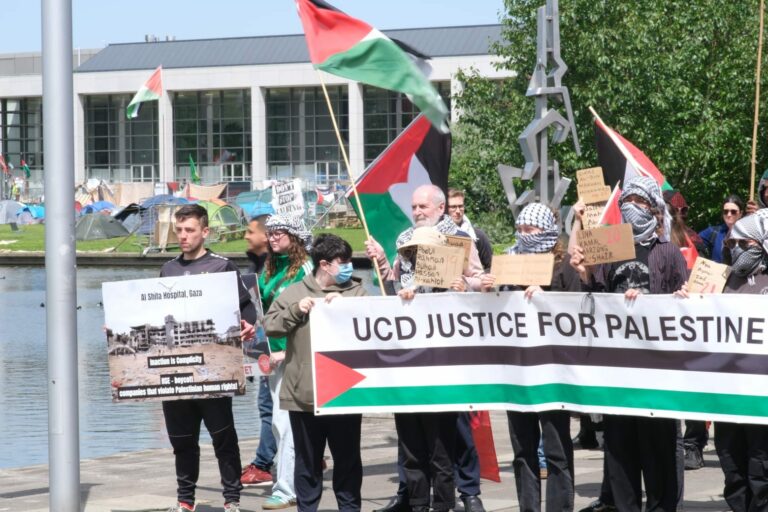
At TCD, a five-day encampment by student campaigners ended on May 8 after the students secured agreement from the university management to desist from investing in Israeli projects.
A statement by the university said: “We fully understand the driving force behind the encampment on our campus and we are in solidarity with the students.”
TCD agreed to a number of requests by the protestors, including a divestment from “investments in Israeli companies that have activities in the Occupied Palestinian Territory and appear on the UN Blacklist in this regard”. It also pledged to “endeavour to divest from investments in other Israeli companies”. The statement also said TCD would give fully funded places to six postgraduate and two undergraduate scholars from Gaza.
The encampment at UCD ended on June 8 following successful talks between university management and protestors.
“We are outraged by the ongoing mass killing of civilians, the withholding of humanitarian aid, and the destruction in Palestine by Israel. As a member of the global university community with an enduring commitment to academic freedom, expression and safety, UCD is particularly appalled by the destruction of all universities in Gaza and attacks on their students, faculty and staff,” said a statement from the university.
UCD pledged to introduce a number of the requested measures, including the establishment of up to eight sanctuary scholarships for displaced Palestinian applicants.
It will also create a working group, including nominees of the UCD Students’ Union, “to develop a policy on ethical investment by June 2025 for approval by Governing Authority”.