

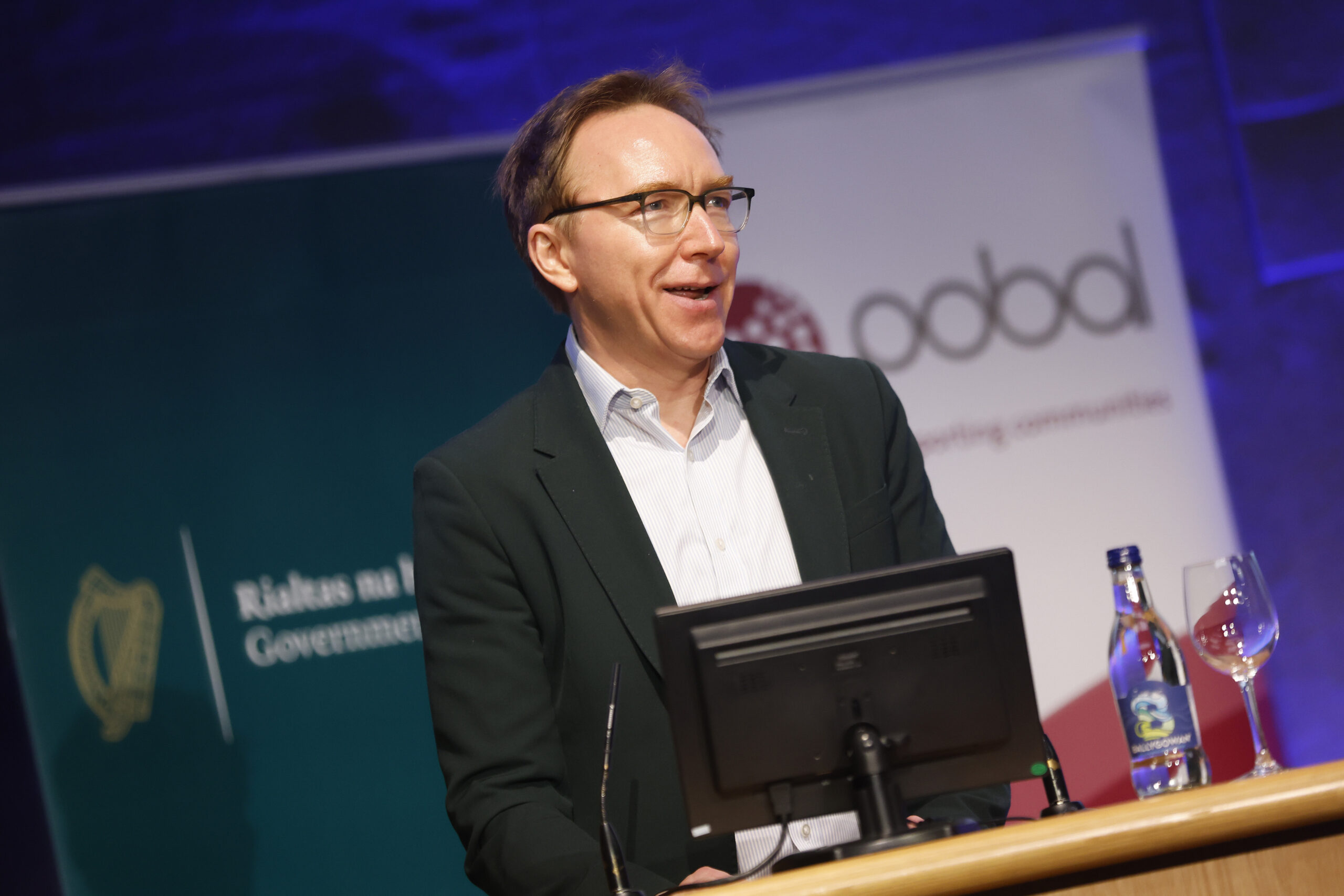
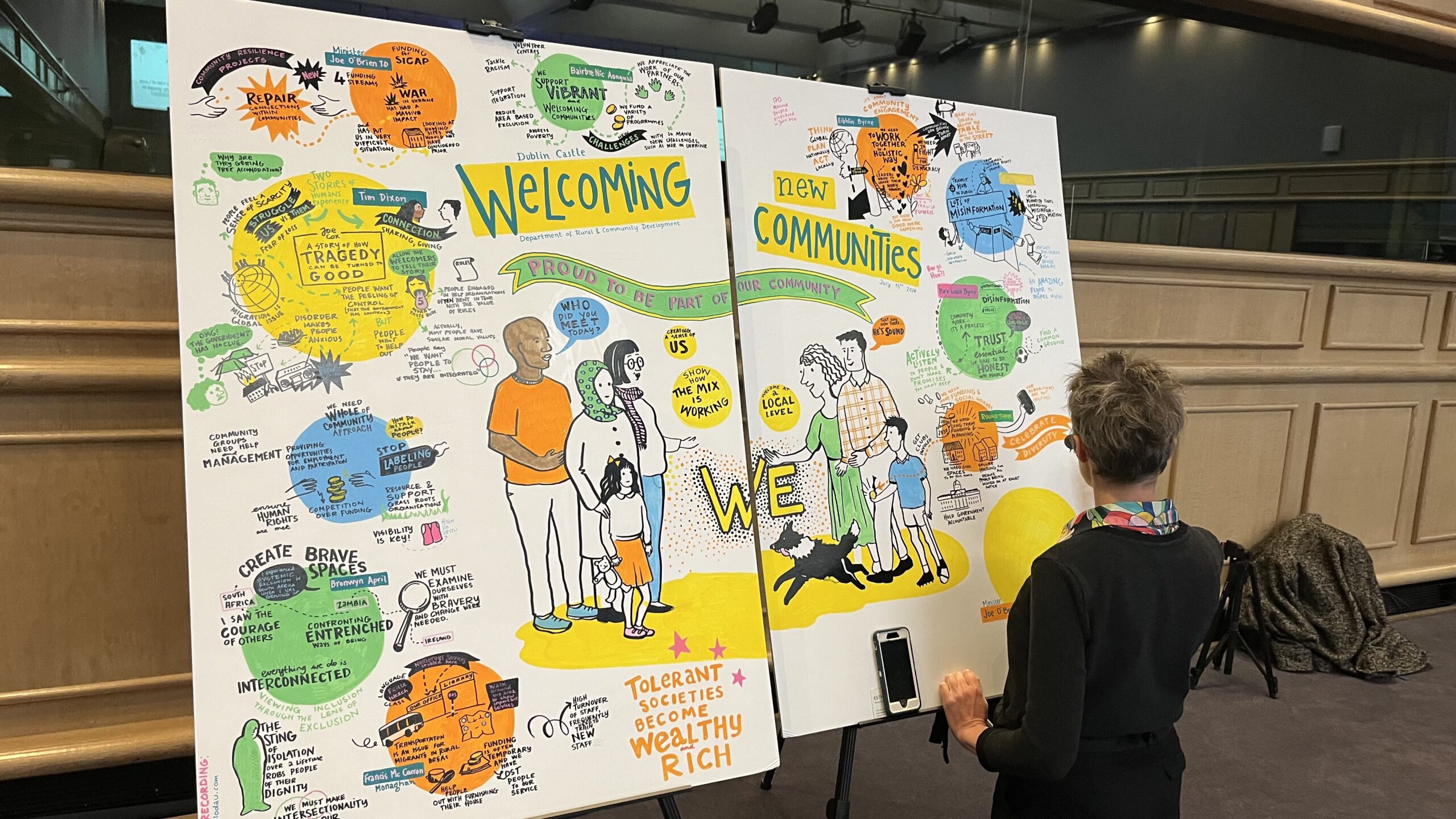
Tim Dixon shared five key thoughts about how to transcend tribalism and “build on the kind of work that many of you are doing at the local level”.
He began by saying that immigration is a difficult issue all around the world, so the challenges that Ireland has are not unusual and then he dived into facts, figures and solid findings.
He highlighted what the science says is most effective when it comes to integration work on the ground and policy-making. The following comes from his speech and has been edited for brevity.
THE CHALLENGES
In Germany, Spain, France and Poland we asked the question: How would you say your government currently manages immigration? For about three quarters of people in Germany, Spain and France the answer was “poorly”.
The challenge right now is that immigration around the world is in the news (and) generally only when something’s gone wrong. However, what drives people’s anxiety about immigration is when they see disorder, when they see people sleeping rough for example – which I know is a very current issue in Dublin.
It’s a big issue in New York and in Denver and Chicago and other cities in the United States. It’s the key thing driving the dissatisfaction with the Biden administration’s handling of immigration at the moment. It’s the southern Border in the United States, it’s small boats in the UK.
It takes different forms in different countries, but it’s the same sort of story; where people see disorder it makes them anxious. It does not mean however that people are hostile towards the migrants themselves.
In the US, the UK and Germany, we asked the question: What is more important – reducing immigration, increasing immigration, or getting it under control?
About 60% of people said having control over who enters the country is the most important thing. The lesson is that the public wants to feel like the government is in control when it sees chaos and disorder. I think it’s useful to understand that. It helps us think about how we respond to reduce community anxiety – it’s a lot to do with people having a sense that there’s a system, that there’s proper processes, the processes are fair.
And of course doing that when you have significant increases in arrivals is really difficult, but that’s the challenge. When you have lots of people arriving then this scarcity mindset can quickly kick in.
In Germany – we asked (to what extent) would you agree with the statement: “Immigrants are prioritised over natives when it comes to benefits and public services?” 60% of Germans agreed with the statement. Nowadays, there is a sense of scarcity of resources. And I know that there’s a very current issue in Ireland too, particularly around housing.
SOLUTION 1
MAKE IT EASY TO VOLUNTEER TO HELP REFUGEES
What are the solutions to that and what works in terms of good practices for community engagement and for welcoming? You know very well from being in the volunteer sector that there is tremendous goodwill to be tapped into in the community.
We did a study recently in the United States showing that more than 50 million American adults would be keen to take part in sponsorship of
refugees or some form of welcoming. We asked a similar question in the UK and got similar response levels. So how do you tap into that 26% (UK 23%) of the population? Not everybody wants to welcome refugees into their own home – about 10 to 12% of people say they’d be interested in hosting directly.
For most people it’s about giving money or driving kids to medical appointments or helping with language classes or something like that. People want to take part and this is the upside of the fact that immigration and refugees are a much more high-profile issue.
The challenge is to create systems that are user friendly and that give the easy way in for people who are interested in taking part. That is about good design. Having worked on refugee sponsorship for the last several years, many of the ways in which the programmes get set up are not very friendly to somebody who you know has a good intention but maybe doesn’t know exactly what the way in might be.
So making it easy for somebody to do a little, not demanding too much. We ask the question: What would stop you in the US? The number one concern was ‘Well I’m worried that I’d be committing way too much money, like more money than I have’. The second concern was ‘I don’t think I have the expertise’.
However, people learn they can be more helpful that they initially realised. For example, people in their 20s who get involved in welcoming quickly realise that because they are more digitally savvy than people in older age groups they can be really useful to newcomers.
SOLUTION 2
UNDERSTAND THAT COMMUNITY WORKERS HAVE BIASES
We have to appreciate that people have different starting points. If you want to turn down community anxiety, you need to start where people are at – and not start just from your own values and perspectives. This is particularly important in the area of immigration.
The social psychology of this is a complex area of work that we do, but we’ve mapped this in all the countries in which More In Common works. We use John Haidt’s observations on moral foundations, which is how we experience the world and what we see as right and wrong. Haidt talks about five moral taste buds: authority, care, fairness loyalty and purity. Conservatives are pretty strong on all of those values. What’s interesting is that activists and traditional Liberals are very weak on some values.
People who often dominate in the kind of welcoming-the-refugee sector, the immigrant rights sector are really weak on a valuing authority. So they sort of devalue, or don’t see authority as importantly as many other people do. It makes them less attuned to the way that other people in society perceive the importance of rules being followed.
So with people crossing borders – many of us might say ‘Well you know people are people and that’s more important than the borders’. However, for the majority of people having an orderly system, having a queue, and people not jumping ahead of others – that’s really important as a moral value.
We’ve done training with UNHCR staff and their social networks tend to be people quite like them. It’s important they understand that other people have different starting points and may feel threatened by difference.
SOLUTION 3
PROMOTING A SHARED IDENTITY HELPS
A third principle in terms of good practices is promoting shared identity. [Tim told about a town in Germany called Freital where there was neo-nazi activity. There had been a lot of new arrivals, particularly from Syria, and community organisations in Freital tried to mobilise people to welcome the newcomers].
Welcome organisers had been talking about the importance of the migrants, the refugees, the arrivals and diversity, but they were really struggling to get others to take part. They shifted the focus to celebrating shared identity. They created a community calendar that was distributed to all 40,000 people in the city and included the faces of newly-arrived people, interspersed with the head of the fire brigade, with
a teacher at a school, with different leaders. What they were promoting was a sense of community. They switched from focusing on otherness to focusing on the ‘usness’.
SOLUTION 4
PEOPLE WHO SOUND HOSTILE CAN ALSO RESPOND AT HEART LEVEL
Attitudes become more welcoming when people see newcomers integrating successfully. A few months ago in Germany we asked about
deportation. 87% of Germans say there should be more deportations of people who have got no legal right to remain in Germany. So 9 out of 10, which sounds very hostile towards outsiders. But when we asked should people who are well integrated be allowed to stay 82% of people
replied ‘Yes’.
It would seem to be a contradiction. This is because most people are not immigration lawyers, they’re not technical experts, they’re responding at a kind of heart level. When they see integration, when they see people working, they’re contributing, they’re part of the community, then they’re okay with them – even people who are often quite anxious and quite fearful. And that says a lot about what work we should be doing as we design policies.
Where people can see that people who’ve come from outside are becoming part of the community, contributing, it shifts public perception. That’s probably the one of the most important finding from all of the work that we’ve done across different countries.
SOLUTION 5
REFUGEE SPONSORSHIP CAN BE EMPOWERING
Community-based sponsorship can powerfully increase support for refugees. The last thing I want to mention relates to sponsorship and specifically refugee sponsorship. There can be a significant shift in favour of welcoming people when it’s being done through the local level. Why? Because it’s more orderly. In general, community-led efforts are seen as more orderly. It results in better integration, better acquisition of language, breaking down those usversus-them dynamics. It brings people together.
We helped the US State Department name their core refugee sponsorship programme that was launched last year and the slogan that they adopted came out of our research. The slogan is ‘Sponsoring Refugees, Strengthening Communities’. That second part ‘Strengthening Communities’ came from a really important finding in our research; people sense their ability to make a difference when they come together as part of the welcoming effort.
For people who feel their community is not functioning very well, when there’s a project people are taking part in – welcoming families in, helping them into school, helping them into services – it has a very positive spin-off effect in how people perceive their own community.
SOLUTION 6
TELL THE VOLUNTEER STORIES
Telling the story of welcoming, not just the story of the welcomed, not just the story of the outsider coming in, but the stories of the people who are the volunteers is really important. In the work that More In Common does we’re often trying to understand how to elevate stories of inclusion, that story of welcome, that story of connection – against the stories of polarisation, division and tribalism.
The name More In Common is from Jo Cox’s first speech in Parliament where she talked about us having more in common than what divides us. So how do we make that story of welcome and inclusion a stronger story than the story of division and polarisation?
You can create champions with powerful stories. We’re in an era where professionals, politicians, NGO leaders, even celebrities, are trusted much less than before. The most trusted person is someone who just looks like an ordinary everyday citizen, an authentic local person, a nurse, a teacher, a doctor just universally more trusted. Sponsorship and welcome activities allows you to highlight such stories.
Finally, one thing that surprised us is about middle-aged men. That age group are often not very interested in welcome activities. We found that they need to do something first and then a change in attitude follows. They get affirmed by others in their community – ‘This is great thank you for doing this’. They feel then that they can be part of something useful, and start to see themselves as welcomers.
For more information, visit: www.moreincommon.com/


