Friday, July 3, 2026
Home Blog Page 53

A lesson for the country – Ballymun kids lift school attendance by 14,000 days

The Government is planning to extend the law that holds parents to account when their child misses school unnecessarily. The new law would also cover the parents of children under six years of age. Meanwhile, Ballymun has come up with a completely new (and possibly complimentary) approach.

A Local Development Company in Dublin has used computer software and a community development approach to dramatically improve school attendances.

By Conor Hogan
In 2008, the attendance rate for primary schools in Ballymun was worse than that of other disadvantaged areas and 3.5% below than the national average.
Local community and educational organisations to take action and in the past two years the gap compared to the national average has halved. Last year, 14,000 less school days were missed in all.
Meanwhile, chronic absenteeism for Traveller boys has fallen by over 24% while the attendance rate for Traveller girls actually overtook the national average for schools in disadvantaged areas.
So how did they go about achieving this?

“A lot of work,” says Colma Nic Lughadha, Education Programme Manager with Ballymun Whitehall Area Partnership which led the initiative. “We knew that educational opportunities was one of the main priorities because of a survey we carried out among 500 local people.”
“Education came second on a list of seven priorities parents had for their children; only apprenticeships were prioritised more. The survey demonstrated to us that behaviour wasn’t matching opinion. But that opinion gave us a good position in which we could hope to mobilise the community.”
A more systematic approach than before was taken. Software was provided to the schools to keep track. Attendance Care Teams were established to raise the issue.
Meanwhile, home school liaison officers were employed in the schools for two hours each day with the specific task of getting into contact immediately with the absent children, whether that be by text or phone call. These were fully paid local people.
“And it was very important for our attitude to be non-judgmental,” Colma says. “It was about rewarding the positive behaviour and encouraging the children to take personal responsibility for their own attendance.”
Creative approaches were taken such as rewarding classrooms for full or best attendances and getting classes to compete for the top prize. This made children more determined to come in and motivated parents to bring them in and not let the side down.
A brochure was distributed to the parents as regards child illnesses, written in association with Dr. Tara Conlon, a local GP. The guide ‘When is a Child too Sick for School?’ is available online: https://www.ballymun.org/dloads/BMUN_School_Att_09.pdf (See pages 6-7).
Recommendations in it included “No need to stay home” for cold symptoms, “No need to stay home unless drooling” for hand foot and mouth disease, “They are a nuisance, not a reason to stay home” for head lice and “Stay home until 24 hours after last bout for diarrhoea.” This drastically reduced the number of children taking sick days.
Attempts were also made to make the school experience as positive as possible for the child, by welcoming each and every one of them in the morning, praising them for their efforts, giving out prizes for attendance achievements and not giving homework at the weekends.
“There are elements any school or community can learn from what we’ve done,” Colma says.
Ballymun’s model it could provide a prototype for the rest of the country.
The average absentee rate in primary schools nationwide, measured in terms of the number of schooldays lost in a school year, stands at 6.2%, according to the latest figures published in May. A total of 9,485,562 days of school were missed by all primary and secondary students across the State in 2009/10.

FIND OUT MORE
The Ballymun School Attendance Community Action Initiative was funded by the dormant accounts board in association with Ballymun Whitehall Area Partnership and the Local and Community Development Programme.
If school attendance is an issue in your area and you wish to learn how Ballymun did it, check out the downloads section of this BWAP’s website: www.ballymun.org

Village buys business and saves jobs

BY EVELYN O’ROURKE

The village of Sangudo in Alberta, Canada, mirrors some of the challenges faced by communities in Ireland.

With a population of 360 people, Sangudo has until recently, experienced a steady rate of economic decline. Businesses were forced to close and the younger population had no option but to leave in order to find work.
Many communities in Ireland are facing similar challenges. With the onset of recession, businesses have been forced to close, and young people are compelled to emigrate.
The community of Sangudo tackled the situation by making positive changes, together. 

In 2005, the education authorities threatened to close the local high school. What followed was a passionate campaign by residents to save their school. Emboldened by their success with the education authorities, community leaders participated in the Active Creative Engaged Communities training.
This provided the community leaders with tools to address the needs of their locality in the hopes of creating a future for their youth. The training led to the creation of the Sangudo Opportunity Investment Co-Operative.
Co-op chairperson Dan Ohler says they aimed to encourage “local money to stay local” and to help retain their younger population by creating employment and business opportunities. In doing so, they enhanced the potential for local businesses to succeed.
In May 2010, a group of close knit residents pooled their resources to create an investment fund, which they used to invest in businesses in the village. To date the co-operative has made a combined investment of $400,000. 
The owner of the meat plant wished to retire.”


Caption: Jeff and Kevin of Sangudo Meat Packers

They raised the funds by selling their investments, many of which were invested in the Toronto and New York stock exchanges. The co-operative considered a number of investment opportunities before they decided on the Sangudo Custom Meat Packers (SCMP).

The owner of the meat plant wished to retire but did not have a succession plan. The Co-op found two entrepreneurs who were eager to purchase the business but unable to access credit. The Co-op decided to buy the building and lease it to the entrepreneurs. By purchasing the assets the Co-op acquired security in the event of business failure. Purchasing to lease also enabled the investors to be active participants in the village economy without having the responsibility of running a business.
The Co-op and the meat packing company signed an agreement which requires the company to make monthly lease repayments and pay a quarterly bonus, based on gross revenue.
The venture was a success and group members recouped 6.3% of their investment in the first trading year. As an established business with customers, the abattoir did not require the level of promotion that start-up businesses do. Several members of the Co-op are experienced in business and were able to mentor the two novice entrepreneurs. Also, because members of the Co-op had a vested interest in the meat packing company’s success they encouraged their friends and family to support the abattoir.   
The Co-op have since invested in ‘Connections’ a coffee house/ community meeting space on a purchase to lease basis. As a direct result of their investment, 12 new jobs were created in the meat packers and four in Connections. Ten of the 12 people employed are under the age of 30, demonstrating the ability of the Co-op to keep their young people at home and increase business opportunities. 
The Sangudo Co-Op is not a government initiative but originated within the community.”


The Co-op are considering a number of new opportunities, including a bio mass generator and housing project for older people.
The Sangudo Opportunity Investment Co-Operative is not a government initiative but originated within the community. It is the first co-operative of its kind in Canada. However, there is a history of government supported community investment funds in other Canadian provinces. The Community Economic Diversity Investment Fund of Nova Scotia was created as a cost effective way of encouraging investment in declining rural economies and reintroducing local capital.
Like many communities in Ireland, Sangudo experienced steady economic decline. However, through the Co-op, the community has improved their economic prospects and created employment. Their story demonstrates that by investing in capacity building, a community can use its strengths to shape its own future.
To learn more about similar projects in the UK please see https://fc-utd.co.uk/communityshares
To learn more about CEDIF please see: www.gov.ns.ca/econ/CEDIF/
Local community website: www.sangudo.net/index.php

DEFINITION of Social Enterprise
Social/community enterprises are businesses involved in economic and trading activity in order to meet a social objective (for example, to provide employment and/ or services to communities) and which operate through independent and democratic organisations.


Cut to Back To Work Allowance “a concern”

Louise Brogan

The level of State financial support for people starting their own business – critical to 5,040 people who did just that last year – has been reduced by two years.
“This is a genuine concern. The four-year allowance added a really big strength to the Start Your Own Business scheme,” said Louise Brogan of Donegal LDC.
Crucially, the Start Your Own Business course in Donegal, as elsewhere, allows participants to avail of the Back to Work Enterprise Allowance. This means newly self-employed people can retain their social welfare benefit in full for the first year and receive a 75% payment in their second year of running a new business.
For example, someone on Jobseekers Allowance gets €188 in the first year and €141 for the following 12 months. Secondary benefits such as medical card and fuel allowance are also permitted.
However, after two years, the allowance stops. Previously, it was spread out over four years.

“The scheme really works, it really turns people’s lives around and if people had another year or two to wean themselves off it would be better,” said Louise.

476 new businesses sprout in Donegal – with a survival rate of 60% after three years

AIB’s Jim McLaughlin, DLDC chair Jim Slevin and winner Michael Conway.  

Ann Styles reports

Entrepreneurs in Donegal have access to a wealth of information and support from their Local Development Company (LDC).
From Start Your Own Business (SYOB) courses to mentoring and workshops, the company provides a comprehensive support system for people, many of who have been long-term unemployed, with a desire to set up their own business. The LDC has two full time project officers who co-ordinate the service which has supported over 1900 people to date.

Donegal LDC Enterprise Officer, Louise Brogan said that, since 2009, Donegal LDC has supported 476 people in setting up new businesses with current trends in areas such as sports and leisure, driving instruction and graphic design. Of the 476 businesses, Louise estimates that at least 60% are still in business.
Louise and her colleagues believe that the future for many people lies in self-employment and that one-to-one support is key regardless of the person’s background.
One man who would agree is Enterprise Award winner Michael Conway: “Without their support I wouldn’t be here, they helped me immensely.”
Michael began with window cleaning and has expanded to include light DIY, painting and decorating, and exterior cleaning.
The supports offered to budding entrepreneurs include a SYOB course, one-to-one appointments, preparation of a business plan and cash-flow projections, mentoring and a bookkeeping course.
The mentoring provided by the enterprise scheme was a vital part of the supports offered said Michael as it prevented you from feeling isolated and gave you the assurance that someone was there to hear your concerns.
The enterprise scheme also provides workshops to improve awareness of, for instance: Sales techniques, marketing strategies, and how to prepare a health and safety statement.
“These courses and workshops save people money by helping them to do it on their own.” said Louise.
Michael agreed, adding that he went to every workshop on offer and found them highly informative, allowing him to garner knowledge in many relevant topics such as tax returns and Internet use.
Returning to work was important to Michael, who had been out of the workplace for some time while battling cancer. He felt it was necessary to alter people’s perception of him as ‘ill’ and instead be seen as capable of contributing to the work sphere. He first contacted Donegal LDC in 2008 and four years on he employs two people, has completed training-for-trainers and regularly passes on work to other self-employed people in his area. He is also the winner of the Donegal LDC Enterprise Award for 2011.
Donegal LDC faces a number of challenges in delivering this service. The catchment area is vast and predominantly rural which limits employment opportunities in the county.
Another challenge is the high volume of prospective clients, coupled with a wide range of educational backgrounds and life-experiences and there are also issues with viability and displacement due to overlaps in business ideas.
In response, Donegal LDC are putting new structures in place to reach a wider number of people, they’re redesigning the business start-ups course and they’re running an ideas generation workshop.
Michael encourages people to “look outside the box” and to give Donegal LDC a call.
For more info, contact Louise Brogan on 086-812-4250. E: lbrogan@dldc.org

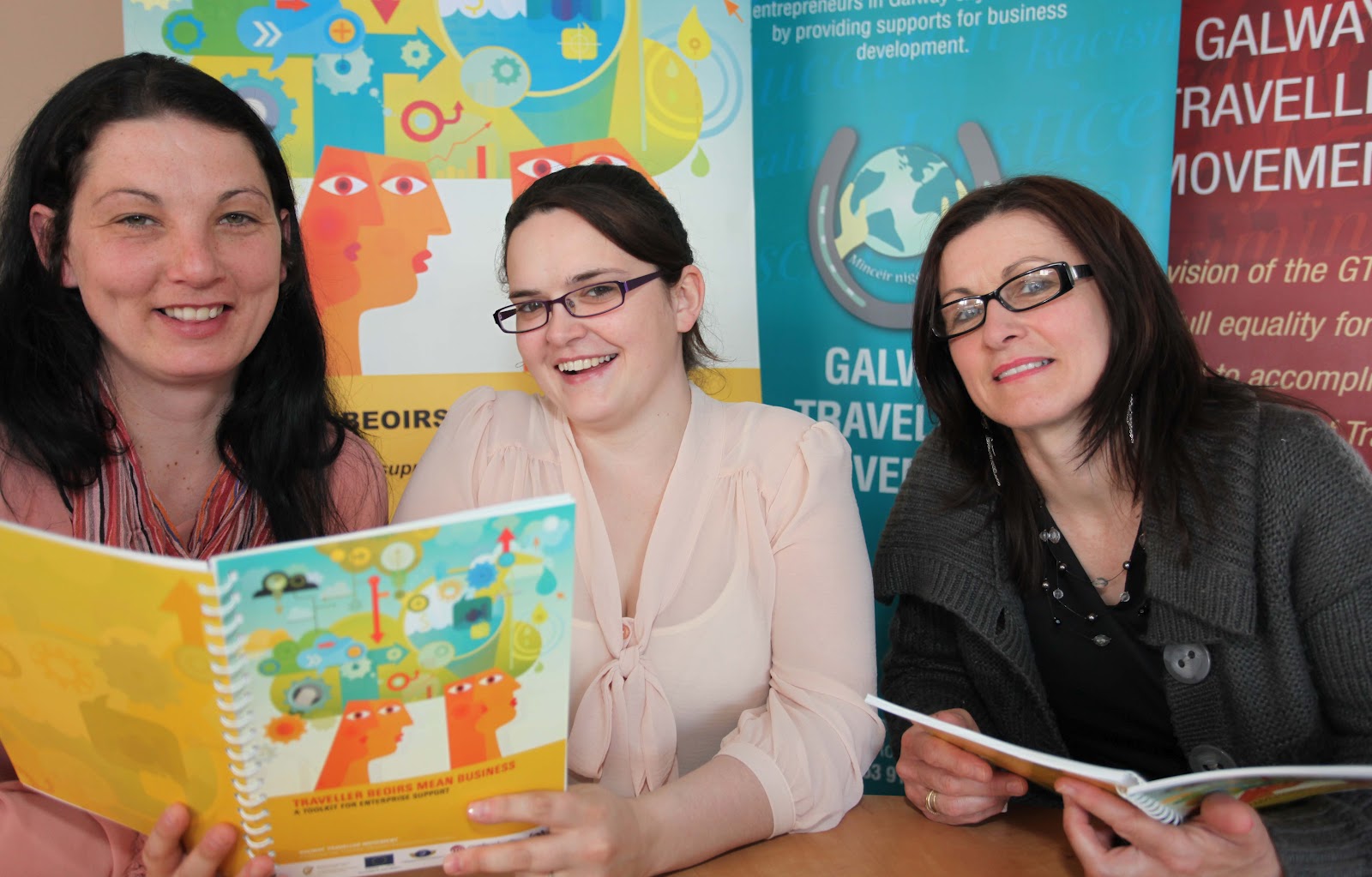
Traveller Beoirs mean business! – Galway Traveller Women Entrepreneurs launch a toolkit

Bridget Kelly, Joanna Corcoran and Anne Marie McDonagh at the launch of the Enterprising Traveller Women’ toolkit by GTM’s ETWE project. Photo by Derek Speirs

In Galway, there is a drive underway at local level to support enterprising Traveller women.
Recently businesswoman Liz Cassidy, an EU ‘Ambassador for Female Entrepreneurs’, was the guest speaker when the ‘Empowering Traveller Women Entrepreneurs’ programme was launched by the Galway Traveller Movement (GTM).
Liz talked with Traveller women about how to overcome barriers they encounter in trying to set up or run businesses.
Bridget Kelly, a Traveller woman with business experience who works with GTM said, “We’re interested in working with Traveller women who are interested in becoming self-employed or getting involved in business. Some women may already be involved in their own business or a family business, but no experience is necessary.”
Tanya Lalor of GTM said training and mentoring on the programme is ongoing: “There are a range of ideas from women interested in setting up their own businesses including, alterations, flower arranging, dress making and importing different products. One woman is even interested in establishing a music career.”

Christina Ward showing off her work at the launch. Photo by Derek Speirs.


The programme allows the women entrepreneurs to have a say in how their training is delivered.
“We provide co-facilitation training where the women meet the trainer in advance. This brings in the experience of the Traveller women relative to the training,” added Tanya.
GTM and those involved in the entrepreneurs’ programme have also launched a new toolkit entitled ‘Enterprising Traveller Women – A Toolkit for Enterprise Support’ targeted at enterprise support organisations serious about working with Traveller women.
“It identifies barriers and provides a step-by-step guide for organisations. It is hoped it will engage and influence wider practice,” said Tanya.
The Galway Traveller Movement is funded through the Local and Community Development Programme.
The Traveller Women Entrepreneurs programme was funded under the Equality for Women Measure and is supported by the European Social Fund.
For more information or to request a copy of the enterprise support booklet, call Tanya Lalor in GTM on 091-765-390 or email tanya@gtmtrav.ie

Offaly men changing their lives

Keith Walsh and Michael Egan

Interviews by Robert McNamara 
 Keith Walsh and Michael Egan from Clara both did the 16 month programme and are continuing on with further education and community involvement. Community workers first approached Keith and Michael about the programme and now they are themselves recommending it to people they meet.

Keith Walsh (27)
What got you involved?
I wanted to do a course.
How have you benefited from the programme?
I got my FETAC Level 3 & 4, which is something I wouldn’t have done.
It was a great help on the computers and I’m now designing posters for the Men’s Shed.
I’ve also taken on a new role with Tús.
What were your favourite parts?
The social aspect and the benefit of the education were the best parts. We went on trips to Moate Business College, the FAS Training Centre and the Men’s Shed in Galway, places I wouldn’t normally get to see. It was good for team-building. Now I’ve got used to getting involved in things.
Michael Egan aged 37
What got you involved?
I attended the course after I was outreached by Karen McDonagh (youth worker) and Catherine Power (development worker) and they asked me to join the course.
How have you benefited from the programme?
It helped me a lot with maths and I picked up a lot of skills on Microsoft Word. It’s opened up doors for me to go onto the next level, which is Level 5 college. I will do level 5. I’m ready for the next step and with more confidence.
I’m confident to get going again. I’d got into a rut at home.
What were your favourite parts?
Drama was interesting – I was nervous at the beginning but I was surprised how good it was and it built up my confidence.
I’ve recommended the course to other people and the Family Resource Centre is local, a place where young and old can go.
210 WORDS
In Brief: Offaly’s ‘Way Forward Project’
•            Many of the participants in ‘The Way Forward Project’ had not found work during the ‘boom’ and were finding it even more difficult now.
•            People who completed the programme told ‘Changing Ireland’ they were attracted to it because transport wasn’t an issue. It was held in their town/area.
•            Led by Offaly Local Development Company, the project was set up in September 2010 and lasted until December 2011.
•            Offaly LDC made the connections with local people through the strong bonds of trust built up by community workers in Family Resource Centres and Community Development Projects. This was one of the Programme strengths.
•            Four programmes were developed namely: Foundations for Change in Birr, the Career Skills Programme in Clara, the Career Development Programme in Tullamore, and the Men’s Project in Edenderry.
•            Funding came from the Department of Social Protection, Offaly LDC and the VEC. Many of the key players were on the Social Inclusion Measures committee and this became the steering group for the project.
•            For community development workers and students interested to learn more, check ‘Changing Ireland’s news blog where we’ve posted a link to a more detailed PDF presentation on what made the programme work and the challenges that it sought to overcome.

Offaly makes a start – as 5 people get a start

BY ROBERT MCNAMARA
A programme supporting those at risk of social exclusion has, in the past few months, helped 55 long-term unemployed people move towards paid employment in Co. Offaly.
Five of the people who last December completed the 16-month programme gained full-time or part-time employment, five more found seasonal work and most of the remainder went onto advanced courses and programmes.
They had all been long-term unemployed.

‘The Way Forward Project’ reached people through locally respected community workers and it helped each person to build up confidence, knowledge and basic education so they had a better chance of landing a job. A third of those who joined the programme had seen their formal education end at the Junior Cert and were out of work during the ‘boom’ and finding it even more difficult now.
I’d got into a rut at home,” said Michael Egan who is now at FETAC Level 5 and much more confident.
Breda Stewart, LCDP programme leader in Offaly,believes that focusing on personal development and giving the participants a say in the course contents was essential to its success.
“The core elements focused on self-development, self-awareness, career exploration, support and mentoring,” she said. “It’s about helping each person to identify and develop their innate abilities and thereby develop confidence in themselves. Then they begin to see realistic routes they could take towards the labour market.”
Only one in five people in Offaly have a third-level education – well below the national average – and nearly half the county’s population left school before doing the Leaving Cert, according to 2006 CSO figures.
The participants chose DIY, painting, gardening, budget and financing and stress management, among others, as practical elements. Core elements of the programme included team-building, communication, IT skills, career options and planning.
Among the 55 participants on the course, 47 were male, 8 were female and there was a good spread in age-groups. They met three mornings a week from September 2010 to December 2011 in local groups of seven-to-10 in various locations.
“So far, five were fortunate to find jobs, but so many more have taken part in further education, training, volunteering and a whole range of activities that all strengthen people’s skills and chances of finding work in the future,” said Breda.
This year, there are another 60-70 people taking part in courses under an Offaly Education programme that has since been developed with the VEC and Department of Social Protection.
Breda said it was “a concerted effort to address the issue of low educational attainment among early school leavers or unemployed people in the county”. The latest rollout again allows participants to tailor it to suit their needs.
“Apart from a small number of core modules, the prospective participants again design the programme, identifying the modules they want to complete,” said Breda.
•            Six programmes commenced in various locations between March and April, aiming to be completed by June or July.
•            The expectation or hope is that many of these participants will progress on to further programmes at higher FETAC levels in September.
W: www.offalyldc.ie

Worklink: another volunteer-led support for job-seekers

An expanding network of volunteers is providing help to job-seekers in Dublin, Limerick, Sligo, Athlone, Cork, Galway, and Waterford.
The Worklink project employs two paid staff in Dublin with most of the work being done by the volunteers.
Unemployed people are offered mentoring and work experience opportunities (eg through Jobbridge) as a step towards full-time employment.
The project has the backing of the INOU and this year Worklink won €50,000 and backroom support from Diageo through the Arthur Guinness Fund.
If you live in any of the areas listed and are interested, either in volunteering or in getting support to find suitable work experience, the project is worth approaching as it has direct links with a number of companies that appreciate its aims.
T: 01-2916603.

Changing Ireland issue 39 – out now


Open publication – Free publishingMore civil society
The most popular Civil Society magazine in Ireland.

LEAD STORY: Jobs you haven’t heard about – 5000 people develop new businesses
Reports from: Canada, Sweden, Brussels, Meath, Donegal, Cork, Offaly, Galway, Limerick & Dublin.
PLUS:
  • Volunteers fill the gaps in West Cork
  • Meath woman says “Bite the Bullet”
  • 12 great websites
  • NEW: textbook about Community Development
  • EXAMINED: The social impact of adult education classes
  • 1-in-6 find jobs with LCDP support
  • Solutions and responses to long-term unemployment
  • Changing the world; changing ourselves
  • Ireland Mark II 
  • The Diary of Doris McDermott
  • News briefs

Belfast unemployed centre fuelled by bar

The John Hewitt, an award-winning bar in Belfast city centre, is owned by and financially supports the operations of the Belfast Unemployed Resource Centre.
The resource centre had always relied on an unsteady series of grants and 15 years ago decided to generate their own funds by going into business.
A manager runs the bar on behalf of the Resource Centre and the idea has proved a winner.
John Hewitt, the late Belfast poet and socialist opened the Resource Centre in 1983 and the bar is named in his honour. The two premises are located side-by-side on Donegall Street.

Volunteers now running 3 job-seekers’ centres

Citizens fill in where there are no staff in West Cork

By Robert McNamara
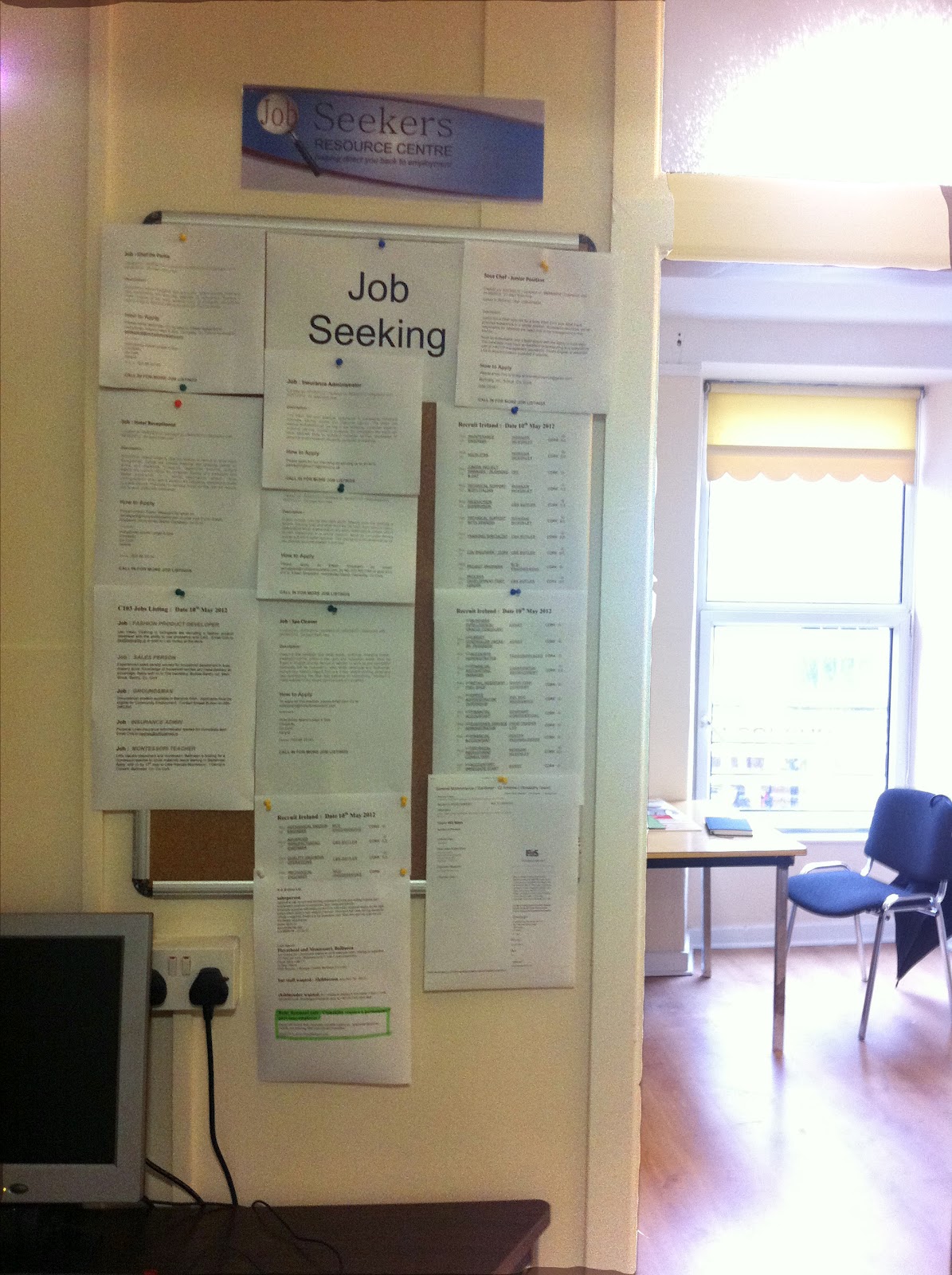
Three community led job-seekers centres, staffed by volunteers, are currently operating in the West Cork area, with plans for three more to be opened.
Only for them, unemployed people in West Cork would be left to swim.

The centres which offer free advice and confidential support in Bandon, Kinsale and Clonakilty are managed by the West Cork Development Board (WCDP) and offer a “holistic” approach to job-searching. A “buddy” system operates, with volunteers assisting the job-seekers in all aspects of the process.

The centres serve a region that comprises of eight mid-size towns, which currently have approximately 10,000 people on the live register. There are no Local Employment Services Offices, or Jobs Clubs, and only 9 per cent of the territory is covered by Local Development Plans.
LCDP manager Fergal Conlon believes that the centres are an essential resource for those looking for work. “They are hugely important because without job-seekers’ centres, a job-seeker would have nowhere to go and no-one to get advice and support from and they’d be left on their own and isolated.”

Karen Moroney is a volunteer at the Clonakilty centre: “We talk to people and assess what their needs are and support them through that. Some people may have been with the one employer for a long time and maybe wouldn’t know how to put a CV together, so we help them. If they want to delve in further and go through the programme that we offer, then we can do that as well”.
The centres mimic the approach of Citizens Information Services by allowing volunteers to deliver information and advice via IT tools.
“They provide volunteers at the front-line to deliver support in a complex area and they’re dealing with complicated information. So in that sense we’re trying to copy them in some ways with a job-seeking twist obviously”, said Fergal.
The idea for the centres grew from an existing website service by the WCDP (www. westcorkjobsupport.com) that offered a range of job-seeking tools and resources. The website proved popular, but ultimately failed to reach out to those not IT savvy .
Three more job-seekers’ support centres are now planned.
“We’re immediately looking at the towns in Macroom, Skibereen and we’ll be considering Dunmanway and Castletownbere later in the year aswell”, Fergal confirmed.
The centres offer a wide range of advice in areas such as rights and entitlements, career decision-making, CV and interview preparation, options and sources of training, course information, identification of job-seeking techniques through networking, publications and the internet, and development of a personal strategy for pro-active job seeking.
Broadband and printing services are also available at the centres.
And every one of the centres depends on volunteers continuing to step forward.
Distribution of employment support services in the ROI. The map shows what’s available but also the gaps; for instance there was nothing between Bantry and Cork City.

The huge satisfaction in serving others – Karen Moroney, Volunteer at Clonakilty Job-seekers’ centre

Karen Moroney
INTERVIEW BY ROBERT MCNAMARA
Karen Moroney was unemployed at one stage and appreciated the support she got. She’s now doing the same for others by volunteering with Clonakilty Job-Seekers’ Centre which was set up under the LCDP. Her volunteering is something that’s important to her.
What are you reading at the moment?
I’m reading Tess of the d’Urbervilles. It’s set way back in Victorian times and it’s about a woman making her way in life.
Whats the last film you saw?
Dark Shadows with Johnny Depp.
Person you most admire?
I don’t tend to admire people as such. I may admire actions that people take, but I don’t have one particular person that I admire. I don’t hold any one person up as a role model.

The top 4 issues in Ireland today besides the economy?
The state of the country is effecting tourism. I suppose that would be matter more down this part of the country. People’s general demeanour and morale, it’s all related and it’s affecting family lives and it’s affecting people in ways we can’t even understand.
Nationally, we need more
People need to be more open and honest. I have a huge thing about being honest where possible.
We need less
Dishonesty.
What’s the best thing about your (LCDP-supported) project?
The fact that it’s free to use for members of the public. We’re not associated with major Government organisations, so people can access the centre in whatever way makes them comfortable. People have different needs, so they can just use it as a walk-in centre and look at the jobs and whatever is available and walk out. They can engage at their own level. If people are ready to engage at a deeper level, they can do that. People get the support that they need.
What could your (LCDP-supported) project improve on doing?
We are a very new organisation, so at the moment our focus is on becoming established, getting set up properly and then letting people know that we are there. And obviously volunteers, we always need more volunteers.
How long are you volunteering in your local community?
I’ve been volunteering for a couple of months now.
How and why did you get involved?
It’s an area that I worked in before in Kerry, I was unemployed myself years ago, I was a lone parent and at the time I needed to get into work. I needed to re-train and I was very appreciative that I got a leg up. There were people to give me advice and help me along the way and I never looked back. To be able to do that for someone else and to give back to the community, I consider myself very lucky and very fortunate. I have work at the moment and to be able to give back something in some small way is important to me.
What difference has being involved made to you?
There’s a huge sense of satisfaction to be able to do something for other people, to pass on knowledge that you have yourself that somebody else doesn’t have.
How have things changed for your community, since you became involved?
Everything is so tight and funding is being cut back the whole time across the board for any community based initiatives. Even charities are finding it difficult to raise funds.
What motivates you as a volunteer?
I suppose for me personally it’s a case of ‘What can I do?’ The opportunity came up and I thought that this is something that I can do, it’s something I can give the time to, I have the expertise and I have skills I can share with people that may help them. That is very simply the way I look at it. I just think that all along my working career, I’ve come across people that have shared knowledge with me and to be able to do that for someone else is good.

Robert McNamara, Journalist

Robert McNamara

Robert McNamara from Corbally in Limerick City, has joined Changing Ireland Community Media Ltd on a long-term work placement as a journalist.
He is currently studying a degree in Journalism and New Media with sociology and politics at the University of Limerick as a mature student.
Robert is the current sports editor at An Focal newspaper and maintains a popular indie music blog. He has a keen interest in current affairs, print journalism, publication design, old and new media.
Robert competes in long-distance running and can often be seen hobbling around after a marathon.
He hopes to graduate from UL in 2014 and pursue a career in the media industry.

“On the cusp of a huge opportunity” Interview with: Ryan Howard in Brussels


Ryan Howard
For a country to have access – by the hundreds of million – it needs to have a network of local action groups in place to channel the funding.
Leading the field, Ireland already has a national network in place, namely the Local and Community Development Programme (LCDP).

“The EC is excited about this and Ireland is in a hugely unique position, through the LCDP companies, in having the whole country covered, including both urban and rural areas,” says Ryan, who heads up a Local Development Company in County Cork.
His enthusiasm reflects his involvement in a European focus group, that reports to the European Commission in Brussels on community initiatives that work.
Since most of us in Ireland have grown used to news from Europe of Troika-related directions and spending cuts, this news runs counter to the regular flow of information on Brussels.
Local development experts across Europe have greeted the announcement as “a great opportunity, not to be missed.” (Ref. LDnet.eu). Meanwhile, politicians are awakening to the possibilities and know it will pass by countries that don’t shape up for it.
It challenges States because the method of delivery is not through national Government agencies, but through regional and local community projects.
“We can offer Europe a community-led platform that works towards social inclusion. We’re seen in Europe as a model, our (LCDP) groups are led by civic society and we’re seen as true Community Development bodies,” says Ryan.
“In the EC, people are reflecting in a far more positive way on what we’re doing than we are ourselves. I find it amazing in Brussels – the level of support, acknowledgement and positivity towards us – it’s a different world here compared to when you go home again. We need to start looking at what’s positive about what we’re doing.
Ryan isn’t blind to the difficulties facing the community sector, including his own Programme, which saw its budget cut to €55.3m in 2012, down from €63.3m the year before.
“The LCDP is dying on its feet because the funds aren’t being put into it. It will be in real trouble if we keep cutting.”
Ryan also recognises that we’re “not at the front of the game” in lining up to access the CLLD funds from 2014.
“Finland is one year ahead of us. Structurally we’re in a great place, but in preparation for 2014 we shouldn’t wait for it to come. Even the EC are saying to get moving before it begins. In Finland, they’ve already started getting out there talking to local community groups.
“This is important because it can’t be accessed through any other structure. To be fair to the Minister (Hogan) – he recognises the importance of the Community-Led process in the future,” said Ryan who met Minister Phil Hogan recently.
“I know other politicians are beginning to become far more aware too – because of the importance Europe will have.”
It’s not easy for everyone, Ryan adds: “We’re not all equal in this; some organisations are very challenged.”
“However, There’s something absolutely critical, amazing and unique about what we’ve done in developing a Community-Led process. And now we’re going to have to start thinking for anew because we can bring value for money that no-one else can.
“It’s not as if everyone’s in the same place. But we’re in a great place for these negotiations. Go look out there because people are reflecting in a far more positive way on what we’re doing than we are ourselves.
“We need to be talking to our communities, our politicians, our leaders … and this is my fear – that it might be seen as not worth the bother.”
·       Ryan Howard is the CEO of South East Cork Area Development. 

·       Ryan was in Brussels as part of a focus group reporting back to the European Commission about Leader within the Rural Development Programme. Leader is one of the four axis of the RDP and was mainstreamed five years ago.


Community-Led Local Development
Features of Community-Led Local Development (CLLD) are that it is area-based, bottom-up, public-private, integrated, innovative, co-operative and involves the use of networking.
It involves directing funding to local community projects via partnerships between EU authorities, NGOs and groups on the ground with the overall aim of realising the long-term potential of their area.
The Commission’s recognition of CLLD is based on the rationale that tackling complex issues such as poverty, deprivation or unemployment, needs an integrated and inclusive approach involving many local actors.
More info: https://bit.ly/KJ5xXs


Community workers seek to harvest ideas for the future

By Robert McNamara and Allen Meagher

INTRODUCTION

A new way of looking at communities in Ireland is being sought in the run-up to the 20th anniversary of the Rio Earth Summit.
President Michael D Higgins thought this work was important enough to officiate at the opening in Cloughjordan, Co. Tipperary, of Convergence 2012 which was filmed by ‘Changing Ireland’. The move is towards promoting “community resilience” in place of “sustainable development.”

BACKGROUND

A wet summer’s day in Cloughjordan

Most of the global promises made in Rio in 1992 were not honoured while economic growth continued to be promoted, destroying ecosystems and increasing Ireland’s temperature in the intervening two decades by 0.75 degrees, meaning we’re on course for a four degree rise here within the lifetime of some of today’s children. 


The message 20 years after the first Earth Summit in Rio is that too few people took notice of the “Think Global, Act Local” slogan to change their lifestyle, become more active citizens and embrace sustainable development.
Instead we’ve had industrial and economic development on a global scale and that’s despite nations promising to slow down to avoid irreversible climate change, the destruction of habitats and so on.
But if the doomsday predictions of societal collapse and species wipe-out didn’t get the message across, what will people listen to? What values shape our behaviour?
That’s the question being discussed around the country this year as part of what’s called Convergence 2012, led by environmentalists and community workers in County Tipperary, who feel we’ve reached the point of “Peak Everything” – a time when the best ideas are likely to come to the fore – as nations and societies begin involuntarily to slow down.

REPORT FROM CLOUGHJORDAN

The ‘Convergence 2012’ programme kicked off on Wednesday, June 6th, in Cloughjordan with an event entitled “Conversations for the Future We Want” which brought together community workers and experts from around the country.

The aim was to re-examine values and breakthrough ideas in order to bring about systematic change.
Participants engaged in group sessions where ideas and information were gathered and “harvested” into a chart for use on the organisation’s website.
“We are collecting and illuminating breakthrough ideas, and we will be showing where these conversations have taken place around the country,” said Davie Philip, event organiser.
Davie Philip on community resilience.

Convergence 2012 is different to previous years and Davie believes a new approach is needed.
“Community resilience is a sort of re-framing of sustainability. We need to build the resilience of our communities and our organisations to be able to thrive in an environment of change, uncertainty, unpredictability and surprise,” he said in a presentation.
“We’ve had 20 years of trying to inform people, organisations, businesses and communities to be more sustainable and yet we’ve probably failed in our objectives. We are really not any more sustainable. The word doesn’t resonate with people,” he added.
Facilitator Chris Chapman, said a change in thinking about sustainable communities was needed in order to make progress.
“Just carrying on and doing more of what we have been doing didn’t feel like it was going to work. It didn’t feel like it was going to end poverty or help climate change,” he said.
Tom Crompton, Change Strategist at World Wildlife Foundation, spoke to the audience in a pre-recorded video that will be shown at other conversations around the country.
“Values inform our work. Intrinsic and extrinsic values are important to all of us. On what basis can we collaborate to create the future that we want? Seen in one way the challenge is simple; finding out what matters to us collectively and finding out what shapes what matters to us collectively.”
Tom, who is based in Britain and does not fly, will be in City Hall, Dame Street, Dublin on June 20th for the next installment of the Convergence programme. 
For more information, or if you and some people in your community wish to hold your own local event, log onto www.convergence.cultivate.ie
Meanwhile, if you sometimes wonder about other people’s values and attitudes or wish to examine your own values in an illuminating way, this should interest you: https://valuesandframes.org
And finally, if you’re one of the many asking is it too late to shift values and to create change – of course it’s not!