Friday, July 3, 2026
Home Blog Page 52

Issue 41 of Changing Ireland available online now

Just click on the magazine cover to read 

It’s now easier to get Changing Ireland then ever before. Here is a quick ‘how to’ guide on accessing the magazine using various technology.

 1. On your computer – Just click the link below and you can scroll around and turn pages just as you would the print edition.

2. On your iPhone – Select your browser. Log onto www.issuu.com and search ‘changingireland’. This will give you access to our library where you can select issue 40. Alternatively go to www.changingireland.ie and click the link on our homepage.

3. On your Android phone – Go to www.changingireland.ie and select the link on our homepage.

Should you experience any problems, please give Robert a call at 061-458090. Print copies will be with readers soon.

JUST PUBLISHED! 24 spectacular pages of local & community development work from around Ireland

It’s out! Packed with news & features, the Winter 2012 edition of ‘Changing Ireland’ has reached many thousands of readers around the country by post, 

is in Easons and you can flick through as easily as the paper version at https://issuu.com/changingireland/docs/changing_ireland-issue_41__winter_2012

LEAD ST

ORYPoliticans Promise The Sun, Moon & Stars, but Martin delivers!

COLLECTIVE ACTIONOlder People Speaking Out (Limerick)
Tackling the Jobs Crisis (Wexford)
16 Days of Action – What did you do?
Santa joins protests against austerity!

INTERGENERATIONAL WORKMonaghan’s Cross-Border initiative
East Wall, Dublin’s pride of place win

COMMUNITY DEVELOPMENTFocus on Kilkenny 

Cats building cars & finding work

SOCIAL INCLUSIONPreventing Early School Leaving
Duhallow’s answer to anti-social behaviour: Boxing
Youths go under the hood
Fun flows for teenage revellers
Anon – How we got the criminals out of our lives

INTERNATIONALImagine if only 36% of your organisation’s funding came from Govt!

VOLUNTEERING
West Cork interview
Laois initiative

ALSO
Conference briefs

Like ·  · Share

A Taste of What’s To Come

–>

Participants on the 2012 Work Taster Programme

–> Work-taster programme lands two participants permanent jobs in Ballymun 

Most employers hate sifting through CVs. It’s just black and white text to them. There’s no personal feeling or relationship with the person whose achievements and experience are listed within the pages.
What if you are from an area that the media has targeted as disadvantaged? Would you have the confidence to apply for a job?


A programme in Ballymun that provides the long-term unemployed with training and real working experience saw two of the eight participants in the pilot retained by their employer.
“The barriers now down, the employer has had the opportunity to meet with these people, rather than having a CV on their desk from a person in Ballymun, says Fiona Descoteaux.
“They see who the person is and what they can deliver. The participant can build up a relationship with the employer. It gives them a chance that they wouldn’t have had before.”
The need for the programme grew out of necessity. The simple addition of a job placement at the end of a period of training has added an extra dimension to training courses.
“We’d been offering training programmes but we found while that the clients got something out of it, they then disappeared”, says Fiona
“We don’t always have a continuous relationship with the individual, so we wanted to make sure that we provide the individual with training – gaining the skills that they require – and also with experience in terms of the work placement so the programme that we are running now is focusing on a training component as well as a job placement.”
Such was the pilot’s success that 60 people applied for the 2012 programme. 20 people were lucky enough to get places.
Participants undertake 300 hours of FETAC level 3 training, split equally between communication training, spreadsheets and word processing. IKEA was the only employer for the pilot project but 2012 participants will have more choice.
“The key is having employers involved who are interested in employing people in their local community”, says Fiona.
“If we are supporting someone to change their life even slightly, I think that’s a fantastic achievement for the Partnership”, she added.

How to get the digital edition of Changing Ireland

It’s now easier to get Changing Ireland then ever before. Here is a quick ‘how to’ guide on accessing the magazine using various technology.

 1. On your computer – Just click the link below and you can scroll around and turn pages just as you would the print edition.


2. On your iPhone – Select your browser. Log onto www.issuu.com and search ‘changingireland’. This will give you access to our library where you can select issue 40. Alternatively go to www.changingireland.ie and click the link on our homepage.

3. On your Android phone – Go to www.changingireland.ie and select the link on our homepage.

Should you experience any problems, please give Robert a call at 061-458090. Print copies will be with readers soon.

LCDP Progress Report published; community groups await “alignment” proposals

0

Some of the 10,000 people who got a training boost through the LCDP in 2011

(1) This week Community Minister Phil Hogan is reportedly due to discuss his “alignment” proposals with Cabinet which could see local authorities gaining far more control over State-funded community and local development initiatives. 


He’s had the summer to digest a final report by his expert group on “alignment” and he’s expected to announce his proposals very soon. The Minister has found the going slow as he told ‘Changing Ireland’ shortly after being elected that he’d make his views on this matter public in July of last year. Therefore, anticipation has built among thousands of workers who are trying to second-guess what’s in store for them and the communities they work with. The matter was debated in the Seanad last November.


(2) Separately, Pobal last Friday published the full final report showing some of the chief outcomes from work carried out under the Local and Community Development Programme. The initial findings were first reported in the summer edition of ‘Changing Ireland’.

This new full report is 114 pages in length. We’ve highlighted a few tables from the report here. Let us know your thoughts/views on the report, or on alignment! Leave your comments on our Facebook page or email: editor@changingireland.ie

– ALLEN MEAGHER


Employment status of those who found work thru the LCDP in 2011.
The LCDP has four goals, one of the most important being to support people to find work or help them set up small enterprises and become self-employed. Best of all, the Programme targets its resources at those most on the margins. Here are the findings of national evaluation by Pobal of work nationwide last year in pursuit of this key Goal.

How many found work and where in 2011 through the Local and Community Development Programme (LCDP) in 2011? Pobal have the answers to this and many more questions in their just published progress report on the Programme.

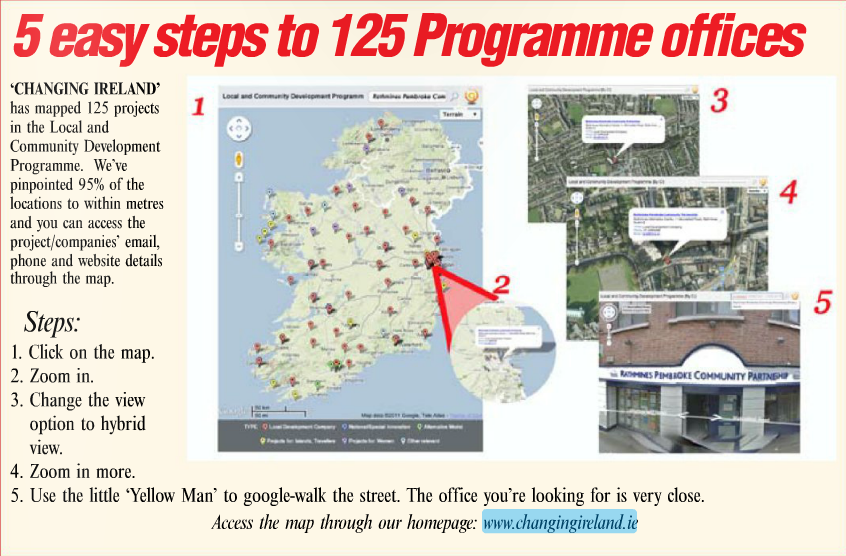
Track down LCDP projects around the country

Did you know Changing Ireland has the most comprehensive database of LCDP projects in the country? We can tell you where they are, how to contact them and you can even virtually stand outside their front door using our map. Above is our ‘how to’ guide to using the map.

Do it yourself! Cavan-Monaghan LEADER paves the way for local festivals

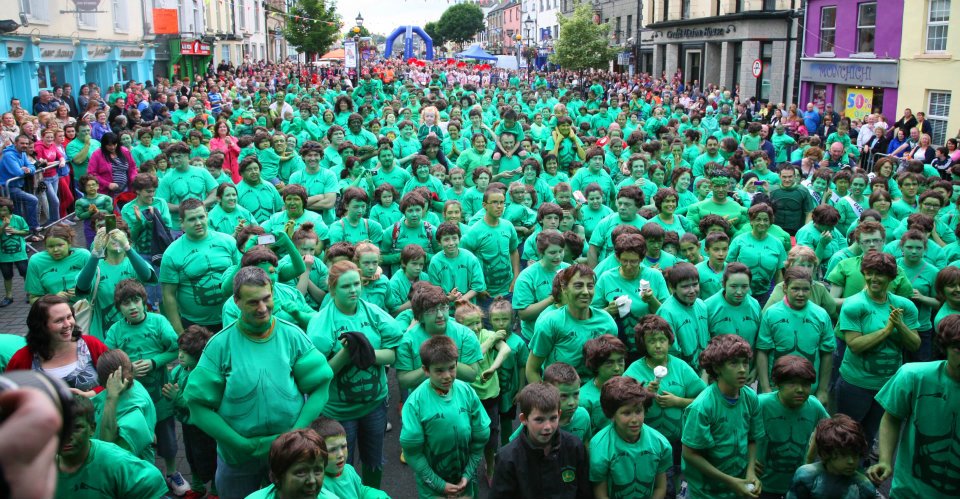
Casteblayney goes green in their successful attempt to break the Guinness world record for the most Hulks in one place. Photo: Glenn Murphy who is a voluntary member of the festivals committee in Castleblayney.

Cavan-Monaghan LEADER have helped to find a solution to a lack of sponsorship and sustain festivals and events in the two counties for years to come, by assisting in the purchase of equipment that would normally have to be hired at at a high cost.

After they were approached by local festival and event groups, regarding support in hiring equipment and assistance in marketing, public information events were held to raise awareness.

‘Castleblayney Community and Enterpise in Monaghan’ formed a band comprised of six local festival groups in order to purchase the relevant equipment which could be shared among them.
 
‘Castleblayney Festivals Group’ were helped with the purchase of festival infrastructure equipment including an all weather public address system, crowd control barriers, street cones, a small marquee and semi-permanent signs for each main access road to the town.   


Each of the six festivals also received support for local advertising, promotional banners, flyers and inclusion on a festival calendar which would be used to promote all events during the following year.   

Diverse events and festivals that have benefited from the funding have included agricultural shows, summer festivals, drama festivals, pipe band parades, fun sports events, film festivals, clan gatherings, heritage events, successful world record attempts and bog snorkelling.
Cavan-Monaghan LEADER has promoted this approach as a model of best practice to help sustain community festivals and events by keeping their running costs to a minimum, whilst maximising promotional opportunities.   Five lead groups have accessed approximately €250,000 in funding support for the benefit of a total of 23 individual festivals and events from Cavan and Monaghan to date.

Mid-West substance misuse support service launched

L-R: Chairperson of the Regional Drug Task Force Mick Lacey, Minister of State Jan O’Sullivan, Mayor of Limerick Gerry McLoughlin and Project Manager at CSMT, Maria Finn

A new service which aims to provide a free support service to under 18’s, who are affected by substance misuse in the Mid-West, has been launched in Limerick City.

The Community Substance Misuse Team will provide one to one, “specifically tailored” programmes to youths, as well as personal development, group, educational and parenting support programmes.

Opening the service, Minister of State Jan O’Sullivan said there was a real need for the service within the region, while CASP Project Manager Maria Finn added, “It’s about positively reinforcing the resources that people have and communities have to support their own members. There are brilliant services already here but sometimes people get lost between the gaps. We want people to realise they are more than the problem itself.”

For more information visit their into their office on the 3rd floor, Theatre Court, 15 Lower Mallow St., Limerick.

Programme work explained in 3 mins by RTE

RTE’s most popular radio programme ‘Morning Ireland’ this week broadcast a feature showcasing the success of the Local and Community Development Programme in helping over 5,000 people last year to set up businesses.

Here’s what was broadcast: 

– RTE’s interview with Corkman Paul O’Carroll who was on the dole and who now employs 3 people: https://bit.ly/MKi9c8
– RTE’s interview with Tony O’Regan, enterprise officer with Cork City Partnership: https://bit.ly/NTNkB7
– RTE’s interview with Allen Meagher ‘Changing Ireland’ editor providing the national perspective: https://bit.ly/MKhMyg
Or you can listen to the full five minute feature here: https://www.rte.ie/news/morningireland/player.html?20120718,3346247,3346247,flash,257

Ryan Howard of East Cork says – Think positive!

PROFILE INTERVIEW 

Who’s your hero?
Nelson Mandela. And my late father was a great man, a hard worker.
Nationally, what do we need more of?
We need to move away from the negative and begin focussing in on the positives. There’s not enough good news being reported and it has a subliminal effect on us all.

Nationally, we need less?

Negativity.
Why did you get involved in community development?
I worked in the private sector and travelled with the food industry. I liked the buzz and the adrenalin, then I took some time off, went back to college and studied rural development. I fell for it because it was so positive, constructive and it made a difference. Then I found myself volunteering in Macroom for three weeks, which turned into one year.

What are the top four issues in Ireland today?
1.     Employment.
2.     Suicide – particularly among young men.
3.     Isolation and lack of community contact within the last decade, although there’s a sense now that it’s improving.
4.     The Economy – there’s a growing sense of frustration.

What difference has it made to you being involved in the Local Development Company?
We are making a difference. Sometimes, you’re working with someone who has a dream but fears for their future… Sometimes, you start with communities who start with very little and you see them develop. It’s also very challenging, there are more barriers than there are solutions sometimes and you’re always thinking of ways to get around barriers. The job never ends.

What are you reading at the moment?
Jeremy Clarkson’s “Around a Bend”.

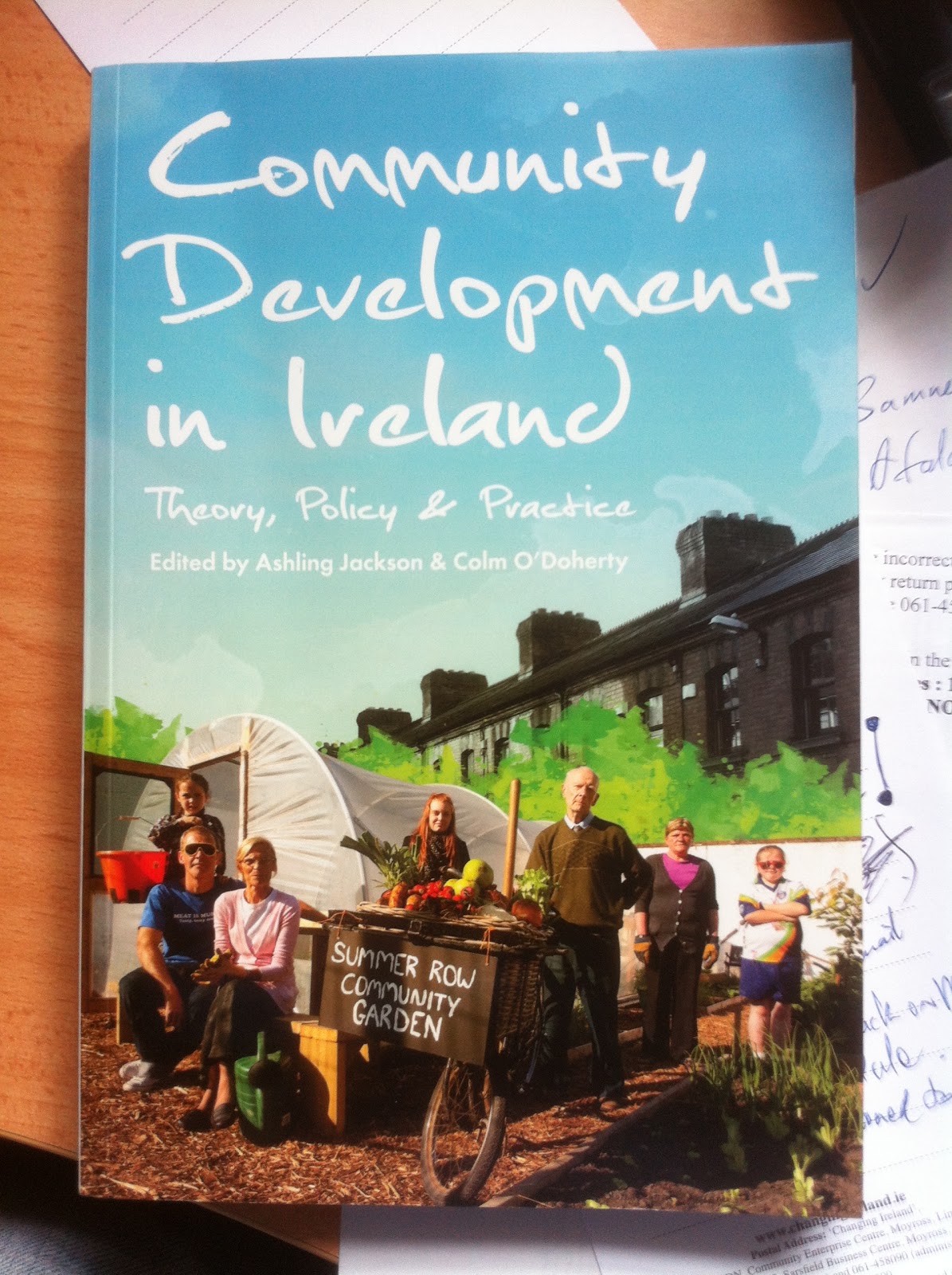
New textbook on Community Development

A new textbook introducing the theories and practices of community development, complimented by case-studies of Irish success stories, has been published.
In 250-pages ‘Community Development: Theory, Policy and Practice achieves a lot, for example it:
·       Shows how community development tackles social disadvantage and is a powerful force for social change in Ireland.
·       Looks critically at the relationship between policy and practice.
·       Shows what’s necessary for effective and sustainable community development in our rapidly changing society.
·       Offers solutions to current issues and challenges in Ireland.
·       Showcases models of best practice in various community development settings.
It also highlights ideas that are currently shaping community development projects and programmes nationally.
The book was co-edited by Dr Ashling Jackson and Dr Colm O’Doherty with third-level students in mind but it should also be of interest to community workers and volunteers/activists in local communities.

It’s published by Gill & Macmillan and was launched recently by Fergus Finlay of Barnardos. There is only one sting in the tail – it’s priced at €29.99. Ask your local library to buy a copy.


A dozen useful websites – find out more about Community Development in Ireland

There are a number of useful websites worth recommending to anyone interested in the Community and Voluntary Sector in Ireland and in Community Development.

1. https://www.activelink.ie
If you haven’t already signed up for Activelink’s weekly e-bulletins, do! They cover events, courses, jobs, volunteer-positions, charity announcements, appeals for help and offers of assistance. Pay to advertise.
2. https://www.changingireland.ie
Find out about the work of the Local and Community Development Programme and access 11 years of archived magazines about community development in Ireland. An online map links to every Local Development Company and there are links to the ‘Changing Ireland’ news blog and social media outlets.
3. https://www.wheel.ie
A well-established national network of NGO and charity organisations. The Wheel produces a print magazine called ‘Le Cheile’ thrice annually which is also downloadable from the website. The site offers visitors a choice of resources that would interest anyone working in communities be it as a worker or volunteer. Courses regularly advertised.
4. https://www.cwc.ie 
The Community Workers Co-op provides political, academic and community insight into what’s happening in particular to State-funded community development in the Republic. Informed commentary and analysis. The CWC produces a regular e-bulletin. Member-driven.
5. https://www.spunout.ie
A lively, interactive site with tonnes of content. For and by young people. Current homepage topics cover everything from “My Volunteer Experience” to “Foreskin and Circumcision”.
6. https://www.ildn.ie
This is the network for the Local Development Companies whose work CHANGING IRELAND is funded to promote. The rural LDCs are also tasked with dispensing funded from the EU’s Rural Development Programme (aka LEADER). Note that the website is still in development.
7. https://www.craol.ie
CRAOL is the official network for the ever-expanding network of community radio stations in the Republic. Links to every station and much more.
8. https://www.volunteer.ie/
Does what it says on the tin – learn more about how you can get involved as a volunteer anywhere in the country. Tips for volunteers and links to volunteer centres around Ireland.
9. https://www.tascnet.ie/
A thinktank and policy-driver that seeks to identify and confront national elites. Has made an impact nationally. According to columnist and almost-ran politician Fintan O’Toole, “TASC challenges the existing consensus and offers new thinking and fresh ideas.”
10. https://effectiveservices.org/
The Centre for Effective Services website looks at best practice in the implementation of national programmes designed to support children, families and communities.
11. https://www.nicva.org/
Forget the ROI! Find out what’s happening in Northern Ireland’s community and voluntary sector NICVA is the Northern Ireland Council for Voluntary Action.
12. https://europa.eu/ey2012/
Finally, European-wide and with the year that’s in it, you should check out the official website of the European Year for Active Ageing and Solidarity between Generations. Lists events across the continent.
It might also help to scan through the organisations ‘Changing Ireland’ has “liked” through our Facebook page: https://on.fb.me/L7rCON
Also, check out the websites of Government Departments that play a major role in social inclusion.
And finally, do let us know what we’ve left out!
– Compilation by A Meagher


Ireland Version 2 – our democracy’s due an upgrade

Gearoid Fitzgibbon
By Gearoid Fitzgibbon
Given the scale of the economic crisis in Ireland, it is no surprise that political reform was one of the key issues in the 2011 General Election. There was a sense that the “operating system” of Ireland, our constitution, needed to be upgraded.
Our democracy needed an upgrade and all parties came up with proposals including Fine Gael and Labour. Nine pages of the 64-page ‘Programme for Government’ were on the topic of political reform.
Along with a number of specific referendums, the Programme promised to establish a Constitutional Convention.

The government has recently begun to sketch the outlines of this convention. It will, we are told, consist of 100 members, 33 elected politicians, and the rest citizens.

It has yet to be decided how these citizens will be selected and the precise agenda for the Convention. With the right focus, such a convention has the potential to begin a radical transformation of politics. It’s time for Ireland Version 2.0 and upgrading our country’s Operating System will need the advocacy and input of people.
Draft Government proposals say that the Constitutional Convention should report within 12 months on:
·         Our Dáil electoral system.
·         Reducing the presidential term from seven to five years.
·         Amending the clause on women in the home and encouraging more participation by women in public life.
·         Removing blasphemy from the Constitution
·         A reduction of the voting age. 
Other constitutional amendments can also be considered.
Though the LCDP, community workers can play a role in assisting citizens groups feed into this process through awareness-raising events on the constitutional convention or by other means. Such work comes under LCDP Goal 4 which aims to get people in communities more involved in decision-making.
To read pages 17-26 online of the ‘Programme for Government’ look up: bit.ly/fglpfg2011. And, by the way, the Irish constitution is also now available online and even as an app for smart-phones.
– Gearoid Fitzgibbon is a community worker with North Tipperary Leader Partnership. Gearóid is chairperson of Changing Ireland Community Media Ltd.

What makes Swedish childcare so different?

By Jenny Tellström 
Six per cent of those working in childcare in Sweden are men, one of the highest rates in Europe. In Ireland it’s less than 1%.
So what makes Sweden different?
Continuing our series on Men in Childcare, Jenny Tellstrom shares the experience of Sweden, where gender equality policies are transforming mens’ involvement in childrearing.

MEN GET ‘MATERNITY LEAVE’
In 1974, “maternity leave” became “parental leave” and it consists of 480 days of paid leave per couple.
Men are given equal opportunities to stay at home and it is up to every family to decide how to use the days.
Over time however, it was found that men continued to take a much smaller percentage of the leave.
In 1994, “Fathers’ Months” were introduced, meaning that 90 days of the total leave became reserved for the parent with the least days (usually the father) so that the couple would lose them if the father didn’t use them.
Men currently use 22% of the 480 days and the new generation of young males seems to have a completely different attitude towards their roles in childrearing. For many young fathers, it is now a given that they spend a few months at home with their children. With men spending more time with their children, attitudes in society towards men in childcare are changing too.
GENDER EQUALITY
The Swedish pre-school curriculum is focusing on playing and developing social skills rather than education and an equality development plan for boys and girls to be equally treated is central to the curriculum. Childcare workers are trained to break down unfair patterns, for example by preventing boys from taking all the attention and encouraging girls to participate more.
Much time is spent doing outside activities, regardless of bad weather.
IRELAND’S CALL
That men in Ireland are significantly under-represented in the childcare sector is not strange when they are not given the same opportunities as women to take part in the rearing of their own children. Men who enter childcare often face suspicion.
Society is not just going to change itself. The key thing is really to advocate fathers’ right to paternity leave. Fathers would have a stronger bond with their children, share more responsibility in the home, and women could go back to their jobs faster.
In time, we will see more men involved in childcare.

You’re never too old

Helen Callan

By Helen Callan
From Townspark, Navan, Co. Meath, Helen Callan, who is now in her 50s, volunteers with young people at risk of drug addiction. She was 40 when she returned to school and she wrote this article “to encourage some of your readers to bite the bullet themselves”. It’s most apt as we celebrate the European Year for Active Ageing and Solidarity between Generations:

I left school at 14 with no qualifications.  I had to mind the house and my brothers and father. To be honest, I was really the woman of the house from the age of 10. My mother had died when I was 5.
Later I got married. I had 6 children and after 15 years my marriage broke down. My whole life revolved around my children and my house. I was a mammy, beginning, middle and end.
As the kids began to get older, I was asked to get involved in a local women’s group, which taught cooking and sewing. It got me out of the house and I enjoyed it. This led to taking part in other family related courses like parenting, personal development and confidence building. At this point any courses I was doing were to benefit my children. At the time, Helen as an independent person didn’t exist. All the skills and knowledge I was learning were all put to use improving life for my children.
As time went on the children grew up. A second relationship failed and I began to look at the reasons why I was making bad personal choices. I had come to the stage where I had to start caring for and working on myself. Now was my time. I got involved in the local community project, got a training place in Navan Traveller Workshops and started taking a Parent to Parent Course.
Parent to Parent educates parents on drugs and how to talk to their children about drugs. I got on so well I became a facilitator and set up a local group where parents could find a safe and confidential space to discuss how drugs were affecting their families and offer them the opportunity to listen and learn from each other.
Looking back at the unsure and uneducated housewife all those years ago, did I ever think she would have grown so much in confidence and knowledge? Did she ever think that she would be leading her own support group for parents and be playing a active role in the community and voluntary work in her town?
I was only starting out.
I was no longer the scared housewife stuck at home with no confidence and no skills.”


Learning to drive at 50 was a huge achievement for me. I could go anywhere I wanted. It was further proof I could accomplish anything I set my mind to.  The amount of women in my area who took to driving for the first time after they seen me in my car was amazing. It was proof that I wasn’t the only one benefiting from my new confidence.
Like many of my generation, circumstances when I was young took my out of education. Even during the time I spent building up my confidence on courses and sitting on committees, there was always something in my head holding me back. Being a dyslexic didn’t help.
The paid jobs I picked were manual, cleaning, waitressing and anything that wouldn’t involve paperwork. I couldn’t read and write properly. I never had the opportunity to learn the basics when I was young. I was too busy being a mother figure to my brothers and father. Now that was going to change.
I was 55 when I went back to education. A friend told me about a Social Care course which I felt suited me down to the ground because of my involvement in the community. I never looked at the contents of the course and never realized how much paperwork would be involved until I started. Essays, reports, exams, everything I used to run a mile from, here it was facing me.
I have to say that the tutors and the VEC were incredibly supportive. The tutors picked up on my difficulties and frustrations and my class also helped me. No-one ever looked down on me. I was never made feel out of place. It was wonderful to be in a group that encouraged me to finish the course, which I did and graduated last year. When I had it all done and finished I was so proud of my achievements.
My new skills and education made me look at myself and my place in life differently. I was no longer the scared housewife stuck at home with no confidence and no skills. Now I could write letters, drive a car and had a qualification. Who was I now?
A very proud woman, I’m working out what my next adventure will be!
NOTE:
Helen was until last year a voluntary board of management member of Navan Community Development Project funded by the Community Development Programme, a precursor to the Local and Community Development Programme.