Friday, July 3, 2026
Home Blog Page 49

Evidence proves early childhood support works

– NO LONGER A HUNCH, BUT A CERTAINTY

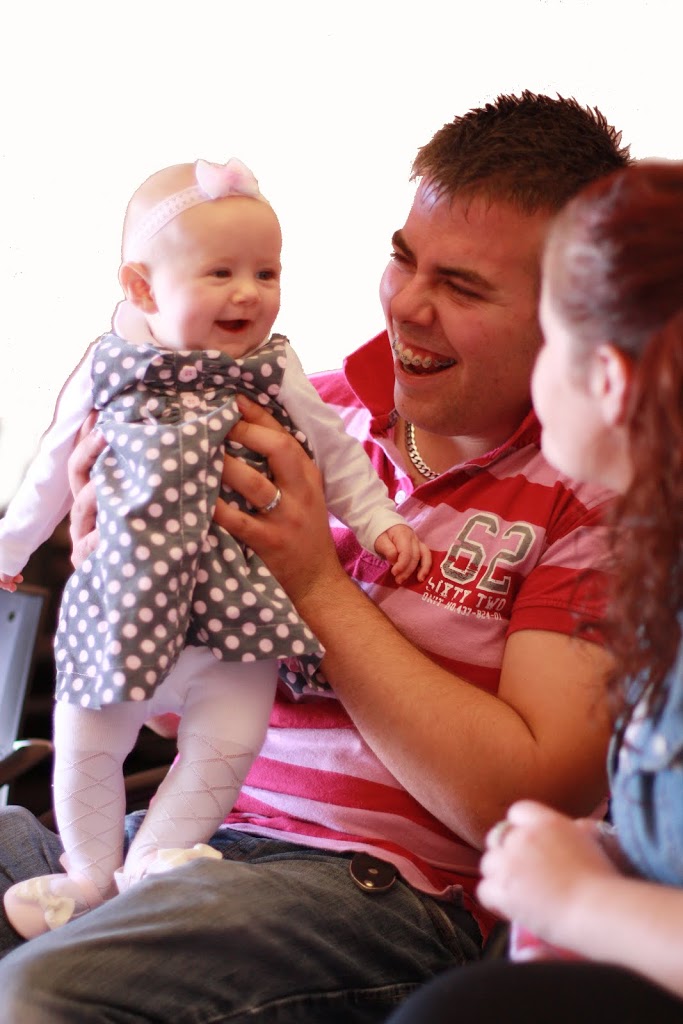
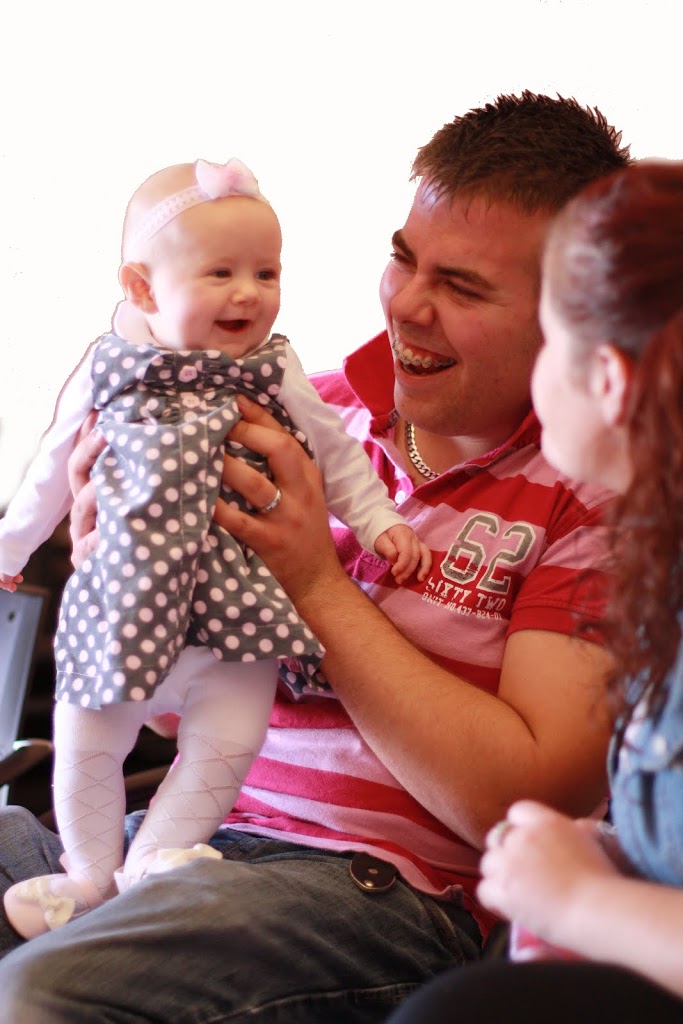
Gillian Cumiskey, Shane Kearney and daughter Mia. 
Photos by Preparing for Life staff.

Breaking scientific news from the world of community development: An early childhood intervention programme in north Dublin has proven that early childhood supports truly do work. 

The team behind ‘Preparing for Life’ worked away beneath the radar for years, like many community workers do. However, they agreed to talk to ‘Changing Ireland’ and featured as the lead in our Spring 2016 edition.
Our coverage include a feature by Ben Panter and an interview with family mentor Sarah Jane Leonard who has been involved in ‘Preparing for Life’ from the beginning. 

Making history with children in north Dublin

Editorial by Allen Meagher

Allen Meagher, ‘Changing Ireland’

‘Preparing for Life’ is a community initiative conducted by the Northside Partnership and funded by the Department of Children and Youth Affairs and Atlantic Philanthropies. What makes it different is that, every step of the way, the work is being evaluated by a team from UCD’s Geary Institute.

And they have proven beyond doubt that early childhood support is worth its weight in gold.
For anyone working in early childhood care or development, they have scientifically measured the impact of your work. If you had a feeling you were having an impact but couldn’t swear on it before, now you have the proof. Presuming you’re doing the kind of things they do in north Dublin.
Tremendous detail is provided in analysing the results and everything is rigorously backed up by science.
The findings to date should be of interest to everyone, from parents to national policy-makers, programme-designers, trainers and lecturers, and community-based projects seeking evidence to support grant applications. They are of interest to students and indeed anyone wishing to better understand children’s development.
The material is all available online. It’s dense, yet insightful, and supported by data throughout. It will be immensely important in guiding us in the long-term.
The project focuses, for instance, on cognitive development and how best they can nurture their children in a challenging environment.
The programme recognises that, “Disadvantage is often associated with lower cognitive resources which can be a difficult intergenerational cycle to break.”
On this issue, the team have made a breakthrough. Their interventions are working. Children receiving support show better cognitive outcomes and this is but one example.
Early childhood interventions can be better targetted as proof emerges about what works best. It should now also be easier to campaign for increased funding to help young children grow and develop to their full potential.

PROOF THAT EARLY CHILDHOOD INTERVENTION WORKS

– Study has “important policy consequences”

Ben Panter, journalist

BY BEN PANTER

A pioneering project – conducted by the Northside Partnership in Dublin and evaluated by UCD – is Ireland’s biggest random control study into the effects of intervention in early childhood. It involves 200 families, has been running for nine years and supports social, emotional and behavioural development, literacy, physical health and cognitive health.
It has also produced evidence that early intervention works. The latest research  – published in January – documents outcomes for children who have participated in the programme from birth up to age four..
The need locally for early childhood intervention was first identified after a 2004 study (Murphy et al) in the Northside area found that half the children starting school lacked skills considered essential for education. The target area includes all of Dublin 17 and parts of Dublin 5.
The study revealed that language, communication, cognitive development and general knowledge were all areas that needed to be addressed.
As fortune would have it, around this time Atlantic Philanthropies (AP) had expressed a desire to invest in programmes for children and youths in Ireland.
The Northside Partnership was asked to submit a proposal and focused on early childhood.
“There is now a lot of evidence to suggest that intervention is better than crisis management later on,” programme manager Noel Kelly told ‘Changing Ireland’.
“Children are more likely to be ready when they go to school, this results in higher educational attainment and a decreased likelihood that they will suffer from addiction, mental health issues and anti-social behaviour.”
Much of his team’s initial work was informed by the research of Prof. James Heckman, a Nobel winner from the USA. He was among the first to provide evidence that investing in early childhood care was a most productive use of resources.

The Department of Children and Youth Affairs got behind the Northside Partnership in supporting the programme alongside AP with five years of funding (through the Area-Based Childhood Programme).

Above: Amber Ward.

 In a project that will have such a long term impact on the lives of its participants, mistakes were not an option. Preparation was essential.     

It was not until 2007 that the programme began in earnest and even then it was a further two years until fieldwork began. Why did it take so long?
Noel said, “We had to be absolutely sure we were not doing harm, yet we had to be sure it worked. The debate raged long and hard and now we can say that this study can stand up to international scrutiny.”
There were huge ethical concerns. The programme involved Randomised Control Trials (RCT) which meant splitting volunteer parents into two groups, all with different levels of intervention.
This presented a dilemma for those involved with the project.
As mentor team leader, Val Smith recalled: “There were concerns, we had two groups of families and all of them would be needy, one group would get the services (but not the other) and we thought that clearly that can’t be right.
“The answer to that was; we actually don’t know whether the programme is going to be doing any good or not, so we are not actually (knowingly) denying anyone anything.”
Orla Doyle, economics lecturer in UCD and the principal investigator on the ‘Preparing for Life’ research team emphasised the importance of the control group: “The study was unique in an Irish setting because most evaluations of early childhood intervention were not tested rigorously.
“The RCT evaluation design ensures that any impact we identify has been generated by the programme, we can definitively say that any outcomes are a result of this intervention.”
With these concerns addressed to the satisfaction of the team, they began the arduous search for willing participants.
“We didn’t have a mandate, we are not TUSLA and we had to win over parents’ trust,” said Noel.
“Parents volunteered, we had to meet them in the maternity hospital which was very time-consuming. We had to do all the footwork and physically meet them. It was successful though, 52% of parents joined,” he said.

David Burns, Gemma Dwyer and daughter Ava.

It was not all plain sailing. Since the programme is voluntary, parents are under no obligation to see it through to the end, according to Val Smith.

“Five years is an awful long time and it can be difficult to keep people actively engaged. There were incentives to get people to sign up and people were joining because of that and it is difficult to keep them engaged.”
A cost benefit analysis is currently underway and the results should be known in September.
Meanwhile, the programme has secured a second phase of funding and over 140 parents have already signed up.
The programme recognises that, “Disadvantage is often associated with lower cognitive resources which can be a difficult intergenerational cycle to break.”
“Regarding child development, the programme was most beneficial for the children of first time mothers and the children of mothers with lower cognitive resources,” state the researchers.
“This is a positive development for the programme with important policy consequences,” they humbly point out.
For more info, contact Melanie Murphy.
E: melanie.murphy@nspartnership.ie
T: 01-8771509.
W: preparingforlife.ie



Sample findings 

BY ALLEN MEAGHER

Each family was part of a group receiving either high or low levels of support and after an 18-month period, researchers made the following discoveries:
·       Children in the high treatment group displayed a higher level of gross motor skills.
·       They were less likely to be at risk of socio-emotional and cognitive delay compared to those in the low treatment group.
·       They had more appropriate eating patterns, were less likely to be hospitalised and had better mother-reported health.
·       Mothers in the high treatment group were more likely to have positive interactions with their children.
·       The home environment was more likely to be appropriate and safe for those in the high treatment group, most notably in the realms of appropriate behaviours toward children, overall health and safety of the environment and the availability of age-appropriate learning materials.
·       Download the 18 months report, a PDF, here: https://bit.ly/1VJEtZU
So, what kind of support is provided?
For example, children internalise and externalise problems. As well as measuring this, the team provided parents with ‘Tip Sheets’ to help them encourage their children to express emotions. This aimed “to offset children’s communication problems which, if left unchecked, could lead to clinical levels of internalising or externalising behaviours.”
At 48 months, results generally – from 217 interviews – were less stark than before.
Children in the high level support group did nonetheless clearly demonstrate “positive programme effects in the areas of cognitive development, behaviour, and fine motor skills”.
There was “some evidence of consistency over time, particularly in the areas of cognitive development, behaviour and age-appropriate skills”, the researchers said.
However, some of the positive effects on children’s behaviour observed at both 24 and 36 months were no longer evident at 48 months.
The research team partly attributed this to flagging interest and involvement in the fourth year of engagement by some parents. The studies continue.
For this, and so much more, visit the website. W: geary.ucd.ie/preparingforlife/

‘Preparing for Life’ events to share their good news

In the coming months, Preparing for Life will host a series of events to share the findings from the random control trial research project by the UCD Geary Institute which has followed the journey of the original 200 Preparing for Life families since 2008. The research project set out to determine whether the programme’s approaches have helped to improve children’s school readiness. 
– The following three updates were first published on April 13, 2016, in Northside Partnership’s newsletter.
1. Research Seminars at the Mansion House, May 17th:
A series of short seminars will provide an overview of specific aspects of the Preparing for Life study beginning with “Preparing for Life – Results for Children at 48 Months” on Tuesday, 17th May from 11am to 1pm. A second seminar will focus on the “Children’s Profile at School Entry Study & Child Health Results” and will take place on Wednesday, 22nd June from 11am to 1pm. To register, email melanie.murphy@nspartnership.ie.
2. Academic Conference at UCD, Aug 31st:
“Preparing for Life – The Results” is a one-day academic conference that will provide a more detailed insight into all aspects of the Preparing for Life study since 2008 together with keynote addresses from Professor Richard Tremblay of the University of Montreal / UCD and Professor Hirokazu Yoshikawa of New York University. It will take place on Wednesday, 31st August from 9am to 3.30pm. Click here to register.
3. Community Celebration in Darndale, 1st week in September:
The research launch calendar will culminate with a special community event in the first week of September in Darndale Community Hall (a final date is yet to be confirmed). This event will focus on thanking the 200 families who took part in the study together with all of the project’s partners and supporters within the community.
1-to-1 INTERVIEW

– with Sarah Jane Leonard, Family Mentor (pictured)

Sarah Jane Leonard is a Family Mentor with Preparing for Life’s Home Visiting programme. She has worked with Northside Partnership for 20 years and with Preparing for Life since 2008. Mentors work alongside families from pregnancy to when the child starts school. They provide information on child development and parenting, with the aim of improving school readiness. Below, she describes what this role entails.
– This interview was originally published on April 13, 2016, in Northside Partnership’s newsletter.
Describe an average day?
Most days are 8.30am – 4.30pm. I divide my time between our Darndale and Coolock office, but primarily my work is in the family’s home. On a typical day I have up to four appointments with my families who are mostly pregnant women and mothers with young children. Depending on their preferences, we meet in their home or a neutral spot like a coffee shop. I also sometimes meet clients in the evening, if they work during the day
The aim of the home visits is to support the parents to be proactive in their parenting role and in meeting the needs of their child. Key child development and parenting issues are addressed using a set of PFL-developed Tip Sheets. We have developed these based on current research and guidelines and we hand them to the parents at each visit. Parents can ask me anything about parenting and child development but I remind them that they are the expert. Boundaries are essential to this role. I also deliver the Triple P programme which helps parents with positive parenting strategies. 
There is also paperwork involved in my role so when I go back to the office I need to maintain case files on our database. On occasion, I also link in with other services working with a family to ensure that all agencies are working together and that everything is transparent.
What do you enjoy most about your role?  
I am very passionate and committed to what I do. I love my job, every day is different. The best part is when I see parents making changes and acknowledging that change. 
A fundamental part of my job is building relationships based on mutual respect and confidentiality. As mentors, we never tell them what to do. We give parents information so that they can make more informed choices and decisions about their children. We like to encourage parents to enjoy their children and to talk to them. 
What personal characteristics should a family mentor have?

I listen and never judge, which helps build relationships. One thing I know is important and that works well is prompting parents to come up with solutions for themselves. Also to give praise and feedback, if necessary. I ask questions like what do you think you could have done differently there? That’s part of our training. One size doesn’t fit all, in helping a family to reach their own solution. 

Students “Stand Up!” to homophobic bullying


by Mark Quinn

The 7th annual “Stand Up!” week was launched this morning in St Nessan’s Community College, Limerick by the Minister for Education and Skills Jan O’Sullivan.


The campaign runs until Friday 27th November and aims to address homophobic and transphobic bullying in schools and youth services by encouraging friendship and a positive understanding of LGBT young people.


“Stand Up!” provides teachers and youth workers with information and materials that helps them to engage in a positive way with the issues that LGBT young people face.


Speaking at the launch, Minister O’Sullivan said that her department is deeply committed to tackling this type of bullying in schools:


“I urge every post-primary school to take part in this important initiative. It continues to go from strength-to-strength each year and is a great campaign, with benefits for students and entire school communities.”


Photos: Alan Place Photograph

The campaign is run by BeLonG To, Ireland’s national organisation for Lesbian, Gay, Bisexual and Transgender (LGBT) young people.


Moninne Griffith, executive director of BeLonG To, said that the recent change to the constitution recognising equal marriage rights for same sex couples is a cause for optimism. However, there is still much work to be done to embed that into a cultural change that young people notice in their everyday lives:


“Even when you introduce marriage equality, homophobia and transphobia don’t just go away over-night. You have to keep working on it and investing in projects that tackle it and that’s what ‘Stand Up!’ does.


39% of civil society groups engaged in advocacy work in 2013

0

The survey found that 61% of groups were not engaged in advocacy work at all. Of the 39% of non-profit organisations that were engaged in social justice advocacy, most did so at local and not national level.

However, planned advocacy was on the rise, with 44% conducting information and awareness raising work, 19% focusing on policy implementation and 18% developing new policy.

Raising public awareness, networking, participation in local committees, and lobbying were the main activities campaigners choose.

1) The advocacy target was most often the general public.

2) The second most popular targets were local committees and county councils.

From the survey, the AI recommended:

  • A key way for civil society organisations to successfully stand up for citizens is to collaborate with other organisations to get the message across.
  • Keep your message simple, tell clear and compelling stories, take risks in campaigns and recognise there is value in creating strong political alliances.

Revealingly, the survey found that only 15% of members of the public thought the Community and Voluntary Sector was influential in political decision making; 46% felt the sector should be influential.

The Advocacy Initiative ran for three years and its website remains accessible: advocacyinitiative.ie

Independence of NGO sector is at stake

UCC conference on assertive communities set for Oct 21 – organised by Co-op Studies & Civil Society researchers

Brian Harvey, Anna Lee, Mary Fogarty and Marian Harkinare among the guest speakers lined up for a conference on local and community development to be held on Wednesday, October 21st, in University College Cork.
Dr Carol Power

“The conference is titled ‘The Changing Landscape of Local and Community Development in Ireland: Policy and Practice’ and “will be of interest to community activists seeking positive change,” says Dr. Carol Power, Centre for Co-operative Studies, UCC.
 
Entry is free, but you must register in advance and the earlier the better (see below). You can view the day’s full programme here.


Organised by UCC researchers at the Centre for Co-operative Studies with colleagues from the university’s Civil Society Research Cluster, it will examine how policy and practice is changing in relation to local and community development in Ireland. 
Together, they began a research project prompted by the Local Government Reform Act (2014) which seeks to achieve better co-ordination between local government and local development through a process of alignment. This is having far-reaching implications for those working at the coalface of local and community development.
The conference forms part of their research project.
The UCC researchers will be joined by the following high-profile speakers:
Brian Harvey
Anna Lee
  • Brian Harvey, author of a landmark report on the impact of austerity on the community and voluntary sector will provide an overview of recent changes in the sector. 
  • Anna Lee, who has worked in the not-for-profit sector for many years, will present the view of community development policy in Ireland from the frontline.  Anna is former CEO of South Dublin County Partnership and currently chairs Volunteer Ireland.

    Mary Fogarty with Maeve O’Hair


  • Mary Fogarty, who with her neighbour Maeve O’Hair pioneered the Loughmore Co-operative Shop and Tea Rooms in Co. Tipperary, will talk about her experience of setting up a co-operative.  Theirs is one of many examples one finds around Ireland of community-led initiatives that seek to combat issues such as rural isolation and lack of services. 
  • The day will close with an address by Marian Harkin, Independent MEP.  


Admission to the conference is free but, due to venue capacity, you are best advised to register in advance by emailing: cpower@ucc.ie

Independence of NGO sector is at stake

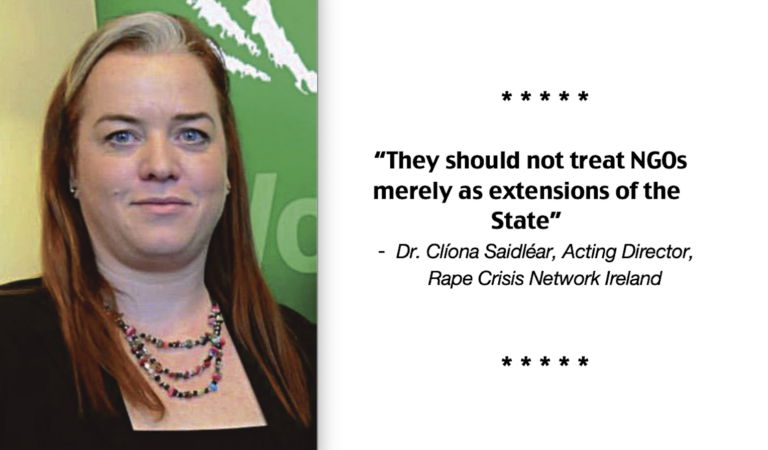
By Dr. Clíona Saidléar, Acting Director, Rape Crisis Network Ireland

In Rape Crisis work, unfortunately, independence from the State is vital, particularly when as many as 65% of survivors of sexual violence who come to Rape Crisis Centres (RCCs) choose not to report to the Gardaí.
One particular contractual clause stands to silence Rape Crisis Centres from advocating for change. It reads:

“The Organisation must not use the grant for… campaigns whose primary purpose is to obtain changes in the law or related Government policies, or campaigns whose primary purpose is to persuade people to adopt a particular view on a question of law or public policy.
“This subsection is not intended to affect the Organisation’s right to utilise other sources of funding to raise awareness of issues or to run campaigns on issues of public policy directly related to the Organisation’s work or which is in conflict (as determined by the Agency) with the stated policy of the Agency.”

Our understanding is that such clauses are becoming largely standard in statutory contracts with the third sector, but is it one we should accept without protests?
Such clauses severely threaten the capacity to do the survivor advocacy and transformation work that is the core of the RCC mission.
Ultimately our capacity to bring an informed and specialist analysis to bear on government decision making in this much neglected area is being eroded.
In a society where 1-in-5 girls, and 1-in-6 boys experience sexual abuse and 80% of survivors do not seek professional support or report to the State, the independent voice of the Sector remains vital.
The lack of engagement of the majority of victims with government means that government simply cannot do this work on its own or in-house.
Any government acting in a legitimate manner on this question must seek to transform society towards prevention. That cannot happen if the independence, scope and range of the activities undertaken by the Sector is subsumed into the State.
They should not treat NGOs merely as extensions of the State whose service provisions are funded purely on the basis of ‘delivering the funder’s agenda’. For this risks emptying the Third Sector of the vital role of listening to the silenced, learning and translating and engaging and challenging policy and practice to create change.

FOLLOW-UP

’Changing Ireland’ took RCNI’s concerns to Minister of State Ann Phelan with whom we had an interview scheduled.

• Ann Phelan, Minister of State for Rural Development.

Minister Phelan called for anyone with concerns over advocacy, clauses in contracts or any other issues to meet with her:

“I’d be willing to sit down with them all, work with the Government Departments and see if we can alleviate their concerns,” she said.

Minister Phelan agreed the National Adult Literacy Agency could be asked to proof-read clauses to ensure they are written in plain English.

RCNI’S FUNDING CUT

More recently – since penning this article – the RCNI began to campaign nationally for a reversal of HSE cuts to its core-funding. Tusla which funded the RCNI until March 31st said:

“The 2015 budget has been directed towards front-line service… The decision to cease the funding to RCNI is dictated by the need to achieve the best use of limited available resources.”

Tusla said it has “developed a strategy for putting the domestic and sexual violence sector on a sustainable footing.”

39% of civil society groups engaged in advocacy work in 2013


Challenger Programme

[et_pb_section fb_built=”1″ admin_label=”section” _builder_version=”4.16″ global_colors_info=”{}”][et_pb_row admin_label=”row” _builder_version=”4.16″ background_size=”initial” background_position=”top_left” background_repeat=”repeat” global_colors_info=”{}”][et_pb_column type=”4_4″ _builder_version=”4.16″ custom_padding=”|||” global_colors_info=”{}” custom_padding__hover=”|||”][et_pb_text admin_label=”Text” _builder_version=”4.23.1″ background_size=”initial” background_position=”top_left” background_repeat=”repeat” hover_enabled=”0″ global_colors_info=”{}” sticky_enabled=”0″] 

INTRODUCTION

TV3’s ‘Darndale, the Edge of Town’ broadcast over three weeks in September presented a touching but sometimes stereotyped picture of the north Dublin suburb, REPORTS ALLEN MEAGHER.
Filmed over 12 months, the producers called it an “honest portrayal of Darndale’s residents’ lives” as they followed the day-to-day struggles of a former career criminal, a heroin addict and two single mothers struggling to make ends meet.
Ciara Hurley who is from Darndale said the programme did not provide an accurate portrayal of the area.
Her own story is inspirational in what she achieved. She always believed in herself and so did her parents.
Today, Ciara is highly educated and gives full credit to herself – “You have to believe in yourself,” she says. She gives full praise to her family first and foremost and to the Northside Partnership for the support it provided to her and hundreds of schoolkids through its 19-years-old ‘Challenger Programme’.
Recently, she told her story (page 5 across) to a large attendance for the first time at a book-launch (see page 19) by the Irish Local Development Network for which community workers and leaders had travelled from throughout the country to attend.
However, Ciara also spoke up to highlight that much rolex gmt master ii rolex calibre 2836 2813 m126719blro 0002 mens 15mm meteorite dial more needs to be done by the State because, as she pointed out,  only 15% of people from Dublin 17 still go onto third level.
The rates have not changed since she was a schoolchild.

If Ciara could change one thing…

– Grateful beneficiary of 7-year-long ‘Challenger Programme’. 
– Triple graduate of St. Pat’s, Maynooth & Bath.
– Now back teaching in the area she grew up in.
– Moves to 3rd level “still just 15%” in Dublin 17.
“I’m from Darndale, I’m one of four children and the first in my family to go onto third level,” says Ciara Hurley.
“Both my parents were early school leavers, they came from working class atvs xtra grossistforsaljning av engangsbloss med 1500 puffar forpackning med 10 st backgrounds, they worked hard all their lives and continue to do so to this day to support us to go to college.
“Growing up in a working class area like Darndale didn’t mean this was unattainable.
“My parents planted the idea very early in my life. I always knew I was going to go to college. Having the full support of my parents both financially and emotionally was one of the biggest factors that added to this success in my life.
“Another factor was the ‘Challenger Programme’. In 1999, I got the opportunity – in my final year in primary school – to join the seven-year programme and break the cycle of low education.
“It gave me a whole range of supports from grind to going to the Gaeltacht and was life-changing for me.
“The programme began a lifelong love affair for me with education… I became a member of a club for people with similar ambitions, we became a support network for each other and my parents met their parents. That was in 1999 and I’m still in contact with many of these friends today. The ‘Challenger Programme’ was about so much more than education, it was a way of life.”
Ciara emerged with an Honours BA from St. Patrick’s College and went onto NUI Maynooth and Bath, England, from where she emerged as a qualified primary school teacher.
“I’m delighted to say I now work in St. Joseph’s National School, Ballybrook, which is one of the five schools where Northside Partnership offer the ‘Challenger Programme’. So things have come full circle.”
“However, when I returned home (from England) I heard about a report from the Higher Education Authority which shows that progression rates into third level education for young people from Dublin 17 is still just 15%.
“As someone who’s came from in the area, has been to college and is now back as a teacher, I hope I can be seen as a role model.
“I know that young people from Dublin 17 are just as talented and have as much potential as young people anywhere else in the country. If they want to go to college – and it isn’t for everyone – (they may choose) to pursue careers that will help end cycles of poverty and disadvantage that effect generations of families in the area.
“In my own life, education has been a powerful influence.
“I’m delighted to be back in Dublin 17 and to have the chance to make a real difference in children’s lives. Sadly, a lot of children will not aspire to go to university – and to be fair it’s not for everyone – but we need more children to consider it as a realistic option.”
If Ciara could change one thing it would be to roll the ‘Challenger Programme’ out for absolutely everyone who wants it in Dublin 17.
“It should be offered to all children in the area,” she said.
On 8th October this year, 154 parents and students turned up for an information meeting about the next rollout of the ‘Challenger Programme’. Northside Partnership organisers describe interest as “huge”.
“Looking back,” said Ciara, “I can see that the supports the programme offered me were very valuable indeed. The programme opened many doors for me and linked me in with the Partnership where I got career guidance and financial support.”
Ciara said however that the support of parents for ambitions children remains “crucial”.

About the ‘Challenger Programme’

The Challenger Programme was set up by Northside Partnership in 1995 to tackle early school leaving and to improve progression to third level education in the Dublin 17 area.
The programme was expanded in 2010 to include two further schools in Kilmore West in Dublin 5.
Today, the Challenger Programme works with five schools located in the Darndale, Belcamp, Priorswood, Bonnybrook and Kilmore West in Dublin 5 and 17, where there is strong evidence of the need for this programme. The programme currently covers an area with a population of approximately 16,000.
According to the 2011 Census, just 6.5 per cent of adults in the ‘Challenger’ target area have a third level qualification, compared with 30.6 per cent of adults nationally. Similarly, 34 per cent of people in the ‘Challenger’area have progressed no further than primary level education, compared with 16 per cent nationally.
To address this, the programme supports ambitious young people from these areas to stay in school, complete their Leaving Certificate and to go on to third level education.
Students commit to a seven-year programme and receive a range of supports from 6th class in primary school through to their final years in second level. The supports offered range from reading clubs, maths clubs, conversational Irish classes, public speaking classes and grinds in core subjects to cultural trips, Gaeltacht scholarships, visits to universities and individual career guidance.
Parents of ‘Challenger’children must also commit to supporting their child’s education by taking part in a FETAC accredited course.
Over 300 students have completed ‘Challenger’. By last year, 242 participants (80%) had finished their Leaving Certificate and 134 had gone onto third level.

[/et_pb_text][/et_pb_column][/et_pb_row][/et_pb_section]

Editorial: Ciara’s calling & Roscrea stands up!

By Allen Meagher, ‘Changing Ireland’.


In preparation for the publication of this our 48th edition of ‘Changing Ireland’, we considered the need for the board, editorial team and other volunteers to head off for a 3-month strategic think-in on an atoll in the Pacific.

There’s a lot going on in terms of State funding and what it will fund in communities these days and what it won’t fund. Plenty to chew over in the mind.
And so the reports we carry in this edition of ‘Changing Ireland’ are intended to shake up your thinking, to examine the possiblities that are before us.
Ciara (front cover) calls for more investment in programmes such as the ‘Challenger Programme’ in Dublin 17 if we are to give everyone in our society the chance of a third-level education.
We’ve a strong focus throughout on projects that follow community development principles, the taking of collective action being one.
If people power – and it sure exists in this country – could be tapped and directed in a positive way, it seems Roscrea is pointing us in some of the right directions. Suicides and drug addiction hit the town hard and people have had enough. Obviously, they’re learning as they go along, but they’ve set a standard for small towns who despair that they are being left behind.
Notwithstanding the dedication of those involved in long-term community-based initiatives, Roscrea’s new approach teaches us to stand up and be counted. Their new approach, in co-operation with Gardai, State agencies and community workers, seems to be working so far.
Things are also looking up here in Limerick (don’t mind most of what you see on television or read in the ‘papers). The city has found a new way of dealing with conflict and it’s working in schools and across communities.
Meanwhile, in Maynooth, one of the key messages from the annual community development conference was that charities obviously have their place, but if you want to tackle poverty you need to take a human rights approach. Makes sense in this new 1% versus 99% world of ‘haves’ and ‘have-nots’.
Finally, on behalf of those suffering from cuts to the community, health and education sectors, we hereby lay a claim on any money Apple is obliged to repay in taxes due – let it be spent on social inclusion. Only right!

Changing Ireland magazine editor’s response to ‘Breaking Crime’ (Limerick)

[et_pb_section admin_label=”section”]
[et_pb_row admin_label=”row”]
[et_pb_column type=”4_4″][et_pb_text admin_label=”Text”]

The editor of national community development magazine ‘Changing Ireland’, based in Moyross, Limerick, has written to TV3’s chief executive, David McRedmond asking for improved treatment by the station of disadvantaged communities.
He has also produced a video response to the first installment of the ‘Breaking Crime’ programme broadcast on TV3.
“There should be a much stronger focus on the positive work being done on the ground, which ‘Breaking Crime’ barely touched on,” said Allen Meagher in his letter to the TV3 boss.
His views are echoed in reactions to the programme’s focus on the capital’s inner city, with the National College of Ireland saying the “negative publicity will make us even more determined to work together… at home, in the creches, schools, afterschools and in the community.” 

Established in 2001, ‘Changing Ireland’ highlights community-based solutions to supposedly impossible social issues. The magazine is based in Moyross which was referred to in the first instalment in the four-part series.
Mr. Meagher, speaking in Southill where the joy-riding element was filmed, said, “The integrity of that programme, in my view, was not quite what it should be. The car crime element provided joy-riders with over a minute’s coverage while failing to mention a project in the area that is successful in steering young people away from such activity. Also, that element of the programme lacked continuity, notably when at one stage a jeep disappeared.”
“We put questions on these matters to Donal MacIntyre through TV3 last week and await a response. We also pointed out there was much to commend in the programme. In the meantime, I have also written to David McRedmond.”
“I have asked that TV3 take on board the fact that there is far more positive action taking place for real compared to the miniscule amount shown for example in ‘Breaking Crime’s first instalment. There wasn’t a mention of the city-wide restorative practice projects in schools and communities that might help explain how Limerick is so much calmer in recent times.
The rise of the Limerickandproud hashtag meanwhile says it all in terms of the programme’s bleak presentation of a much-loved city. Columns by national press journalists Robert McNamara and Kehlan Kirwan have also highlighted the programme’s failings.
“We have additionally pointed out to Donal and the station that, for a programme supposedly looking at solutions to youth crime and poverty, there was no mention (certainly in the first programme) of the impact of cuts on community services while poverty was barely mentioned, never mind explained.”
“Donal MacIntyre’s well-intentioned work is overshadowed by the focus on producing film that is noisy and dramatic. A programme could have been produced – perhaps even more dramatically – that dug deep into the structural causes of poverty and crime.
“It would have been fairer had at least more time been given to the full range of activities that communities are engaged in to better their areas. That kind of work is going on nationwide.”
Mr Meagher has invited TV3 to seek new ways to balance the need for commercial success with their duty of care towards vulnerable people and communities and to focus more on issues and solutions within communities and less on the drama on the streets.
Mc McRedmond has in the past spoken of turning TV3 becoming a “centre of excellence” and of focusing on more home-produced content. 
“No doubt, TV3 wishes to demonstrate that communities are close to its heart and are off limits when it comes to playing a ratings game with other stations,” said Mr. Meagher.
(For examples of proven solutions to issues facing communities on the ground around Ireland, visit: https://www.facebook.com/changingirelandmediaor https://www.changingireland.ie).
FURTHER RESPONSES TO ‘BREAKING CRIME’
Overall, the first programme provoked a phenomenal reaction. It was condemned as “unbalanced” by journalist and Limerick native, Robert McNamara, writing for www.examiner.ie. Columnist Kehlan Kirwan, also writing for the ‘Irish Examiner’ and also from Limerick, invited people to go for a drive around the city and see for themselves. He provided an itinerary for people curious to see the city properly (https://bit.ly/1ucj4rz).
The public led by local councillor Daniel Butler who is also a community worker responded on twitter via the #LimerickandProud hashtag.
In response to the criticism, Mr. MacIntyre said Limerick is “over-sensitive”. 

[/et_pb_text][/et_pb_column]
[/et_pb_row]
[/et_pb_section]

Young, unemployed, angry and calling for action – one person’s experience

Vivien Whelan

– VIVIEN WHELAN SPEAKS OUT

Vivien Whelan from Wexford is angry about being long-term unemployed, yet remains positive about the future – once people realise they must take action.
If you’ve an interest in seeing this country facing up to long-term youth unemployment, Vivien’s article gets to the heart of the challenge at a personal and societal level and comes highly recommended by ‘Changing Ireland’ editor Allen Meagher.

Flood-relief Volunteers & Community give it all

– while Government criticised

‘Changing Ireland’ reporter Darragh Clifford-Cronin spoke to volunteers who came to the community’s aid after flooding of St Mary’s Park, Limerick, while local and central Government’s input was less than desired.
This week, residents published a report which was very critical of the official response and forwarded a copy onto An Taoiseach, Enda Kenny.

Darragh, a media student with Limerick College of Further Education, was on placement with ‘Changing Ireland’. Watch out for his print media reports in our Spring 2013 edition.

Ecoeye inspired by Tipperary’s community energy scheme

– Duncan Stewart sees groundswell build in face of “massive change”

RTE’s Ecoeye on Feb 4thshowcased the work of an unique LCDP-supported community energy project in North Tipperary.
Reflecting afterwards on this and a project he visited on Inis Mor, presenter Duncan Stewart said, “I believe we’re on the cusp of a massive change… it’s slow but it’s coming.”

All credit to the people in Drombane and Upperchurch in Tipperary, as well as North Tipperary Leader Partnership, for setting the example and showing how it can be done.

RTE’s Ecoeye visited Drumbane-Upperchurch to see how the Tipperary Energy Agency worked.
Their work featured in a broadcast on Feb 4, 2014.
Duncan is optimistic about communities showing resilience in the face of climate change: 
“Each community needs champions and a committed team. On Aran, it’s a co-operative; in Drumbane and Upperchurch, it was the local energy team. The idea of community energy is beginning to catch on.

“Recently, 51 local newspapers around Ireland have initiated the nationwide ‘Get Involved’ competition*, their aim is to encourage communities to set up sustainable energy co-ops in each Irish town.

“I believe we’re on the cusp of a massive change. There’s going to be a groundswell movement in every small little community across Europe. In Ireland, it’s slow but it’s coming where people will be saying ‘We want local energy, we want not to be using fossil fuel, we want to be able to reduce our energy demand and I think that movement is just about to start.”
Noel Byrne of Drombane-Upperchurch with Duncan Stewart.
* For more information, contact the SEAI or your local newspaper. The Drombane Upperchurch project has its own Facebook page.
Also, read ‘Changing Ireland’s earlier reports: https://changingireland.blogspot.ie/2013/10/retrofit-country-and-well-save-3billion.html

Affordable (€10) ‘Social Media for Change’ training in Cork on Jan 21st

In 1994, Ballyphehane CDP’s office had a typewritter and a telephone to communicate with the outside world. Now everyone has a tablet and they can communicate with most members of the community without leaving the building (they do leave the building). On Jan 21st, they’re hosting a seminar on using Social Media for Social Change and will look at how new technologies can help us communicate, campaign and challenge in the 21st century.

The event is supported by Cork City Partnership, the Irish Examiner and RTE. 
Cost €10.

CLICK THE “READ MORE” BUTTON BELOW FOR DETAILS…


Zen and the Art of Local development

by Robert Carey

Anyone who read Robert Pirsig’s best selling cult book (most likely in their younger years) ‘Zen and The Art Of Motorcycle Maintenance’ and claimed they understood every word could most kindly be accused of being self-deluded.
It was possible however for us mere mortals to glean the essence of some very important concepts. One of these, which was the tension between an empirical approach to life and a more qualitative approach, resonates highly for people today across a range of sectors, not least for those working in local development.
Our work is now dominated by outputs, indicators, logic models, audits, accounting, etc.
This is not to deny the importance of numbers, accounting and systems. They provide necessary structure within which the core work can be carried out and they can also contribute to value for money and in the case of numerical reports for example inform future work.
The importance of finding the correct balance however was illustrated for me at the AGM last week of the company in which I work:

The core portion of the meeting was presentations from those who had been beneficiaries of, and partners in North and East Kerry Developments community development work. Two women who had been supported under a women’s strategy funded at various points under both the LCDP and ‘Equality for Women Measure’ shared their experiences; the support had helped them to change their lives.
For one it was the catalyst to progress from a situation where she was contending with a marriage break-up, a son having issues in school, unemployment and low self-esteem. She and her family have since been transformed by the programme.
Another lady was becoming isolated in the home having had a child and again suffering an erosion of confidence. She found the friendship and support from the group instilled her with confidence and has since been offered a job.
Pirsig book Zen and the Art of Motorcycle Maintenance.Finally, we heard from a social enterprise run by people with disabilities which was presented by a member of the group who charmed the audience with her passion for the project and sales patter.
The financial report given was positive and its importance is not underestimated, but the meaning of the work and the reason for the organisation’s existence was put to the forefront. This was an important reminder to staff and board members alike about what lies behind the seemingly  endless paper shuffle.
At a variety of levels in Ireland there is a fundamentalism about money, auditing and numbers.  Ironically despite the ugly demise of the Celtic Tiger, there is still a focus on the price of everything and value of nothing approach, all be it in with different motivational spectre, not caused by status anxiety as previously but that of austerity, and now there is a new spectre in the form of alignment.
The balance is skewed and it will impact on people’s lives and the ability to find creative and imaginative solutions to social issues. As Pirsig says, “To live only for some future goal is shallow. It’s the sides of the mountain that sustain life, not the top.”
In other words, it’s what happens in between that really counts.
* Robert Carey is LCDP manager with North and East Kerry Development.

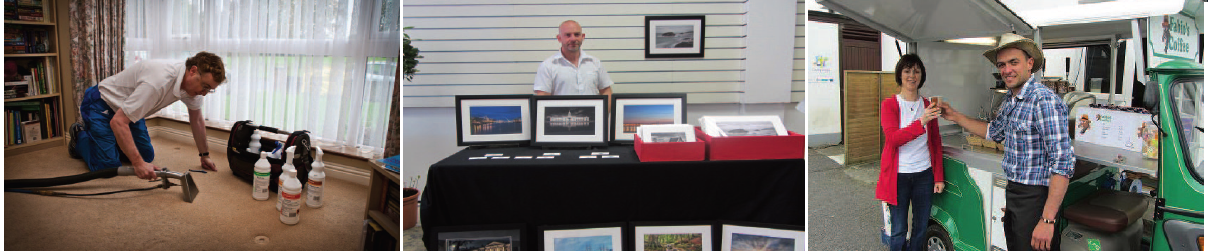
10,700 unemployed people set up their own jobs

And in turn created work for 700 more…

Every working day, an average of 23.4 new jobs are being created through the Government’s main community-level, social inclusion programme.
This is one of the unrivalled achievements of the Local and Community Development Programme (LCDP) as highlighted in a new report by Pobal.
The 108-page ‘Supporting Inclusion Through Self-Employment’ shows that the LCDP offers virtually nationwide, start-to-finish support for unemployed people with good business ideas.
As a result, over the past two years, close to 12,000 new jobs were created in Ireland by unemployed people with small enterprise ideas:
– 10,726 were created by people who set up small businesses;
– a further 717 jobs were created in turn by them for others.
Remarkably, two-thirds of the enterprises have got past the difficult first two years, the research demonstrates. Approximately 8,000 of the jobs remain in existence at the present time, many of the businesses are flourishing and new hopefuls are entering the marketplace every day.

The LCDP acted as the catalyst by uniquely targetting support at long-term unemployed people and those “furthest removed from the labour market”, among others.
Most of the LCDP-supported businesses are small, local operations, often sole-traders. The support is provided as a social inclusion measure by Local Development Companies (LDCs) which is what differentiates their work from that of Enterprise Ireland and City/County Enterprise Boards:
CEBs generally do not focus on long-term unemployed people with vague or non-existent business ideas, while for the LDCs these clients are their target group.”
AIM IS NOT JOB CREATION, BUT SOCIAL INCLUSION
“The LCDP is not supporting LDCs to operate as job creation agencies,” notes the report.
It provides something that wasn’t there before for the long-term unemployed in previous recessions:
The LDCs currently occupy a particular niche within the areas of social inclusion and self-employment, which is not covered by other agencies and organisations.”
The LCDP work also saves the country money every time it supports someone, particularly from the second year onwards when the enterprise allowance payments are reduced.
The report was commissioned because “In the context of policy developments, Pobal considered it to be particularly timely to review the self-employment supports being provided through the LCDP.”
FINDING 10,000 PEOPLE WITH GOOD BUSINESS IDEAS
Some of the successful business-people only had foggy notions when they first went to their LDC enquiring about courses, possibilities, advice or out of sheer desperation.
They may have called enquiring about a computer course for instance.
However, after the LDCs weave their magic, people’s outlook can brighten considerably and vague ideas can be developed into solid business propositions.
The freely available advice and support to guide unemployed people from start to finish as they go about setting up small businesses is available in virtually every part of the country through the LCDP.
OVER 30,000 MADE ENQUIRIES
In the past two years, over 30,000 unemployed people sought information from LDCs about starting a business, with under half of them going further with their ideas.
A critical component to the self-starters’ success was the further support provided to them by the Department of Social Protection which allows successful applicants to retain a payment that matches what they were getting on social welfare: 94% of people striving to enter self-employment availed of the Back To Work Enterprise Allowance Scheme or the Short Term Enterprise Allowance Scheme. The BTWEA lasts for two years, the STEA for less than that.
Pobal’s report points out that, “significant saving to the State arises from those who remain in business beyond the first year.”
IMPORTANCE OF BACK TO WORK ALLOWANCE
The report notes: “There are strong indications that the enterprise supports provided by the LDCs have played an important role in enabling businesses to survive beyond the period of the two year BTWEA ‘safety net’.”
However, as LDCs highlighted, “consideration” should be given to doing a cost-benefit analysis on extended the scheme for one more year (it was until recently a 4-year scheme) as this would “make a huge difference” in encouraging more unemployed people to consider the self-employment option.
“On a value for money basis, the combination of LCDP supports and the BTWEA can be seen as providing good value to the State, in assisting individuals to move from being financially dependent to becoming positive contributors to the public purse,” the report noted.
BENEFITS TO FAMILIES “CANNOT BE UNDERESTIMATED”
The other benefits – to families, the unemployed persons themselves and the positive role-models they become in communities also “should not be underestimated”.
Supports are provided generally on a one-to-one tailored basis and they begin when the citizen is seeking general advice and continue through to when the business is trading (or otherwise).
It must be emphasised that the LCDP also supports unemployed people who, more conventionally, are seeking to become employees, who seek re-training in new skills, who need their confidence boosted and who may have personal development needs.
As one person told the researcher, “The LDC gave me great confidence and self-belief that I could make it. I had been unemployed for three years.”
In 2012, the Programme spent €11.7 million supporting unemployed people (Goal 3) and almost €5 million of that went towards guiding long-term unemployed and socially excluded people into self-employment.
The report highlights areas for improvement, calls for a sharing of best practice and notes that delivery standards vary around the country.
Pobal manages or administers 18 programmes for six Government departments and European Union bodies.
The report is available for download as follows: https://bit.ly/19GwIho

Holistic approach suits dealing with people “at a very low ebb”
Pobal’s report noted that many long-term unemployed people “are at a very low ebb, are experiencing significant financial and emotional problems and some are suffering from anxiety and depression with a pessimistic view about their future lives (and) it is clear that they are seeking some hope and solace.”
The LDCs therefore have a responsibility to:
1. Be straight with the client (about whether they have what it takes).
2. Give an honest and dispassionate assessment of the business idea.
3. They may need to give a recommendation as to whether clients should be approved onto the BTWEA.
The report found that enterprise officers “have generally kept the right balance between maintaining some hope and being realistic with the client”.
As Breffni Integrated Development put it, “Enterprise Officers are well rounded in the area of community development, social awareness, outreach and have knowledge in other sectors such as social welfare payments, means testing, employment schemes etc.”
The capacity to deal with individuals at their own level… is what sets LDCs apart from other agencies and organisations,” said the report, noting that LDCs adopt a holistic and whole person approach to their work.
As Roscommon Integrated Development explained it:
– They may have an enterprise idea which will lead nowhere, or may have a good idea but lack the confidence to pursue it.
– Our role is to signpost them internally in our LDC company or to other agencies that could meet these needs.
– The core of the work undertaken with our clients who are LTU is developmental work. The majority are never ready to walk straight into a business start-up course.
 “It comes back to our experience in looking at the person and not just the business idea,” remarked an interviewee from Southside Partnership in Dublin.


Some recommendations
The following are among the recommendations in the report published by Pobal about the LCDP titled ‘Supporting Inclusion Through Self-Employment’:
·         There is a need to maintain a clear and unambiguous focus on long-term unemployed and other socially excluded target groups of the LCDP in any successor programme.
·         The report stressed the importance of communities retaining local accessibility.
·         Assistance with the BTWEA application and business planning processes is a key dimension
·         On displacement concerns, it says: “Greater consistency could be achieved through the development of national co-ordination and guidelines.”
·         Given ongoing cuts, the report notes: “It is necessary to have a minimum level of resources/staff to make a self-employment support service practicable.”
·         Convening a network of LCDP enterprise officers should also be considered, as a means to sharing information and models/examples of good practice (and providing) support and training for staff.
·         Long-term unemployed people should have a reasonable expectation of receiving a certain level/standard of self-employment support from their closest LDC. (The standard of service varies from place to place).

Costs and value for money
There was a direct LCDP contribution of €1,134 per start-up, in addition to the funds spent by Government on BTWEA costs etc.
Some clients also received additional financial support for example, from the Rural Development Programme and County Enterprise Boards, while others have received technical assistance grants from the Department of Social Protection.
Further training or mentoring supports may come through the VECs and FÁS which obviously increases the average cost per start-up.
However, the BTWEA does not add any additional cost to the exchequer in the first year (it replaces social welfare payments) and it ceases completely after the second year.
LDC’s capacity to lever and to secure additional funding was particularly strong within some of the larger well-resourced LDCs which have a significant tradition and track record in the area of self-employment.

Town’s spirit rises as volunteers show up with tea and chocs

Working on a shoestring budget, sustained by tea bags, mars bars and a good sense of humor, Borrisokane Community Forum is doing what was done by paid local community workers until recently.
Volunteers in Borrisokane are showing that a huge amount can be achieved by local people working together,” said forum chairperson Miriam Lewis and fellow-volunteer Catriona Lennon.
But such volunteer effort is not a limitless resource. There needs to be more hands on support for initiatives such as ours. The State can’t just pull the plug on community development in local communities.
The €1,346.20 spent by the Taoiseach’s Department on tea and coffee in one month would finance this hard working group for at least 3 or 4 months” said Miriam.
 
– In the absence of a full time community worker, volunteers in Borrisokane are doing it for themselves

Two years back, Borrisokane Community Forum featured in ‘Changing Ireland’ shortly after a pair of volunteers got the ball rolling. Miriam Lewis and Catriona Lennon have pulled together a strong volunteer group.
Here, they tell us how it’s been:
Things have changed a lot. We established a presence on social media to raise our profile and we held our first AGM. We’re all local people who care for and want to make a difference in the community.
The whole process of getting things up and running has been very interesting and if it wasn’t for phones and e-mail, it would have been very slow. Sometimes, we wanted to pull our hair out, but we never gave up.
With the help of North Tipperary LEADER Partnership (NTLP) we took on a member of our group Donna McLoughlin for nine months through the Jobbridge scheme and NTLP let us use their rural transport office for our operations. Following a hugely successful year, Donna remains a committed volunteer member of our group.
In the early stages, a lot of Donna’s and the group’s time was spent on a local needs/resources analysis. We conducted surveys among all local community groups and businesses and afterwards held a public meeting in Borrisokane. Over 70 people attended and groups that emerged from that night acted as catalysts in setting up Borrisokane Food and Craft Market, Stella FM Radio and Borrisokane LocalSwitch Association, among others.
RTE’s Operation Transformation leader Gregg Starr joined town mayor Darragh McKenna to launch our Needs/Analysis Report in March last year. The report contains results from the survey and local consultations, census information and recommendations to direct the community over the next few years. A copy is available from https://bit.ly/17dnD86.
Last September, a Jobs Fair initiative was organised in co-ordination with Borrisokane LocalSwitch Association and NTLP. As a result, 15 local people joined a ‘Start Your Own Business’ course.
                   
WORK PLACEMENTS
Work placements have been a great help to us. Apart from Donna, we had two ladies on work experience – Sheila Comerford, from Roscrea Colaiste Phobal, worked with us on the volunteer-run After-School Club, while Wendy Hodgins on a student placement from LIT (Tipperary) also worked with the Forum.
Transition Year students from the local community college also help out at the After-School Club, with one doing so as as part of An Gaisce Awards.
In January of this year, after a long wait, NTLP facilitated us in getting a TÚS worker. We got Pamela Burke – a wonderful local girl who has transformed our group. She brings with her a supply of stress busting and anger diffusing Mars Bars for the tea-break.
LOCAL TRAINING
We were able to offer family cookery classes and computer classes for beginners, in conjunction with the local VEC adult literacy co-ordinator, Liz Flannery. All were over-subscribed.  
A personal finance course was run through the VEC’s Life-Long Learning Centre with encouragement from local community college principal Matthew Carr and we’ve organised a beginners painting course and a quilting group through the local library.
NTLP funded specialised training to upskill our volunteers, including FETAC Level 5 in After School Childcare, Children First Child Protection, Resilience in the Community, and first aid.
Also this year, we held our first AGM and elected officers.
Long term, we hope to move into the town’s disused former courthouse which could be used as a base for the Forum and for other local community groups.  
E: borrisokanecommunityforum@hotmail.com
Borrisokane Community Forum is also on Facebook.