Friday, July 3, 2026
Home Blog Page 48

Ain’t no mountain high enough: Young dads learn the ropes

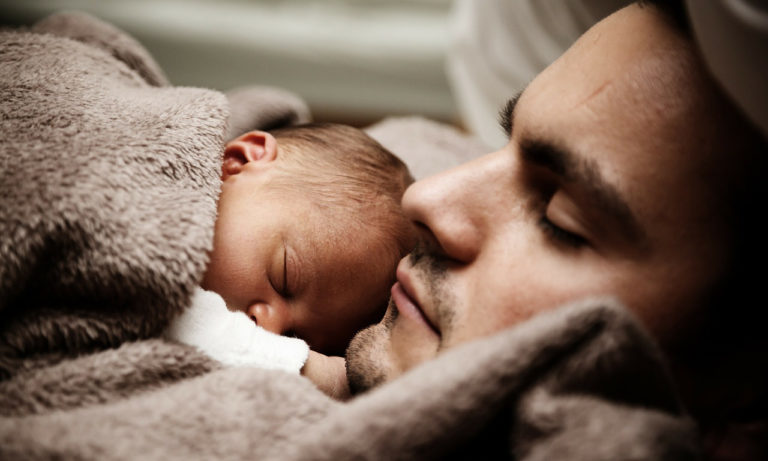
When you hear the phrase ‘teen parent’, the mind jumps to a scared young girl and an absent father. Yet, this is often not the case.

A 2012 study by Crisis Pregnancy revealed that, in general, adolescent males who are parents believe they should take responsibility for the pregnancy and not leave everything up to their girlfriend. Furthermore, given a range of preferences for the future, 38% of those surveyed wanted to stay with their girlfriend and raise the baby together.

While surprising to some, this reflects reality. Almost a third of young parents are already cohabiting.

Margaret Morris, coordinator of the national Teen Parents Support Programme (TPSP), explains that keeping fathers involved in their child’s life is crucial, even if the parents’ relationship has ended.

“All the evidence shows that, from a child’s point of view, a child fares better if it at least knows who its father is and, ideally, has contact,” she says. With the father involved, “the baby has not just the father’s influence and care in its life, but also the paternal family’s influence and care. For a child, it’s all about ‘the more people who love you the better’”.

FamiliBase

TPSP consists of 11 separate projects funded by Tusla and the HSE.

One of these projects is FamiliBase, in Ballyfermot, where Tracy Skerrett works with parents and their children.

Skerrett said FamiliBase works with “young parents who need support around housing, unemployment, mental health problems, family law, information, advice, parenting, and everything to do with being a parent and living in a community with social deprivation”.

The project realised from the beginning that young fathers are often forgotten: “It’s really hard for the young fathers to be identified as a young father, even statistically, because it’s not recorded anywhere. Unless they are actually in a relationship with the mother – or the mother has given consent to have their name recorded on the birth cert – it can be really difficult for the young father to play a role automatically in their child’s life,” said Tracy.

FamiliBase has carried out research to identify the needs of young fathers. They found men lacked information on how to access their children and how to work through the legal system. As Skerrett said, “a lot of young men just don’t know how to go about getting access to their children”.

Their research also found there was a strong need for peer support, and that mental health issues were impacting young fathers.

FamiliBase were determined to rise to the challenge. Working with Paul O’Shaughnessy of Cherry Orchard Youth Services, and Derek Ahern, sports development officer with Dublin City Council, they set up a Ballyfermot young fathers group. The group provides a place where teen fathers come together and learn from each other.

A Familibase group mid-hike
A FamiliBase group mid-hike.

Older fathers share their experiences with younger members and the group promotes a positive attitude to mental health. Regular hikes and cycles across the country build up to some impressive yearly events. For example, members of the group successfully scaled Ben Nevis in Scotland one year, and they walked the Camino de Santiago in Spain the next.

Perhaps the most anticipated event, however, is the family day where, once a year, FamiliBase workers help fathers and their children spend a night away together.

“But, whatever the activity is, the group keeps costs low,” Skerrett said.

While building team spirit and individual resilience, the group aims to show parents that they can enjoy time with their children without spending much money.

As Skerrett pointed out, “a lot of our young dads worry [that] when they have access, because of the cost of everything, that they can’t do anything with their children.”

The activities the group engages in help them to see that money is not always necessary.

While the group has been very successful in Ballyfermot, Skerrett realises the impact has been relatively small. “There are a lot of young fathers out there who aren’t getting support and who aren’t being recognised,” she said. “They are facing a lot of the problems that the young dads we work with have faced. But they’re doing it alone. And they’re doing it silently.”

Helping these young people is vital, not just for themselves, but “to ensure the best possible outcome for their child”.

Main Photo: PublicDomainPictures/Pixabay

Pobal conference: Varadkar responds to criticisms from the floor

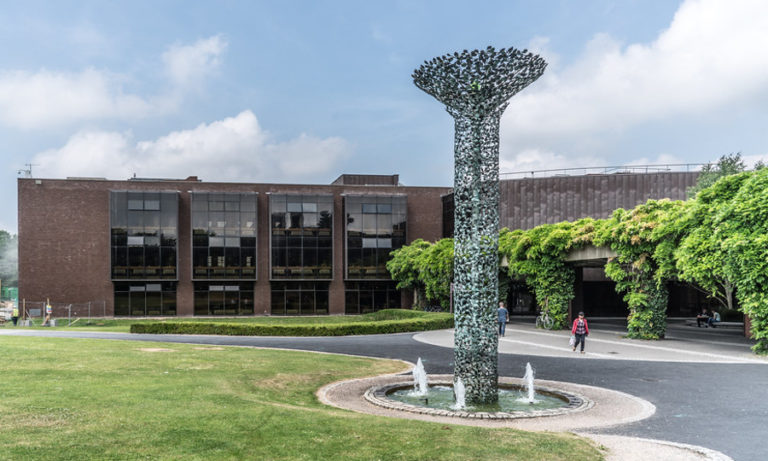
The 2016 annual Pobal conference was held in the Helix, on Dublin City University grounds, the day after the world learned that Donald Trump had won the US presidential election.

Given the platform on which he stood and how he tapped into alienation among the working poor and those on the margins, Pobal’s conference theme – Creating an Inclusive Labour Market – was apt.

Unemployment in Ireland had fallen to 7.2% by January of this year (2017), 0.1% lower than in November 2016. However, unemployment remains high for groups such as refugees, Travellers and people with low levels of formal education, and people who have been unemployed for more than three years (termed ‘very long-term unemployed’) face considerable barriers.

The audience and participants at the Pobal conference, as well as the many guest speakers, identified barriers and sought solutions to make employment opportunities more socially inclusive.

Minister identifies successes and failures

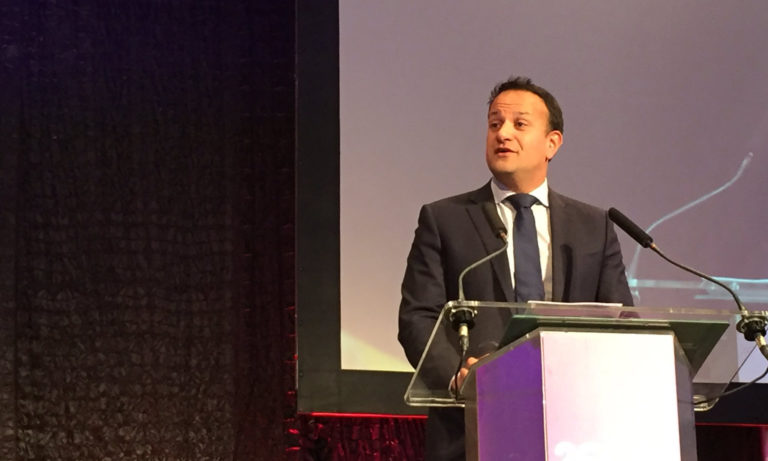
The debate was lively. Ken Loach’s heart-breaking movie I, Daniel Blake was mentioned by a speaker from the floor. The movie is about an unemployed man struggling to get social welfare supports. Minister for Social Protection Leo Varadkar had been to see it:

“I’d recommend anyone to go see it. I’d like some of my staff to go see it too, to get a different perspective as to how a person can interact with our department and how sometimes engagements can be very meaningful.”

He added, however, that he could imagine a “counter-movie that might provoke our customers”.

Pointing out that he is only the second Fine Gael member in 60 years to hold office in the Department of Social Protection (or in its earlier manifestations), the Minister said: “I’m a strong believer in the contributory principle. If people pay into the system, they should benefit from it.”

He highlighted progress on “encouraging self-employment and entrepreneurship,” such as the extension of more social protections.

The most important area of his work, he said, was “moving people from welfare into work,” and “creating an inclusive labour market is part of that.” Over five years, the department aimed “to move 100,000 people from welfare to work,” said Minister Varadkar. “But, while the numbers who are unemployed are falling every month, we’re actually seeing the number of people unemployed for more than five years increasing,” he acknowledged.

“As unemployment falls, the cohort of people who are unemployed are harder to reach and it requires much more focused interventions than we have at the moment,” he said.

Minister Varadkar referred to barriers such as the lack of transport (particularly in rural areas) and costs. “Obviously, childcare is an enormous barrier,” he continued, drawing attention to the government’s initiative to subsidise childcare.

Plans for 2017 he pointed to included:

– Making it easier and quicker for people to access the Back to Work Enterprise Allowance.

– Engaging employers to increase their awareness of grants to support them in employing people who are long-term unemployed, who are young and unemployed, or who have a disability.

– Relaxing the rules governing access to Community Employment (CE) and Tús schemes.

– Investing €1m extra in the Community Services Programme.

The Minister also spoke about the Action Plan for Jobless Families, JobPath, Gateway and the importance of services delivered through CE and Tús. On intergenerational unemployment, he said, “any intervention is going to have to be holistic, and expensive too, but if we’re serious about doing this we’re going to have to do it properly.”

Responding to attendee’s questions

Questions from the floor included one from a community worker from Kerry which resonated with the audience.

Dee Keogh, a Jobs Club co-ordinator in Castleisland, said, “I work with a lot of 45-year-old skilled males who are course-weary, tired of CE schemes, and of hearing there’s a job out there. They might do a Tús scheme – it lifts their morale and confidence for a time – but afterwards they come asking me what will they do next.”

She said more than two funded ‘interventions’ should be allowed for each individual. She said that it can take community workers up to eight (often voluntary/unofficial) meetings with individuals to lift their courage and confidence to be ready for one of the formal interventions, such as joining a course or applying to a scheme.

She called for a new Tús Plus scheme: “I have people who’ve worked in a charity shop for a year through Tús and, when they’re finished, they go and do another scheme for free because they just want something to do.

“There’s no jobs where I live in Castleisland. Check it out yourself – we’ve no bus service, no wifi. And, no disrespect, but these men don’t want to do computer courses; they want work. Real work,” said Dee.

From Dublin, a Simon Community worker called Tracey endorsed the Kerry contributor’s views, adding: “We need to measure the quality-of-life impact of our work on people who are homeless, who have disabilities, who are third-generation unemployed, to see the impacts that don’t show up in cost-per-head or regional analysis.”

Minister Varadkar replied, “I totally hear the point you make about course fatigue and scheme fatigue, and spending years going from course to scheme to welfare, and that’s not a success.

“I’m always open to new ideas, including a Tús Plus, or people spending longer on CE, but I don’t think we should see it as a success if somebody spends three instead of two years on CE.

“But, bear in mind, all of this is paid for by taxpayers, who go out and work every day, who maybe aren’t in their dream job or ideal job, but go to work to earn money for their families and themselves – and pay taxes – and they have a right to raise questions if somebody is saying, ‘I’m not going to take a job because it’s not suited to me, or I don’t like it. It’s not the job I want and, by the way, in the meantime you should pay for me’. We can’t have that,” he said.

Addressing the point raised by the Simon worker, he said, “of course we should take into account the quality of life and the impact any intervention we make has on a person,” said Minister Varadkar.

Work still to do

Philip O’Connell of the Geary Institute said he too shared the concerns expressed from the floor. “Recovery has seen the growth of a substantial group with multiple disadvantages who stay unemployed for very long periods,” he said, citing age, skill-levels and education among the determining factors.

He said there has been “an alarming growth” in the number of those unemployed for more than three years: “About two-thirds of those unemployed for two or more years are still unemployed one year later. It is very hard to escape long-term unemployment, though there is some indication that activation is reducing long-term unemployment.”

In 2016, around 50% of those on the live register were long-term unemployed, compared to 63% in 2012.

He credited the Social Inclusion and Community Activation Programme with playing a role in reducing the levels of very long-term unemployment. He spoke about a “rationing of services” available through the government’s Pathways to Work, and said socially excluded groups such as ex-offenders should be better supported.

Calling for a range of measures, he said, “as unemployment falls it becomes necessary and possible to adopt more inclusive client-centred investment in employability of all with the capacity and desire to work.”

Meanwhile, Donald Storrie of Eurofound, an EU agency promoting better social, employment and work-related policies, spoke about the employment challenge facing refugees, noting that 4,000 people from Syria and other war-torn countries are due to arrive here. “They’ll be traumatised and far from the labour market,” he said. “Unlike labour migrants, they are not labour-market ready,” he said. Looking at Sweden’s experience, he said migrants and refugees “do catch up after many years, but for women it’s a big catch-up.”

He pointed people to the latest Eurofound research paper for more information on the best approaches.

Inclusion workshops

Six workshops – on co-operation, social enterprises, employers, work and homelessness, the ‘Activation Agenda’ and the role of local authorities – took place during the conference to identify key learning points from experience to date.

The first workshop looked at how local agencies providing employment supports co-operate and exchange information.

The second examined the performance of local authorities, and local and community development committees, in supporting employment activation and broader economic development. It also looked at the impact of local economic and community plans.

Workshop number three highlighted the contribution of social enterprises to creating employment opportunities for disadvantaged groups.

The fourth workshop heard how employers can engage with employment services to create local job opportunities for disadvantaged groups.

The fifth highlighted integrated approaches to supporting people at risk of homelessness in finding work.

The sixth workshop discussed the value of apprenticeships and how they operate locally.

Family of late Clodagh Hawe launch fund for Women’s Aid

The mother and sister of Clodagh Hawe, who was murdered in her home last year alongside her three sons Liam, Niall and Ryan, have set up a fund in their memory, with all proceeds going to Women’s Aid.

The aim is to raise at least €50,000. “Clodagh was strong and beautiful inside and out, and was so loving,” wrote Clodagh’s mother, Mary Coll, and sister, Jacqueline Connolly on the fundraising page.

“She was warm, loving, bright and capable, and she was bringing her boys Liam, Niall and Ryan up to have those same qualities. We want their deaths to help other women who are living in fear and isolation in their own homes.”

“Please support our fundraising appeal for Women’s Aid. One in five women in Ireland experience domestic abuse and many women are isolated and alone,” wrote Mary and Jacqueline.

Clodagh and her children were killed on 31 August by Clodagh’s husband (and father to the three boys) Alan Hawe, who afterwards killed himself.

Femicide

By December 2016, 209 women had been killed in Ireland since Women’s Aid began recording figures in 1996.

Marking the annual 16 Days of Action Opposing Violence against Women, Margaret Martin, director of Women’s Aid, said: “Femicide must not be accepted as a fact of life. Women should be safe in their homes and in their relationships. And we must recognise the strong connection between the killing of women and domestic violence.”

The organisation’s Femicide Watch shows that a woman in Ireland is most likely to be killed in her own home and by a current or former boyfriend, partner or husband.

Where the cases have been resolved (through the courts or in cases of murder-suicide) 89 women (54%) were murdered by a current or former male intimate partner. Another 54 women (33%) were killed by a male relative or acquaintance, and 21 women were murdered by a stranger.

Meanwhile, figures from the Central Statistics Office show that breaches of domestic violence court orders have nearly doubled in the past 10 years.

Lashing out at those in power who could do more, Sharon O’Halloran, CEO of SAFE Ireland, said, “We can prevent these murders. We can open the doors of our refuges and let people in when they call, instead of turning them away due to a lack of resources.”

Women’s Aid defines the 16 Days of Action Opposing Violence against Women as “an important opportunity to raise awareness and call for changes at an international, national and local level to make women and children safe from abuse.

Local actions

Local actions took place nationwide throughout the 16 Days.

Limerick Women’s Network members gathered to hold a minute’s silence in solidarity with victims of domestic violence. Members of the Circle of Friends group produced a symbolic wreath recording the names of the 209 victims.

The network also launched a booklet listing all the services for women in Limerick city.

The event took place on 7 December in Watch House Cross Library, Moyross, and was attended by members from women’s groups across Limerick.

According to group facilitator Edel Geraghty, the issue of violence against women is one that the women’s network deals with on an almost daily basis. “We come across many women survivors of domestic abuse who have never reported the crime. Statistics say one in four women are affected by this issue but, from our experience, the number is likely to be far higher.”

If you are affected by any of the issues discussed in this article, please contact the Women’s Aid 24hr National Freephone Helpline on 1800 341 900. It operates all year round.


As Brexit looms, cross-border projects need more support

It has been well established that Brexit poses a threat to the peace process on these islands but, beyond that, there are myriad other concerns to consider. Support and funding for many community groups is at risk, for instance, in spite of the broad impact their loss could have.

In late 2016, Anthony Soares, deputy director of the Centre of Cross Border Studies, told Changing Ireland that, because of Brexit’s impact to date, cross-border projects already need more funding – and this was before political power-sharing collapsed at Stormont.

In December, the House of Lords EU sub-committee deliberated on Brexit, saying an agreement should be drafted to “guarantee open land borders and sea boundaries, support cross-border trade and preserve EU funding for cross-border projects”. That same month, the issue also received attention from the British-Irish Parliamentary Assembly, while An Taoiseach Enda Kenny has addressed the matter as being of the utmost concern.

The UK’s Brexit minister, David Davis, visited Belfast and Dublin late last year, meeting with political representatives and business leaders. He did not meet community and voluntary sector representatives.

This sent out a strong signal to those in the sector that the priority is trade, commerce and business.

Meanwhile, as a direct result of the Brexit vote, community organisations are seeing an increasing workload. Witness, for example, the subsequent rise in hate crime, said Soares. [See below.]

Significant concerns

Soares told Changing Ireland that there are “significant concerns” for communities on both sides of the border with regard to the continued funding of community projects if – or indeed when – the UK leaves the EU.

The European Social Fund (ESF) will continue for the Republic of Ireland. “They’ll be okay,” said Soares. However, for community groups in Northern Ireland, some of which depend almost completely on ESF funding, their very existence is under threat.

“We’re already seen organisations talking about shutting up shop. For example, I’m thinking of one project focused on young people’s employability. Groups are really concerned going forward,” he said.

“For cross-border projects, without the EU funding I don’t think a lot of them would continue to run,” he said. “Putting it generously, the governments in Dublin or Belfast don’t have the funding that those cross-border projects need.”

In the most positive scenario, cross-border projects may still have EU funding, but this depends on a soft exit. There is a precedent for this: Norway is outside the EU, but inside the single market, and takes part in social programmes.

One of the two most important cross-border programmes is Interreg, which covers Northern Ireland, the Republic, and West Scotland. (The other is the ESF.)

Interreg promotes “inter-regional integration,” the opposite of what Brexit was supposedly about.

The Peace Process

The other “really important programme”, according to Soares, is the Peace Programme: “We are the only part of the EU that has such a programme.”

“The needs, rationale and logic is there, but where the funding comes from? Even if the UK leaves completely and doesn’t want to fund any more cross-border projects, well, the need will still be there,” he said.

“The [Centre of Cross Border Studies] and other groups have been proposing, in that scenario, that the UK government should create a new Interreg for the Republic of Ireland, Northern Ireland, West Scotland and also Wales. Let’s keep the projects going and new projects – by creating a new fund, we propose.”

The issue there is that a new UK government may come along and, at budget time, drop funding for peace and cross-border activities.

“That’s absolutely true,” admitted Soares. “In one year, the money could be taken away.”

EU funding has always been of increased value because it comes in seven-year cycles.

Soares’s organisation is safe as, since 2014, it has not relied on significant EU funding, but it is still campaigning hard with others

“A new hard border doesn’t have to be physical, because as soon as differences around rights and regulations emerge, it becomes a much more significant border.

“We’ve already started, since June, seeing an increase in hate-crimes against immigrants,” said Soares. Immigration was introduced to the discourse by those in the Leave campaign.

“We’ve proposed that, for the current Peace Programme, the Irish and UK governments should add a special pot of money to deal specifically with the uncertainty caused by the referendum result, and the erosion around social cohesion at the border and away from border.

“As a co-guarantor of the Good Friday Agreement, Ireland [the Republic] could argue that it needs the EU to recognise special circumstances, and the EU might continue to support the Peace Programme. We in the Centre for Cross Border Studies have been arguing for that.

“Peace isn’t done. It’s a very young thing we have here. We have to continually work at it. We’re no different from other places. You can return to conflict – it doesn’t have to be violent conflict,” said Soares.

Main photoJordan McDonald and Shannon McClenaghan/Unsplash

Coveney briefs community reps on new development framework

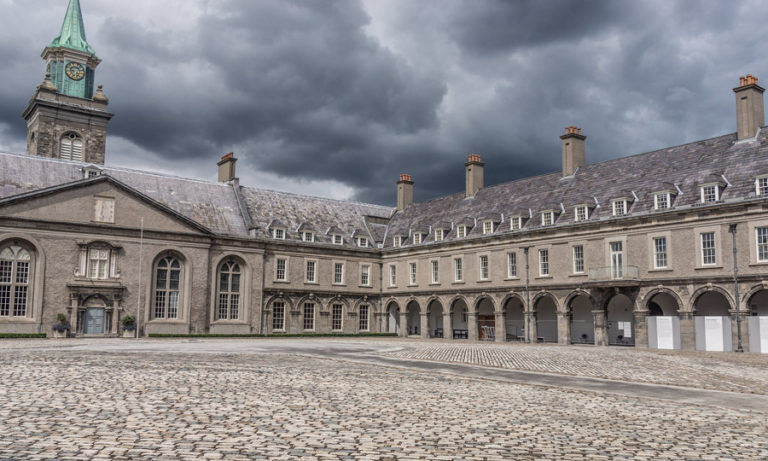
“We are serious as a Department of Communities,” Minister Simon Coveney assured people gathered in Royal Hospital Kilmainham. It was November, and the Department of Housing, Planning, Community and Local Government was holding a forum meeting with community representatives.

The aim of the day was to help develop an implementation plan for the government’s ‘Framework Policy for Local and Community Development’.

Community reps were gathered to hear about turning policy into a practice that will work on the ground and that will deliver community-driven, bottom-up social inclusion.

Opening the proceedings, Minister Simon Coveney noted that, in the most recent budget, “we saw an increase in funding” for community programmes.

While this was a positive, he also noted that “the approach towards community development has changed”.

“In rural Ireland, it was very much led by LEADER funding, financing ground-up led projects and we’ve been through a painful enough policy change, but I think we can make it work in ways that are more effective than before, even though there are many good and strong things about previous decision-making and funding structures which we don’t want to lose.

“The opportunities are there now for real engagement and genuine partnership between community leaders, community groups, sectoral interests, and local and national government.

“And getting those structures right is key,” he said.

He listed the five priorities in the government’s framework policy for the sector – published last year – saying, “They’re all fine and aspirational, but what I’m interested in is their pragmatic implementation. How do we ensure that the community has had involvement and a say in the process when I make decisions on the basis of recommendations that come up to me from talented and serious civil servants in the Department? Ensuring that involvement is the only way we’ll start to light a fire again under communities and empowering them…as opposed to top-down instruction.

“One of the reasons that I took the ministry I was offered was because I wanted to close a gap that had opened up in the past decade between communities and [the State]. One of the reasons we’re insisting, for instance, on mixed-tender housing development rather than segregated builds is because we are serious about community and community relations and diversity and we are trying to learn lessons from the past.

“We’re not going to be able to do everything, but I hope ye see me as somebody who if you have good ideas you want to share and incorporate into policy that we can do that,” he said.

While “sometimes, we disagree,” it was essential to have a forum to ensure there was an open line of communications and to enable us to work together.

“Communities have to be involved in decision-making”, said the Minister, adding that people should get in touch with him directly if they feel they are being ignored by the process.

Among those to also address the forum were Anna Marie Delaney, CEO of Offaly County Council, who outlined the extent of the policy changes in recent years.

Rachel Doyle of Community Work Ireland (CWI), in her contribution, reminded the audience of the critical role of community work in addressing poverty, social exclusion and inequality, and in building participation of communities in decisions that affect their lives. She stressed that this work cannot take place in the absence of strong, autonomous community development at local, national and international levels.

Policy into practice: What happens next?

The implementation plan is expected to be completed by the middle of this year.

The policy seeks to promote “a joined-up, collaborative and participative approach to local and community development at local level”.

Community and voluntary sector groups largely welcomed the framework policy statement when it was approved by government in late 2015, but also expressed criticism. Minister Coveney acknowledged there were some difficulties with the framework and the forum event gave community representatives a chance to strengthen it from the bottom up.

The event included five workshops themed around the policy:

  1. Engaging with Communities
  2. Working with Partners
  3. Planning for Local and Community Development
  4. Achieving with Partners
  5. Securing best outcomes for Communities

Since the forum, the Department has been busy preparing a detailed report to be published early in the new year.

A cross-sectoral group is also being established, guided by advice received through the forum, to assist and advise in the development of the implementation plan.

Meanwhile, CWI planned to meet with the Department to review the event and hoped to also meet with Minister Coveney.

Away from the main stage

The forum event was hailed by many as significant, as it had been quite some years since the Department had called a meeting of community representatives to discuss future possibilities.

The last occasion for such a gathering heralded in amalgamations, closures, cuts and cohesion, leading to the ‘alignment’ of community development with local government work.

In Kilmainham, the interaction between people was high, the venue was spectacular, the food excellent, the atmosphere good, and the promises of change made impressed a mature audience normally given to healthy scepticism.

One of the community rapporteurs remarked on stage that people present had put a lot of trust in the Department and that they now expect action in the coming months. That echoed what Minister Coveney said would happen, what civil servants said would happen and what is expected.

Meanwhile, there was an update from Junior Minister Catherine Byrne, who spoke about a new SICAP being introduced in 2018. Byrne also promised investment in training and capacity building for local community development committees to support the delivery of the programme on the ground.

Her audience included people who, while unhappy about elements of their work, obviously hold out hope for true bottom-up community development.

As was emphasised at the forum, community involvement isn’t an add-on – it’s central to the whole thing. Community development must be bottom-up and, ideally, the country should be led by bottom-up influenced policies.

Furthermore, the relationship between the State and the community and voluntary sector may indeed be improving.

“Two key words came through today, trust and respect. We acknowledge it was a great day. But, there’s a trust that we’ve been listened to today and a respect that something will happen out of today,” said a community worker addressing the forum.

Only time will tell – depending on the quality of the implementation plan for the National Framework – if communities are truly turning a new corner.

Main photo: William Murphy/Flickr.com (CC BY-SA 2.0)

5 award-winning social enterprises to empower Dublin communities

Five thrilled business owners were presented with cheques for between €5,000 and €15,000 as winners at the Social Enterprise Grant Scheme Awards, which took place in Dublin on 15 December. The awards were presented by Minister of State for Housing and Urban Renewal, Damien English.

Minister English didn’t go away empty handed himself, either. He was presented with a hand-made navy-blue House of Akina bow tie by project co-founder Lye Ogunsanya. (Ryan Tubridy already wears one.)

The ceremony took place at the Hugh Lane Art Gallery in Dublin. The winners were: ReCreate, the Yard (at Solas Project), House of Akina, Aspire Productions and Third Space.

The Social Enterprise Grant Scheme Awards were established in 2015 to raise awareness of social enterprise and to reward the important work being done by social entrepreneurs in Dublin.

At this year’s awards, a total of €45,000 was handed over to the winning projects to further develop their operations and organisations.

Evanne Kilmurray, Inner City Enterprise CEO, said that social enterprises in the city “play a key role in rejuvenating many of the local communities and have long-lasting impacts in terms of job creation and provision of real social services”.

The awards help to showcase what social enterprise can achieve in our communities.

The scheme was launched “to address the gap for accessing funding for start-up social enterprises,” and Kilmurray said funding and mentoring makes “a vital difference”.

Minister English praised the important work done, saying: “Social enterprise is the up-and-coming way to give ownership back to a community by delivering much needed local services in an efficient manner using self-sustaining enterprises.”

Aspire Productions

Aspire Productions is a new social enterprise, based in Dublin, that can produce high-quality, low-cost media products on demand. The production team consists of people with Asperger syndrome.

The project taps into their creative sides, and provides employment and a commercial service in the community.

Manager Aileen Cruise described the disability: “Some people with Asperger’s see the world in a really black and white way and, because of that, it’s difficult for them to get employment, but they can also be incredibly creative.

“We’ve made an animated documentary about Asperger’s – what it is and what it isn’t. The 10-minute feature was supposed to be launched six months ago, but they’re perfectionists,” said Aileen.

So, crucially, can the team work to deadlines?

The answer is ‘yes’. The group entered the Wheel’s ‘Better Ireland’ video competition, and their entry was “done and edited on time,” said Aileen. Once they have a deadline, they meet it.

Aileen refers to the group as “the lads”. She said this is because the ratio of men to women with Asperger’s is 9:1.

“More men are diagnosed. Women have Asperger’s as well, but women are better at modelling the behaviour of others. We’ve all men attending at the moment, so I just talk about the group as ‘the lads’.

“They may have to learn coping skills to fit in with society, but I don’t want them to have to change,” she said.

The team’s skills cover animation, direction, storyboarding, project management, leadership, writing, editing, sound and lighting. Its “unique outlook on the world reflects on the end result,” said Aileen.

Aspire has been supporting people with Asperger’s since 1995, enabling them to access the same opportunities as their peers and meet their full potential.

House of Akina

House of Akina’s slogan is ‘look good, do good’, promoting the idea that you can spend your money on trendy yet ethical products that benefit marginalised members of society.

The social enterprise works to support women living in direct provision in Ireland by creating handmade, limited-edition items of clothing, mainly accessories such as bow ties and pocket squares.

Products are made by women who have been through the Irish direct provision system and now have the legal right to work (and remain) in Ireland.

Profits are used to fund workshops to support and educate marginalised migrant women in Ireland in order to facilitate better integration of new communities.

ReCreate

ReCreate collects clean, end-of-line materials from businesses and redistributes them for all kinds of creative and artistic purposes.

The concept – creative reuse – encourages the whole community to reuse (in all kinds of inventive ways) everyday materials that are normally being thrown away.

Members pay a set annual fee and have unlimited access to ReCreate’s materials.

The idea is to nurture fun, creativity and holistic development of the individual, and care for the environment by diverting materials from refill through resource exchange. It affords quality employment to a range of individuals, including people who have been long-term unemployed and people with physical, sensory or intellectual disabilities.

Third Space

Third Space was set up to open and run eating and meeting places in the redeveloped areas of Dublin that lack these community spaces.

Each Third Space serves as a community hub where people can gather regularly, informally and inexpensively.

Built around a simple but great menu, an excellent team and an informal environment, they will nurture a creative buzz that reflects the vibrant variety of life at the heart of a modern urban community.

The first Third Space has become a hub for the community in the Smithfield area of Dublin, and has helped in the transformation of the area.

That was just the start. New outlets are expected to open in other areas in 2017.

The Yard

The Yard is one of five projects run by the Solas Project in south inner city Dublin. It works mostly with men aged between 15 and 24 – the Yard Crew.

They produce woodwork products – from bowls to pens, to full-size canoes – which are then sold to partly fund the programme.

There is “no huge formality” about young people joining the crew, said Eddie D’Arcy, CEO of Solas Project.

Solas Project aims to broaden the horizons for young people who are not in employment, education or training and who come from challenging backgrounds. Some will have experienced homelessness, poverty, and alcohol or drug misuse.

After taking part in a 16-week course with the Yard Crew, these young men will walk out with work experience, practical woodwork skills, bicycle maintenance skills, and the ins and outs of running a social enterprise.

The programme runs three times a year.

The Yard gives young people skills, knowledge and confidence, empowering them to fulfil their personal and professional potential.

Behind the Awards

The Social Enterprise Grant Scheme Awards are supported by Inner City Enterprise, which formed a partnership with Dublin Local Enterprise Office, the Irish Social Enterprise Network, the Carmichael Centre, Dublin City Council and Dublin City University. Their aim is to promote practical business supports to social enterprises in Dublin city.

Support has also been provided to the entrepreneurs through the Social Inclusion and Community Activation Programme (SICAP), which is co-funded under the European Social Fund.

Main photo: Tony Hand/Unsplash

Groups campaigning for gender parity in Irish politics

In December 2016, Minister of State for Tourism and Sport Patrick O’Donovan put national sports organisations under pressure to improve the gender balance on their boards.

Punitive measures were discussed for organisations that failed to reach a quota under which 30% of members would be women. During debates, some politicians were in favour of penalties, while others were opposed.

And yet perhaps they’re needed. Despite women and girls playing soccer, rugby and Gaelic games, only one woman sits on the executive committees/boards of the Football Association of Ireland (FAI), Irish Rugby Football Union (IRFU) and Gaelic Athletics Association (GAA) combined.

In 2018, these three bodies shared €7.4m in State funding for youth development alone, and they oversee thousands of games annually that involve women and girls.

That sole woman is Niamh O’Donoghue, secretary general of the Department of Social Protection, who sits on the board of the FAI.

These sports organisations are essentially not-for- profits, not unlike many of the groups operating in the community and voluntary sector, so it is not beyond the bounds of possibility that quotas could also be sought – or imposed as a condition of future funding – for the boards of community projects.

These tables indicate how steep the challenge appears to be:

Chart detailing gender disparity in Donegal County Council, Donegal Peace III Partnership and Donegal County Development Board

Chart detailing gender balance on several cross-border bodies

But sometimes you can crest a hill almost before you know it. There is currently a campaign gaining momentum that seeks more balanced gender representation.

The 5050 Group seeks equal representation in Irish politics, and encourages debate on the need for more women to engage in politics.

Quite simply, they want a 50-50 split, women to men, in all political parties by 2020. As it stands, slightly more than 50% of Ireland’s population is female, yet only 35 out of 158 Dáil Éireann seats are filled by women. That’s just 22%.

Globally, Ireland was ranked 76th out of 133 countries on a world classification list (compiled by the Inter-Parliamentary Union in 2016) that looked at gender balance in governments. That marks an improvement – four years ago, Ireland was ranked 89th.

The 5050 Group is a single-issue national advocacy group without political affiliations. Its members – women and men – believe that the under-representation of women in Irish politics is an affront to the democratic ideals of justice and equality.

It seeks to encourage the formation of affiliate groups at community level and endorses both male and female candidates who support special temporary measures to redress the over-representation of men.

Nationally, the campaign raises awareness about candidate selection quotas, and encourages more women to run, more people to campaign for female candidates and more people to support female candidates. It further challenges political parties to effectively implement the candidate selection on quota.

North West concerns

Donegal Women’s Network (DWN) is long established and is typical of the groups that are members of the 50/50 campaign. DWN works to inspire community growth by providing a friendly local support network, advocating for and promoting women’s rights, highlighting the reality of women’s lives in the county, promoting and supporting women’s empowerment, and bringing local issues to a national level.

Here’s how the situation looks in Donegal: only three out of 37 councillors in the county are women and, since 1918, only two female Donegal TDs have served in the Dáil (Mary Coughlan and Cecilia Keaveney).

Currently, there are no female TDs representing Donegal, Leitrim or Sligo in the Dáil.

The 5050 North West group covers these three counties and is supported by individual women, DWN, the North Leitrim Women’s Centre and the National Collective of Community Based Women’s Networks (NCCWN).

Nationally, the NCCWN supports 17 women’s projects that seek to empower and support community-based women who experience disadvantage and marginalisation as a result of barriers to participation and lack of opportunities.

The NCCWN is funded by the Department of Justice and Equality.

Main photo: James Rea/Pixabay

Who are the winners of this year’s Pride of Place?

Pride of Place is an all-island competition, set up in 2003 to acknowledge the hard work communities are carrying out every day all over Ireland. It focuses on and rewards people who are coming together to shape, change and improve daily lives in their communities.

“The competition is about showing respect and inclusion for every sector in our communities – young, old, rich or poor – and creating communities to which the people are proud to say they belong,” says Tom Dowling, former Meath county manager, and chairman and founder of the Pride of Place initiative.

The 2016 winners hail from all corners of the island, from Cork to Antrim, and represent communities of all sizes and varieties. They came together in Belfast on 26 November of last year to celebrate.

Main competition winners

Population 0–300Broadford Development Association, Co Limerick

Population 300–1000Clonbur Community Council, Co Galway

Population 1,000–2,000Borris Tidy Towns, Co Carlow

Population 2,000–5,000Moate Action Group, Co Westmeath

Population over 5,000Douglas Community Association, Co Cork

Age-Friendly Community InitiativeMcAuley Place, Naas, Co Kildare

Community Social EnterpriseMeath River Rescue, Co Meath

Community Business Enterprise InitiativeFerbane Food Campus, Co Offaly

Communities Reaching Out InitiativeIntegration and Support Unit, Waterford City, Co Waterford

Housing EstatesThree Drives Family Resource Centre, Tipperary Town, Co Tipperary

Islands and Coastal CommunitiesClogherhead Development Group, Co Louth

Urban NeighbourhoodsDominic’s Community Centre, Tallaght, Co Dublin

Cities

Neighbourhoods under 1,000: Glór na Móna, Belfast

Neighbourhoods 1,000–2,000: Stoneybatter Heritage Village, Dublin

Neighbourhoods Over 2,000: East Belfast Community Development Agency, Belfast

Age-Friendly Community Initiative: Mahon CDP Agelink, Cork

Community Enterprise Initiative: Foyle Down Syndrome Trust, Derry

Community Arts Initiative: Blue Teapot Theatre Company, Galway

Special awards

Cities Competition 

Play Resource Warehouse, Belfast

Saol Café, Galway

Main Competition

Liskennett Farm – St Joseph’s Foundation, Granagh, Co Limerick

Mulhuddart Motocross Project, Fingal Co Dublin

Trinity Arts Project, Castlerea, Co Roscommon

Wexford Marine Watch, Co Wexford

Special Council Award

Dublin City Council

Main photo: Emily Morter/Unsplash

Sola Symposium: Focus on greater quality to achieve greater equality

In December (2016), Sola held a national symposium at University of Limerick. It brought together voices from communities, organisations and business to discuss services for disabled people.

The symposium asked how organisations and individuals could move from providing a service to being of service. It was geared towards disability organisation managers, volunteers and frontline staff, funders of disability services, and professionals with expertise in the field of quality.

Opening the event, former education minister Jan O’Sullivan, TD, emphasised “the importance of the voice of those for whom a service is being provided, and ensuring the service is of use”.

“The late Martin Naughton fought for so long to change that culture of expecting people to take whatever is provided, rather than to have control over their own lives and being able to decide what is right for them,” she said.

She congratulated Sola’s partners for their collaboration and co-operation, and hoped she was “correct in interpreting what this symposium is about: that it’s about ensuring the person is at the centre of the service”.

At the event, activists, academics and industrialists discussed what ‘quality’ meant to them. This coming together reflected Sola’s triple-backing from a national community organisation, a third-level institution and a private company.

In looking at how ‘lean principles’ – widely used in business and manufacturing – can be adopted by the community and voluntary sector, Billy Stack of Disability Federation of Ireland reviewed research on “using lean principals to enhance transport services for persons with a disability”.

Examining how quality systems can help protect people’s rights, Deirdre Nally gave a presentation on the potential of quality systems to protect a persons’ rights as enshrined in the UN Convention on the Rights of Persons with a Disability.

Meanwhile, Stuart Lawlor of the National Council for the Blind talked about the practical steps needed to implement a quality management system in a community-based organisation.

The symposium also heard about a new system called PQASSO (pronounced ‘Picasso’) which promotes 11 core competencies, the majority of which put the person using an organisation’s services at the centre of those services.

While the event was focused on improving services, attendees were wary of ‘service- orientated’ language. Regarding service-delivery in particular, there was some concern expressed about ‘language-creep’, whereby the lingo from the ‘top’ is adopted by those on the frontlines.

Disclosure: Claire Gallery, an administrator at Sola, is chairperson of Changing Ireland Community Media CLG.

Main photo: William Murphy/Flickr (CC BY-SA 2.0)

What supports are in place to combat rural poverty?

Across rural Ireland, low-quality jobs and unemployment have forced thousands of people into poverty. Yet their suffering is rarely seen.

Seamus Boland, CEO of Irish Rural Link, describes hidden poverty as, “the lack of opportunity available to people. It’s the falling off of services. It’s people who are getting themselves into poverty, not being able to afford basics, which you don’t really see.”

He highlights how the problem is exacerbated in rural areas: “You can travel around…and there’s no great signs of poverty there, whereas in urban [areas] you tend to see physical deterioration.”

The figures back him up. Unemployment rates in rural Ireland continue to however around the 10% mark. In contrast, Dublin and the Mid-East score 8% and 6% respectively.

Furthermore, a 2014 CEDRA report on income and living conditions found that almost one in five people in rural areas were at risk of poverty, compared to 15% living in urban settings.

Although it might not be obvious, rural Ireland is still hurting.

Boland says, “The solutions have to include developing much more micro-enterprises in the rural regions”. He points out that, collectively, small businesses are the largest employment providers in rural Ireland. More growth in enterprises means more local jobs and more sustainable rural communities.

Youth unemployment

Emily Casey is a youth worker with Clare Youth Service. She runs a programme under the Youth Employment Initiative (YEI) – which provides support to young people living in regions where youth unemployment was higher than 25% in 2012 – aimed at tackling youth unemployment in Clare, a county where three out of five people live rurally.

Casey explains that unemployment is a downward spiral. “When you’re out of work and have no routine, your routine is all messed up. You’d be doing most of your living during the night-time and sleeping during the day. People would have a certain level of lack of motivation and a borderline bit of depression as well.”

Casey holds one-to-one meetings where she helps people identify career goals and prepare development plans. The participants, aged 18 to 24, come from a wide range of educational backgrounds, from early school leavers to degree holders.

Casey says: “I don’t give advice. I give support and I facilitate. That’s my role. It’s not to advise and lead someone down a certain path. They tell me what they want and I facilitate them in how to get there.”

The programme is innovative, with Casey travelling to the participants, rather than they to her. This allows people in rural areas with few transport options to take part. However, in such locations, training opportunities and jobs are limited. Casey says, “There is a need recognised to have more accessible training in these areas”.

One problem with enterprise promotion and YEI-style programmes is that they often only target those already unemployed. People trapped in low-paying, part-time or poor-quality jobs are excluded.

Casey admits this: “There are lots of people in casual work who are finding it very difficult. They want to move on, they feel they’re stuck. It’s something we’ll be reporting back.”

Perhaps under-employment, as well as unemployment, needs more attention in the future.

Rural living stats and facts

  • 16% of the population is at risk of poverty. In rural areas, the figure rises to 19%. It’s 14% in urban centres.
  • Those most at risk include people living in rented accommodation below market value (36%) and those who are unemployed (40%).
  • Nationally, unemployment has dropped. However, the gains are poorly spread. Over 62% of the increase in employment last year came in counties Dublin, Meath, Kildare and Wicklow.
  • Western counties saw a decline of 8.6% in the number of registered active enterprises between 2008 and 2014. The rest of the state only dropped 1%.
  • Over 114,800 people are employed in the agriculture, forestry and fisheries sectors.
  • A third of farms were economically vulnerable in 2015, according to Teagasc. Brexit is forecast to heap additional pressures on farming families.
  • The estimated costs of running a car for a year is €10,850. Public transport is patchy in many rural areas and non-existent in others.

Additional reporting by Allen Meagher

SIERRA LEONE: Surfing and Community Development

[et_pb_section fb_built=”1″ admin_label=”section” _builder_version=”4.16″ global_colors_info=”{}”][et_pb_row admin_label=”row” _builder_version=”4.16″ background_size=”initial” background_position=”top_left” background_repeat=”repeat” global_colors_info=”{}”][et_pb_column type=”4_4″ _builder_version=”4.16″ custom_padding=”|||” global_colors_info=”{}” custom_padding__hover=”|||”][et_pb_text admin_label=”Text” _builder_version=”4.23.1″ background_size=”initial” background_position=”top_left” background_repeat=”repeat” hover_enabled=”0″ global_colors_info=”{}” sticky_enabled=”0″]

SURFING FOR A LIVING IN SIERRA LEONE

 Sustainability is key in community development. Projects that last are ones with strong local foundations. Bureh Beach Surf Club in Sierra Leone is a great example of a community-led initiative using its resources to their best advantage.

Here, a determined local effort, along with a little international support, made a big difference to a small, coastal community.

Bureh Beach. Pic by Cian Kearns.

Sierra Leone has had a torrid time. In 2014, the country was thrust into the international limelight for all the wrong reasons. Images of death and disease swamped the global media. Yet Sierra Leone is a land full of potential. And with its golden, palm-fringed beaches and pristine wildlife sanctuaries, tourism is certain to play a key role in its future.

40 km south of the capital, Freetown, a long crescent beach hugs the coast, framed by lush jungle spilling off the hills above. A river flows into the bay, sculpting the sandbar that produces one of the best waves in Sierra Leone: a long, mellow, left hand point-break. This is Bureh Beach.

Sitting outside the surf club, with waves lapping up almost to his feet, Galway man Shane O’Connor explains his role in founding the club. “Basically I wanted to help my friends and make sure they got the benefits of the natural resources: the waves here in Bureh.” He focused on fostering ownership amongst the locals. Rather than manage, he prompted and advised. Gradually, he has stepped back. Now, more often than not, he is just another punter renting a board when the waves are good.

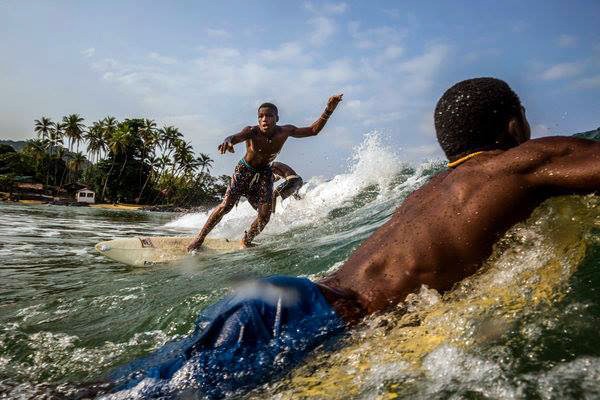
Charles, one of the young surfing talents of Sierra Leone, says: “The community thinks that surfing is the best thing in Bureh.” He explains that along with being enormous fun itself, surf lessons provide a source of much needed income for local surfers. All the club members have a role to play. Some give surf lessons to tourists, mostly expats working at NGOs, who frequent Bureh Beach on the weekends. Others cook food for visitors or manage the rental equipment.

As a community-based organisation, all revenue from lessons, gear rentals and selling food is reinvested locally, with 25% set aside for community-based projects. The surf club members decide what they want to do with these funds including supporting new businesses and promoting events such as the country’s first surfing competition imitation rolex day date mens rolex calibre 2836 2813 118239 silver tone automatic.

The club has been a great success. Even when things were difficult during the Ebola outbreak the club did not disintegrate; it hibernated. When the epidemic ended, the skills, equipment and experience remained. Bureh Beach quickly bounced back.

Today tourism to the beach has increased. Small restaurants and guest houses have sprung up to accommodate new visitors. These provide employment in an area people previously left to find work. Jabez, the club manager, summed up the community’s feelings: “Now everybody’s in love with surfing, everybody wants to get in the water!”


IN SOLIDARITY: GO SURF AND SEE FOR YOURSELF!

Charles goes for a surf at Bureh Beach. Pic by Cian Kearns.

Cian Kearns travelled with support from the Simon Cumbers Media Fund, after becoming fascinated with Sierra Leone, as he explains here:

Sierra Leone is a country that defies your expectations. Perched on the coast of West Africa, it’s a place on the very edge of global consciousness, where the romantic dream of Africa meets the hot, sweaty reality alchemaster e liquid al sale di nicotina guaiava di ghiaccio.

On Freetown’s streets a thousand dramas are played out daily. Along palm-fringed shores, white sand beaches stretch out as if plucked from a dreamer’s imagination and in the interior, red, earthen roads pierce dense jungles, revealing their mysteries to the intrepid. Sierra Leone is a place of adventure.

My urge to visit the country arrived subtly but grew irresistibly, nourished by whispered rumours of an unmatched vibrancy there. My ears pricked whenever I heard Sierra Leone mentioned. Then, scanning the internet, I stumbled upon a peculiar fact: Sierra Leone had just opened its first ever surf club – and the founder was a Galwayman! Intrigued, I made my decision. I sent an email to the unlikely founder, booked my flights and packed my bags.

Traveling in Sierra Leone is a challenging but rewarding experience. Tourism, although growing, is still rare. It’s a tough country to travel in. It’s safe – I never felt threatened in any way – but it’s a country unused to visitors. Sierra Leone is a country that dances to its own rhythms. Let its pulses draw you in and you’ll find yourself coming home dancing.

MORE INFORMATION

Generally, information on Sierra Leone can be difficult to find online. However, just because there’s no website doesn’t mean that there isn’t a thriving business – they’re just offline.

Bureh Beach Surf Club is on Facebook: https://bit.ly/BurehFB

To contact the Surf Club directly, including to make bookings, call/sms/ whatsapp on: 00232-88-644273 or 00232-88- 808654.

A phone number is by far and away the best method of getting in touch with people in Sierra Leone.

UPDATE – Watch TRT World’s 2018 video report from Bureh Beach here:


[/et_pb_text][/et_pb_column][/et_pb_row][/et_pb_section]

Enclude: Who supports the support services?

We in Enclude were struck by the cartoon in the last edition of Changing Ireland that showed a community worker toiling endlessly in front of a computer screen to address the reporting needs of funders. It doesn’t have to be so.

Enclude is currently working with partnership companies in Dublin to design an information management system that will remove some of the drudgery they are experiencing at present.

The system will manage their interactions with people they serve through the Social Inclusion and Community Activation Programme (SICAP), assist with reporting to IRIS [a system used by SICAP community workers nationwide], and track interventions that are not currently recognised by SICAP categories.

In the past, we’ve done similar work in the addiction services area, working with the HSE and projects to develop custom-made client care and staff management systems.

A recent evaluation conducted with the addiction services shows that the system is helping them to generate savings in staff and management time worth almost €50,000 per year on average (equivalent to 285 working days per year), simply by cutting out duplication and reducing time spent on administration.

Furthermore, addiction services reported that they have saved 89 working days of managers’ and administrators’ time each year, and that there has been an annual saving of €18,000 on software licences.

The new system also helped to improve the quality of data available for management of interactions with clients, as well as the data available to meet funders’ reporting requirements.

Lisa Gavillet, development worker with the North Eastern Regional Drugs Task Force, told us: “Our eCASS system has given us a way to record and report on actual contact time, outcomes and progression of clients from a service perspective. This then feeds into a larger statistical gathering exercise providing timely and relevant information to funders and policy makers.”

Enclude in practice

When an NGO grows, it needs to have systems in place to handle that growth. Witness Pieta House’s Darkness into Light walks, which now see up to 120,000 people taking part annually.

Pieta House has grown significantly since it was set up in 2006. The non-profit organisation provides a specialised treatment programme for people who have suicidal ideation or who participate in self- harming.

Enclude has been involved with Pieta House since 2009, and has helped it to cope successfully with the growth.

As demand for services grew, Enclude developed a client relationship management (CRM) system so the NGO could easily produce up-to-date information on the use of their services and keep a record of client bookings.

In addition, Enclude set up a system whereby Pieta House and vulnerable clients could contact each other via text message. This also meant Pieta House could text reminders directly to clients and this has helped ensure high attendance rates at appointments.

The CRM system also enables the various branches of Pieta to share availability of therapists for emergency assessments. As a result, clinical support staff in any centre can see all available therapists in a shared calendar and book an appointment directly from the calendar. This means that, for example, if a distressed client attends at one centre where there might be no therapists available, staff can look at nearby centres and book an urgent appointment.

Mining data for policy and campaigns

In 2012, Pieta House recruited a new in-house researcher to interrogate the data from its centres and to identify the key issues emerging. Enclude worked with Pieta House over a three-month period to upgrade its systems so that they could produce that quality data. Many of the national news stories over recent years on suicide, suicide ideation and self-harm have been sourced from this unique database.

Pieta House founder, Senator Joan Freeman, explains how the data mined from its systems helped shape one of its campaigns:

“We saw from data that 48% of clients coming to our centres across the country were men. At first, we thought ‘Wow, so we are one of the few organisations in the country that men come to’. But our IT system let us see deeper than that and, on closer analysis, we realised that most of the appointments were made by women. This key insight prompted us to launch our ‘Mind Your Men’ mental health campaign.”

TURAS

The Canal Communities Training Programme, TURAS, is a rehabilitative education and training programme for stabilised drug users. Trevor Keogh, manager, said Enclude’s eCASS system helped them support their clients to engage more effectively with their care plans and with getting into, or back to, work.

“This has really supported client engagement. For example, because of eCASS, clients can now move between addiction services with much greater ease, and staff changes in our own service generate much less disruption than they did previously,” said Trevor.

There are benefits for staff, too, as they now have less paperwork to do than before.

TURAS operates as a Community Employment Scheme, funded and supported by the Department of Social Protection, the HSE, the local Education and Training Board, and the Canal Communities Local Drugs Task Force.

Eamon Stack is the CEO of Enclude. Stack co-founded the company in 2006 as he felt strongly about reducing the digital divide he felt was apparent in Irish society. He is also a part-time lecturer in management information systems at National College of Ireland.

Additional reporting by Allen Meagher.

Main photo: John Schnobrich/Unsplash

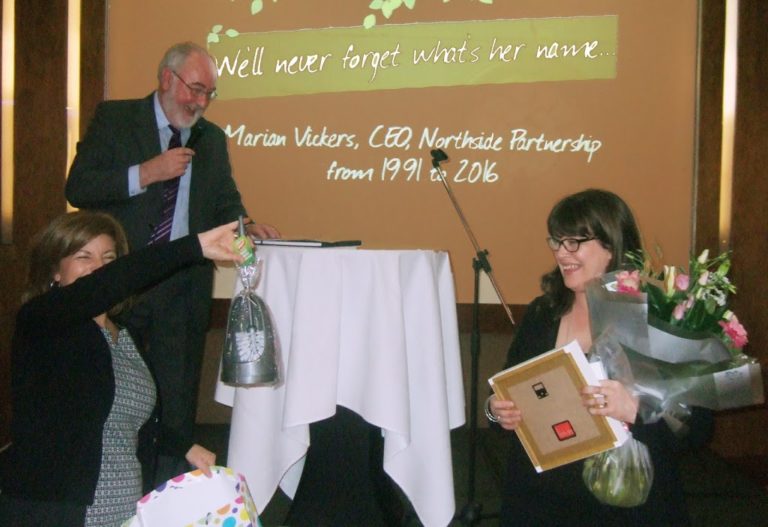
“We’ll never forget what’s her name”

Colleagues making presentations to Marian Vickers, former CEO of Northside Partnership. She and her husband Aidan have moved to Kerry to open a Bed & Breakfast. She was with Northside from the beginning.

–  Marian Vickers got project going with a hundred pounds
– Retirement event marked a quarter-century of development

BY BEN PANTER

It’s been 25 years since Marian Vickers was handed a cheque for a hundred pounds with which to begin her adventure with Northside Partnership Company in Dublin.

Denis Leamy, CEO of Pobal, Gerry Kearney, the retired secretary general of the former Department of Community, Equality & Gaeltacht Affairs, Marian Vickers who has retired from Northside Partnership and Clodagh McDonnell, Principal Officer, Department of the Environment, Community & Local Government (as it was known until recently).


“Today, Marian and the Partnership are synonymous,” said chairperson Lorcan Ó hÓbain, at a party marking Marian’s retirement. She was the company’s one and only CEO until now.
With the retirement in December of another CEO in Munster – also a long-timer – all but two of the people at the helm in local development since 1991 have handed over to successors.
“When we started this organisation, there was Marian, a mobile phone and later a car and that was it,” said Lorcan. “The impact that she has had over the last 25 years has been absolutely essential and we really say thank you.”
She also served as vice-chairperson of the Irish Local Development Network, among other interests.
The Hilton Hotel on Malahide Road hosted the event which opened with a ‘Champagne Reception’, in stark contrast to Marian’s humble beginnings. Guests included family, friends, community workers, academics, and representatives from various agencies and strands of government and the Department of the Environment, Community and Local Government. All were there to celebrate Marian’s quarter-of-a-century tenure and reflect on progress since Northside Partnership’s humble start.
The Partnership’s first chairperson Padraic White recalled that, “The philosophy we all tried to follow was the same as at national level where the government, trade unions and the community sector had come together after the recession of ‘87 to improve the country. We followed that at local level. It was a great time of innovation.
“As people know, the culture, organisation, and template of new projects are set down at the start and we were fortunate to have an amazing board of people around that table,” he added.
Over the years, with Marian at the helm, the Partnership became a pioneer in the Community Development Sector. 
           For example, RAPID set up in 2001 to address issues of social exclusion attracted ˇ5 million into the area in its first five years and is still in operation.
           Northside’s Preparing for Life programme has become a flagship project according to an enthusiastic Dr Matthias Borscheid, SICAP manager (see inside this issue for more).
           SpeedPak, a distribution company set up in 1995 with help from the partnership to address unemployment in the area, was briefly featured in our last issue – It has become a valuable partner to Changing Ireland over the years.
           The Challenger Programme made the front page in the Winter 2014 edition featuring one of its successful graduates Ciara Hurley.
The Northside Partnership’s initiatives impact on every area of life – they even run quit smoking courses for those of us sick of the devil’s weed.
All this is in contrast to Marian’s early days in the job which started out with so much promise and then quickly took a nosedive, as she explained:
“I met the board in very salubrious offices next to the Shelburne Hotel – you’re talking mahogany, crystal glasses, a beautiful boardroom. I met the directors, I signed the contract and I was given a petty cash cheque for a hundred pounds. And then they gave me the Parish Priests mobile phone which took eight hours to wind up – I could make about four calls on it.”
She went on to pay tribute to her colleagues: “We have had the most incredible board of directors, management and staff over the years.”
She spoke of the “privilege” she felt to be involved with the community development sector, saying she felt “very moved” working with people in the community and enabling them in “transforming their lives”.
Soon, Marian and her husband, former local credit union manager Aidan O’Brien will be working with people in a different capacity. They are this Spring opening a B&B in Dingle, Co. Kerry.
If she approaches this latest venture with the same attitude and efficiency that her colleagues described, Francis Brennan might be nervously looking over his shoulder.
* The new CEO is Paul Rogers a native of Coolock who previously worked for Tolka Area Partnership.

The Community Sector in Ireland – THE VIEW FROM THE STARTING BLOCK

– HOW OPTIMISTIC ARE YOU ABOUT FINDING WORK IN THE COMMUNITY SECTOR?


BY ALLEN MEAGHER

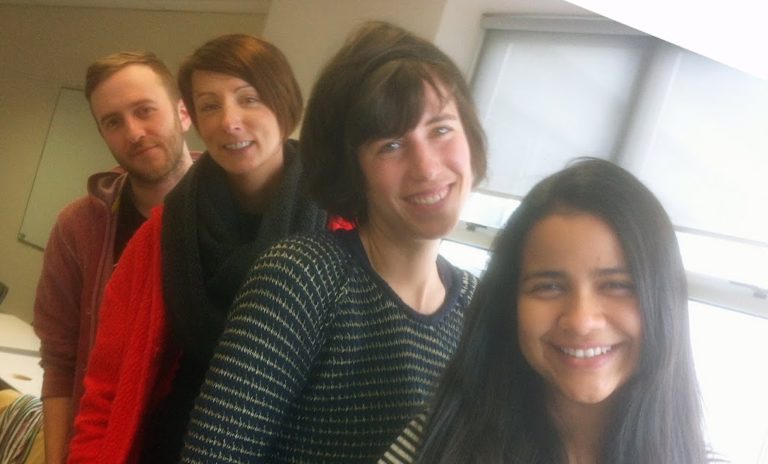
As folk who’ve been working in the Community & Voluntary Sector since the early 1990s begin to retire, we asked five up and coming community workers how optimistic they were about finding work and where their passions lay. Silvia, Luke and Donna are engaged in a Postgraduate Diploma in Co-operative Organisation, Food Marketing and Rural Development. Lesley is studying for a Masters in Youth Work with Community Arts and Sports Studies. All are students of UCC.

All are counting on not just a qualification but also highly rate voluntary experience to help them find paid work.

Lesley – you make your own opportunities.
Lesley O’Sullivan – Cork
I love this area of work, I really enjoy working with young people.
While there are more jobs in Dublin than in Cork, there are more possibilities now through Erasmus Plus and other European funding mechanisms. I come from an arts background and I’ve learned you make your own opportunities.
I work sometimes with East Cork Music Project, connecting with young people by maker education, which mixes art and technology. I also work with the Youth Advocate Programme (which supports vulnerable families and young people).
I went to college because I wanted to get more skills and get a proper qualification. For instance, we’ve learned how to use development education and creative methodologies in our work. Ideally, after my Masters, I would like to start my own project – a ‘Maker-Space’ for young people. Look it up!
 
Silvia wants to work in community development.
Silvia Amador – Nicaragua
I want to work in community development. I’ve done it and I want to keep on doing it. What excites me is – and this might sound a little clichéd – I can gain professional development and at the same time personal satisfaction, while being paid for it, and I’m helping to improve other people’s lives. That’s really a motivation for me.
It’s a very competitive area. (Employers) mostly require people with years of experience. So, that’s the reason I’m doing this Masters, so I can combine my work and experience with a good title. 
Luke – You need to get paid.
Luke Casey– Kilkenny
To break into the Sector, you need a certain level of experience so I would be willing to do voluntary work again, but not for as long as in the past. I did it for a year before.
Some of the lecturers are saying there are more opportunities coming up, but nothing is concrete. I’m finding it hard to see past all the voluntary work. You need to get paid.
My background is doing community work in developing countries. I’m also interested in working with credit unions, helping them to make more of a connection through social media with young people in particular.
Stefanie – very fulfilling work.
Stefanie Debuck – Belgium
It’s a challenging sector, but it’s very fulfilling work. I was volunteering for a year and more and I did an internship in Cuba and Guatemala. Let’s see how it goes. I was more focused on NGOs before and now I’m more focused on social enterprise.
I would love to set up with others a co-op or social enterprise, especially related to food and agriculture.
Donna – Rural areas have so much to offer.
Donna Cleary – West Cork
My interest is in working with rural communities and promoting rural areas in terms of food, regional branding, tourism, eco-tourism, hopefully working in the LEADER programme. Rural areas are dying and they have so much to offer, but we need to get the momentum going.
I’ve absolute confidence I’ll find work. I have to have. If you really want it, you go after it and if that means having to volunteer for a time, that’s fine. The economy is picking up and we need more promotion of rural areas and I feel there will be jobs in that sector.

Superb equality resource idea from Monaghan County Council

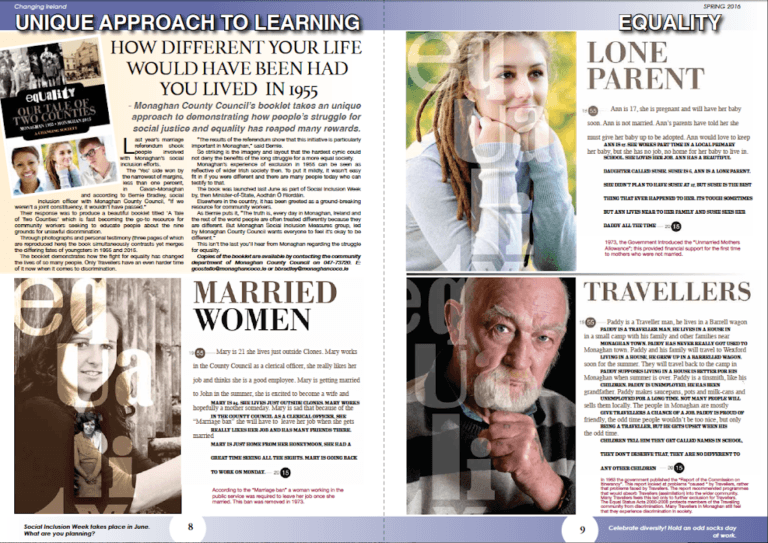
Compare how different your life would have been had you lived  in 1955

Monaghan County Council’s booklet takes an unique approach to demonstrating how people’s struggle for social justice and equality has reaped many rewards. Anyone in Ireland today would find it useful to give them perspective in the struggle for equality.

Click here to download the 2 page spread!

Last year’s marriage referendum shook people involved with Monaghan’s social inclusion efforts. 
The ‘Yes’ side won by the narrowest of margins, less than one percent, in Cavan-Monaghan and according to Bernie Bradley, social inclusion officer with Monaghan County Council, “If we weren’t a joint constituency, it wouldn’t have passed.”
Their response was to produce a beautiful booklet titled ‘A Tale of Two Counties’ which is fast becoming the go-to resource for community workers seeking to educate people about the nine grounds for unlawful discrimination.
Through photographs and personal testimony (three pages of which are reproduced here) the book simultaneously contrasts yet merges the differing fates of youngsters in 1955 and 2015. 
The booklet demonstrates how the fight for equality has changed the lives of so many people. Only Travellers have an even harder time of it now when it comes to discrimination. 
“The results of the referendum show that this initiative is particularly important in Monaghan,” said Bernie.
So striking is the imagery and layout that the hardest cynic could not deny the benefits of the long struggle for a more equal society.
Monaghan’s experience of exclusion in 1955 can be seen as reflective of wider Irish society then. To put it mildly, it wasn’t easy fit in if you were different and there are many people today who can testify to that.
The book was launched last June as part of Social Inclusion Week by, then Minister-of-State, Aodhán Ó Ríordáin.
Elsewhere in the country, it has been greeted as a ground-breaking resource for community workers.
As Bernie puts it, “The truth is, every day in Monaghan, Ireland and the rest of the world people are often treated differently because they are different. But Monaghan Social Inclusion Measures group, led by Monaghan County Council wants everyone to feel it’s okay to be different.”
This isn’t the last you’ll hear from Monaghan regarding the struggle for equality. 

Copies of the booklet are available by contacting the community department of Monaghan County Council on 047-73720. E: gcostello@monaghancoco.ie or bbradley@monaghancoco.ie

– By Allen Meagher & Ben Panter for ‘Changing Ireland’.