Organisers put in 16-hour days in the run-up to hosting the World Community Development Conference (WCDC) in Maynooth, Co Kildare.
“We’re not big enough to be doing this,” said one organiser, nonetheless beaming at the end of a highly successful day one.
As she took a lift in my car from the town square back to the university, she brought me up to speed. The conference had got off to a great start – everyone spoke well, there was a superb atmosphere and it finished with a sing-song on the streets of Maynooth.
What else had I missed? Pobal’s Paul Skinnader had posed the question (without answering it himself), ‘Should Ireland once again have a community development programme?’
Maybe if there was one, we’d be under less pressure.
Many present, but more missing
It felt like it had taken me 16 hours to drive to Maynooth from Limerick. I arrived at 10.50pm, giving me 10 minutes to locate my accommodation at Maynooth University. Easier said than done… The campus is now twice the size it once was.
I was escorted by a friendly accommodation staff member to a modern building and a neat, concrete-walled, university-style apartment. Very swish, but I wouldn’t last a full term. I couldn’t get the shower to work properly, even with advice. There’s an invisible box outside your door with an invisible switch you turn on 20 minutes before your shower and you’re sorted.
In fairness, climate change meant the cold shower was not an issue – we were in the midst of a heatwave.
Mary Robinson, in opening the conference, linked climate action work to community development work. While she was speaking, I was doing critical admin to get a magazine out. Probably only people in community and voluntary groups understand. Getting a cheque signed for us can involve a 10-kilometre roundtrip and four stops.
I say this because Irish participation in WCDC 2018 was as much about who wasn’t there as who was. Many were willing, but not everyone had three days on hand. And volunteers couldn’t afford the fee.
The Department of Rural and Community Development issued a number of free conference tickets – which could be shared – to groups working in community development, but many chose to remain at ‘the coalface’. They knew they were missing out.
I met people who came for two days who were sorry they didn’t book for longer. Over 400 people attended the conference from Ireland and – obviously – many other countries. It was brilliant. While it was largely an academic conference, it gave a platform to world-class speakers to set out the challenges of the day. Imagine a diploma course being held over three days, where you’d need a team of 10 to cover everything.
The Department of Rural and Community Development had almost that many staff there, and senior officials addressed the gathering and joined the workshops.
‘Purple People’
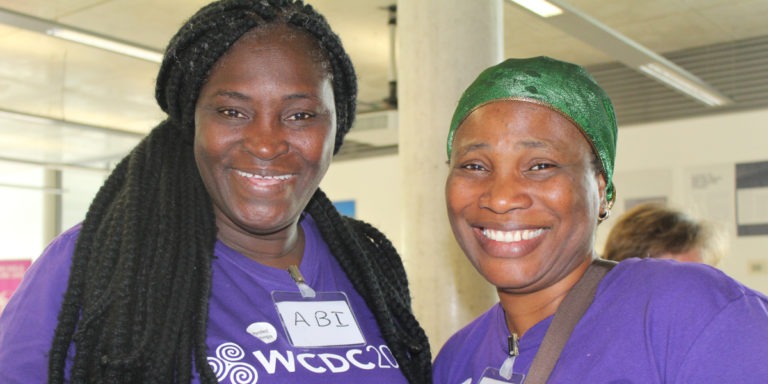
There was a festival feel to the start of day two at the conference. Two volunteers in purple t-shirts sang their hearts out and everyone joined in.
— Allen Meagher journalist (@allenmeagher) June 26, 2018
Organisers relied on these ‘Purple People’ throughout, student volunteers from the university.
Day two was seen by full conference attendees as even better than day one. Bernadette McAliskey set the tone, urging community development workers to up their game now that fascism is coming well into view. An Australian speaker, Jim Ife, told us that, while struggles for equality were worthy, those with power and wealth were laughing all the way to the bank while we were ‘distracted’. Meanwhile, we are burning the planet.
We cooled off that evening with iced drinks and a set meal in a Harry Potter-style dining hall, followed by a sing-song and a return to the square. This was the premier networking spot.
There, I met Fiona Boyle from Australia who spent six months travelling mostly overland for conference. She’ll have to do it all again next year to reach Scotland.
Dundee next
I met past and future organisers of the WCDC, from New Zealand and Scotland, respectively. Two very energetic people, beaming positively.
John Stansfield from New Zealand said, “The best thing for me was the way very poor students from West Auckland stepped up to lead the conference as volunteers”.
Clare MacGillivray from Scotland and John Stansfield from New Zealand, organisers respectively of the next and the last world conference. Photo: Changing Ireland.
Clare MacGillivray from Dundee proudly told us that the conference host for 2019 is a “revolutionary, forward-thinking and friendly city”. Encouraging people to plan ahead, she said that, “just like Ireland, it’s going to be scorching. At least 30 degrees”.
Maynooth’s conference programme shows that the third day was planned to start a half-hour earlier than the day before, but not enough of us took notice of the earlier start time. Everything ran a little late. People were not overly concerned.
It wasn’t as if anyone could get to see everything. You’d need to be able to be in two places at one time to take in less than a quarter of the sessions. People had to choose from 11 parallel seminars and workshops, each with multiple speakers. And that was just one of the morning sessions.
Look up #wcdc2018 and you’ll get a good flavour of what rocked people’s boats.
And never say never. Getting to Dundee will only cost most Irish people €50 or €60 more than attending Maynooth. Just as Maynooth provided cheap, quality accommodation (€37 per night), so too will the University of Dundee, Clare assured me.
Presuming prices don’t change, the only additional cost will be the travel. The questions to ask yourself, then, are whether you can plan to have three free days in your calendar a year from now, and how you are with haggis.
From 25-27 June 2018, community development workers from all over the globe descended on the small town of Maynooth, Co Kildare, for the World Community Development Conference (WCDC).
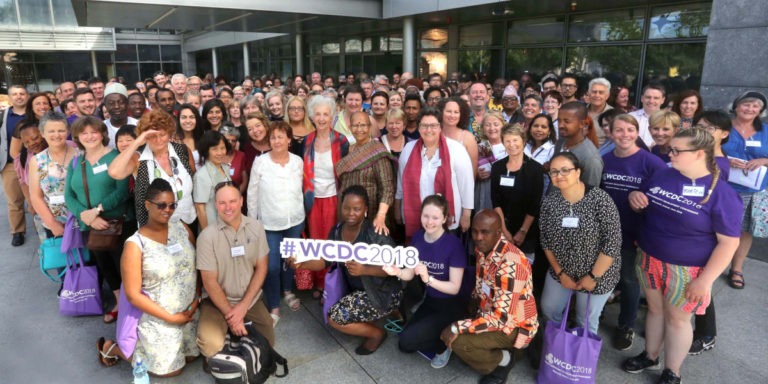
WCDC, held in the lecture theatres and classrooms of Maynooth University, brought together 400 people from 40 different countries to talk, learn and share experiences of community development under the topic of ‘Participation, Power and Progress: Community Development towards 2030’.
Attendees gathered en masse each day to hear plenaries and keynotes from some big names in community development – including former president Mary Robinson, activist Bernadette McAliskey, academic Yaser Alashqar, Community Work Ireland’s Rachel Doyle, academic Jim Ife, Dóchas CEO Suzanne Keatinge, and academic and activist Lynne Segal – before splitting into smaller groups for sessions and workshops.
Emerging themes
Over the three days of WCDC, a number of themes seemed to emerge. Attendees heard and talked again and again about social, economic and environmental justice, empowering women, and giving voice to the voiceless.
While many speakers and panellists touched on these issues, it was Mary Robinson – opening the conference with a talk on the connections between community development and climate justice – who spoke about them most succinctly.
Former President of Ireland Mary Robinson meets Rohingya activists at the World Community Development Conference in Maynooth. Photo: Derek Speirs.
“Climate change and migration are the burning issues of the future,” said Robinson. “Climate change is a man-made problem which needs a feminist solution.”
Quoting Arundhati Roy, she highlighted the need to bring many voices to the table: “There’s really no such thing as the ‘voiceless’. There are only the deliberately silenced, or the preferably unheard.”
Intentional or not, giving voice to the voiceless was a theme that ran throughout WCDC.
Jim Ife spoke powerfully during his plenary talk (on humankind’s impact on the planet) about hearing non-white, non-male, non-Western voices: “I used to think that one of the differences between human rights and the rights of nature was that we can’t expect nature to articulate rights and demand rights in the ways that humans can. Then I realised that if we had only listened to Aboriginal people, to indigenous people, they would tell us, ‘Yes, nature does demand its rights. It’s just that we’ve forgotten how to listen’.”
Ife’s talk followed one given by Francisco Cali Tzay, a former president of the UN Committee on the Elimination of Racial Discrimination and, as one of the Mayan Kaqchikel people from Colombia, the first indigenous person to hold such a position. Cali Tzay spoke about the long hard struggle to ensure indigenous voices were heard in corridors of power and reminded attendees that it was impossible to talk about community development towards 2030 without including indigenous people in the discussion.
Grassroots energy
Another thread that ran through the entire conference centred on the recent referendum result. Rachel Doyle, joint national co-ordinator of Community Work Ireland, said during her plenary, that “the recent overwhelming vote to repeal the eighth amendment gives us great hope in the power of grassroots movements and the potential for change.”
This sentiment echoed through sessions and workshops over the three days, with many calls for community organisations in Ireland to capitalise not only on the results of the election, but also the enthusiasm with which both sides fought their corners.
For people from outside Ireland, the result meant something more. When asked why she had come to a panel on reproductive rights and feminism in community work, one American attendee replied with real emotion in her voice: “Things have been getting pretty dark at home. I’m here because I really need to find some hope.”
A call for more time
If there was one complaint that was prevalent throughout the conference it was that there wasn’t enough time – enough time for discussion, enough time to absorb, enough time to sit in on all of the interesting, informative sessions and workshops.
And yet it was impossible to leave Maynooth without gleaning at least something worthwhile, whether from individual sessions or on the whole. One of the most striking takeaways from the conference, for example, wasn’t the differences between practices around the world, but the similarities.
This was apparent in numerous presentations, but never more so than in one ringing statement from Kwon-Kin Fung, a Hong Kong-based academic and community worker: “One of the issues facing community workers and social workers in Hong Kong is a focus on paper work more than people’s work.” Murmurs of recognition and agreement filled the room.
More than a State of the Union – a clarion call
But WCDC was far more than a state of the community development union address – it was, as its overarching topic dictated, a look forward at how the sector needs to change and act in the next decade. As such, many speakers dotted their speeches with powerful words and almost revolutionary calls to action.
Bernadette McAliskey called out the “lurkers”, asking “What are any of us doing if we aren’t systematically working towards real social change? Are we becoming pacified by government partnerships? Are we becoming pacified by funding requirements?”
Mary Robinson took a feminist approach, stating “Increasing women’s participations in environmental planning leads to improved outcomes for everyone – the whole community benefits. We must tackle the complex barriers to meaningful women’s participations.”
Lynne Segal delivers the closing address of the 2018 World Community Development Conference in Maynooth. Photo: Changing Ireland.
In a workshop on feminism and community work, Trish Brennan of the Women’s Council of Ireland reminded attendees that their job, as community workers, was to upset the apple cart.
Rachel Doyle warned against the pacification of community development workers: “I hope we’ll go home with fire in our bellies and enthusiasm to join the push back against complacency.”
Lynne Segal, who closed the conference, ended with a banner-waving moment – a moment that said the fight is far from over: “We have to refuse to abandon the desire to see real change, because that’s what all our enemies want us to do.”
Yet, in spite of this fire and spirit, the conference itself wound down on a more conciliatory note with the reading of the Maynooth Declaration, which ends:
“We reconfirm community development as a proven means of building a just, sustainable and peaceful world, and call on local, national, regional and global authorities and governments to recognise, support and sufficiently resource independent community work through appropriate political leadership, funding, policy and legislation.”
One thing is clear: with or without that government support, community developers won’t be going down without a fight.
If you’d like to attend the next World Community Development Conference, it will take place from 24-26 June 2019 in Dundee, Scotland.
I first met Bernadette McAliskey in the mid-1990s, when it was hard work being a community activist in Co Tyrone.
I was a reporter with the Mid-Ulster Mail, and happened to be present for a small piece of history: President Mary Robinson dropped in on a community project in Coalisland, Co Tyrone, and was greeted on arrival by McAliskey.
The President was not on an official visit to the North. She came unofficially, to the annoyance of many and the joy of many more. She was paving the way for peace in a pushy way. An activist at heart.
Both women were on stage at the World Community Development Conference (WCDC) this summer, held in Maynooth, Co Kildare, in June.
McAliskey pointed to people involved in community work and asked what we are doing, if anything, about the rise of the super-rich and about inequality.
Jim Ife, later, went further. We’re so focused in community development on ourselves – meaning the activity of human beings – that we forget about nature and the environment. We’re missing the point of community development, he says.
The conference was a gathering of the faithful, though it would have cost you. Next year’s WCDC will be taking place in Dundee. Ask your company or organisation to part or fully fund your attendance.
Like the general Irish public with the Ploughing, every community worker should strive to go to at least one World Community Development Conference in their life.
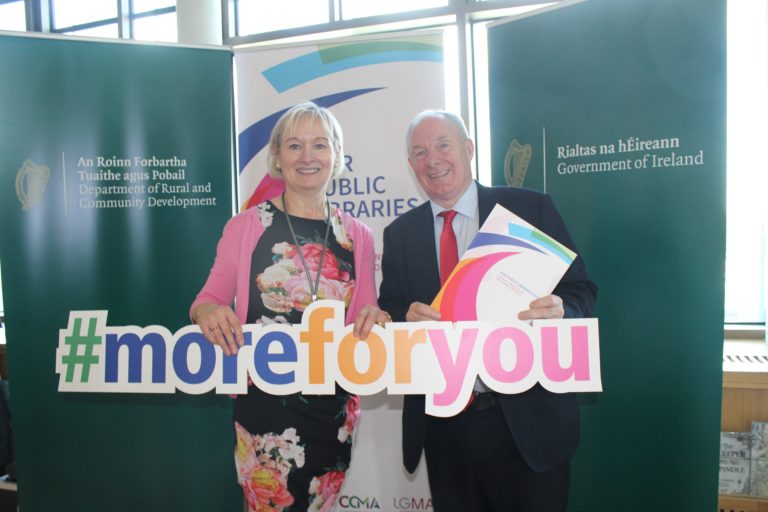
Library staff around the country have been applauded by Minister for Rural and Community Development Michael Ring TD for their “commitment, passion and enthusiasm…in delivering the broad range of services now available”.
“Library staff have been leaders in driving change in our public libraries,” he said.
Libraries have indeed changed. They may appear the same as before on the outside, but looks can be deceiving. Step inside and it’s a different world.
You can now bring a coffee with you into the library, hold public meetings there, sign up to improve your health and fitness, and stay ‘til late. And much more is promised between now and 2022.
It makes for a striking contrast with the UK, where public libraries have shockingly been forced to shut. [Lord John Bird, founder of The Big Issue, described the shutdown of 500 libraries in Britain between 2010 and 2016 as a “dastardly deed, this process of philistinising our communities”. He told the House of Lords: “If you are going to cut libraries, you must be prepared to build more prisons, to build more homeless hostels.”]
In the Republic of Ireland, as the new strategy makes clear, “there remains strong local and central government commitment to support, develop and resource the service as a modern multi-functional service at the heart of communities”.
Will we see library staff taking on the role of community worker? It already happens in places. But can we trust that this strategy will really see libraries become the ‘community hubs’ that have been envisaged?
We turned to our Secret Librarian – who we will call Laura [not pictured] – for a blunt appraisal. She’s an old hand who’s seen it all before and, we believe, speaks for many.
So, what does she make of the new strategy? Well, it’s mostly positive. She’s concerned about staff being replaced by automated services, but sees progress in other areas.
Fines not all gone yet
Laura’s library has done away with fines, but other places still have them. The service varies from county to county, and even within counties.
12 million books
You can now borrow any of the 12 million titles available across the library network.
It’s true. Laura can source a book from anywhere in the country and have it delivered to your local library for collection.
Community development training
While librarians are partly engaged in community work, it’s not something they are trained in.
Laura and her colleagues did receive mental health training, which she says was very good. They also received two hours of anger management training.
Yes and No to food and drink
People can use the rooms in Laura’s library for meetings and can bring along food and drinks. Adults in the main library can bring in a (non-alcoholic) drink, but children can’t.
Some libraries are open much more than others. Oddly, some full-time libraries don’t open on Saturdays – only from Monday to Friday. Laura would like to see this change.
Some libraries already are community hubs
The new strategy for libraries promises to “develop new relationships and build on existing ones with local communities and organisations; to promote local libraries as vibrant centres of community, culture and learning for all communities”.
Laura is already highly committed and actively engaged, linking up with local community groups, collaborating, running events and offering new services.
She ably demonstrated how connected her colleagues are with the people in the community. They know when members are stressed and will reach out.
Libraries are definitely already becoming community hubs. In many places, people now only have libraries and post offices to meet in.
Team development
The new 2022 strategy promises “library team development with skilled staff taking a more proactive and confident customer-focused approach”.
Laura said staff numbers are low, as there was a moratorium in place until recently. She’s glad it’s gone, but recruitment embargoes are cyclical. There was a moratorium on recruiting staff in the 1980s and the fear is that it will happen again when the next recession comes.
Proper planning
The new libraries strategy promises “to establish a flexible structure for communication across the library team”.
Locally, Laura’s experience up to now is akin to having been a mushroom. She and colleagues were kept in the dark by senior management on any local plans.
The strategy’s ambition for better communications may reflect concerns Laura and colleagues nationally had. Thankfully, library staff across the country were fully engaged by those tasked with drawing up the new strategy. Laura’s crew were engaged in formal consultations for two full days.
Already, times are changing for the better. Senior management is now obliged to hold regular meetings with staff, and the meetings must be minuted.
Internet access and training
Society is in the midst of its fourth industrial revolution – the internet – and the new libraries strategy promises to “establish the library as an important enabler of digital services and facilitator of digital skills development”.
Laura and crew already help people with scanning documents, printing and accessing email. Many people don’t have a computer and, as the CSO found in 2016, 18% of households had no internet connection.
People often call to the library in a state of panic. They might need to print off bank account statements and don’t know how.
Laura has seen the value of government investment in teaching digital skills to library members. Her library has people in their 80s who now know they have to learn how to use computers.
People v machines
Laura is not pleased about the installation of self-service machines for people borrowing books. She is not sure that this is the way we should be going. It raises a philosophical question: What kind of society do we want? The banks are already automatic and people hate it. The supermarkets are going that way too. Do we really want libraries to be the same?
Another strategy!
Laura sees the new 2022 strategy mostly as a vision document. The library service already has three strategies guiding it, which she is happy to extoll. They are:
Right-to-Read
With the Right-to-Read campaign, for which local government is responsible, libraries sought to become champions of literacy support and development. Laura likes the campaign, especially as there is an onus on local authorities to ensure it happens in their areas.
Work Matters
Regarding Work Matters, which supports people in business, Laura queried the point of the hot desk facilities [dedicated computers for people applying for jobs and so on]. There are other agencies already providing this support, but someone in Dublin had a bright idea, she supposed. She sees it as duplication.
Healthy Ireland
Last year, Healthy Ireland and the HSE gave €400,000 to the library service to buy a large number of health and medical-oriented books.
In Laura’s workplace, the special shelf of health-related books is on prominent display. Recently, a chef visited and gave members cookery lessons. Cooking in the library? Whatever next!
Laura was impressed.
Interested in reading more about the state of Ireland’s community development sector? Check out our latest issue.
My Open Library
The My Open Library initiative will see opening hours extended on a self-service basis for library members, seven days a week, from 8am to 10pm, 365 days a year.
By 2023, a hundred libraries should be offering this service.
My Open Library is currently available in Banagher and Tullamore libraries in Co Offaly, and the Tubbercurry library in Co Sligo. A full range of services are available there, including book borrowing, meeting facilities, study spaces and ICT facilities.
The aim is to allow access to the library at times that suit members, while allowing libraries to become a focal point for community engagement. [Return to article.]
There’s nothing like real consultation, and the new strategy has all-round backing. It was launched, with immaculate timing, a day after unions voted overwhelmingly to call off the threat of industrial action.
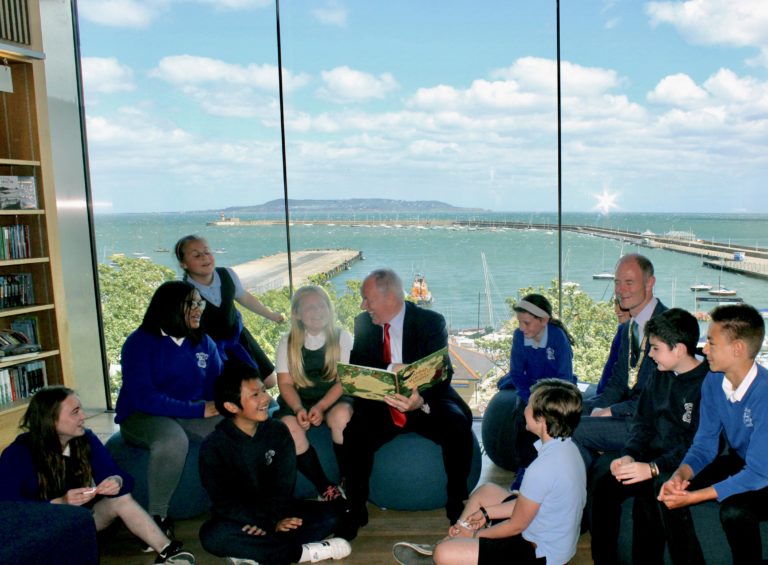
The new strategy was launched in the spectacular LexIcon in Dún Laoghaire by Minister for Rural and Community Development Michael Ring.
He said: “The overall aim is to increase active library membership from 16% of the population to 30% by the end of 2022.”
Judging by the 2016 census figures, that means moving membership numbers up from 761,000 people to approximately 1,500,000 members by January 2023.
In part, that will be achieved by ending fines, extending opening hours, and reaching out further into communities.
On ending fines, Minister Ring said the strategy focuses on “removing barriers to access by eliminating fines and other charges and challenging the belief that the library is only for certain sectors of society.”
Fines are already gone in many areas and are on the way out in others.
The roll out of the My Open Library service will see a pilot scheme expanded to “up to 100 libraries by 2023, with the goal of reaching 200 library branches over the next decade”.
This means that libraries will be open at night-time, including over weekends.
The Minister said the strategy “aims to improve access, use and visibility of the library as a community hub, and develop the library as a focal point for community and cultural development”.
It promises to see our libraries “work with local partners to reach disadvantaged, marginalised and new communities, increasing these communities’ awareness of services available and firmly establishing the library as a resource for all”.
In the past 12 months, there has been a multimillion-euro increase in funding for our public library service, with the government investing more in libraries last year than in the three previous years combined.
Speaking at the time, Minister Ring said: “This very significant investment in our public libraries will enable the purchase of self-service technology for more than 200 libraries, books to promote literacy for children, and hot desk facilities for business people and jobseekers. It is an exciting time for the public library service and for library staff.”
Interested in reading more about the state of Ireland’s community development sector? Check out our latest issue.
The 1,000th LEADER project under the current programme (which runs from 2014 until 2020) was approved for funding over the summer: Muckross Rowing Club (Muckross RC) in Co Kerry.
Rowing is one of the oldest sporting traditions on the Lakes of Killarney, dating back for 350 years. The application for funding was made to enable Muckross RC to buy a coastal rowing boat, with a view to retaining young members who often leave the sport in their late teens.
While most of Ireland knows of Olympic champions the O’Donovan brothers, Muckross RC has its own high-performing rowers. Paul Griffin, Sean Casey and Cathal Moynihan have all competed in world championships.
The club continues to look to the future and recently held an open day to attract new members.
On reaching the milestone 1,000th LEADER project, Minister of Rural and Community Development Michael Ring pointed to a further 300 project applications currently going through the approval process for a share of funding of €20m more.
After delays in the first year, more than €30 million has now been released through the programme to support communities and businesses across rural Ireland.
By the end of 2020, €250m in grant aid is expected to have been provided to rural communities and businesses through LEADER.
The LEADER grants are awarded to projects under three themes:
Economic development, enterprise development and job creation
Social inclusion
Rural environment
Since its launch in 1991, LEADER has provided rural communities across the European Union with resources to enable local partners to actively engage and direct local development in their area through community-led local development.
Minister for Rural and Community Development Michael Ring and Minister of State Seán Kyne welcomed increased funding to the Department of Rural and Community Development as part of Budget 2019.
The overall level of funding for the department will increase to €293 million for next year (up from €231m in 2018). This funding will facilitate the continued delivery of programmes across the rural and community development areas, provide €55m for the roll out of the new Rural Regeneration and Development Fund in 2019, and allow additional supports for programmes.
Key Budget 2019 measures
An additional €55m has been made available to invest in rural towns and villages through the €1 billion Rural Regeneration and Development Fund, which begins in January 2019.
A further €2m is budgeted for expanding the successful Walks Programme, bringing its total allocations for 2019 to €4m.
Extra funding of €3.3m will be provided to support the new library strategy, bringing the total library development allocation for 2019 to €7.2m.
Additional support of €2.4m was announced for measures under the Dormant Accounts Action Plan to address economic, social or educational disadvantage. This brings the total Dormant Accounts allocation in 2019 to €12.6m.
The Community Enhancement Programme will be receiving an additional allocation of €2m, bringing the total 2019 allocation up to €4m. This is to enhance community facilities in disadvantaged areas, e.g. renovating community centres, or improving town parks and common areas.
Additional funding under the cross-border PEACE Programme 2014-2020 will bring the total 2019 allocation up to €5m.
Furthermore, an additional €500,000 will go to enhance the Western Development Commission’s capacity to support innovative and strategic regional development initiatives in the West. This increased this allocation to €2m.
Irish Water Safety will be receiving additional funding, increasing the total allocation for 2019 to €1.1m.
Interested in reading more about the state of Ireland’s community development sector? Check out our latest issue.
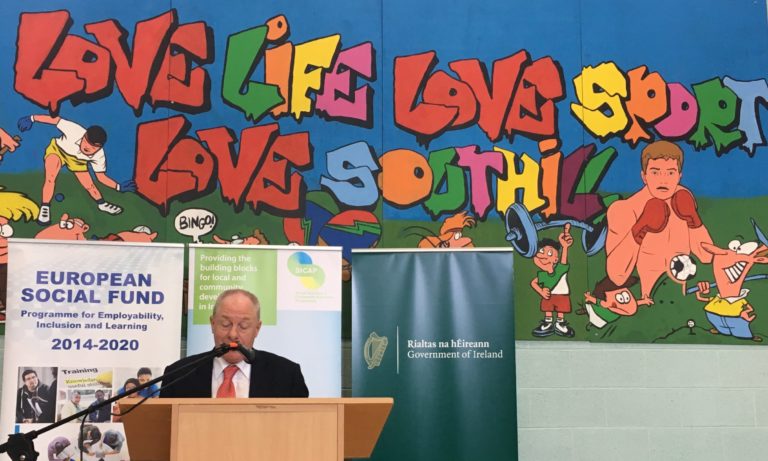
On 20 April, Minister for Rural and Community Development Michael Ring arrived in Limerick for an important event: the national launch of the new Social Inclusion and Community Activation Programme (SICAP).
The dual launch took place in two Limerick communities representing urban and rural areas that benefit from the programme: Southill in the city and Ballybrown in the county.
Minister Ring described SICAP as a “major investment by the government to tackle disadvantage in Ireland”.
The €190 million spend will run from this year until 2022.
“This announcement demonstrates the government’s commitment to tackle poverty and social exclusion in the most disadvantaged areas for the next five years,” said Minister Ring.
“Working at a local level with community groups and individuals, SICAP funding supports life-long learning, strengthens communities and helps people to become job ready.
“By providing practical guidance and supports, the programme helps disadvantaged people throughout the country to make progress in their lives and to realise their potential,” he said.
The programme supports unemployed people, people living in deprived areas, people with disabilities, single-parent families, people on low income, members of the Traveller and Roma communities, and other disadvantaged groups.
It is overseen at “lot” level (often a county) by local community development committees (LCDCs), while it is implemented at community level by the staff of local development companies, such as Partnerships or LEADER companies.
The programme follows in the train of earlier programmes stretching back to the early 90s, all aimed at tackling poverty in collaboration with communities. These include the Local and Community Development Programme, the Local Development and Social Inclusion Programme, and the Community Development Support Programme.
There was often resistance when programmes ended, but for community groups to continue to receive funding, they generally gave in to pressure to go along with what came from the top down.
On this occasion, it is different. The redesign of SICAP – SICAP 2, as it is known by people working in the sector – took on board the majority of the observations and recommendations that came from the grassroots up.
The changes introduced for the current programme were welcomed far and wide.
While the funding for earlier programmes was at times higher than for SICAP, the programme has (since 2015) established a record for itself in “helping disadvantaged people to make progress in their lives”.
The government sees it as being more efficient.
Speakers at the dual launch included Minister Michael Ring; Patrick O’Donovan, TD; Tom Neville, TD; Cllr Stephen Keary, Mayor of Limerick City and County Council; Cllr Jerome Scanlon, chairperson of Limerick’s LCDC; and Shay Riordan, CEO of West Limerick Resources.
We asked people involved in the delivery of SICAP around the country what they made of the new programme.
Meath
Michael Ludlow, CEO of Meath Partnership, said he and his team are “very happy this time around”.
“We’re very happy with this SICAP in comparison to the last SICAP programme.
“It allows us to engage more with the individuals who are meant to benefit from SICAP.
“It’s more focused on doing quality work for individuals who need assistance, rather than achieving numbers and targets with minimal impact on the beneficiary,” said Ludlow.
Mayo
Gerry O’Neill, CEO of South West Mayo Development Company, was pleased with changes to the programme, but he criticised the decision to put the work out to public tender.
“The fact that we’re through the second tendering process is a relief, obviously, for us all. Having done it once, it was easy to do the second time, but these programmes should not be in that space – they shouldn’t be tendering.
“Having said that, we’re where we are now. The new programme has been simplified in that there are two goals rather than three.
“And the fact that the targets are reduced a bit enables us to work more intensively with less people, rather than working under pressure with regard to meeting targets.
“In our case, the main priority remains with individuals, with younger people and with what would be classically called ‘NEETs’ [people who are not in education, employment or training].
“From the community side, there would be a lot of rural isolation. We’re also looking to put more effort into supporting social economy projects,” he said.
Slevin said SICAP had been “streamlined and is doing everything that it should be doing, so we’re very happy with it at this point in time. It is working very well for us”.
North Tipperary
Caroline Shanahan, from North Tipperary Leader Partnership, said: “I work as a project worker on SICAP. We do work sometimes that never gets seen or heard of, and I enjoy working on it.
“Overall, I think it’s a great programme. I’m glad they made some changes from the last programme. I just feel it might be easier to work with,” she said.
Limerick – LCDC perspective
Newcastle West-based Fine Gael councillor Jerome Scanlan is the chair of the LCDC in Limerick. He said SICAP was “fantastic” and had “delivered very well for Limerick through our three LEADER companies: West Limerick Resources, Ballyhoura Development, and the PAUL Partnership”.
He said it was “absolutely fitting” that Minister Ring conducted the launch in Southill.
Limerick – a worker’s perspective
Maeve Gorden is with St Mary’s Aid, based in Limerick city’s King’s Island.
She said: “It’s lovely to see that the consultation that was done over the past few years was taken into account. There’s a move towards the bottom-up approach in allowing communities to grow with the programme.
“And it’s open now to more people; it’s not as closed to target groups. It’s open to older people, and reaching out and recognising the needs of women as well. They’re all good changes. It’s going in the right direction.”
National perspective – the ILDN
The Irish Local Development Network (ILDN), whose members implement SICAP across the state, welcomed the new programme and its design. Chairperson Marie Price-Bolger said: “It will allow our members, whose approach is community-based and community-led, to advance the social inclusion needs of disadvantaged individuals and groups on a planned basis over the next five years. The ILDN looks forward to supporting our members in their delivery of the programme.”
National perspective – Pobal
Pobal’s CEO, Denis Leamy, welcomed the fact that SICAP 2018-2022 will have “an increased focus on targeting the most disadvantaged individuals and communities, using community development approaches, more intense engagement, and greater collaboration with other agencies”.
Interested in reading more about the state of Ireland’s community development sector? Check out our latest issue.
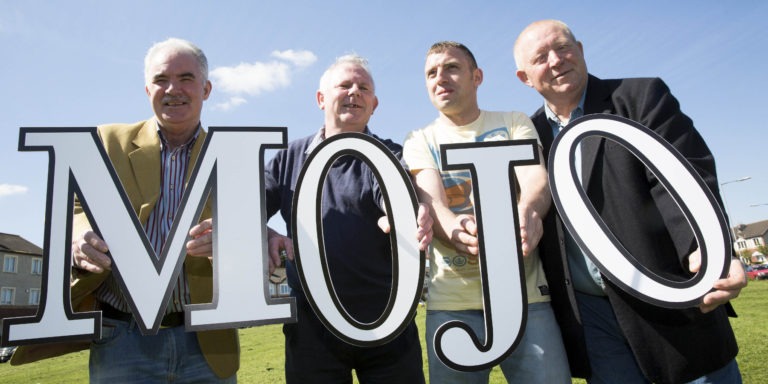
While walking in Tullamore some time ago, an interesting looking poster with a striking logo and a catchy slogan – ‘Mojo: Creating Male Space’ – caught my attention. Taking two steps back to read it fully, I was quite intrigued with my new discovery.
Mojo, I learned, is a 12-week training programme developed by a collective of organisations and designed to reduce the high levels of male suicide in Ireland. The programme is aimed at men who are in distress and facing employment issues stemming from a lack of availability of jobs, poor physical or mental health, or providing care to a family member. It is intended that those who attend the programme will be empowered to create a more positive future for themselves and their families.
The first Mojo Offaly project ran in 2011, part of a national movement spearheaded by Mojo Projects and supported by the National Office for Suicide Prevention.
“The downturn in the economy in 2008-2009 found a lot of men with time at home, unemployed,” said Mojo Offaly programme co-ordinator Caroline Brickland about the programme’s beginnings. “The South Dublin County Partnership [SDCP] wanted to respond and meet men’s needs, so they set up the Mojo Project.”
The project was the first of its kind in Ireland.
With the Mojo 4 programme currently underway, I met with Caroline, as well as six past Mojo graduates from Mojos 1, 2 and 3, who each spoke of their experiences with the programme.
Speaking to the men who were present, it was clear that there is no such thing as a stereotypical Mojo programme participant, with a wide range of ages and personalities in attendance. One thing was abundantly clear though: through the programme, they all experienced positive outcomes and life-affirming improvements in their personal lives.
“At the end of every Mojo, you see how straight the men are walking,” said Willy, a participant on Mojo 1. “I got great energy out of it. [There are] great tools to be got in it. I got my confidence back and am able to take on challenges easier.”
One aspect of the programme that can be of particular benefit to participants is the friendships that develop out of a shared situation. Joe from Mojo 3 found that his complaints and worries weren’t unique to him. He said that Mojo is “kind of like an extended family. You could talk to and build up a rapport with them… A little bit of hope is all you need”.
As Caroline put it, “with voluntary participation, it is a male space, talking about issues that are pertinent to men”.
Joe agreed that Mojo gives you the tools to deal with life’s challenges. Graduates of the Mojo programme are known as Mojo Brothers, and they maintain contact with the local organisation. Some return periodically to visit, or indeed to assist with programmes currently running.
What does Mojo cover?
These programmes combine mental health support, adult guidance, physical fitness training and an overview of social networking methodologies. This helps participants to be and stay well, to identify the barriers to achieving their goals, and to learn how to plan for the future.
Each participant also has access to two one-to-one sessions with a life planner.
The Mojo national office is supporting the development of Mojo projects across Ireland. Currently, there are four Mojo projects in operation: Mojo Kildare, Mojo South Dublin, Mojo North Dublin and Mojo Offaly. Other projects are in the development phase, with interested parties across 13 counties. The aim is to have 20 Mojo projects throughout Ireland by 2020.
Willie, a Mojo 1 graduate, spoke about “black ops to the shops”. He said some men are so isolated, and maybe paranoid, that even a trip to the local shop is like a secret mission.
A musical performance breaks out at a Mojo meeting. Photo: Ray Lucey.
“They just want to get what they need and make it back to base with as little human interaction as possible in case questions are asked regarding how they are,” said Willie.
He says Mojo is so successful because it is transparent and built on pillars of truth and honesty. As a Mojo veteran, he meets newer participants halfway through their course and helps them by sharing his experience. He says this approach is key.
“A lot of them open up as they can see what I got from Mojo through being honest with myself. When Mojo men realise that it is their space, and once they open up, they confide in each other and relate to each other, given time to express themselves and other men to listen.” Willie claimed that in overcoming life’s issues and challenges, “Mojo gives you the bricks and mortar to build that bridge and get over it”.
He said that when commencing the Mojo course, you take “small baby steps going into it, but now it’s ‘What else can I learn?’”
Confidence-building is a key element of the programme and participants are signposted to services available to them, Willie says.
“All they need is a kickstart.
“As long as I keep doing the right thing, I’m OK, whether that’s helping myself or others. That’s the main thing: men finding their own space. You are not dictated to or not being put under pressure to get something done. Do it at your own pace and, when you see the end result, that’s when you get your Mojo back.”
Who makes the ideal Mojo man?
Where do Mojo participants come from? Two-thirds are referred from mental health services, primary health care, the probation service and drug rehabilitation projects. The remainder are self-referrals, or come because the men hear about the programme through word of mouth.
“Self-referrals are best. Services are saying, ‘Give this a try,’ but men are also hearing about this through the grapevine,” said Derek McDonnell, CEO and co-founder of Mojo.
“We are building up a trusting relationship in each area we go into. With the men, we look at their values about life and what stopped them in the past from achieving their passions.
“We address masculinity and what it means to be a man. That’s really important; that whatever type of man we are is perfect – we don’t have to be any certain type,” he said.
In April, a ceremony took place in Tullamore and Mojo graduates spoke publicly about the change it makes getting your mojo back.
Daniel, a Mojo 4 graduate, said, “It helped me find my purpose. After Mojo, everything came together.”
Richard, another recent graduate, said, “I was stuck in a rut for 15 years. With Mojo, I have a lot more options. Everyone was supportive and helpful. The best thing about this is there is no judgement from anybody”.
Thomas, another Mojo 4 graduate, was referred to the Mojo Offaly programme. “I need a change in my life and went open-minded into Mojo. I was told to take out of it what I could, and I got what I needed from the course. The key thing for me now is to move forward and start a new beginning.” His particular focus is on adult education, with his hopes set on Social Studies and a course commencing this September.
Offaly County Councillor John Leahy spoke at the graduation about people with mental health issues and those affected by isolation.
“They just need someone to break that mould.”
He said he had seen how Mojo helped people to transform themselves in 12 weeks.
“The biggest crisis is in mental health and we need more programmes like this for adult men and for youngsters,” he added.
Caroline spoke at the Mojo 4 graduation: “For every man, his goals are different, but one thing unites everyone: we are all striving to be the best we can in life.
“The members of the Interagency Advisory Group guide the programme in Co Offaly to ensure that all men who can benefit from the programme have the opportunity to engage with a quality service that is supportive and responsive to their needs, signposting options for each Mojo man that will assist him to meet his life goals and ambitions.
“Each one of you committed yourself to sharing lessons from your life experiences for us all to learn from, reflect on and ultimately grow. As a group, you were open to suggestions and feedback, and really harnessed the team ethos, in that ‘together, everyone achieves more’.”
The support system Ireland needs
According to Derek McDonnell, CEO and co-founder of Mojo, the programme was built with a community development approach – “from the bottom up, with support from the top” – in conjunction with national policies, including the Connecting for Life suicide strategy.
“It is important to keep that connection, from the local to the national,” said Derek.
All Mojo projects are run independently and with a degree of autonomy. A key component of the Mojo programme is that it is facilitated – rather than taught – by the programme managers. At its core is peer support.
Mojo was the culmination of a three-year plan involving an interagency response and research into the high incidence of men at risk of suicide in South Dublin. It has since expanded its scope, with projects operating in Kildare, North Dublin and Offaly.
Given the programme’s focus, ensuring its continuation is understandably a priority. Currently, Mojo is retaining between 86% and 90% of participants per course.
“We make sure the quality stays the same as the programme develops,” said Derek. “Mojo is so successful because of the quality assurance piece we have developed. It just shows how much value the men place on the programme. We realise the positive impact on the men and the transformative effects on their families.”
The results speak for themselves. After completing the programme, 83% of participants report a reduction in anxiety and depression. 70% of Mojo graduates progress to work, education or volunteering.
‘That’s the part we don’t realise – how close we are to a mental health issue or life-interrupting issue.’
– DEREK MCDONNELL, CEO, MOJO
Derek has an explanation for the programme’s success. “We created a space that men would want to come to, but also in relation to mental health, education, work life and physical health. Up until Mojo, local organisations could not get men into programmes. We created a space for men that they own, where men are equal partners [to those running the programme]. It has to be really organic and, if not, it’s not Mojo.”
The three founding fundamental principles that underpin Mojo are community development, adult education and mental health recovery. According to Derek, everything in the programme must be in line with them.
“It is important to us that when men leave the programme, they have had a really good experience and an opportunity to connect with other men who will support them post-programme,” said Derek.
This can have a real-life impact on the programme’s bottoms-up approach. Two past participants are now on the national board of Mojo.
“It is important to us that we always listen to men who have been on the programme, and that they can build their capacity to advocate for themselves and for other men as well,” said Derek.
While the programme is yielding results in Dublin, Kildare and Offaly, it is clear to Derek that there is an urgent need for Mojo around the country. “That’s the part we don’t realise – how close we are to a mental health issue or life-interrupting issue.”
The intention to expand is very much part of Mojo’s plan, but the communities that are in need will have to be a big part of its development. “We build each project from the ground up and leverage resources that are in the community,” said Derek.
He elaborated: “Our job when we are working with the men is to be a facilitator, not a teacher, and to facilitate the men to know about themselves what they didn’t know. Unearthing tacit knowledge and supporting the men to connect with each other.”
“We need to be really careful that we are invited to do something, as opposed to going in thinking we should be doing something.
“The big thing for me is to bring about change.”
2 Mojo days at a glance
Mojo programmes feature input from various services working in health and wellbeing, volunteering, employment and education service, and lots more. This plays a big role in some of the themed days the programme puts together.
Wednesdays: Wellbeing and resilience
Exploring what mental health is
Exploring how physical activity impacts on one’s mental wellbeing
Mindfulness
Anxiety/stress
Coping mechanisms – decider skills
Sleep
Routine and structure
Self-esteem
Wellness Recovery Action Programme
Thursdays: Life Planning
Goal setting
Change
Communication
Self-employment opportunities
Volunteering
Educational opportunities
Employment-based programmes – jobs clubs/EmployAbility
Department of Social Protection
Citizens Information Service
For more information, or for advice on setting up your own Mojo project, contact the Mojo National Office on 01 450 8561 or at info@mojo.ngo.
Interested in reading more about the state of Ireland’s community development sector? Check out our latest issue.
The main role of LCDCs is to implement six-year local, economic and community plans (LECPs). The plans were adopted in all local authority areas in 2015.
The community elements of all plans are similar, and include actions on health and wellbeing, drug and alcohol abuse, age-friendly progammes and youth initiatives, the environment, integration, disabilities, unemployment, and many other issues.
Membership includes elected members, local authority staff, representatives of public bodies that provide services, and communities. The majority of members favour local and community development participation, hence the LCDCs’ bottom-up approach.
A world of acronyms
LCDCs were born at a time when quite a number of similar acronyms were floating about in the community and voluntary sector. For example, in 2014, we already had the LCDP – the local and community development programme – which was a national programme for communities that has since been replaced by SICAP.
We know. Stick with this. You might just get more clarity.
We also have more than 50 LDCs (local development companies), which are still very much around. They’re also known as programme implementers (or PIs) for SICAP.
Not surprisingly, there are plenty of connections between these three. Since Phil Hogan’s time as Minister for the Environment, Community and Local Government, there has been a new emphasis on collaboration between communities and councils. And what are they doing together? They term it local and community development.
“[The LCDC] must consider the economic elements of the plan in order to enhance co-ordination with the community elements and ultimately integrate the two elements, but it does not have a role in deciding on the economic elements. It has a general role in seeking to ensure effectiveness, consistency, co-ordination and avoidance of duplication between the various elements of local authority activities in the community,” says government.
Monaghan’s LCDC was involved in the campaign to challenge stereotypes that featured on the front cover of Changing Ireland’s current issue (Issue 60, June–July 2018). LCDCs rarely make the front pages in your local paper, though Monaghan’s work shows it can be done.
Interested in reading more about the state of Ireland’s community development sector? Check out our latest issue.
Musse stands, shoulders slumped, beside a tousled gap in a wall of branches.
“Simba dragged the goat through here,” he says, pointing at the boma, a thorny cattle enclosure. We’re surrounded by low, scraggly trees, their branches bare and thirsty for the coming rains.
The goat was pregnant, he adds. It’s a double loss.
Musse believes it’s the same lion who has been preying on other small homesteads in the area. I peer uneasily into the undergrowth around us.
Ruaha Carnivore Project
I am in central Tanzania with my friend and colleague, Ray Foley. We’re here to see how conservation and development are linked in this part of the world.
The search has taken us to the Ruaha Carnivore Project (RCP). It’s not easy to sum up their work in a single sentence. The project is a lot of things: a community development initiative; a conservation effort; even a scientific research station. The challenge for RCP is balancing these essentially different goals.
Traditionally, when a lion killed livestock belonging to the Barabaig (a nomadic pastoral tribe in central Africa), the answer was simple: a hunt was called. Young tribesmen from nearby villages assembled, thin metal-tipped spears in hand. Skilled trackers would note minute details – bent blades of grass, darts of hair hooked on branches – and the lion would be found. Then, with courage bordering on recklessness, it would be attacked and killed.
Yet times are changing for the pastoralists. Their old ways have fallen out of favour. Modern society begins to encroach on their traditional way of life. The old, migratory paths followed for generations through Kenya and Tanzania have narrowed and are closing off. Settled communities press inwards from the coast, bringing agriculture and land control measures.
RCP aims to help the Barabaig adapt by balancing their societal needs with the realities of a country-wide population boom and conservation efforts. As camp manager Benji Casio puts it, “while the main goal of Ruaha Carnivore Project is to address the problem of human-wildlife conflict, we have several other goals”.
One of these goals is to gather information on big cat depredations. And it’s this that has brought us to Musse’s boma. In spite of the lion attack, there will be no hunt today. Musse is a lion defender (LD), part of the flagship programme run by RCP.
Musse stands in front of his predator-proof cattle enclosure, subsidised by Ruaha Carnivore Project. Photo: Ray Foley.
Lion defenders and cultural considerations
In each village where the organisation works, they identify the most experienced and respected hunter and ask him to become an LD. It is a coveted position. The former hunters are paid a salary to prevent hunts and help carry out research. Benji estimates that LDs stop as many as five to 10 hunts a month, although this often puts them in direct conflict with their tribal elders.
The problem is that, although strictly illegal, hunting lions carries strong cultural significance for the tribe. A warrior’s prowess on a hunt confers status and even marriage rights.
It is hard to kill a lion. The first spear only angers it. The first hunter to strike is rewarded for his bravery with the deceased lion’s claw. He straps it to his arm and wears it as a badge of courage at the ritual dance that follows every successful hunt.
I asked Benji how the programme balances the community’s traditional perspective with conservation efforts. He explains: “You can’t force that change. I can educate you on why it’s important for the ecosystem, but until you’ve gotten your basic needs taken care of, until your livestock is safe, until your children have supplies in the school to be educated, I think it’s very unrealistic for you to make that leap. And so that’s why we have these programmes, interacting with the community to try to square their basic needs as best we can.”
Barabaig gather for a dance. Photo: Ray Foley.
RCP offers community support programmes such as educational national park visits, provides veterinary supplies – 80% of livestock mortality in the area is due to illness – and runs an informal ambulance service. The project also organises monthly dances in lieu of those missed through aborted hunts. Traditionally, only those who partook in a hunt could dance. At RCP dances, everyone can. In the Barabaig’s ritualised society, this allows courting without killing.
Practical help
Despite the midday heat, we travel on to a second boma, where another lion attack occurred. This time, the animals were kept save thanks to an RCP initiative: subsidised metal cattle enclosures. Here, chain-link fences are used to reinforce or even replace the traditional enclosures, and they can be rolled up and taken with the tribe when they move on.
On this particular fence, stretched and misshapen chain links clearly mark where the lion’s entry was denied. Tellingly, while this defence held, the traditional enclosure around it was breached. Lions can easily jump over the thorny vegetation with a goat in their mouth. Failing that, the lions will encircle the enclosure and spook the livestock, who panic and break out.
Sean McEnry is a Tanzanian Irish conservationist who has split his life between the two countries. It gives him a unique perspective on the issues faced by the country. He believes tying conservation efforts to local communities is critical to their success.
“A lot of the conservation is driven by outside countries, nationals from other places that come and spend a few years. If there is going to be a turnaround, then it has to be done by the Tanzanian people.”
Ruaha Carnivore Project provides basic veterinary supplies to the largely nomadic community. Photo: Ray Foley.
One such person is Michael Kamara, a senior research assistant at RCP. He’s from Arusha, in northern Tanzania, and he’s keenly aware of the damage wild animals can present to livelihoods. When he was growing up, he says, elephants regularly destroyed his family’s crops. They were considered pests.
However, studying conservation in both Tanzania and the UK has changed his mind. Now he wants to influence others.
He says: “People are changing. And that is something which I can say that I am proud of myself to be part of the Ruaha Carnivore Project, because lion killings are decreasing.”
However, the conservation does not work unless everyone is on board. As Michael points out, “If you have 100 people, and one is against you, once he puts his poison in the carcass of a cow, for example, it will kill all the pride”.
“They understand why hunting lions isn’t good for them,” Benji says, as we begin our long, bumpy ride back to camp. “They understand the pressure that it puts on the community, the negativity that comes with it. It’s still very difficult because there are lions taking their livelihood by killing their livestock. But I think they’re seeing that bigger picture, whether it’s from tourism or from organisations like RCP and the benefits that we bring.
Specifics and statistics
Ruaha is a 20,000-square-kilometre area that is home to various nomadic peoples and an estimated 10% of all the lions in Africa.
The Ruaha Carnivore Project is funded by Oxford University. Since its establishment in 2009, the project’s funding has increased ten-fold.
Beginning with a team of three people working in one village, the project now employs more than 60 people working in 21 different villages, and in park and wildlife areas.
Of overall spending of $350,000 (USD) in 2015: 17% went on community initiatives, including a camera-trapping competition for villagers; 15% was spent on lion defenders; and 15% went on chain-link fence enclosures and guard dogs. The remainder was spent on research, outreach, overheads and travel.
Cian and photographer Ray Foley travelled to rural Tanzania with support from the Simon Cumbers Media Fund.
Interested in reading more about the state of Ireland’s community development sector? Check out our latest issue.
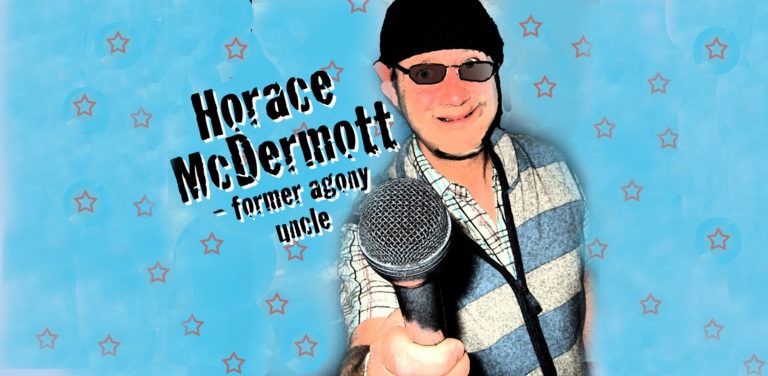
When the bosses over at Changing Ireland ask for jokes, you can bet I’ll deliver. When I was a kid, people used to laugh at me when I said I’d be telling gags in print one day. Well, no one’s laughing now! [Sorry about the ratio of GOLs to LOLs (groans to laughs) here. Horace’s sense of humour is questionable at best. – Ed.]
I also decided to put my new year’s resolutions down on paper too. That way, the words will be around way longer than the actual resolutions.
Have a great 2018, folks!
Time
Why did the community development worker fling the clock out the window?
She was fed up typing reports and wanted to see time fly.
Community supports
What did the traffic light say to the Family Resource Centre psychotherapist?
“Relax, I’m changing!”
Change
How many community workers does it take to change a light bulb?
Probably just one, but it could take six months as they’d have to consult with the community first, and involve them in the decision-making process, and the community might not want it changed anyway.
By the way
How many psychologists does it take to change a light bulb?
None, but they’d listen patiently while the light bulb changes itself.
Community engagement
Knock knock.
Who’s there?
Canoe.
Canoe who?
Canoe please stop knocking!
International funding
The manager of an international, not-for-profit organisation found a magic lamp. She gave the lamp a rub and a genie appeared to offer her one wish.
The development director said, “I wish for €1m to support my community”.
“Done!” said the genie. “Go to your office tomorrow and it’ll be there.”
Next day, outside the door to her office, she found boxes containing three million binder clips.
“What the hell?!” she said to the genie. “I asked for €1m!”
“Yes,” said the genie, “but you didn’t specify it couldn’t be a payment-in-kind.”
Solutions-focused
Dog-owning resident to community worker: “I lost my dog. Can you help?”
Community worker: “I know! I can put a notice on our Facebook page.”
Dog owner: “Don’t be silly. He can’t read.”
Looking back
After it was all over, why was Santa’s little helper shy to talk about his contribution?
Because he had low elf esteem.
New year’s resolutions
I resolve to give up some of my superstitious beliefs.
I will keep doing the Lotto. You never know your luck.
I will do less laundry and use more deodorant.
I will work with neglected children – my own.
I will stop repeating myself again, and again, and again.
I will watch less TV in standard definition. (Guess who got a new telly in the sales.)
I will no longer waste my time reliving the past. Instead, I resolve to spend it worrying about the future.
I will become vegan for day before inevitably realising it was a missed steak.
Given the opportunity to respond to the article, the DEASP provided the following information:
The most recent performance report on the JobPath service, published on the DEASP’s website, indicates that 19% of jobseekers who engaged with JobPath between July 2015 and March 2016 entered full-time employment. This was 36% above the weighted reference performance rate of 14%.
Up to 31 October 2017, of the approximately 129,000 clients who had commenced with the service, 412 complaints have been made, representing 0.32% of the total number who have engaged.
The department commissioned a customer satisfaction survey to be carried out at the end of 2016. The survey was conducted using a representative sample of 2,000 JobPath clients (1,000 from each provider).
The results of the survey indicated that jobseekers feel that they are receiving a good service, with 76% to 81% satisfaction, against 5% to 8% dissatisfaction; that the contractor’s staff make them feel valued (90%+); and that they have a good relationship with their personal adviser (90%+). They also feel that the service has improved their chances of getting a job (68% to 77%).
There is a robust complaints process and inspections regime in place for the oversight of the JobPath contracts. Should a customer feel they have received a less than satisfactory service; it is recommended that they engage with the complaints process provided.
During their time on JobPath, participants are encouraged and supported to take up employment-related training, upskilling or other activities that could lead to a sustainable job, in addition to assistance with the job application process.
If a person is successful in finding employment, the JobPath company will provide in-work support to assist with the move back into employment.
What is JobPath?
JobPath is described on welfare.ie as “an employment activation service provided to assist jobseekers on the live register to secure and sustain full-time paid employment or self-employment”. The service is provided on behalf of the Department by two private companies: Seetec and Turas Nua.
Who gets called?
The department selects jobseekers on a random basis for referral to JobPath. The scheme is backed by sanctions for those who, without good cause, do not cooperate.
Success v criticism
There is no doubting the government’s success in reducing unemployment, from a high of 15% five years ago to 6% today. Nonetheless, long-term unemployment remains high and the JobPath scheme – while well-meaning, and in spite of the government saying that the number of formal complaints is low – has drawn much criticism.
Opposition parties say JobPath makes it impossible for people to take up internships or CE places, to the detriment of communities depending on CE-supported services.
Social Democrats TD Catherine Murphy has raised very serious complaints about the scheme in the Dáil. Sinn Féin said JobPath sometimes makes it harder for unemployed people to find work and has published a document called ‘JobPath Exposed’. Fianna Fáil labour spokesperson Willie O’Dea has highlighted the intrusiveness of questions posed by Turas Nua.
Citizens have also challenged the demand on them to “comply and engage”.
There are some who have found that JobPath worked for them but, in spite of statistics that point to only low levels of complaints, the ‘labour activation’ programme seems to dissatisfy many. It has even been debated in the Dáil. However, nobody in that chamber had my first-hand experience.
Jon was ecstatic. The Community Employment (CE) scheme had offered him a role as a carer, enabling him to achieve his lifelong vocation after a period of unemployment. Days later, his tone had changed.
“Because I am with Turas Nua, I am not allowed to take the job,” he said.
I thought he was joking, but alas no. A place on a CE scheme is not a job.
Turas Nua is one of two companies that provide JobPath supports nationally and, as the overseer of national policy for the scheme later told me, “CE is not full-time sustainable employment, but it is a stepping stone back to work for those who have been out of the workforce for an extended period”.
Once activated onto the JobPath scheme, the principle goes, employment prospects should improve, negating the need for such initiatives.
It doesn’t work that way
Unfortunately, the JobPath programme can actively hinder prospects. According to figures from the Department of Social Protection (DSP) JobPath performance report of January 2017, people unemployed for one to two years found themselves less likely to find work in their first year on JobPath.
When I asked about these troubling findings, I was told by an official, “it’s drawn from a very small sample size – the report qualifies that.”
And yet I was soon made rudely aware that fewer employment prospects might in fact be a reality.
I was promised that JobPath would provide “a personal adviser who will provide individual support and assistance to help you find a sustainable full-time job”.
If by intensive they meant three sessions spread over six weeks, in which you are asked the sort of questions a probation officer would ask – about addiction, debt and family dynamics – then they were right.
An optimistic start
Early on, unaware of the experiences of Jon and many other people, I chose to throw myself in. I revised my CV and began trawling the websites for job opportunities.
Two weeks later, I was called to Ennis to attend a meeting where I was guided through a questionnaire. It probes for details such as your family situation and any addiction or debt problems you might have.
After an allotted 15 minutes, my time was up and I was re-booked for another meeting a fortnight later to complete the task that could have easily been completed online.
The slow progress rankled. I was used to working efficiently with the bright young ranks of future journalists in the University of Limerick newsroom.
‘I finally got the promise of career advice and a mock interview, just 26 weeks into the 52-week programme’
Journalism, I was advised by the then supervisor of the Ennis office, Roisin, was a “niche career”.
“That’s alright, I’m flexible,” I replied, keeping the bright side up. Surely a shiny new degree would get me something?
JobPath blocked opportunities
A JobBridge internship in a local community radio station seemed the ideal chance to polish my broadcasting skills, and the much maligned €50 extra per week would almost cover the transport up and down the coast of Clare.
“You won’t be able to apply,” the station manager told me bluntly. “People on JobPath cannot avail of the scheme. We had the same problem with our other candidate.”
Not one to be put off, I secured an interview for a job as a graphic designer with a multinational in Shannon.
The application process had been challenging, involving phone screenings and online tests. This was a valuable opportunity. Taking ‘ownership’ – to borrow from the list of HR buzzwords employed by the programme – I asked Turas Nua for a mock interview.
The appointment was made, but my advisor failed to show up. Another day lost coming and going for nothing.
I flunked the interview. I know that was on me, but still.
Actively hurting
Winter was in full swing, I was living in a seasonal town with next to no transport and local employment was non-existent.
I needed transport, so I broadened my search for paid work, looking beyond journalism.
Fortunately, I had a decade worth of experience driving heavy machinery on building sites and I heard of an opportunity in construction. The pay was good and I would soon be out of the mire on those wages.
There was one barrier: the price of my Safe Pass, manual handling and machine tickets totalled €450. A small investment that would be paid in weeks if I was on a salary, but on social welfare would take months to save.
A phone call to O’Dwyers Safety Services in Limerick seemed to bring forth good news.
“The government will fund your machine ticket if you have been claiming benefits [including Back to Education Allowance] for the last 12 months,” he told me, which was true. Then the catch: “…Unless you are on JobPath,” he added.
It was no longer up for debate. The scheme tasked with getting me back to work was actively hurting me. I was frustrated, confused, and aware that depression was beginning to sink its claws into me.
‘I could have been a poster boy’
To get back into the workforce I needed to get out of JobPath. I contacted Ann Monaghan in the DSP.
“We do not facilitate a customer to move from one activation support to another,” she said. “This is for a number of reasons, one of which is to ensure that the customer derives the maximum benefit from the support they are with.”
“What can I do?” I asked.
“If you do not find a full-time sustainable job at the end of your 52 weeks with JobPath, you will return to the Intreo activation service, and CE remains an option which you can discuss with your Intreo case officer,” she replied.
In other words, wait it out, which was the course that Jon had decided to take.
“I told Turas Nua that I will do what they need me to do and no more,” he told me. It was a waste of his time, his social welfare payments and the resources funnelled to HR professionals in light and airy offices.
I furnished Roisin with my experiences, my findings and the work I had been doing behind the scenes, making sure to inform her of my correspondence with Ann. I finally got the promise of career advice and a mock interview, just 26 weeks into the 52-week programme.
Potentially, I could have been a poster boy for their organisation. Someone who had committed to improving his career prospects and was flexible and keen to work.
In spite of my experiences, I will remain so, handicapped though I have been in my attempts at a new journey with Turas Nua.
Changing Ireland gave me a choice this year. They said I could go to one or other of the two traditional options that farmers have once the harvest is in: head to Lisdoonvarna to find a wife, or to the Ploughing to find farm machinery.
I’m glad I had the choice! Lisdoon’s a let-down. The lady I met there last year wanted to move in with me, and applied for a job as a post-mistress in my local post office. Unfortunately, closures meant they wouldn’t letter. Crestfallen, she packed her bags and left. It took me months to tractor down.
Career changes
Everyone seems to be trying something new at the moment. My cousin Shirley (the social worker) is changing career. She’s going to be a bartender.
It came about suddenly after she got fed up last Tuesday over how big her case load is, so she abandoned her desk and went to the local for a few vodkas. The barman looked a happy chap, which bugged her, so she asked him, “Tell me – what’s the difference between your job and mine?”
He replied: “You’re a social worker, yeah? Well, let me guess. You went to college for six years, paid thousands of euro, did loads of exams and went through poverty to get your qualification. Now you sit with people for session after session, using technique after technique, but you still don’t know if they’re telling you the truth, never mind telling you everything. They often leave your office sobbing.
“Well, I went to bartending school for 10 weeks and I learned to mix a little of this with a little of that. At work, I only have to wait an hour or so – sometimes no time at all – and I have people telling me everything; their innermost thoughts, love stories, finances, health problems, trouble with the law, the lot. They go home happy.”
She starts in the same pub next week, behind the counter.
She’d only broken the news to me when I bumped into a community development worker I know. He asked me, “What time is it?”
“Sorry, I haven’t a clue,” I said. “I’ve no watch.”
“Never mind,” he said. “The main thing is that I consulted you and we discussed it.”