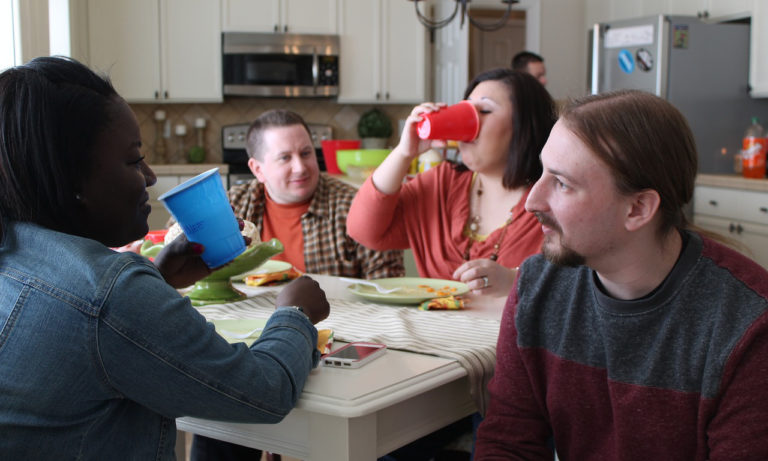
Over the May bank holiday weekend (from 4–6 May), groups across Ireland will be taking part in the country’s first ever National Community Weekend. ‘The Big Hello!’ will aim to strengthen community ties and help tackle the problem of social isolation.
Michael Ring, Minister for Rural and Community Development, is encouraging communities to come up with ideas to make it a success.
“National Community Weekend belongs to everyone,” said Minister Ring. “We don’t want to tell communities what they should do – the events will be very much driven by communities.”
The Department of Rural and Community Development hopes that at least 1,000 local events will be held throughout Ireland, and each of the 31 local authorities have been allocated €10,000 to support initiatives in their areas.
There are good reasons to hold a community weekend. People are busier than before, digitally distracted and often do not know their neighbours.
This nationwide event will present an opportunity to involve or say ‘hello’ to those among us who are living alone or isolated.
“The weekend is a chance for people to foster a sense of helping each other,” said Minister Ring. He said he too does not see as much of his own neighbours as he would like – as he is often away on government business – and he looks forward to the weekend.
Events could include themes around sport, history, baking or anything that will help neighbours to come together. It could be as simple as neighbours meeting up for a cup of tea and a chat.
Those interested in organising an event in their community can contact their local authority for an information pack and funding.
Share your ideas for celebrations with us and we’ll pass your brainwaves on via social media.
How does the rest of the world celebrate community?
National community days and weekends are uncommon, with seemingly few countries holding events of this type.
The Caribbean island of Dominica, with its population of just over 73,000 people, holds a National Day of Community Service every November, during which people engage in ‘Tidy Towns’ type activities and acts of kindness.
Perhaps Ireland will set a new trend? If you know of other countries that hold events to honour and support communities, please let us know.
Interested in reading more about the state of Ireland’s community development sector? Check out our latest issue.
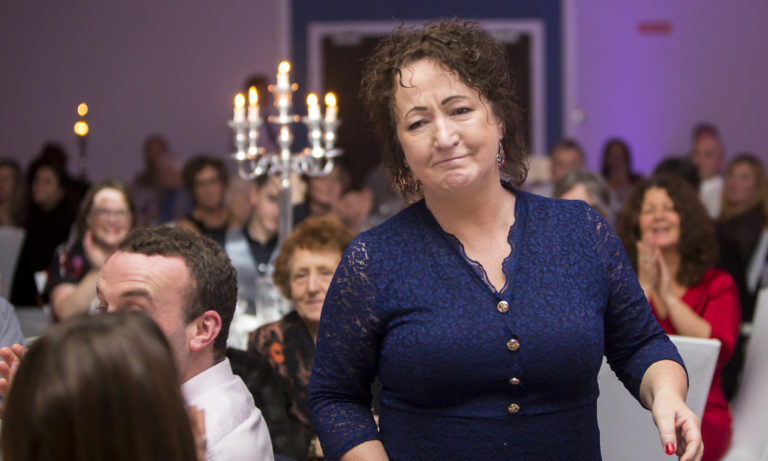
At a December 2018 ceremony, Volunteer Ireland announced the winners of its prestigious awards, held annually to honour those dedicating their time to helping others. Mary Fitzgerald, from Inagh in Co Clare, was named as Christine Buckley Volunteer of the Year 2018.
What the judges said
Since she was young, Mary wanted to make a difference to people’s lives. In her teens, she was moved by TV images of street children in India and Romania. She volunteered with Mother Teresa’s Missionaries of Charity in Calcutta and in a Romanian orphanage.
She was touched by the plight of Clare families fleeing from domestic abuse who were forced to sleep in the Garda station. Mary took some of these women and children into her own home and then decided she needed to do something more.
She got a small group of people together and they co-founded Clare Haven Services in 1993. In collaboration with Respond Housing Association, 24-hour emergency refuge accommodation was provided. Meanwhile, Clare Haven’s frontline support services and educational programmes helped hundreds of women and children who have experienced domestic abuse.
After 20 years, Mary recognised the need to focus on long-term solutions to break the cycle of domestic abuse and to stop young people from going into unhealthy relationships.
Haven Horizons was set-up to establish prevention programmes which address the lack of awareness and education around the underlying causes of domestic abuse. It also aimed to promote international models of good practice that change public attitudes and professional responses.
Mary connected with a US-based group with a model for responding to domestic violence that has saved lives. The Minnesota-origin ‘Blueprint for Safety’ model prioritises the safety of women and children and seeks to hold perpetrators accountable.
Winning
Remarkably, in the same week that Mary won the Volunteer Ireland award, she also won the overall Community Hero Award from The Wheel, the umbrella body for charities.
Interested in reading more about the state of Ireland’s community development sector? Check out our latest issue.
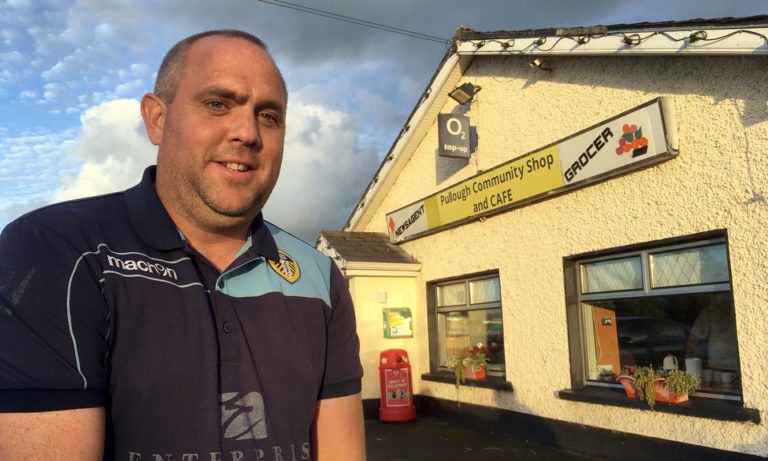
When Changing Ireland took to the country roads of west Offaly, seeking a community project that stood out, we rounded the corner into Pullough village and struck gold.
It was as if we’d been fated to be there.
The inaugural meeting of Pullough Men’s Shed was taking place that evening and, better still, it was taking place in the Pullough Community Shop and Cafe.
There are only seven or eight community shops in Ireland, so it was the sign above this shop that caused us to stand on the brakes.
The village is in a picturesque spot, but the needs are obvious: rural isolation is evident in every direction in this boggy part of the country near the River Shannon. In the winter, cut off by snow or storms, this is a place where neighbours have to rely on each other.
Since our visit, the desolation (for want of a better word) has only grown worse. The post office has closed, and mass layoffs from the local peat-burning electricity station that is being decommissioned will hit hard.
The villagers are undeterred by supposed setbacks. If it weren’t for them being ready to put in long volunteering hours, and having a small bit of good fortune, the place would be on its knees.
If it weren’t for the fact that Martin Buckley ran out of milk one evening, it might have been a different story.
A coffee morning in aid of Offaly Hospice at the Pullough Community Shop. Photo: Changing Ireland.
Isolation becomes inspiration
Martin knew something needed to change when he drove home one “dirty winter’s night” having forgotten to buy milk when passing through Tullamore, the last big town.
“I was going to sit down and watch a match on TV, and we all wanted a cuppa. By the time I got into the car, drove up the road to Ferbane and returned with the milk, the match was over,” he said.
He cursed remembering the incident.
“The shop here was closed for two years. It wasn’t commercially viable – you can’t compete with Tescos – but the village needed somewhere for people to buy bread and milk.
“We’re cut off from the mainstream; isolated. It’s a 25-minute drive to Tullamore, presuming you’ve a car.”
This was exactly what was needed to inspire a comeback for the village.
Martin and a team of volunteers set about reopening the shop and revitalising the community. There were even plans for a full-on café, though the HSE ruled out that possibility due to the number of regulations that would need to be adhered to. The volunteers took it on the chin.
“Some of the regulations – in hindsight – were good for us, because the shop is now becoming more of a youth space,” said Martin.
“Now, the kids are our best customers. They have a community hall, but they have no after-schools club, no Foróige, no Scouts. They had all that, but it’s all gone. So, this is more than a shop now.
“We put in a pool table for them and we’re developing the space.”
When the group applied to the Applegreen Blossom Fund, they were one of just 62 successful applicants out of more than 300. This win funded development of the shop’s youth space.
But how did they get the shop so easily in the first place?
“We have an agreement with the owner who’s after letting it out to us,” said Martin.
First meeting of Pullough Men’s Shed. Photo: Changing Ireland.
The owner, Joe Bracken (who we also met), believes that if the village benefits, everyone wins.
He is enjoying the village’s resurgence and is a member of Pullough Men’s Shed, which is now running successfully, with members producing a range of craft goods at Christmas time for sale locally. Funds raised were invested back into the community.
Community pride to personal growth
The opening of the Community Shop has had a marvellous ripple effect.
Martin said, “We set up our action group [Martin is chairperson], and volunteers have kept this going, doing a shift or two a week. We’ve helped ourselves. Paddy O’Reilly, our treasurer, put in four shifts a week during our first winter to keep it going.
“From that, he has become involved now in Pullough’s residents’ association. The group had collapsed, but they have resurrected it and now they meet once a month.”
“I was self-employed – I lost my job in ’09 with the recession. My missus is working full-time and I minded the kids. When they started going to school, I had a bit of extra time and said I’d put the time into the community. It’s taking up more time than I thought it would, but it’s very enjoyable. In October, I went back to studying.”
Bringing new life to the village
Pullough’s development began as a local initiative and has now become an example to other villages of what can be done by volunteers with a little luck, small amounts of funding, and support through the Social Inclusion and Community Activation Programme (SICAP).
“CEO Brendan O’Loughlin has been out to lend support. Their social enterprise manager, Sarah Kennedy, came to meetings and encouraged us to start a committee.
“Within a few weeks of setting it up, all the councillors on the Local Community Development Committee came out to see what we were doing,” said Martin.
Pullough Community Action Group following their win in the Outstanding Group category at the Volunteer Ireland Awards. Photo: Volunteer Ireland.
Their hard work is paying off and winning the tiny village much respect.
In December of last year, Pullough Community Shop won the top award for Outstanding Group at the Volunteer Ireland Awards.
The judges in Volunteer Ireland saw great merit in what Joe, Paddy, Martin and their fellow activists were doing. They said:
“In spite of the fact that they had no money to bring about their dream of re-opening a shop which had fallen into disrepair since its closure a few years ago, this group set about fundraising to set up a community voluntary-run shop.
“Within a few months, they had secured permission from the owner to lease the premises, raised enough money to cover the cost of insurance, repair, restore and stock the shop.
“Overcoming all obstacles, they forged ahead and opened Offaly’s only community shop in June 2017. Since then, they have remained dedicated to their roles as volunteers. The shop is open seven days a week, even remaining open during the severe storms and snow of the past year.
“The reopening of the shop has brought new life to the village. It not only provides local people with the opportunity to buy food locally, but has become a ‘social hub’ and is greatly contributing to inter-generational interaction through the hosting of community events. The creation of a youth space in an area of the shop is a wonderful addition.
“This venture has re-ignited the passion people have for the betterment of the village.”
We want to hear more grassroots good news stories from rural Ireland. If you have one in mind, get in touch!
Interested in reading more about the state of Ireland’s community development sector? Check out our latest issue.
Last summer, Terenure Enterprise Centre ran a training course – Destination Innovation – for young entrepreneurs. It gave participants a sense that they can be their own bosses and create their own jobs. It was a revelation for some of them.
We hope to replicate the course later this year.
The project was started after we were approached by the Walkinstown Association for People with an Intellectual Disability (Walk).
Walk’s team of employment staff knew that young people with disabilities have difficulties finding paid and meaningful employment, and the labour market in Ireland is all but closed to individuals with intellectual disabilities. When it came to such bright and brilliant individuals, the association felt that supporting them in creating their own businesses could be a solution to the issue.
We then designed a hands-on entrepreneurial training course to meet the needs of the group of young people in an accessible way.
The course was a success because we were very flexible in our approach and did things with the participants that they were passionate about. We were following their lead.
How did it work?
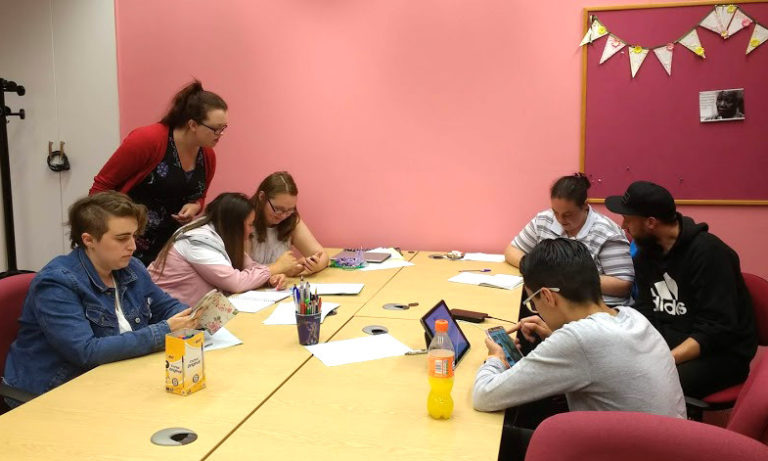
Five young people took part and the training took place over four sessions, each lasting two hours. The participants drew on their talents, passions and skills to develop a variety of business ideas. They proposed a handmade jewellery business and an artwork business, as well as working as a band manager, a DJ and a beautician.
Each training session was filled with practical activities and tailored to the needs of the learners, as each of them was at a different stage of creating their products or services. Some participants were already testing their ideas, while others were building a body of work or refining their skills to start their business.
The students had a chance to discuss their business ideas and decide what resources they needed to make it a reality. One of them (the DJ) turned the work he was doing voluntarily into paid work.
The course also focused on future clients, making themselves and their businesses visible online and offline, and improving their digital skills. All participants felt the course was a valuable experience.
The project finished with a showcase event in October – organised by Walk – where the young entrepreneurs presented their businesses and won over new clients.
For more information on the course, and to find out how you can replicate it in your local community, contact Vasilena Vasileva at Terenure Enterprise Centre.
Interested in reading more about the state of Ireland’s community development sector? Check out our latest issue.
The Centre for Independent Living was established in 1992 and is based in Carmichael House, Dublin, but you won’t hear much more about it. As a brand, the name is history.
While its work will be continued by the same organisation, it has rebranded itself as the Independent Living Movement Ireland (ILMI). A new logo and website have been launched emphasising freedom, rights and empowerment.
It will be run “by and for people with disabilities with the main aim of ensuring that people with disabilities achieve independent living, choice and control over their lives and full participation in society as equal citizens”.
It’s not unusual for groups to change their name. Community Work Ireland used to be the Community Worker’s Co-op until it changed its name in 2015. Pobal was called Area Development Management from 1992 to 2006.
Launching the new look for the 26-year-old organisation, ILMI chairperson Shelly Gaynor said, “We are a campaigning, national representative organisation that promotes the philosophy of independent living and to build an inclusive society. Central to the way we work is to ensure that policy decisions that impact on the lives of disabled people have to be directly influenced by those whose lives are directly affected.
“Our philosophy can be summed up as: ‘Nothing about us without us!’ and ‘Rights, Not Charity’.”
Those have, in fairness, been how genuine disability activist organisations led by community development principles have behaved for decades now.
“Our vision is an Ireland where disabled persons have freedom, choice and control over all aspects of their lives and can fully participate in an inclusive society as equals,” she said.
Speaking at the launch, Ms Gaynor said: “Central to disabled people achieving equality and having their human rights protected is the principle ‘Nothing about us without us’.”
“Independent Living Movement Ireland is about building a collective, grassroots organisation across the island of Ireland,” she said.
She said they wanted to become the voice for people with disabilities in the development of policies and practices based on lived experience.
“We are the experts in our own lives, we know what needs to change and, in ILMI, we will build an organisation that empowers disabled people to collectively lobby and campaign for that change,” said Ms Gaynor.
At the launch of the ILMI, Minister of State for Disability Issues Finian McGrath TD said, “Having ratified the UN Convention on the Rights of Disabled People, it is vital to recognise the role of Disabled People’s Organisations to monitor the implementation of the Convention.”
“I congratulate ILMI on their new strategic plan and wish them success on building on the legacy of the Centre for Independent Living.”
Strong collective voice
As part of the launch of the new strategic plan and website, ILMI delegates at the conference discussed strategies for building a strong collective voice in campaigning for change.
Ms Gaynor said, “Our strategic plan will focus on the four pillars of Independent Living over the next three years: personal assistance, housing, transport and employment. We’ve begun engaging disabled people across the country to campaign for a real personal assistance service.”
She said, “The personal assistance service is a key tool that allows many disabled people to live independently. It needs to be defined that it is led by disabled people not service providers. It needs legislative protection. It needs to be invested in to ensure people can get the hours they need to live independently and it needs to be promoted.
“Our new strategic plan is based on three core objectives: leadership and representation; equality and human rights; and strategic political campaigning.”
She said the plan seeks to build a grassroots collective approach, where disabled people across the country are active participants in the movement and are empowered to be part of policy development and political campaigns. The movement will be led by disabled people.
“People are stronger together, and a collective voice can be heard,” said ILMI CEO Damien Walshe. “Building a movement for change needs disabled people to become actively involved and see ILMI as a vehicle for getting involved in collective action.”
The ILMI believes in a rights-based social model of disability. It will challenge the unacceptable charity/medical model of disability.
“We are working towards the removal of societal barriers that prevent active equal participation of disabled people and we are challenging the denial of people’s rights and the promotion of the philosophy of independent living,” said Mr Walshe.
The ILMI is keen to build relationships with people across the country and also with organisations supporting disabled people, particularly ones providing support through the SICAP programme.
This Saturday afternoon (23 February, 2019), the public is invited to the National Museum of Ireland – Country Life’s ‘I Am Traveller: Our Histories and Heritage’, a panel discussion focusing on Traveller culture and tradition.
A strong panel has been assembled for the event, with Senator Colette Kelleher chairing the three-hour event (2-5pm) and Brigid Carmody, Hugh Friel, Michael McDonagh, Mary Collins and Oein DeBhairduin sharing their insights on traditional and contemporary Traveller culture and community initiatives.
“The panel discussion will examine culture and heritage and good social inclusion practices,” said museum curator Rosa Meehan. “We hope it will be of particular interest to Social Inclusion Community Activation Programme (SICAP) teams who work with and support the Traveller community.”
Representatives of Traveller groups from across the country – including Cork, Donegal, Meath, Mayo and Dublin – plan to attend the discussion.
According to organisers, tickets are going fast and only a very limited number of spaces remain available – booking, they say, is essential.
The panel discussion is one of a number of events taking place as part of the Travellers’ Journey exhibition, which will be on show in the museum until May.
The exhibition shows the rich culture, traditions and crafts of the Traveller community in the west of Ireland. It has been curated in partnership with the Western Regional Traveller Health Network.
It is clear that the tech sector is a force to be reckoned with – that a grounding in tech skills can make a monumental difference in a young person’s life, and can create shifts and growth in their communities.
So what should those communities be doing to create a tech-savvy generation, and to support adults to join the digital revolution? And how, in particular, can girls and young women be encouraged to pursue these skills?
Speaking at Inspirefest 2018, Dr Anne-Marie Imafidon (the co-founder of a programme called Stemettes) answered that question: “Introduce [girls and women] to all kinds of people and spaces – show them that you don’t have to be white and male to be part of innovation.”
Of course, the focus doesn’t have to be solely on the female (slightly more than) half of the population, and many programmes can be welcoming of boys and young men as well – it’s just a matter of seeking them out.
If you’re interested in setting up a tech-focused programme in your area, but don’t have the time or energy to reinvent the wheel, the following should give an idea of what’s available to emulate and where you can start.
#techmums
#techmums consists of a five-week guided course that aims to build confidence by tackling different aspects of technology in classroom-based workshops. It looks at basic IT skills, online safety, and even programming and app design, and fosters a community of passionate, self-motivating and self-confident tech-savvy mums.
“Today, it’s easy to see technology as the enemy, whereas, in fact, it can be life-changing in an incredibly positive way,” founder Dr Sue Black OBE has said. “Our courses help women harness that potential in their own lives, giving them the confidence, skills and inspirations to play an active role in our shared digital future.
The programme saw early success, with research showing that it gave participants a huge boost in their confidence with tech and, more generally, in their personal confidence. According to the #techmums site, the headmaster of the first pilot school also saw a marked difference in the children of these mothers.
Although initially operating solely in the UK, #techmums came to Ireland in 2015 with a successful first run in Dublin’s Digital Hub.
CoderDojo
CoderDojo has become a household name and a global coding-club phenomenon. You may be surprised to learn, therefore, that it was started by a then-18-year-old James Whelton – a young tech-whizz from Cork.
The homespun club grew incredibly quickly when Kinsale-born investor Bill Liao came onboard, with Dojos popping up in Asia, the US, South America and Africa within the first year. Now, there are more than 1,900 verified Dojos in 93 countries around the world, and new Dojos are starting almost every day.
The CoderDojo movement aims to impart an understanding of programming languages at an early age, through a network of free, volunteer-led, community-based programming clubs aimed at young people.
You might think you need a grounding in tech to set one up, but you’d be wrong.
“We’ve had people from all backgrounds start clubs, from youth workers who taught themselves some basic programming so they can get a club up and running, to seasoned programmers who would have loved the opportunity when they were young,” Giustina Mizzoni, CoderDojo’s executive director, told us.
“You can start a Dojo that runs once a week, once a fortnight or monthly to reach the youth in your community. If that still seems a little daunting, we have created a quick three-week course – in one hour a week, our team will walk you through the process.”
Online and in-person training is available for interested volunteers.
Kids are quick studies when it comes to tech. Image: Rawpixel.
Women Who Code
Aimed at an older audience than many of the other resources listed here, Women Who Code is a global network that targets career-aged tech professionals (and those interested in gaining a foothold in the industry).
With more than 167,000 members and a presence in more than 80 cities, Women Who Code is striving to create a world where women are proportionally represented as tech leaders, execs, founders, venture capitalists, board members and software engineers.
“We are creating a space for those who exclusively identify as female to come together and develop their technical skills and grow their digital confidence,” says Sheree Atcheson, founder of Women Who Code UK and board-appointed global ambassador for the international non-profit.
“We are showcasing relatable local role models in all of our locations while highlighting the sheer power and impact women can have on this industry. It’s fantastic.”
Member have access to coding resources, leadership opportunities and exclusive job boards. And the best bit is that it’s all free.
Says Atcheson: “We provide all of our meetups for no charge because, regardless of your socioeconomic background, you should be able to obtain knowledge and grow your skillsets—everyone is important in this industry.”
Stemettes
A UK- and Ireland-based social enterprise focused on supporting young women into science, technology, engineering and maths (STEM) careers, Stemettes is working towards a world in which women are proportionally represented in the sector, and is aiming to inspire the next generation by showing them the amazing and successful women already working in STEM.
The organisation does this through a series of panel events, hackathons, exhibitions and mentoring schemes, and a policy close to many young women’s hearts: it’s free, it’s fun and it involves food. No wonder more than 40,000 girls between the ages of five and 21 have signed up…
In 2018, Stemettes launched Stemillions, a school-based network of clubs run by young women and designed to allow exploration of STEM, with clubs sorted into houses and competing for the (virtual) House Cup and a slew of other prizes.
An Cosán hardly needs an introduction, but we’ll give it one anyway: the Tallaght-based organisation—founded in 1986 as ‘the Shanty’ by current Minister for Children and Youth Affairs, Katherine Zappone, TD, and Dr Ann Louise Gilligan—provides adult education and other services to women from disadvantaged areas.
The organisation offers the educational support of basic IT skill development and a number of digital interventions designed to bridge the digital divide, ranging from ‘Computers for the Terrified’ (open to men and women) and ECDL (European Computer Driving Licence) classes, to a QQI Level 5 qualification in Business and Information Technology. Other courses cover social media for beginners, online security, web and app design, and cyberbullying.
There is also an ‘An Cosán Tech Army’—a group of people passionate about providing awareness, competence, reliability and physical access to digital technologies—which aims to support people as they work together to take action to bridge the digital divide, and provides communities with access and training.
A Digital Pathways programme develops and delivers IT workshops at a variety of locations around the country, offering accessible education in digital and employability skills.
When a country overthrows a brutal dictator after 22 years, as the Gambia did through democratic elections in December 2016, the only way is up.
Until two years ago, the dictator sowed distrust in every community. Who was a spy? You never knew. The repercussions of voicing criticism could be deadly.
People are now much more at ease within themselves, their homes and their communities.
Demba Jawo was a journalist whose life was under threat, but the tables turned when democracy won out. He was appointed the Gambia’s Communications Minister for the first 15 months of the new government.
“Now there is a lot of hope in the air,” he told Changing Ireland earlier this year. “You go out in the street, you see everybody is happy with the new dispensations, the freedom of speech and freedom of movement.”
In 2016, Gambian people found their voice, the dictator lost the presidential election and an alliance of West African countries ensured there was a peaceful transfer of power. Once Yahya Jammeh heard Senegalese jets fly over the presidential palace in January 2017, he knew the game was up.
Diaspora Gambians, many pining to go home, followed every dramatic turn on social media.
But the historic ousting of one of Africa’s brutal dictators did not get quite the international coverage it merited, because global media were pre-occupied with unfolding events in the USA.
The sprawling diaspora and good intentions
Adama Barrow, a compromise candidate representing the hopes of all the main parties, was sworn in the day before Trump took office on the other side of the Atlantic. One democracy restored; another lost. The Smiling Coast, as the tourism department likes to call it, was smiling once more.
Sally, Jarjue and Kunda Badjie, pictured at a naming ceremony in Busumbala.
“However, expectations are much higher than what is possible,” warned Minister Jawo.
People are now placing trust in community organisations once again and – as well as there being an influx of EU aid – diaspora Gambians are setting up charities to help their fellow citizens in one of the world’s most materially impoverished countries.
I met two Gambians, separately, who returned with good intentions.
Claudius Taylor, a lawyer based in London, runs Banjul Open Box: “We send law books to the Ministry of Justice and Gambia University. We reach out to Gambians through education and other social welfare means.”
Musa Sanyang, now living in Leipzig, Germany, is involved in a charity called Schools for Gambia.
“We have built, renovated and expanded numerous schools, [and] sent and distributed containers of school furniture, school supplies, textbooks, clothing and other donations to the Gambia,” he said.
A dark past
I lived and worked in the Gambia – via the now defunct Agency for Personal Service Overseas (APSO), which operated from 1974 to 2001 – during the mid-1990s, when the country’s media practitioners were to the fore pushing for democracy, human rights, freedom of expression and proper governance. Without those basics, community development and national development could not progress.
Jammeh had his critics arrested and tortured, and sent murder squads after those whose reporting he feared most. Media houses were burnt down.
His face was on billboards everywhere – quickly torn down when he lost the presidency – and also on banknotes, which are slower to replace. He married and divorced a series of women, had homes in various countries and a fleet of flash cars, and insisted on being addressed as His Excellency Sheikh Professor Alhaji Dr Yahya AJJ Jammeh Babili Mansa.
Jammeh was a thief, a torturer and a mass murderer, and he twisted religion to suit his criminal pursuits. His legacy is now being dissected at truth and reconciliation hearings deemed essential to the country’s recovery.
Gambians still complain plenty about the new government, but it was democratically elected and people now genuinely enjoy freedoms they had not known since 1994, if they had even been born then.
Community living
It’s a small country – the smallest on the continent – where everyone feels they know each other. During Jammeh’s tenure, villages still held ceremonies to mark births, comings-of-age, marriages and deaths. Soccer matches and wrestling continued.
However, when it came to community development, people needed to be open and trusting of each other. That wasn’t always possible.
“You could not trust anyone but your family and closest friends,” said Lamin Sanyang, a civil servant who (quietly) opposed the regime throughout.
Jammeh fired village Alkalos [village chiefs] and community leaders who did not support his regime. In 2012, he began to terrorise communities by sending out a team of witch-doctors with military backing. Communities, including elders, were humiliated.
This helped to drive people to oppose his rule, said Mr Sanyang. Abroad, tens of thousands of Gambians forced into exile began to organise via social media in protests that ultimately helped to topple him.
Women at the Busumbala naming ceremony.
Mr Sanyang brought me to a naming ceremony in his native Busumbala, Western Division. He said, “we have freedom now to do and speak what we want”.
However, the Gambia’s version of Tidy Towns has, for the time being, collapsed. Monthly Set Settal clean-up operations became an involuntary activity under Jammeh.
“During Jammeh’s time, it was kind of forced onto people. There was a period from 9 o’clock to 1pm when no vehicles were allowed to move and shops were closed. People were not happy with the situation,” said Minister Jawo.
After Jammeh’s demise, the new government struggled to get communities involved in clean-ups and, earlier this year, it gave up, realising people had enough of top-down mandates.
“When this government came to office we tried to continue with these cleaning exercises, but people would just stay at home. So, we thought the best way is to allow people to do it on their own on a voluntary basis. We abandoned the idea of trying to do it the way Jammeh used to do it.”
Bottom-up community development is now stronger in the Gambia. For example, successful clean-ups were organised by a civil society group in December to tackle plastic polluting the country’s beaches.
“People are now free to do things on their own, without having to look behind them to see if somebody is watching them all the time,” said Minister Jawo. “With freedom of speech, freedom of movement and everything, people are encouraged to take matters into their own hands and do things exactly the way they want them done. So, community development is definitely picking up very fast.”
Communities groups are now free to organise, hold gatherings and fundraise. There has been a sunburst of activity the length and short breadth of the country.
Renewed freedoms
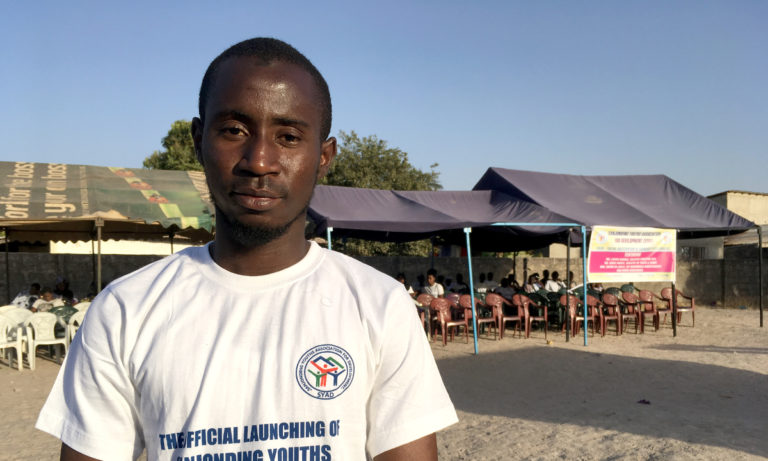
An example of one of the many local community groups to launch this year is Sanjonding Youths Association for Development (SYAD). Its president, Mustafa Saho, told me, “We want the community to reflect on the role of youths’ participation in community development.”
The youth-led community organisation had done charitable works for some years, but without ever formally launching, so SYDA ran a high-profile event to highlight its successes to date and to “inspire and create partnerships with other organisations”.
Mr Saho said, “Youths are the cornerstone for any community development, and we have to be centre-stage as far as community development is concerned. We want to take ownership and take responsibility in our communities. We want to make sure that all community facilities are better available and that people benefit from these facilities.”
Afterwards, he heralded the launch as a great success “because it fostered the spirit of unity, tolerance and understanding among the young people of Sanjonding community. This is one of our top priorities in the peace and reconciliation process at the community level”.
The news media – locally and nationally – are central to recovery. In Fajara, I called to The Pointnewspaper and met former colleagues of murdered co-founder Deyda Hydara.
Jammeh, in particular, sought to silence reporters who asked how he enriched himself. He said his millions came “from Allah”, but his claim was at Gambian people’s expense; many died escaping poverty and violence on the treacherous journey to Europe.
Later, with Lamin Sanyang, I visited the street corner where Mr Hydara was killed. Previously, people who visited this place were followed and beaten. Now, the talk is of one day erecting a statue, or symbol, in tribute to Hydara’s peaceful resistance.
The printed newspapers that survived are now prospering, relatively speaking, and are very sincere in purpose.
Pap Seine, a 2010 World Press Freedom Hero, was arrested “many times” and witnessed much suffering as the other co-founder of The Point. His vision and optimism is however undimmable.
Looking forward, he sees his newspaper spawning a television station. Yet, what remains uppermost in his mind is that the Gambia “upholds democratic values”. This is more important to him than any profit margins.
“We are working tirelessly to promote good governance, respect of human rights and the rule of law,” he said.
The Point, while critical, enjoys good relations with Barrow’s government.
“There is no censorship, thank God,” said Mr Seine.
Sam Mendy, head of the Gambia Press Union’s school of journalism.
Peace and recovery
While a minority still support Jammeh’s old party, most Gambians, having won freedom through the ballot box and in street protests, share Mr Seine’s values. Today, The Point is the most popular newspaper in the Gambia.
Mercifully, community radio stations survived the cull of the mainstream media. They stuck to safe subjects, such as giving agricultural advice. Now, they are expanding in number and in confidence, and training is provided to their broadcasters by the Gambia Press Union (GPU).
“We recognise community radio as very important,” said Sam Mendy, head of the GPU’s School of Journalism.
In 2017, 25 broadcasters from 10 stations received training. The stations are seen as “a mouthpiece for rural communities and as a tool for development”, according to Yusupha Bojang, coordinator of the Network of Community Radios of the Gambia.
Mr Mendy showed me around the journalism school, uselessly flicking the light switch in the studio. It remained dark. One of the biggest challenges facing the government is improving the electricity supply.
From the early 1990s to now, the Gambia’s population has almost doubled (to over two million people), but average income remains low (€100 per month, said one bank clerk). The Gambia ranked as the 13th poorest country in the world in 1995, and was in much the same position when Jammeh was deposed. Unemployment is high and the country is over-reliant on agriculture and tourism.
But, change is coming. Diaspora remittances are now a significant help to the economy, the EU has promised more aid, and specific European countries promise investment.
While Jammeh reintroduced the death penalty, pulled the Gambia out of the Commonwealth, and declared the country an Islamic state, all three positions have been reversed under Barrow.
In October, Changing Ireland heard about the ups and downs in the implementation of the Social Inclusion and Community Activation Programme (SICAP). Mostly ups.
Views were aired by community workers at a series of 17 meetings held around the country during the autumn. Pobal organised the meetings, which drew in hundreds of frontline workers and those overseeing SICAP at local level. The aim was to see what is working best and how to improve the programme.
There is no shortage of case studies to show the programme works and that it is reaching more community groups than ever before. The statistics bear this out. Statistics also show, however, that Travellers should be getting more support through the programme. Contradictions such as this clearly show why speaking to those on the front line is so important.
On that front line, complaints about the quantity of paperwork involved continue to be aired by community workers.
It was also pointed out that asking people if they have a criminal record before you begin working with them immediately puts up a barrier. Community workers felt this obligation compromised them.
Welcome consultations
The fact that community workers and others have been consulted was welcomed.
In discussions, it was agreed that not enough people in communities have heard of the SICAP programme, including the people who directly benefit from it.
A participant said: “We are hopeless at explaining what SICAP is trying to do.”
Another said: “You could spend time with a beneficiary, but at the end they still wouldn’t know it was through SICAP.”
“Our number-one audience is our community,” one community worker pointed out.
Colleagues made the following points:
– We need to link individuals’ stories to the policies that affect them, as Oxfam do.
– The testimony from people who have benefitted is what matters.
– The programme is backed up by community development principles, but that is not appreciated.
– We need to get people on the ground saying what they feel the programme is good for.
– People don’t relate to SICAP the acronym. The name is even a barrier.
Discussion followed about rebranding SICAP, or even renaming it.
The last of the 17 workshops in the series took place in Mayo on 25 October. These consultations were carried out in coordination with staff from the Department of Rural and Community Development.
Between now and 2022, the SICAP programme will be worth €190m to communities.
Set up in 2006 as the successor to the Social Economy Programme, the CSP is now being formally reviewed for the first time.
Currently, there are more than 400 projects funded under the CSP, and the number of projects has grown since the programme became the department’s responsibility last January.
CSP supports community companies and co-operatives involved in everything from community radio and meals-on-wheels, to tourism ventures and more.
The funding allocation for the programme in 2018 was €44m. Out of that, projects receive funding as a contribution to the cost of a manager and a specified number of full-time equivalent positions.
Through funding these projects, the programme aims “to provide local social, economic and environmental services through a social enterprise model”.
An independent body will carry out the review – which will take approximately six months to complete – on the department’s behalf. The review will inform decisions on the future shape and structure of the programme and will examine “the value added to services being delivered to vulnerable communities that would not be delivered otherwise”.
“A formal review will ensure the programme is more closely aligned with current department and government policy, and better placed to meet community needs,” said the department.
Scope influenced by public
The department recently carried out an early consultation on the scope of the review. The public were given the opportunity to have a say in the topics and issues the review should focus on. A report on this was published earlier this month (January).
“The department is now proceeding to tender to engage a third-party review body. The formal review is expected to commence in February,” said the department.
A steering group will be established to oversee the review and to provide strategic oversight and direction.
This group will comprise an independent chair, a single representative from the department, a representative from Pobal, a representative for social enterprise, community representatives and an independent external advisor (with academic or other expertise).
The 2018 picture
In 2018, approximately €44m in funding was provided under the CSP, supporting over 400 projects.
Many of the projects run community halls. Many more provide services that would not otherwise be delivered, such as meals on wheels. A third strand of funding goes towards supporting projects that help unemployed people from disadvantaged or stigmatised communities into employment. The programme specifically seeks to support Travellers, ex-prisoners, recovering drug misusers and people with disabilities.
Qualifying projects must follow a social enterprise model, with CSP contributing towards staff costs.
Currently, the CSP provides €19,033 per full-time equivalent worker and €32,000 per manager.
In 2018, the programme directly co-funded approximately 1,650 full-time equivalents and 300 manager positions.
CSP projects are most often found in disadvantaged communities where public and private sector services are lacking.
The programme is managed by Pobal on behalf of the Department of Rural and Community Development.
There is a push on to teach the public about the benefits of social farming, and committed farmers in a half-dozen counties have held public open days.
In addition to a highly successful event at Rena Blake and Lisa Fingleton’s farm in Ballybunion, two social farms in the west recently threw open the gates: John F Geraghty’s farm in Williamstown, Co Galway, and Anna and Oliver Dixon’s organic farm near Claremorris in Co Mayo.
Across in Ballinamona, Kilmuckridge, Co Wexford, Shelly Berry’s farm held an open day in September.
Others farms to open to those interested in learning about the initiative include John Murphy’s in Kildinan, Co Cork, Campbell’s farm in Plumbridge, Co Tyrone, and Tommy Earley’s farm in Mountallen, Co Leitrim.
But the number of farmers keen to spread the gospel of social farming says less about the initiative’s potential for success than does the positive experiences of its participants, the enthusiasm of supporting organisations, and the optimistic responses of open-day guests.
Martin Sheehan at work on the farm.
Martin’s best day of the week
Martin Sheehan goes to George Kelly’s farm every Monday.
Martin’s mother Eileen said, “that’s really the only good day that he has every week”.
The farm has a black pot-bellied pig and it sits outside the front door waiting for Martin to arrive, much to everyone’s amusement.
“I clean outhouses, feed the calves, clean up and collect eggs. We get tea and biscuits,” said Martin.
‘Should more farmers embrace social farming?’ we asked another participant, John. “They should,” he said.
Antoinette says people should ‘sign up today’
If anyone still had any doubts about the value of social farming, participant Antoinette O’Sullivan won them over when she spoke at the Kerry Social Farming’s open day.
Ms O’Sullivan comes to the farm once a week and she outlined how it works.
“I love farming,” she declared. She said they usually start the day with a cup of tea with Rena, who explains to her and fellow participant Bronagh what work they have to do.
Antoinette (left) pictured with fellow participant Bronagh (right), presenting gifts to Paul Geraghty and Lisa Keveney from the Department of Rural and Community Development. Photo: Changing Ireland.
“The work is good. I love coming here,” she said.
She told the crowd about improvements in her health: “I have a condition called Apert Syndrome, and constantly planting and moving my hands in the soil is good for them. It is exercising my fingers.”
The place is also peaceful. “There is a lot of space. If you’re having a bad day, you can go for a walk and you’ll be happy going home,” she said.
There’s no rushing for the gate when time is up though. “When we finish our work, we usually stay on longer,” she admitted.
The bond formed between farmer and participants is at the centre of the venture.
She urged new social farmers in Kerry to “sign up today”, and promised that they wouldn’t be sorry.
As for herself, “My confidence has grown. It’s getting me out of the house and I’m learning something new. It’s fun, it’s not serious, but we do do our work,” she said.
Rena testified that seeds that Antoinette and Bronagh planted grew much better than those she did.
“They took the time. I rushed,” she recalled.
Support from Saint John of God
The Saint John of God (SJOG) organisation plays an important role in social farming in Kerry. Just over half of all the social farming participants there at present are supported by the organisation.
Saint John of God participant John, pictured with social farmer Mary Healy. Photo: Changing Ireland.
“Every week, we have 17 people working on farms across the county,” Michelle Angdon of SJOG in Kerry said at the social farming open day in Ballybunion.
Her organisation was involved with Kerry Social Farming from the start, in 2013.
She said it was “very timely” because, in 2012, the HSE had produced New Directions – draft standards for people to become more independent, respected, healthy and safe, and more involved in their communities.
“The Kerry Social Farming project was perfect for what we were trying to achieve and we keep hearing participants speaking so positively about it.
“The lads tell us what they like: being out and about, that it’s good for their wellbeing, their mental health, they get a sense of achievement and independence, they’re learning all the time. The big thing they talk about is the host farmer and their families… They get a sense of social belonging,” she said.
In recent years, social farmers have also welcomed people with more significant disabilities, including blindness.
What does Saint John of God do?
Saint John of God is an international Catholic social care organisation that employs hundreds of care workers in Ireland who perform roles that are provided for by the state in some other countries.
SJOG says that it strives for “a society inspired by hospitality, where the potential of each individual is reached”. It operates across the country and receives over €130m in HSE funding annually.
In Kerry, it currently organises training, employment, and social and residential programmes for more than 300 people with intellectual disabilities.
Central to local
Until 2006, SJOG had 160 people travelling from all over Kerry to access services in a central location in Tralee. That year, they began to move the services and people back into their own communities. Today, SJOG has centres in Beaufort, Cahersiveen, Castleisland, Dingle, Kenmare, Killarney, Killorglin, Listowel and Tralee.
“So, we have people available all across the county,” said Ms Angdon.
Naturally, transport is a challenge, but Local Links helps. In Kerry, the subsidised, community-based transport programme has organised volunteer drivers in cars to bring people to different places, including social farms.
SJOG now has a waiting list of participants wanting to try out social farming.
Department guests wish to return
Lisa Keveney from the Department of Rural and Community Development (on left) listens to Julie Brosnan of Kerry Social Farming. Photo: Changing Ireland.
He and his colleague, Lisa Keveney, were guests at the open day in Kerry.
Mr Geraghty was among those to speak in the marquee set up for the visitors:
“I know there have been reports written, but when you spend 10 minutes listening to a farmer involved in this explain the benefits, then you really understand,” he said.
“What you have here is inspirational and we’re delighted to support it,” he added.
While they had been briefed beforehand, he and Ms Keveney were impressed to see for themselves the scale of the project.
“It’s a credit to you all and it’s been an eye-opening day,” said Mr Geraghty.
He promised to return with additional staff to learn more.
In October, Changing Ireland attended an open day – organised by Kerry Social Farming (KSF) – on Rena Blake and Lisa Fingleton’s farm outside Ballybunion, Co Kerry.
At the event, KSF staff member Julie Brosnan told us how social farming can help to strengthen rural communities. It has clear benefits for participants and also reduces rural isolation.
So far, KSF has 31 participants and 19 farms involved.
While that might not seem many, given the population of Kerry, Ms Brosnan argued that it is very good value for money, that KSF is “very low-cost” and that they “stretch” their funds.
She more than proved her point.
Someone going to a social farm in Kerry could end up rearing sheep, suckler calves, or dairy or beef cattle, or find themselves in a community garden or organic garden – whatever suits best.
“We’re not tied to old ideas of farming,” said Ms Brosnan. “We have a dairy farmer with 70 cows, and a traditional sheep farmer from the Black Valley, but we also have a community garden in Abbeydorney, Maura Sheehy’s Cottage Flowers near Tralee, and an orchard farm.
“Some farms take only one participant. It can take a farmer a little time to get used to it. Gradually the numbers build up. Recently, a number of new farms have joined, including Rena and Lisa’s farm here,” she said.
‘Like the Men’s Sheds, it’s going to grow and grow because it brings out the best in everybody.’
– Seán Kelly, MEP
To widen its reach, KSF collaborates with the Local Links service and with Rural Social Scheme projects.
“In all aspects of our work, we’re supported by the two local development companies. They collaborate with Kerry County Council, the HSE and others,” said Ms Brosnan.
Over 150 people attended the open day, and Ballybunion Men’s Shed ran a Park and Ride operation to ensure there were no hold-ups. They did so with the same positive attitude and commitment (it lashed rain) that recently earned them a European Citizen Prize.
Mags O’Donohue, a social farming participant, told how the initiative had brought her on a grand tour of the country. “We love farming, we love being out, and, through social farming, I’ve been to the Ploughing Championships, to Donegal for the Pride of Place awards, to a conference and to the Dáil,” she said.
A social farmer called Eamon spoke warmly about his experience. It had taken a while for the penny to drop, and for him to see what a big deal social farming was for the participants. There are benefits for the farmers and their families too.
Farmer favours no-pay model
There are different models of social farming. In the scheme operating in Kerry, farmers are not paid. Under the other popular model, which takes an all-island approach, the farmers do receive payments. Each approach has its own advantages.
George Kelly has seen social farming develop in Kerry from the beginning. He currently takes five participants to his farm and believes that the voluntary social farmer model works best.
“I’m a host farmer since 2013 and we feel we have the perfect model. We choose the voluntary model and we think it is the best model to follow,” he said.
Social (and organic) farmer Rena Blake shares her knowledge with visitors during the open day. Photo: Changing Ireland.
The original seed funding for the Kerry programme came through the predecessor programme to SICAP in 2013. Later, through CEDRA, two community workers were employed, although the host farmers are not paid for participating.
“We’ve overcome great hurdles in the past and I’m sure we will in the future,” said Mr Kelly. “We have the experience now to help roll it out to other local development companies.”
“I admire them for their commitment, ability and honesty. Working with them, I have the firm belief that we can achieve a lot more.
“I believe there’s no better way to help yourself than to take a step forward in helping others,” he added.
Men’s Shed-style growth
MEP Seán Kelly may have a point when he predicts that social farming is going to – no pun intended – “grow”.
“Like the Men’s Sheds, it’s going to grow and grow because it brings out the best in everybody,” he said. “You couldn’t have a better sense of Christianity, spirituality, generosity, humanity than you have here.”
“This is something that is very special,” he continued, cautioning prospective social farmers to bear in mind that it may “not be wise to put a time restriction” on it, as a bond often develops between the farmer (and their family) and the participant(s).
He flew in from Strasbourg at 3.30am, but rose a few hours later to go and see Rena’s farm. His friend and cousin, George Kelly, is one of the social farmers involved.
He had “special praise” for the two local development companies in Kerry for co-ordinating the social farming project over the past five years.
We very much welcome progress to enact legislation that will cap the rate charged by moneylenders, thereby ending the exorbitant fees currently charged on the loans of 330,000 people, or 7% of the population.
The second stage of the private member’s bill brought by Pearse Doherty, Sinn Féin’s finance spokesperson, passed in the Dáil on 13 December.
If Deputy Doherty’s cap is introduced, it would bring Ireland into line with other EU countries that already cap the interest rates charged on loans. In Spain, anything above 24% is unacceptable. At present, moneylenders here charge up to 187%.
We endorse the suggestion from Michael McGrath, TD (Fianna Fáil), that legislators should invite moneylenders such as Provident, as well as MABS and the Social Finance Foundation, to speak to the select committee so that they could hear all the different perspectives.
In the debate, McGrath said: “We must try to establish why so much business is being done in this sector. When one looks at the figures, it is hard to believe so much business is being done with licensed moneylenders. It is big business and it is very profitable.”
All sides recognise the importance of providing alternative sources of credit to replace the service currently provided by moneylenders, and we are heartened to hear politicians call for “a reliable alternative to licensed moneylenders”.
We are pleased to see Fine Gael – indeed all parties – recognise that the key is to get the credit union movement to commit to serving the people currently serviced by moneylenders.
Half of credit unions are currently taking part in a Personal Micro-Credit (PMC) scheme, and the other half will, we hope, now strongly consider joining it.
Moneylenders lead many people into a poverty trap. It is a mark of a mature democracy that we are finally clamping down on this social injustice. As our study (conducted on behalf of the Social Finance Foundation) showed, borrowers in Ireland currently owe more than half a billion euro to moneylenders.
How things stand
Within nine months, 330,000 people on low income in Ireland are expected to pay €153m to 39 moneylending companies. The loans are subject to interest rates of up to 187%.
These are some of the findings taken from our report, launched on 14 November, entitled ‘Interest Rate Restrictions on Credit for Low-income Borrowers’. Research was compiled by us [Olive McCarthy and Noreen Byrne] and Mary Faherty at University College Cork’s Centre for Co-operative Studies.
That report found that:
Most customers of moneylenders are female, in the lower socio-economic group and aged between 35 and 54 years of age. They owe an average of €566 each, to be paid back over a nine-month period.
There is no doubting the popularity of the quick and easy loans, but most countries curtail the interest rates charged.
In Ireland, all 39 licensed moneylending firms are currently allowed to charge interest rates of up to 187% (excluding collection charges), and up to 287% including charges [known as Annual Percentage Rates, or APRs].
Of the 39 firms, 31 are categorised as home collection credit firms. Home collection credit firms have APRs of up to 287%, and call to customers’ homes on a weekly basis to collect loan repayments.
The remaining firms are catalogue companies. Catalogue companies typically have lower APRs than home credit companies, with interest rates in the region of 43% to 72%. Almost 50% of the customers of moneylending firms are customers of catalogue companies.
Despite the extremely high-cost of moneylending credit, customers report satisfaction with the convenience and ease with which they can borrow from and repay moneylending firms.
Olive McCarthy is a senior lecturer at University College Cork, and is director of the university’s Centre for Co-operative Studies.
Noreen Byrne is a lecturer at University College Cork, and is a member of staff at the university’s Centre for Co-operative Studies.
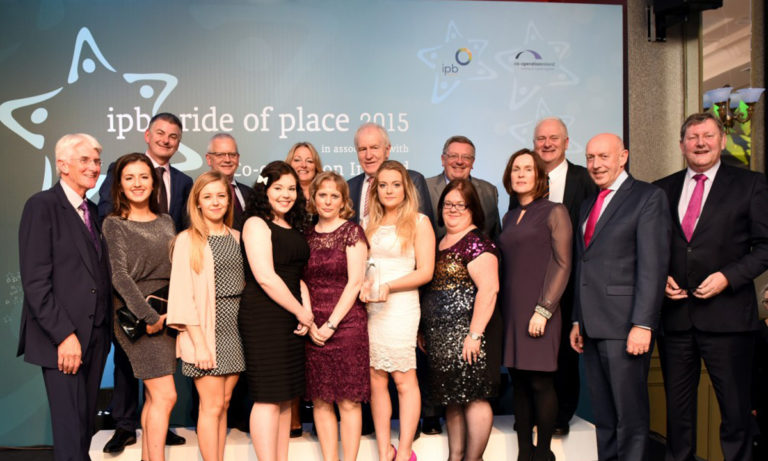
There wasn’t a hotel room to be found in Cork city in mid-November, as 700 people settled in Leeside for the 16th annual Pride of Place Awards.
The awards are the biggest community and voluntary sector event of the year, and the organisers hired Cork City Hall to seat the audience in style. Many groups revelled in the opportunity to let their hair down and celebrate the fruits of hard volunteer work.
Pride of Place awards recognise the invaluable work volunteers do in communities across the island of Ireland. Each year, local authorities submit nominations in order to highlight local groups that make “an outstanding contribution to supporting and strengthening their local community”. The stand-out projects are then visited so that judges can see for themselves who shines the most. No easy task.
The competition began as a Co-operation Ireland programme and is now the island’s largest event recognising community development achievements.
“It is important to recognise the role of local authorities, north and south [of the border], who work closely with their communities to support inspiring voluntary initiatives,” said Michael Garvey, CEO of event sponsor IPB Insurance.
Including runners-up, there were 49 winning groups this year. (See below.)
The Maharees Conservation Association team pictured outside their building. Photo: Domnick Walsh.
Special award for the Maharees
The Maharees Peninsula was one of six places to win a special award.
The Maharees, together with Tralee Bay to the east and Brandon Bay to the west, make up an extensive complex of coastal habitats and support a rich variety of wildlife, including Ireland’s endangered natterjack toad.
It is an area of outstanding natural beauty and has one of the best examples of a tombolo in Ireland. (A tombolo is a bar of sand or shingle joining an island to the mainland).
Working collaboratively with agencies and stakeholders – such as Kerry County Council, NUI Galway, NPWS, Clean Coasts (an Taisce) and IT Tralee – its mission is to protect the coastline and natural heritage of the Maharees, raise awareness of the cultural and ecological importance of the area, and ensure the viability of the Maharees community.
The Maharees’ special award was accompanied by a citation describing the peninsula (and the conservation association) as being “notable not just as an area of great natural beauty, but distinguished by a dedicated local group working to ensure a sustainable approach to conservation that is exemplary and a model for others to follow”.
2018’s big winners
Population Category 0-300 Ray, Co Donegal
Population Category 300-1,000 Balla, Co Mayo
Population Category 1,000-2,000 Rathdrum, Co Wicklow
Population Category 2,000-5,000 Bunclody, Co Wexford
Population Category over 5,000 Shannon Town, Co Clare
Following the 23 November release of the Women’s Aid Femicide Watch 2018 report, the organisation has called for the introduction of a system of formal domestic homicide reviews (DHRs) as an essential means of saving lives.
According to the report, 225 women have died violently in the Republic of Ireland since records began in 1996. Of these, 137 (61%) were killed in their own homes and, where the cases have been resolved, 98 (56%) were murdered by a current or former male intimate partner.
“When women call Women’s Aid and tell us that they are afraid for their lives, we believe them. We know just how dangerous domestic violence can be,” said Margaret Martin, director of Women’s Aid. “Femicide by an intimate partner must be accepted as a fact of life for women. Women should be safe in their homes and in their relationships. And we must recognise the strong connection between the killing of women and domestic violence.”
That connection is the driving force behind calls for DHRs, as many of the risk factors in domestic violence homicide cases overlap with behaviours and tactics used by perpetrators of domestic violence, including physical abuse, threats to kill, abuse during pregnancy, jealousy, stalking and surveillance, and controlling behaviour.
In a system of DHRs, information gathered during reviews would be used to create tools and recommendations to improve prevention, risk assessment and risk management strategies currently used by agencies tasked to protect women and children, such as An Garda Síochána, social workers and the HSE.
Trends, patterns and histories
Explaining why this system is so essential, Dr Jane Monckton Smith, a forensic criminologist and expert on domestic violence, said: “Murder is never a ‘crime of passion’… If we keep explaining these murders away as spontaneous crimes without looking into the trends, patterns and histories, we will remain in denial. But, more importantly, we will be letting down past and future victims.”
This year, the Women’s Aid 16 Days campaign is focusing on femicide, breaking the pattern of male violence, believing survivors, and challenging myths, and the call for DHRs will play a big part in that. But it is also a time to honour the women who have already been lost.
Martin put this best: “We publish our Femicide Watch Report 2018 to pause, and to remember and reflect on the lives lost to male violence. Women’s Aid stands in solidarity with families, friends and communities of women murdered, and with the many women currently living with abuse.”
16 Days
The annual 16 Days of Activism against Gender-Based Violence campaign took place from 25 November to 10 December. The dates were originally chosen so that it would start on International Day for the Elimination of Violence Against Women and end on Human Rights Day.
Over the span of those 16 days, the international community also observed International Women Human Rights Defenders Day (on 29 November), and the National Day of Remembrance and Action on Violence Against Women was marked in Canada (6 December).
The 16 Days campaign was started in 1991 to challenge violence against women and girls.
While the Women’s Aid 16 Days campaign focused on femicide [the killing of a women or girl, in particular by a man, on account of her gender], breaking the pattern of male violence, believing survivors, and challenging myths, the international theme was the Ending of Gender-Based Violence in the World of Work.
Global campaigns raised awareness of violence against women, called for changes at international, national and local level, and aimed to send a strong message that violence is not acceptable and that women and children have a right to live lives free from violence, abuse and fear within their homes and relationships.
The campaign also aimed to challenge the victim-blaming culture that surrounds domestic violence, and dispel some of the myths that are still believed about its causes and appropriate responses.
The symbol of the 16 Days campaign is a #BelieveHer purple ribbon.
If you are experiencing domestic violence, or someone you know is, call the Women’s Aid 24-hour National Freephone Helpline on 1800 341 900. Trained staff and volunteers are available 24 hours a day, seven days a week, to provide support and information.