National research commissioned by the Department of Employment Affairs and Social Protection (DEASP) found that the not-for-profit Local Employment Service (LES) is successful in achieving full-time employment placement for 28.8% of those referred to them annually.
It found a very high proportion of LES clients nationally “indicated that their attendance with a Local Employment Service had been beneficial, with 75% stating that their engagement had motivated them to find work or to undertake further education or training”.
Nationally, the service also received significant endorsement from employers, with 89% indicating that the LES had helped them to find suitable candidates for jobs. Also, 83% of employers who engaged with LES and responded to the researchers said it provided an efficient recruitment service for their organisation.
Northside Partnership was particularly pleased because the data “highlighted that the LES operated by Northside Partnership in Coolock and Kilbarrack is one of the most successful in the state, with over 40% of job-seeking participants progressing into employment in 2016”.
“As a non-profit organisation we are immensely proud of this achievement,” said the board of Northside Partnership in a statement.
“Placing almost 30% of referrals into full-time employment is a significant achievement, but it must also be recognised that for many of today’s jobseekers, progression to a part-time job, internship, employment scheme or further training are valid pathways to full-time employment and career development.
“At this time of welcome falls in unemployment, there are still many who need significant support to achieve job-readiness and access the labour market. We work intensively with these people in their local community, helping them to address any barriers to employment including skills needs, mental health issues, self-esteem and personal discipline.
“The cost per full-time employment placement is €2544 and this reduces significantly when part-time positions are taken into account. The savings to the state in welfare payments as well as the transfer to the state in new tax income are considerable,” said the ILDN.
The ILDN represents Ireland’s 49 local development companies, many of which deliver the Local Employment Service on behalf of the DEASP.
The DEASP provides a nationwide Public Employment Service. It is delivered by the Department’s own Intreo service, by community-based, not-for-profit companies operating the Local Employment Service (LES) and Jobs Clubs, and by private contractors through JobPath.
Many of these public employment services (including LES and Jobs Clubs) are currently up for review ahead of renewal at the end of this year. Minister for Employment Affairs and Social Protection Regina Doherty TD and the DEASP are in the process of designing the tender(s) for these programmes’ maintenance or replacement.
Interested in reading more about the state of Ireland’s community development sector? Check out our latest issue.
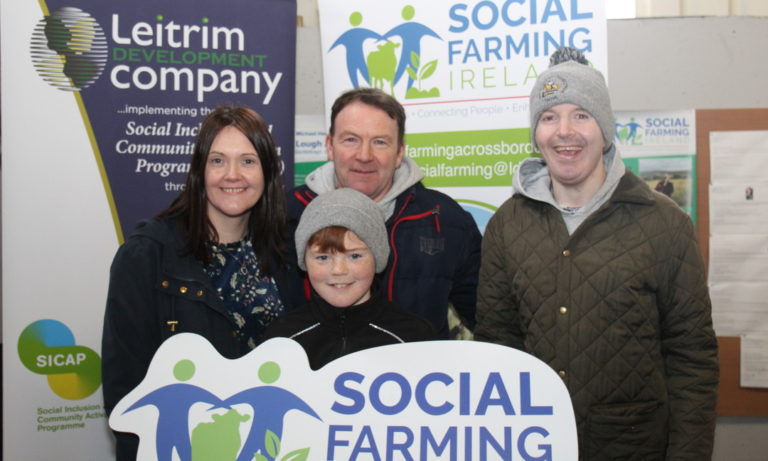
Martin Hannigan, a social farming participant, is on placement on Corina and Patrick Corrigan’s farm near Carrickmacross, Co Monaghan. It’s clear from talking to him and the Corrigans that they’ve bonded for life.
That doesn’t happen every time, but you’d be surprised how often deep connections are forged in social farming.
The practice has spread to 22 counties in the Republic, and more than 3,000 people will participate in social farming this year. It is also gaining popularity in Northern Ireland.
Though farming families have traditionally been known for their hospitality to strangers – certainly in the days before litigation and modernisation – the idea of social farming as such is new to Ireland.
Open days are regularly held to showcase the concept and the first open day of 2019 was held in January in near-freezing temperatures. The weather put nobody off and 103 people descended on the Corrigan farm to learn more.
Showcase attendees on a tour of the Corrigan farm. Photo: Changing Ireland.
In Corrigans’ barn, Aisling Moroney, policy worker with Social Farming Ireland, put it all in context for us as we sat on bales of hay, drank tea and listened attentively.
“Social farming is a relatively new concept based on ancient concepts such as togetherness, belonging and community,” she said.
Aisling Moroney addresses the crowd at Corrigans’. Photo: Changing Ireland.
I met a number of participants and, while Martin was shy about being interviewed, he nodded in agreement when Patrick said, “Martin gets a great sense of achievement here”.
“We ourselves got great benefits from it too. Round here, I’m always flying around. If you are doing social farming, you need to slow down and take your time.”
“Take people for who they are and do the simple, ordinary things you do on a farm with them and support that person. Corina and Patrick have shown that, even on a busy commercial dairy farm, it is possible to make space for inclusion.”
They said it wouldn’t work
“The non-believers told us we wouldn’t get farmers. They said it was far too risky; that people will never come out for social farming. They said, ‘You’ll never get insurance for this’. We’ve overcome all those hurdles,” said Aisling.
The latter’s Social Inclusion and Community Activation Programme (SICAP) directly co-funds social farming placements.
“Through SICAP, we track, monitor and review social farming to make the experience more positive for everybody, and our latest research report tells the story of social farming and SICAP.”
Community workers with local development companies (LDCs) engage with farmers and participants directly and Aisling described as “invaluable” the local connections and knowledge embedded in these organisations.
“Without people on the ground making this happen, social farming would be happening in a more ad-hoc, risky environment,” she said.
Jeanette Leyden, a development worker with Leitrim Integrated Development Company, gets her best work done when she puts on her wellies and heads out to farms to meet clients.
“I got to know my clients far better on the farm than in my office. People may have had a very poor experience of the education system and, when they come into my office, it’s formal and daunting. When I meet individuals on a farm, they’re much more relaxed. We tend to talk while doing farm activities,” she said.
Jeanette Leyden at the Corrigans’ farm. Photo: Changing Ireland.
“Social farming has proved hugely beneficial. Like the SICAP programme, social farming is person-centred, based on the individual’s needs and interests. And all credit to the farmers – they really delve into the participants’ interests.
“My role in lifelong learning is working with individuals and getting them into employment or training. I have learned that people may face a range of barriers … and accreditation isn’t for everyone,” said Jeanette.
National figures
Helen Doherty, national co-ordinator of Social Farming Ireland, listed impressive statistics:
“We have worked with 45 different organisations and that’s something we’re proud of.
“We’re reaching into many different sectors. For example, we’re reaching into the education sector, with children in school who have challenges. And it’s happening from Donegal to Wexford.
“In 2017, we had 140 participants who experienced over 1,700 days of activity across the country. In 2018, that grew to 300 participants and 2,700 days.
“In 2017, we had 28 farmers. We doubled that in 2018 and now have 56 farmers actively involved.
“In 2017, we were active in 11 counties; we’re now active in 22 counties. And we have farmers trained in 25 of the 26 counties in the Republic. Longford is the only county left. We hope to overcome that this year.
“These figures were compiled in October and we have moved on since then,” she said.
(And the figures have gone up again, no doubt).
Personal development and social farming
Frank Murtagh, CEO of Westmeath Community Development, said they were first impressed when a client came to them with “very positive feedback” from social farming.
Shortly after, in late 2017, Cathy Duffy from the HSE made contact.
“She had a group of people she said she would love to do social farming with,” said Frank. “So, I linked her in with our SICAP employment co-ordinator.”
After that, a representative from Social Farming Ireland visited and spoke with the staff.
“We have since developed a programme that is more than just social farming,” said Frank.
“We put together a four-week training programme on personal development [and] safety on the farm, and we helped the participants with their CVs.”
Some of those gathered in the Corrigans’ barn to learn more about social farming. Photo: Changing Ireland.
“SICAP allows for flexibility, so we could fund the individual clients. All the participants were placed on two farms in Co Westmeath.
“They finished up with a day back in our office after they’d done their training and their placements. It was a very enjoyable day for us.
“For 2019, we’re expecting to run two to three more programmes, in relation to people with disabilities and refugees.
“We see great potential in it. We see it as something that key SICAP target groups can engage with and it’s something I hope we can play an active role in over the coming years,” Frank said.
Funding 3,000 social farmers
While popular in mainland Europe, social farming has only begun to take off in Ireland in the past decade.
Department of Rural and Community Development officials see the benefits for everyone involved in social farming and want to do more to support the initiative.
Paul Geraghty is the principal officer for the Social Inclusion and Communities Unit in the Department of Rural and Community Development. He and colleague Lisa Keveney were guests at the open day at the Corrigans’ farm.
“We see the benefits to the participants [and] to the farmers, and what it means to people,” said Mr Geraghty. He welcomed the abovementioned report by the team in Social Farming Ireland.
“The report is going to help us figure out how SICAP can work with social farming into the future. It has great case studies and is hugely interesting,” he said.
Paul Geraghty at the Corrigan farm open day. Photo: Changing Ireland.
“It’s getting purchase everywhere”
“We’re very proud as a department to be associated – through SICAP – with this. SICAP goes a bit of the way towards enabling social farming across the country. We’d like to see it doing more, because it is a tremendous initiative,” he said.
He congratulated everyone involved and commended LDCs for “being imaginative and innovative in challenging funding situations, still making it work and pushing it out. It’s getting purchase everywhere with farmers [and] participants, and there’s now a range of government departments involved.”
Finally, Mr Geraghty appealed to social farmers: “I’d encourage any farmer involved to talk to their neighbours and sell the benefits of this to them. It’s clear it works really well,” he said.
Interested in reading more about the state of Ireland’s community development sector? Check out our latest issue.
Koreikyo: The co-operatives that are reshaping ageing in Japan
by Niamh Dunne
Koreikyo, or senior co-operatives, are a consumer and worker co-operative hybrid operated by and for Japan’s seniors. The co-op’s guiding mission is to help senior citizens remain active, independent and engaged.
All services are provided for and by seniors. Through the Koreikyo, frail seniors are cared for by more active seniors. The frail seniors receive the assistance they need to remain in their own homes for as long as possible, while employment (that pays) is provided for active seniors, keeps them active and adds meaning to their lives. Members can both provide and benefit from the co-op’s services.
Ms Yoshida (78), a member and service provider of Koreikyo explains, “Without a family of my own, this chance to work here and rely on Koreikyo means a very great deal to me. I’m sure I’ll need it even more in the future, so I’m really grateful that it’s here.”
The co-op’s core services include nursing home assistance and a home helper service. However, the social aspect is just as important for Koreikyo members. Different activities and events are organised by its members, providing opportunities to socialise and remain active.
Member and service user Uchida Hirosh (89) says, “My wife and I became members because we like the personal touch. It’s so important for people to help each other and do things together. This is really the principle behind it all.”
Members buy a book of tickets and exchange these tickets as payment for services. The service providers are also members and redeem these tickets as payment through the co-op or use the tickets for services themselves.
With low fertility rates and high life expectancy, Japan is facing the world’s worst ageing crisis. It is predicted that 40% of the population will be over 65 by 2040. Mounting social and economic pressures are changing the way the elderly are cared for in Japan. Koreikyo are emerging as an innovative solution to many of the problems ageing presents.
Community pub an answer to social isolation in West Cork
by Joseph Marken
An Irish town without a pub? Who’d believe it…
And yet that’s the situation facing residents of the west Cork parish of Barryroe. Their local, the Grange Tavern, closed in 2017 due to lack of business, and the Barryroe GAA club – unlike most GAA clubs – does not have a bar attached.
The closing of a local bar may not sound like a serious issue, but it will most likely worse the impact of social isolation that can be felt in Barryroe and many other rural communities.
But there may be a solution: co-operatives.
According to Kathryn Sharpe, secretary of the co-operative behind the Dog Inn pub in Belthorn, Lancashire, the re-opening of the Dog Inn has helped to regenerate the village of Belthorn, which has a similar population to Barryroe.
Kathryn is also the local community nurse, and she sees how having a community pub is of benefit in “helping ensure the health and welfare of the local population”. The Dog Inn has become an integral part of village life, and has grown to incorporate a restaurant, shop, and community rooms and gardens, among other facilities.
Replicating the success of the Dog Inn could be an easy task in Barryroe. First, however, the community will need to decide if they need or want a pub, and then whether or not they want to go down the co-operative route. The community is well-placed to do so, as it already has a successful farmer-owned co-op.
Belthorn has shown how this can be done; how a community can be saved. All that is now required is for interested people in Barryroe to get the ball rolling.
Editor’s note: Inishturk island 14km off the Mayo coast hosts yet another excellent example of a bar (legally a club) in community hands. Boasting – probably correctly – to be the pub with the best view in Europe, Inishturk Community Club has been in operation for over 20 years.
Organic Valley not mucking around when it comes to renewable energy
By Adrian Sheehy
In November of last year, figures released by the Environmental Protection Agency showed that Ireland had increased its greenhouse gas emissions by 3.5% in 2016, keeping the country on track to miss EU climate targets by 2020.
With fines estimated to be in the region of €445m for missing these targets, isn’t it high time that Ireland looked to new models for the way forwards?
The majority of Ireland’s increased emissions are generated by the use of fossil fuels in energy production. One US-based co-operative has found a different approach.
Organic Valley is a dairy co-operative founded in 1988 in the midwestern US state of Wisconsin, in reaction to the aggressive expansion of farming conglomerates. Its founding member were seven family farms hoping to remain viable as businesses while maintaining their philosophy of stewardship and sustainability.
The co-operative recently announced a set of partnerships with local renewable energy companies. Through these partnerships, Organic Valley intends to become 100% powered by renewable energy by 2019, making it the largest green energy organisation of its kind anywhere in the world.
In the process, it intends to generate 30 megawatts of energy for local communities and potentially raise renewable capacity by as much as 72% in Wisconsin alone.
The commitment of Organic Valley to protecting the environment is enhanced by the fact that the sites identified for solar panel and wind turbine installation will be planted, rather than covered in gravel or concrete. The installation sites will be filled with native flowering plants and grasses, and create bee and butterfly habitats that will support local biodiversity.
According to Organic Valley founder and ‘CEIEIO’ (CEO) George Siemon, these efforts to move the company towards a renewable and environmentally sustainable ethos are in keeping with the founding principles and values of the co-op.
Organic Valley has annual average sales of more than $1 billion and has 2,000 farm members internationally. Every member helps guide the co-operative, using a highly democratic governance structure supported by 22 individual committees.
Rising community sector stars Adrian Sheehy, Joseph Marken and Niamh Dunne were students of University College Cork’s Centre for Co-operative Studies at the time these articles were written. The articles reproduced here were converted by the students from assignments. Sheehy, Marken and Dunne graduated in 2018.
Interested in reading more about the state of Ireland’s community development sector? Check out our latest issue.
The late John B Keane, author of The Field and many other fabulous plays and novels set in rural Ireland, would have scratched his head if he was told all of Ireland’s towns and villages would one day be smart.
He wrote about ordinary country people, their curiosity about each other and their cunning, cleverness and contrariness, especially when cornered by institutions or moved by circumstances beyond their control.
Often, his characters struggled to get accurate information.
But what changes might come? Will some villages end up ‘smart’, and others not?
The smart towns and villages concept probably stemmed from success with smart cities that focused on technologically-integrated infrastructure such as smart traffic lights and street lights.
Already, we’ve come a long way from peeking out the window to see what’s going on and, broadband connectivity issues notwithstanding, technology is changing society at a rapid pace.
Smart towns and villages will mean better-connected, more efficient communities, as well as people who understand their communities better through metrics.
This would mean – in theory – that a community could make more informed decisions and more people could participate in the decision-making.
So, what does the future hold? Let’s imagine living in one of Ireland’s smart rural villages in five or 10 years’ time. It could look something like this:
– You can pay for local club membership and enter the local GAA lottery through an online community platform.
– Back in 2019, there were already fewer physical shops than there had been, but local businesses are now making up for that by selling products and services through an online local marketplace.
– Menial tasks that put people off from volunteering are automated and digitised, giving people more time to work together and take action. Voluntary management structures are more easily formalised.
– Dashboards of metrics related to the local environment and business help locals understand their community’s needs better.
– New projects are carefully task-listed and people from across the community and country provide pinpoint help.
– Local online volunteers are a valued asset to the community. Those skills your children once picked up playing Fortnite are being used to great advantage in online local volunteering.
– Low-administration micro-financing is easily facilitated for things like booking a room for a meeting, for example.
– The process for grant applications is simpler.
– Blockchain is allowing local currencies to become more common, something that the late Richard Douthwaite, ecologist and radical economist, always hoped for.
That’s just for starters. Who knows where the internet of things (IoT) and 5G are going take us? Our bins already always know where they are at all times of the day or night. (They’re geo-tagged).
Maybe smart towns and villages might even end up teaching smart cities a thing or two.
John B would have found it fascinating…
Pat Kennedy is the owner and head of strategy at digital development company eConcepts and the digital community platform eTownz.
Interested in reading more about the state of Ireland’s community development sector? Check out our latest issue.
Leaving Certificate students and mature students are today (Monday 1 July) faced with an important milestone: figuring out what their future will look like.
Today is the final day on which the CAO Change of Mind facility will be available, with an application deadline of 5.15pm. That makes today the last day to create a course of study that could line up with a future in community development.
For jobs in the sector, according to GradIreland, “relevant experience has in the past been more important than a qualification, and accredited qualifications in community development tend not to be seen as a requirement,” plus “newly qualified community workers will normally train on the job with the support of experienced colleagues”.
This is particularly welcome in a world where the secondary-school-to-college funnelling process is continually questioned, as are the pressures placed on non-academic teens to embark on lengthy college courses that may not be a good fit.
If you do choose to pursue a third-level education, however, there are numerous courses offered through the CAO that can potentially give you an advantage as you try to find work in the community development sector.
GradIreland cites degrees in community development, social sciences, public administration, anthropology, economics, political sciences, social work, sociology, psychology and urban planning as particularly relevant to the sector.
That still leaves a lot of the CAO course catalogue to wade through, and not much time to do it. To make it a little simpler, take a look at the below list detailing available third-level courses that should give you a solid grounding in these areas:
The public has had its say on a draft National Social Enterprise Policy for Ireland, which was published on 23 April. The consultation period ended on 14 May and the next step – after taking feedback on board – will see the document submitted to cabinet for approval.
This is a notable moment in the history of social enterprise in Ireland, and long-time activists and champions of social enterprise are getting excited about the changes that are coming.
Government adoption of the new policy “will be the subject of a major celebration by long-time activists,” said Senan Cooke from Dunhill. “The implementation phase will open up many new opportunities for thousands of social enterprise companies, projects and new startups. The new policy will empower and build new capacity on the ground in communities. Barriers and blockages will be removed. The vast potential of social enterprise will finally be realised,” he said.
Social enterprises have existed in rural and urban Ireland since the 19th century.
Senan Cooke, author of The Enterprising Community, with PAUL Partnership’s Elaine MacGrath.
In the meantime, Dunhill Ecopark in Co Waterford hosted a public event on 13 May that brought together EU- and national-level experts to debate the potential that social enterprise has to revitalise rural Ireland.
Titled Citizens’ Dialogue: Revitalising Rural Ireland, the event also aimed to tell people of EU-level support available to social enterprises.
Rural and Community Development Committee tours Wexford and Waterford social enterprises
Members of the Joint Oireachtas Committee on Rural and Community Development visited Gorey, Co Wexford, and Dunhill, Co Waterford, on 27 March, to see enterprise developments in both places for themselves.
The visitors included TDs Joe Carey, Martin Kenny and Éamon Ó Cuív, and senators Paudie Coffey and Grace O’Sullivan.
Committee press officer Shawn Pogatchnik and committee policy advisor Sarah O’Farrell accompanied the public representatives.
Members of the Joint Oireachtas Committee at Dunhill Ecopark.
They were welcomed to the Hatch Lab incubation space in Gorey by Tom Banville, head of enterprise; John O’Connor, manager of the Hatch Lab; and Vanessa Tierney, co-founder of resident startup Abodoo.
In Dunhill, the committee ate at the Ecopark and were brought up to date on projects covering social enterprise, the environment, education, geology, voluntary housing, heritage, tourism and adventure pursuits. The group was also taken on a tour around Dunhill’s four villages.
The committee made the visits as part of their work writing a report on the future of rural Ireland. They have made several excursions to different parts of the country over the past year.
Interested in reading more about the state of Ireland’s community development sector? Check out our latest issue.
Derek was, for a time, unemployed. Like others, he had a small business idea that, once he received the right support, could provide him with sustainable work. So, like thousands of others every year, he availed of the Back to Work Enterprise Allowance (BTWEA).
The BTWEA scheme encourages people getting certain social welfare payments to become self-employed. There is also a separate Short-Term Enterprise Allowance, which supports people on Jobseeker’s Benefit to start their own business.
Through BTWEA, people have opened bakeries and hair salons and become self-employed gym instructors (to give just a few examples). These entrepreneurs also received training and advice from local development companies (LDCs)*.
And, in many cases, these small-business owners went from being unemployed to becoming employers.
Most of the businesses helped through the BTWEA have had continued success.
Derek was truly entrepreneurial in his ambition to produce frozen wheatgrass shots. His was also very much a family affair, as his wife Anna is his business partner.
Late last year, Derek and Anna’s products – Natnoot juices – were accepted into SuperValu’s Food Academy and are now available in-store. Two of the newest juices are called Achieve and Believe.
Image courtesy of Natnoot.
Before starting Natnoot, Derek literally faced a dark future, and needed a business idea that would provide an income long-term. He had degenerative loss of sight and was becoming increasingly blind.
Today, he is an inspiration to other small entrepreneurs on the BTWEA.
Derek and Anna appeared on RTÉ’s Nationwide recently to talk about the reasons behind setting up the company, and the challenges Derek faced.
He was among the guest speakers at the national small enterprise awards in Tullamore on 16 May, organised by the Irish Local Development Network.
In a Changing Ireland opinion piece last month, Robert Carey asked why community work has to continually justify its existence. The answer? Seeing successes can give funding bodies the confidence to maintain their support, making it more important than ever for community organisations to become skilled at spinning narratives.
Storytelling in the community and voluntary sector is growing wings, as one of the sector’s main funders – the Department of Rural and Community Development – encourages groups to share their stories with the public.
Powerful regional Social Inclusion and Community Activation Programme (SICAP) case study presentations were made during the spring, which should help shape opinion and policy as they get a wider hearing. They focused on community groups and individuals whose opportunities in life are now improving.
The storytelling initiative is welcome. Most community groups have consistently ranked PR as being one of their top five priorities, but rarely get around to it.
The community sector was encouraged for years by funders – usually the State – to concentrate on statistically provable outcomes. They now increasingly recognise the power of also telling stories.
Oxfam discovered this years ago: statistics don’t lie, but they don’t move people to act in the same way stories of individuals can. You probably remember the name Alan Kurdi, but do you know how many people drowned when the most recent boat sank crossing the Mediterranean? As humans, we relate to stories about each other better than we do to stories about numbers.
Today, in a world of hate and consumerism and love and courage (hello Ruairí McKiernan), it’s only right to bombard people with our stories.
Yes, the very fact that there’s a need for community development automatically implies that something is lacking in the first place – fairly paid employment, health, sobriety, fair play or financial wellbeing.
And, of course, no government wants to hear talk of poverty, unemployment or drugs.
But our stories are about highlighting what needs to be done (and what is being done) on the ground. We never put spin on them. They are summed up in one word: solutions.
We plan to feature particular SICAP case studies in upcoming editions. If you want coverage, call us.
And don’t forget to get the news out on community radio!
4 valuable projects from Clonakilty to Cavan
There are ample statistics to prove the case for further funding for communities, but now compelling real-life stories are being highlighted to make a hurricane-strength case for more national resources for communities.
In February – on Valentine’s Day, no less – Changing Ireland met passionate people engaged in empowering communities in Waterford city, Limerick city and Clonakilty, Co Cork. We also spoke to a community worker in Cavan separate to this event (see detailed report below).
Some of the groups they work with are very vulnerable.
Waterford
The Sudanese community in Waterford, men and women, receive ongoing support. Waterford Area Partnership gave a superb account of their work engaging members of the Sudanese community. Sudanese society is much more patriarchal than Irish society, and diplomacy and respect were central to this work.
Waterford Area Partnership representative addresses audience.
West Cork
In Clonakilty, where there are numerous hotels and tourism attractions, there was no community centre. Now, they have one.
West Cork Development Partnership took – no surprise – a community development approach to setting up a community centre in Clonakilty, and that’s what made it work. Townspeople really got behind the project and gave even more donations than were needed. The centre is now open.
West Cork Development Partnership representative briefs crowd.
Limerick
In Limerick, people learned how to improve their wellbeing and mental health. It was life-transforming for participants and their communities.
This case-study aptly demonstrated SICAP’s impact. With the programme’s support, the PAUL Partnership developed a wellness recovery action plan for people across the city. Called WRAP (not to be confused with rap, as some thought), all the events held were oversubscribed.
Paul Partnership representative outlines the wellness recovery plan for those gathered.
These three community initiatives were presented as detailed case-studies, and we look forward to visiting many of these projects to find out more and hear about them from the horse’s mouth.
The case-studies event, organised by Pobal and the Department of Rural and Community Development, was one of four to take place nationally. The aim? To increase awareness of the true positive impact of interventions funded through SICAP.
Hopefully, the people behind the money will hear these stories.
Breffni Integrated development worker Sandy Holland (on right) with art workshop participants.
‘He used to only paint using black paint; now he paints in colour’
In February, community development worker Sandy Holland told Changing Ireland about a project Breffni Integrated supports – backed by SICAP funding – that is making a big difference in the quality of life of a small number of people with disabilities in Cavan town and Virginia.
It began in 2016 when Breffni Integrated helped to set up the Cavan Disability Network, a collective of disabled people and their carers.
“One of the network’s priorities was to do something [with SICAP support] about the fact that there were limited activities for adults with disabilities,” said Holland.
In 2017, they began holding art workshops facilitated by an art therapist and, as the year progressed, a drama and musical theatre facilitator joined the team.
With support, Cavan Disability Network applied for further funding and secured another €8,000 from the National Lottery.
Breffni Integrated development worker Sandy Holland (far left) and arts facilitator Kim Doherty (far right) with art workshop participants.
Trust grew
In 2018, the network sought to adapt and learn.
“Trust had grown between the project organisers, care staff, workshop facilitators and the participants. More people joined the workshops and they held a public exhibition of their artwork,” said Holland.
Last year, massage therapies were introduced and had a significant impact. The project also bought musical instruments.
Pointing out that any project’s impact is magnified when organisations combine resources, Holland highlighted amazing input by care staff in supporting and encouraging nervous participants to engage in activities for the first time.
The workshop facilitators – whom he called “incredible assets” – were willing to adapt to plans that changed as they went along.
Meanwhile, the HSE found that, as a direct result of people with disabilities participating in the new activities, the health goals the HSE set out in care plans were surpassed.
There are of course challenges. For instance, the funding goes up and down and does not always arrive when expected, causing administrative headaches.
Yet the challenges are worth it. Holland called on people to look at the impact to date for participants:
– they enjoy the activities;
– they’re involved in directing the activities and are producing credit-worthy artwork and drama;
– they went to places they had no previous experience of, such as the Ramor Theatre;
– they exhibited their artwork in a proper venue, and had their work publicly acknowledged.
As Holland put it when speaking about the progress of one participant: “He used only to paint using black paint; now he paints in colour.”
The personal achievements by the participants in turn inspired the various programme partners to want to keep investing in this fabulous project.
Interested in reading more about the state of Ireland’s community development sector? Check out our latest issue.
“Do you know only 1% of Irish farmers grow vegetables?” Lisa Fingleton asked me in Kerry the other day. I was down to see her farm.
“It’s the lowest in the EU,” she added. The data comes from Eurostat.
I didn’t know. I have a cousin who’s a farmer and I live in a rural area surrounded by farms, but I was ignorant, I had to confess.
Lisa is big on community resilience and growing our own food. She wants communities to test their resilience.
One day, about three years ago, Lisa had a profound ‘moment’. She stopped at a petrol station and bought a BLT sandwich. She was eating on the run, as busy folk do.
This time, for some reason, she turned to the ingredients and found there were over 40 listed, and they were from all over the world. There was much more than simply bacon, lettuce and tomato in this BLT.
She began to picture in her mind the journeys all the ingredients made to end up in a sambo on a shelf in a petrol station in Kerry.
“It felt like this sandwich connected me to so many places, people, plants and animals from all over the planet. I started to think about the energy needed to bring this sandwich to me; all the electricity, fuel and water,” she said.
She pictured the waste. Lisa had been to Borneo and witnessed the destruction of the rainforest for palm oil plantations first-hand.
Today, Lisa credits the BLT sandwich for pushing her to make a film, hold an exhibition and, most recently (in November 2018) publish a book. Now, she is reaching out to communities to encourage them to wise up, and warning the government that we are overly dependent on imports.
The system as it stands favours sales over sustainability
“I learned a lot from that BLT,” said Lisa. “It really made me question if there is really any such thing as ‘cheap food’. Someone somewhere is paying the price in terms of poor conditions for workers, crowded conditions for battery hens, or health implications for the consumers of processed foods.”
[In fact, since this article was originally published in December 2018, there has been an outbreak of listeriosis (a flu-like illness caused by exposure to the listeria bacterium) in UK hospitals, leading to five deaths and four sick patients at time of writing. The outbreak has been linked to pre-packaged sandwiches and salads eaten by patients. Perhaps not the health implications to which Lisa was referring, but not unrelated. – Ed.]
“I am concerned about the fact that we are importing so much of our food and losing the capacity to be self-sufficient, despite what we know about climate change and carbon footprints,” she said.
[In response to the release of the government’s Climate Action Plan yesterday (17 June), Lisa was vocal on Twitter and Facebook about its shortcomings. The plan, she said, mentioned organic farming just once and vegetables not at all. “I guess we are meant to eat meat, chemicals and plastic,” she commented. – Ed.]
Years ago, imported food was a luxury; an occasional indulgence. Once a year, you might get to eat an orange. Today, we have year-round strawberries thanks to global inequality and a total disregard for the environment as Tesco, Dunnes, etc, fly in fruit for the rich Irish.
Thanks to Lisa, we know now there is another way. But could you or your community group live only on food grown locally for an entire month?
Lisa began the 30-Day Local Food Challenge by planning it out and doing it herself, and now others have joined in.
“We eat only ingredients grown on the island of Ireland,” she said. “That means doing without imported goods such as sugar, bananas, chocolate and other luxuries to which we have become accustomed.
“It’s a great way to eat good food, support local food producers and become more resilient.”
But why the book?
“Groups around the country started inviting me to give talks and workshops on eating local food. It wasn’t possible to meet everyone, so I wrote a book,” she said.
The Local Food Project, Lisa Fingleton
What’s it about? Marketed as “an inspiring book about the power of eating local food,” it’s also an honest look at the discomfort of trying to live only on fresh locally produced food.
What’s to like about it? It’s colourful, full of photos and is an easy read. It’s somewhere between a booklet and a book – as much a pictorial account as a textbook. It makes important points on subjects many of us don’t like to think about. It’s a wake-up call for Ireland.
Price: €13, including postage
About the author: Lisa is a filmmaker, artist, farmer, development worker and musician. She lives in Kerry, but originally hails from Laois.
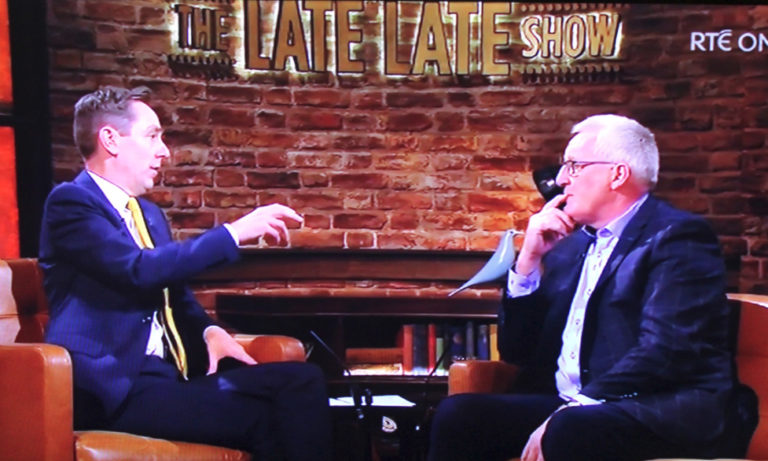
Kerry football legend and sports pundit Pat Spillane appeared on RTÉ’s Late Late Show recently to talk about rural Ireland. He was critical of work by the Department of Rural and Community Development, in particular of a nationwide weekend-long initiative called the Big Hello (held over the long weekend in May). He implied it was a waste of money when rural communities are facing big challenges.
Editor Allen Meagher was among the 650,000 viewers (the Late Late’s weekly average) who watched the show.
Yet, an irate Pat Spillane – appearing on RTÉ’s Late Late Show on April 19th – focused venom on a minor initiative (costing €0.3m) that was being tried for the first time by the Department.
The Big Hello’s aim was to bring communities together over a weekend, nationwide. It never promised to cure poverty and inequality, tackle climate change or topple the elite. It simply sought to encourage people in urban and rural areas to get together at community level.
“Motherhood and apple pie… gobbledegook,” Spillane called it, and worse.
To hear him mouth off about it – he was funny at times – you’d think the Big Hello was the be-all and end-all of what the Department does. The Big Hello will cost the Department just 0.1% of its budget by year’s end. (Further funding to communities also comes from other departments).
For a national event with a potential reach into thousands of communities, spending €0.3m was surely worth a try. (Over 800 events were held nationwide as part of the initiative, the Department reported).
Lessons will be learned to make the Big Hello even better if held again next year. Responses already coming into Changing Ireland from community development workers suggest that:
– As it partly aims to tackle isolation, holding the event either in October or November (when the suicide rate rises) might be better.
– Perhaps it should be held on an ordinary weekend, as many people already have plans for long weekends.
– Communities shouldn’t be confined to holding it on one specific weekend.
The sector isn’t without problems
Leaving aside his personal grievances, Spillane made fair points on a wider level about rural Ireland’s absolute need to offer more employment and to retain shops, post offices and so on.
“If you want to tackle isolation and tackle loneliness and invigorate communities, well, make an effort to keep the shop open, make an effort not to close the post office and to keep the doctor’s surgery open.”
He said he was very passionate about rural Ireland. “And if I am angry about it, I make no apologies about it.”
He said that “grants are great, but grants are short-term, sticking-plaster solutions.”
Reaction on social media suggests that Spillane, while not saying anything new, expressed the dismay many people in rural Ireland feel.
He said, “If I was being a cynic… Say a big hello to the shopkeeper before he closes his door for good. Say a big hello to the postmaster before the post office closes…”
Rural Ireland needs help
He exaggerated, but it worked to get the points across. Yes, we have Garda checkpoints galore, but fewer Garda stations to call to when in need.
We have poor or no broadband – which he didn’t mention – in many rural areas.
Hundreds of shops are gone from towns and villages. The Department will of course point to the growing success of its Town and Village Renewal Scheme (€53m spent to date supporting 675 projects). Yet, the number of community shops in Ireland, highlighted in our previous edition, stands at less than 10.
Of 159 appeals to An Post not to shut post offices, only four were successful. To be fair, that is outside the Department’s brief and the Government shoulders collective responsibility for their demise. Or is EU competition law to blame? Either way, communities have lost out.
It’s not all bad news
On the other hand, I heard no mention on the Late Late about libraries expanding to become community hubs, or of the gratitude from community groups for the grant schemes dismissed by Spillane as ‘sticking plasters’. Nothing about the rollout of LEADER funding.
Elections are coming and Spillane claimed that’s why he was speaking out; that election-time was the best time to highlight issues facing rural Ireland.
He made some good points, but passed up on the opportunity to say something inspiring on a premier show. He had the stage to himself (bar Tubridy).
“Why can’t we bring jobs to rural Ireland?” he asked, but we didn’t hear about the thousands of jobs created over the last decade (in both rural and urban areas) through community programmes supported by the Department. We didn’t hear about social enterprise coming into its own, or of initiatives to support people with disabilities and combat isolation.
He said there were some “really good projects,” but didn’t tell us about any of them. Meanwhile, away from the TV screens, community groups are becoming their own ambassadors. They’ve developed their own voice – where the structures are working (in most counties) – through Public Participation Networks.
Local projects are becoming storytelling ambassadors to highlight what’s working for individuals and in communities. They are being actively encouraged to do this.
Almost all the targets set under the Social Inclusion and Community Activation Programme (SICAP) have been surpassed and we’re now starting to hear from the people previously represented in those statistics.
Oxfam researchers have proven that the general public cannot easily relate to big figures, but when combined with an individual’s story it can have an impact. The two together are more likely to benefit society by influencing policy makers.
This is the way to go. It’s not one or two voices shouting loudly that impresses; it’s many speaking as one, or similarly.
Furthermore, empowering people to engage in collective action and speak up is important in community development. The Department under Minister Ring is to be applauded for recognising this. (For his part, Minister for Rural and Community Development Michael Ring TD has said he would have liked to join the discussion, and criticised RTÉ for its lack of balance.)
So, let’s see more support for community development workers to plug into what their communities are saying, to support workers to network at county level, to collaborate and speak out nationally. If they employ humor, show passion and claim to have been wronged, Tubridy might even have a big hello for them on stage!
Disclosure: Changing Ireland magazine – based in Moyross, Limerick, and managed by a voluntary board – is independent. We receive core-funding from the Department mentioned in this article, but do not shy away from expressing healthy criticism or allowing other writers to do so.
Our journalism is focused on communities, on community development and on social inclusion.
Interested in reading more about the state of Ireland’s community development sector? Check out our latest issue.
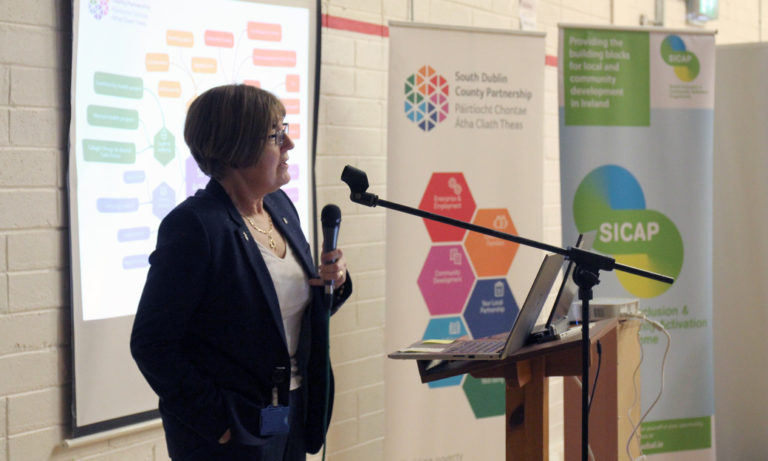
In February, South Dublin County Partnership (SDCP) held an open day in Fettercairn. Among the speakers was chairperson Marie Price-Bolger, who is also the chairperson of the Irish Local Development Network, the umbrella body for local development companies (LDCs).
Price-Bolger emphasised “the capacity within the not-for-profit sector to deliver programmes that government can’t, and to deliver them in an effective, efficient and value-for-money way.”
Citizens – not profits – are at the centre of everything done by local development companies, she said, noting that fees are paid to directors of the for-profit, private companies now edging into the community and voluntary sector:
“LDCs are all not-for-profit, registered charities that operate to a very high standard. For example, SDCP adheres to EU audit standards.
“We operate for the benefit of clients. We reinvest every penny in our communities and not in directors’ fees, as we [volunteer directors] well know.
“Our sector consistently provides services on behalf of government departments in an efficient, effective and value for money model that cannot be matched by any private sector programme.”
Driving communities
Directly addressing Minister for Rural and Community Development Michael Ring, who was in attendance, Price-Bolger said:
“Your department and the SICAP programme are the best enablers of social inclusion in this country, by supporting and maintaining a presence in disadvantaged communities, providing courses, education for all ages, employment supports [and] alcohol awareness, and managing addiction programmes, health and wellbeing programmes.
“All [of these] are supported by SICAP with additional funding leveraged from other departments and agencies.”
“Without SICAP, many of the projects here today would not exist. It is the glue that holds the SDCP inter-agency work together.”
SICAP and previous community programmes were also, she said, an endorsement by government of “the culture of the volunteering that drives the development of communities”.
EU-level auditing
She showed how SDCP was a “prime example” of how this sector can provide services that government departments can’t:
“We are not averse to change, or audit or impact assessment.
“We have a minimum of eight audits each year and we are accountable for every cent of the €11m that comes into the county through us.
“We are transparent, faithful to our mission of social inclusion, and adhere to the complex requirements of our 34 funding bodies.
“SDCP is the embodiment of inter-agency work that delivers for the State by an action-orientated committee and not just talking shops,” she said.
Message for cabinet
While acknowledging Minister Ring’s “own personal commitment to social inclusion,” Price-Bolger pointed out that “change is still being thrown at us…by different government departments”.
“The latest one to directly impact us here, and nationally, is that cabinet is going to look at employment services in 2020. We want to make sure that the message you bring back to cabinet is that employment services should remain with local development companies where the State is getting efficient, effective and value for money. We engage with the client through a totally professional and knowledgeable staff.”
Hidden volunteers
Price-Bolger thanked the Volunteer Centre while drawing attention to volunteers who are rarely noticed, but whose contribution is critical: those who sit on committees. Some are retired people, but many such volunteers work flat out in the community sector, recognising the importance of this behind-the-scenes volunteering.
“They give endless hours through boards and executive committees and various sub-committees,” she said.
She counted herself as one of these volunteers: “We make time to make local development companies work.”
She also emphasised the value of local volunteers.
“People who live, work and volunteer in their area have a knowledge and understanding that does not get acknowledged enough within government circles”, she said.
Interested in reading more about the state of Ireland’s community development sector? Check out our latest issue.
Out of a Budget in excess of €75 billion, the amount allocated to the Department of Rural and Community Development – at €291 million, the smallest budget of any government department – seems like peanuts, but those peanuts can go a long way.
Here’s how the Department’s 2019 budget allocation breaks down (as of 22 March):
• The Rural Regeneration and Development fund gets €86m for a total of 84 approved projects. The fund aims to revitalise rural Ireland, make a significant and sustainable impact on rural communities, and address de-population in small towns, villages and rural areas.
• The Town and Village Renewal scheme supports the rejuvenation of rural towns and villages with populations of under 10,000 people. Funded projects must be of viable, long-term benefit. It gets €53m for 675 projects.
• The Local Road Improvement scheme provides funding to help councils carry out improvement works on private and non-publicly maintained roads. The Department has provided funding of more than €48m for works on over 1,100 roads since September 2017.
• The Outdoor Recreation Infrastructure scheme funds new facilities, as well as the maintenance, enhancement and promotion of existing outdoor recreational infrastructure in rural areas. Since 2016, the scheme has provided funds of €41m to cover 600 projects.
• The Community Services Programme supports community-based organisations to provide local social, economic and environmental services through a social enterprise model.More than 400 organisations have benefitted to the tune of over €40m.
• A new Social Inclusion and Community Activation Programme (SICAP) launched last year. It aims to reduce poverty and promote social inclusion and equality. It supports work with the most disadvantaged and the hardest to reach in communities. The programme is the successor to others stretching back over two decades, and has been allocated €190m for the five-year 2018–2022 period.
• CLÁR supports the sustainable development of rural areas that have suffered the greatest levels of population decline, with the aim of attracting people to live and work there. It mostly funds small infrastructural projects such as play areas, cancer care transport and community safety measures. Since 2016, €25m has been spent across 1,270 projects.
• The LEADER programme is an EU initiative to support rural development projects initiated at the local level in order to revitalise rural areas and create jobs. Funding of almost €58m has been approved for 1,686 projects, and a further 379 projects – with a value of more than €22m – are in the approvals process.
• The Community Enhancement Programme (CEP) is a flexible, streamlined and targeted approach to fund facilities in disadvantaged communities. It covers small and large, from lawnmowers and IT equipment to minor renovations and buildings. During 2018, €12.5m was spent on CEP; €4.5m has been earmarked for 2019.
• The Seniors Alert Scheme encourages community support for vulnerable older people through the provision of personal monitored alarms, allowing them to live securely in their homes with confidence, independence and peace of mind. More than 19,000 personal alarms were delivered in 2018 at a cost of €7m.
• The new Library Strategy aims to develop the public library service over the next five years. Libraries are an essential community service. Digital services and facilities had a price tag of €7m over the course of 2018.
Other initiatives
• Walks Scheme: 39 trails, with a value of €2m in 2018 and €4m for 2019
• Tidy Towns: €1.4m in 2017 and 2018
• Funding for agricultural shows: €800,000 in 2017; €600,000 in 2018
• Men’s Sheds: €500,000 allocated in 2018
2019 budget
• 2019: Current €153m + Capital €138m = Total €291m
• 2018: Current €144m + Capital €87.5m = Total €231.5m
Interested in reading more about the state of Ireland’s community development sector? Check out our latest issue.
A planned €500m terminal in the Shannon estuary to allow the importation of liquefied gas – including contentious fracked gas – will, for now, not go ahead.
In February, the high court ruled that the European court of justice must look into the matter (taking the EU’s Habitats Directive into account) before construction can begin. That process could take two years.
The case was brought by Friends of the Irish Environment (FIE), which has a mandate under European law to protect the environment.
A 13-group coalition opposes the Shannon estuary development on environmental grounds and activists – including some who contacted us directly – were jubilant about the referral to Europe.
Campaign group Not Here, Not Anywhere said: “Given everything that is happening globally with the student strikes and the Green New Deal in America, there is definitely something in the air. The people are rising and building a global climate movement.”
When the developer Shannon LNG first secured planning permission in 2008, the impact on climate was not a major consideration for planners. That is changing.
Following the high court’s decision, the US company stated that it remained “committed to advancing this critical project for Ireland’s security and diversity of energy supply”.
We were unable to get a direct statement from the developer, whose website was down as we went to print.
Awards for Ireland’s best job creators: local people
On May 16th, a national awards ceremony was held in Tullamore, Co Offaly, to celebrate small enterprise successes among people who availed of the Back to Work Enterprise Allowance (BTWEA).
It is only the second event of its kind. (The first was held in 2016.)
Remarkably, among the 5,712 people who set up businesses with BTWEA in 2017 (the last year for which statistics are available), 3,116 were rural people.
As we said at the time, despite all the hoo-ha, it is not Google or the other tech giants that keep Ireland standing.
“Most employment in this country is provided not by tax-shy multinationals, but by small enterprises run by dedicated individuals who usually have their workbase in the local community,” we reported then.
It remains true.
Peace funding safe from Brexit
The EU has introduced a legal mechanism to allow current and future peace programmes for Northern Ireland and the border region to continue.
In late April, Minister for Finance, Public Expenditure and Reform Paschal Donohoe welcomed an EU regulation that allows for the continuation of the PEACE and Interreg programmes “even if there is a disorderly Brexit”.
He said that means that €550m in cross-border investment between 2014 and 2020 remains secure.
Post office anger in Tipp, and a bittersweet victory in Kerry
People in Tipperary are seething following An Post’s decision to relocate Thurles Post Office from the town square to a shopping centre on the town’s outskirts.
‘Large crowds’ marched in protest in March, it was reported by Tipperary media.
One irate local, Pat Morrissey from Ballinahow, told Changing Ireland: “Don’t mind what you hear about rural Ireland being looked after; it’s not.”
Meanwhile, in Baile an Sceilg on Kerry’s Iveragh peninsula, a community that campaigned hard (as did others) was celebrating because their post office had been saved.
Due to State obligations on An Post, the semi-state agreed to re-open a post office in a Gaeltacht area.
Of 159 post offices slated for closure, only four were successful in their appeals to An Post.
The four are in Ballycroy, Co Mayo; Cliffany, Co Sligo; Clogheen, Co Tipperary; and Baile an Sceilg.
Interested in reading more about the state of Ireland’s community development sector? Check out our latest issue.
To coincide with US President Donald Trump’s visit to Ireland, protests will be held at Shannon Airport on 5 June, starting at 3pm. The US President is expected to land at Shannon that day, fly out and back again on 6 June, and to leave on 7 June. A Peace Camp will be set up outside the airport for the duration of his visit, and people are invited to spend whatever time they can there in order to maintain an ongoing protest against his presence in Ireland.
In announcing the planned protests, Edward Horgan of Shannonwatch said: “Trump’s greatest danger to humanity arises from two closely related areas. The first is climate change denial and wanton destruction of our living environment. The other is unjustified wars of aggression, motivated largely by the desire to steal other countries’ resources. Oil-rich Venezuela and Iran are the most recent targets for Trump and the US.”
He added: “The US military has become the world’s greatest destroyer of our environment, in addition to using up a huge proportion of the world’s scarce resources. And, since 2002, successive Irish governments have allowed them to use Shannon Airport to do just that.”
Approximately 3 million troops and their weapons have passed through Shannon Airport in the last decade and a half. US military and military contracted planes land on a daily basis at the airport, and are provided with protection by the Gardaí and Irish Defence Forces.
Aisling Wheeler of Extinction Rebellion Clare said: “We are opposed to Donald Trump visiting Ireland because he is a climate criminal. By taking the US out of the Paris Agreement, he has knowingly endangered the stability of our climate and consequently put the lives of millions of people at risk.”
She added: “Any world leader who is not taking decisive action to reduce their country’s emissions is guilty of criminal negligence. As an active denier of climate breakdown, Trump has gone one step further and deliberately sabotaged the kind of robust climate action that we so desperately need at this time.”
Anne Marie Harrington of Futureproof Clare said: “In Clare, Trump’s environmental decisions are very local problems. We are the county that is most vulnerable to the storms and flooding of climate breakdown, while Shannon LNG, a terminal for US-fracked gas, may be built in our Shannon estuary. We don’t want our home to be a transit point for this climate-wrecking fossil fuel. This visit is an opportunity to voice our opposition.”
John Lannon of Shannonwatch said: “US President Trump has approved the use of torture in contravention of international law. He has increased military spending to levels not seen since the height of the Iraq War. And he has dramatically reduced the number of refugees, particularly from Muslin countries, who can seek sanctuary in the US.”
“We must also bear in mind his failure to condemn white supremacists, his sexist rhetoric, and his failure to protect minorities. Together these make it unacceptable to welcome him as a head of state,” he added.
Organisers point out that the protest is not just against Trump and US policy. It is also against the Irish government’s breaching of neutrality by allowing the US military to use Shannon.
During the protests, letters will be handed over for delivery to US President Trump and to an Taoiseach Leo Varadkar, who is scheduled to meet Trump at Shannon. These will call for an immediate end to the US military use of Shannon, to Irish complicity in US military operations, and to the environmental destruction of the planet.
Organisers of the anti-Trump protests at Shannon emphasise that they will be family friendly. Banners, art, music and any forms of peaceful expression are welcome at the peace camp and surrounding area.
“It will be an expression of the people-centred positive alternatives to Trump’s warmongering and destruction of the planet” said one of the organisers, John Lannon.
People coming to Shannon are asked to park at Shannon Town Centre, where they will be directed to go by foot along Drumgeely road to the peace camp and demonstration point closer to the airport. This road runs parallel to the dual carriageway.
In February, hundreds of volunteers, as well as local authority, government and agency staff, joined community development workers in Fettercairn at an event to showcase the work of South Dublin County Partnership.
Launched by Minister for Rural and Community Development Michael Ring TD, the event highlighted the importance of the new Social Inclusion and Community Activation Programme (SICAP), which is worth €190m to communities over five years and which has helped 7,649 community groups and 143,114 individuals to date [as of publication in Issue 64, May 2019]. The programme will run until 2022.
Minister Michael Ring (centre) with SDCP CEO Larry O’Neill and social enterprise development officer Emily Smart. Photo: Changing Ireland.
Remarking on the figures – which have exceeded targets – the minister said: “It’s a credit to everyone involved and we’re building on solid foundations.”
“I can see how you are all enthused by the work you do. I’m looking at what this programme does and everything I see I’m very happy with,” he said.
He urged workers to “continue the good work”.
The staff at South Dublin County Partnership are all top-notch kickboxers… Photo: Changing Ireland.
“I will be fighting your cause. We won’t win every fight…but I’ll be there to make sure that these schemes and these programmes…must be left there.”
The minister made a point, as he often does, of thanking volunteers nationwide who work in communities.
Members of the Roma community attended the open day. Photo: Changing Ireland.
Giving examples of people he personally knew, he hailed the power of schemes to change lives, and believes his department should be strengthened.
“My department is Rural and Community Development and the most important part of that is community. Sometimes we forget about communities,” he said.
Councillor Mark Ward, mayor of South Dublin County Council, also spoke at the event, and praised the community spirit on display. Photo: Changing Ireland.
“We should be looking around at many other departments – health, social protection and [others] that should be in [my department]. We should have overall responsibility in relation to community. I know that’s being looked at. I’m looking at a few areas myself where I can bring in schemes and we’ll be doing that over the next number of months.”
“I hope, whatever government comes in after the next election, that this Department will be left and, not alone that it be left, but that it be strengthened.”
“The only problem is that I don’t have more funding,” said Minister Ring, determined to see that change.
Interested in reading more about the state of Ireland’s community development sector? Check out our latest issue.