‘Changing Ireland’ focuses on Offaly in its current edition with local groups given credit for their work during the pandemic.
Ray Lucey has been writing for the Limerick-based magazine for the past 10 years.
“I never imagined interviewing my mum, never mind her appearing on the front cover. Then Covid-19 arrived on our shores and caring for those who are most vulnerable became the nation’s priority,” said Ray. He has been sending copies of the magazine to family and friends around Ireland and abroad.
Eileen Lucey being visited by Caroline Bryant from Mucklagh Community Development.
The cover shows Eileen being visited by Caroline Bryant from Mucklagh Community Development.
As editor, Allen Meagher said, “There are 350,000 carers in the Republic of Ireland and they saved the country from being in a more precarious state due to Covid-19. This is clear from our report by Ray Lucey in Offaly where he and his mother Eileen speak from experience. Eileen kindly allowed him to turn his journalistic focus inwards and describe his life as a carer and to gently interview her as someone who receives care. Thankfully, well-embedded community supports make Eileen’s life comfortable and enable Ray to commute to work – essential to provide for his family.”
“We should be grateful to Ray and Eileen because this aspect of Irish life is usually hidden from view. Any of us could end up a carer, or being cared for. Whether or not we would receive a carer’s allowance is another story – see side column. “
Ray also talked to Family Carers Ireland, based in Tullamore. Their observations put the care provided for Eileen in a national context.
Eileen is delighted to feature on the front page.
“It was such a great boost. My mother is absolutely thrilled to see her coverage,” said Ray.
Offaly Local Development Company staff packing food hampers – supported by SICAP and St Vincent de Paul – ready for An Garda Síochána to deliver to homes in Offaly
The magazine, publishing for the past 20 years and focusing on positive news from communities nationwide, also highlights the work of Offaly Local Development Company (OLDC) and includes an interview – again by Ray – with social inclusion co-ordinator Siobhan Broderick.
OLDC sprung into action early on in the pandemic, reaching people who were isolated – not everyone has mobile phone or an internet connection – and keeping them connected.
Siobhán Broderick of Offaly Local Development Company.
Siobhan said that the first lockdown highlighted “the plight of children experiencing disadvantage, of lone parents, working parents (childcare issues) and carers. It also highlighted the lack of IT in many homes.”
“We found so many people were willing to help. We had shops and charity shops giving us supplies. Everyone helped, from knitting shop owners to local butchers. Every request for help we made to businesses was met,” she said.
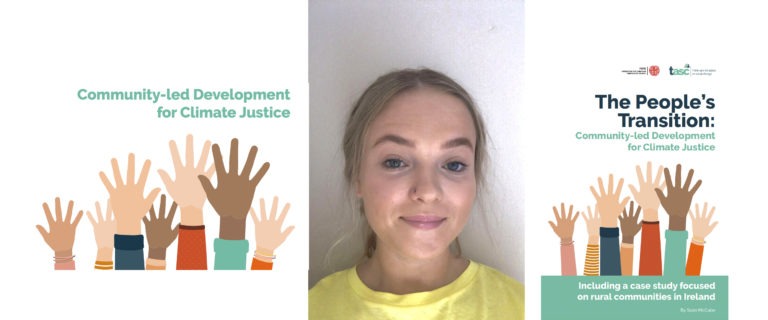
Beth Ardill, a Community Development undergraduate gives her views on a new report from Tasc that focuses on “Community-led development for Climate Justice”. Her interview with Allen Meagher is here; her written report below.
As a community development student, it is great to see the bottom-up approach being used as it is one of the best ways to go about community work. It is important for communities to have a say in any decisions, especially decisions that affect their community on issues such as climate justice. Involving everyone in the community brings people together, it makes people feel involved and for them to know they that were involved in the decision-making brings them a sense of inclusion.
“‘The People’s Transition’ proposes an approach to climate action that puts communities and local development at the heart of Europe’s Just Transition.” – This quote got my attention as it is important to have communities and local development at the heart of the Transition and climate change is affecting every community and local area.
The report talks of “…the bottom-up component of the European Green Deal which seeks to give everyone a voice and a space in which to design new climate actions, share information, launch grassroots activities and showcase solutions that others can follow”.
This also caught my attention as giving every individual in communities a voice is important; it can make people who have been marginalised from their community feel involved again.
In my opinion, the community-led approach points to a fairer future as everyone is involved in the decision-making, everyone’s opinions are considered. Nobody is left out or is made feel that their opinion does not matter in this approach.
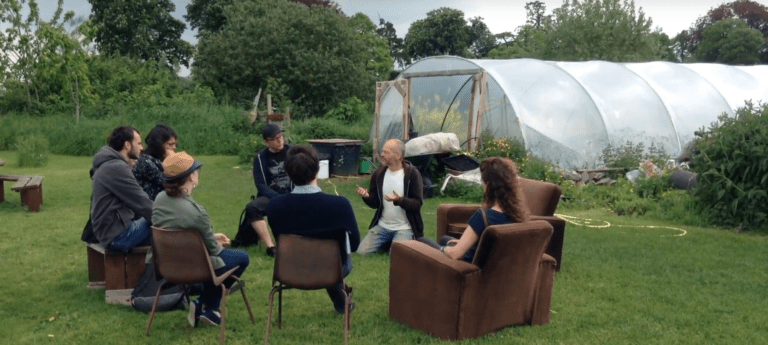
This will require more community workers. Groups could be set up to discuss with the community what is happening and inform them on everything they need to know, and to hear their opinions and ideas. This approach requires more time, but it is more rewarding knowing the community as a whole is involved.
I would love to be involved in bottom-up development in the future, especially with issues such as climate change – it is a serious issue and everyone needs to be involved for change to happen.
If you are a community or climate activist I think you will appreciate what has been brought together and proposed in the excellent new report by Sean McCabe, ‘The People’s Transition: Community-led development for Climate Justice’.
The report was published by Tasc and the Foundation for European Progressive Studies (FEPS).
The study builds on the pioneering work that is already being carried out by community organisations, cooperatives and rural communities across Ireland and Europe. The report proposes a participative model of dialogue and climate action as an enabler of local development.
It says: “This report can only scratch the surface of the remarkable work being done at a community level – there is so much to be learned from listening to and working with each other. “Is ar scáth a chéile a mhaireann na daoine” is an Irish saying that translates as: “It is in each other’s shadow that we flourish.”
The collaborative approach to addressing the climate emergency that the report advocates for puts communities and local development at the heart of Europe’s Just Transition. The study recognises that the transition can’t be top-down and it proposes that tackling inequality can also be done through the delivery of climate solutions and by raising standards of living for all.
Mr. McCabe hopes, “that this study can serve as a framework for designing and implementing policies that realise an enabling environment for a just transition by expanding the capabilities of individuals and communities facing transition.”
There is a focus on climate justice throughout the report, highlighting that the burdens of the crisis must be shared. It recommends ensuring that the most marginalised and impacted are included in participatory community dialogues and in the development of local action plans.
“If climate action is to be fast, it must be fair. If it is to be enduring, it must be inclusive. If it is to benefit from widespread public support, it must share benefits and burdens equitably and fairly,” the report states.
By valuing local knowledge and including people and communities in the design, planning and implementation of the transition to a zero carbon society, the study suggests we could catalyse and get buy-in to actions that are urgently needed.
In its executive summary, it states:
“Fast and effective action will be delivered when people see tangible improvements in their standards of living and, as a result, demand, rather than resist, the radical transformation that is required to avoid catastrophic climate change.”
The report, which runs to over a hundred pages, introduces the emerging concept of community wealth-building to ensure local wellbeing. Through changing the procurement practices of big institutions, local authorities and government, this can redirect their spend to the local economy and in doing so strengthen resilience and bring economic security to our regions.
Community wealth building is a practical response to austerity, financialisation and automation. As the ‘The Peoples Transition’ puts it:
“Community wealth building is a new people-centred approach to local economic development, which redirects wealth back into the local economy, and places control and benefits into the hands of local people.”
ABOVE: A table from page 73 of the 104 page report compares funding committed to Just Transition, Rural Development and Climate Action with the average annual spend in Ireland on public procurement. As climate action becomes mainstreamed across government actions, it should be possible to align more and more public procurement spending with positive climate actions.
According to the paper, tackling inequality, expanding the capabilities of all people, and building trust between stakeholders, will ensure a virtuous cycle of action.
“The transformative potential of the transition can be realised through the redistribution of power and wealth through genuine, community-owned approaches. This serves to build public support for climate measures and uplift standards of living and well-being for communities, particularly those in situations of disadvantage.”
New approaches like participatory budgeting and community ownership along with models of community supported agriculture, food and energy coops, organic and regenerative farming practices are all discussed as enablers to addressing converging challenges. In summary, this report offers a bottom-up framework that puts people and local communities at the heart of the transition, which if not fair will not be made at all. The full report can be downloaded here.
The report was based on “a robust nationally representative sample of 500 young people (aged 18-25)” and was conducted by Red C.
It found that 3 in 5 young people have either personally experienced or know someone aged 25 or younger, who has experienced abuse by a current or former partner.
Community and civil society groups nationwide hold events annually at this time of year as part of the 16 Days of Action Campaign, which aims to raise awareness and call for changes at international, national and local level to make women and children safe from abuse. It is a campaign ‘Changing Ireland’ has reported on since 2001.
• See the full 20 year archive at: https://changingireland.ie/digital-magazine-archive/ These page images link to reports in our 2nd edition.
The research published today revealed that 1 in 5 of the young women who took part in the survey were directly abused, with 51% being under 18 when the abuse started. The report also shows how gendered this form of abuse is among younger people including minors, in line with international figures on all ages. The survey found that 1 in 11 young men experienced abuse.
Sarah Benson, CEO of Women’s Aid, said it shows “that we have particularly alarming levels of intimate relationship abuse experienced by young women in this country. One fifth of young women said they experienced abuse which included emotional abuse, physical violence, and sexual assault, stalking and harassment. Based on our 2016 CSO data this is as many as 44,540 young women (18-25) which is shocking.”
She said, “Even more troubling is the fact that 51% of young women who had suffered abuse said that it began before their 18th birthday, with just 18 years old being the average age at which the abuse began.”
New research has shown that 1 in 2 young women abused by a partner experiences abuse online, “including constant bombarding with messages, hacking of email and social media accounts and the taking, sharing and threatening to share intimate images without consent”.
Ms. Benson also stated that they “know that the abuse that takes place online can be particularly devastating given the ‘always on’ nature of life online. It is draining, can often feel inescapable and can be difficult to block a persistent abuser from making contact. It is not a reasonable solution to ask a young person being abused to ‘opt out’ or ‘switch off’. This only isolates people ever more and they should never suffer or be further excluded because of the actions of the perpetrator.”
There are long lasting effects from an intimate abusive relationship. “Our research showed that 84% of young women said that the abuse had a ‘severe’ impact on them. Young women reported that they had suffered anxiety, depression, low self-esteem as well as being isolated from family, friends, and workmates because of the abuse. Some also reported suicide ideation and hospitalisation due to physical injuries,” she said.
Ms. Benson said their report only scratched the surface of this huge problem in Irish society: “We need regulation. We need legislation. We need more in-depth research and extensive education and awareness campaigns – including in schools. Most of all, as a community we need to ensure responsibility lies with the perpetrator and to say loudly and clearly to anyone affected by intimate relationship abuse that ‘Yes, it’s abuse. It is never okay. It is not your fault and you will be believed and supported.”
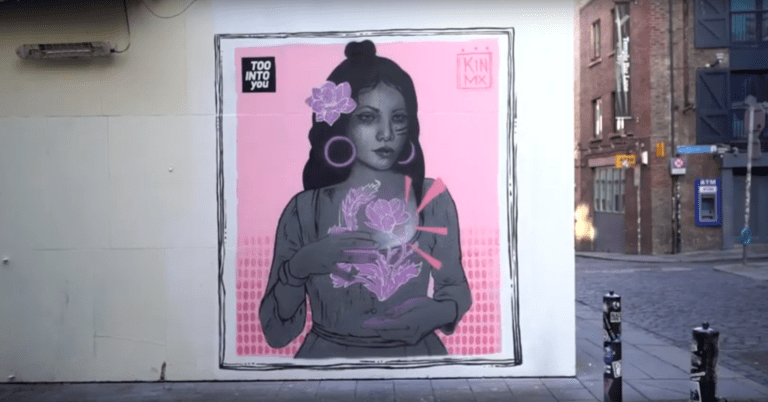
Women’s Aid have launched their ‘Too Into You’ Public Awareness Campaign which “highlights the signs of unhealthy relationships and encourages young people to reach out for support.” The campaign website has a number of useful tools including a relationship health check quiz and a guide to protecting yourself online.
How much has society changed since Martine Brennan conducted this interview for us in 2001?
• The Refuge-One Woman’s Story – by Martine Brennan. Published on page 12 of ‘Changing Ireland’s 2nd edition, Winter 2001.
The Family Resource Centre National Forum (FRCNF) welcomed ‘Our Story’ for looking at the historical, current, and potential future development of the National Family Resource Centre Programme.
One of the most interesting sections looks at the opportunity cost had we not had Family Resource Centres (FRCs). In another chapter, it is clear the programme compares well alongside supports provided in other European countries.
The State’s 121 FRCs could rise to 130 by 2025.
The report was well received by supporters:
Deirdre Hegarty called the 60-page read an “outstanding piece of work outlining the huge amount of support being provided to communities all over the country not just in this time of crisis but all the time”.
Ballyduff FRC in Co. Kerry said it was “a brilliant read” because it described “all the hard work we do as a team, a workload that makes us proud of who we are, what we do, how we do it, when we do it, where we do it and the biggest reason – why we do it.”
The Family Resource Centre Programme is the State’s largest family and community-based support programme and has been in operation for over 25 years. It is today funded by Tusla – the Child and Family Agency.
The report’s main recommendations are to:
Maintain the core values and practices of the work of Family Resource Centres through raising the public profile of the programme.
Rebuild operational capacity: human, financial, training, supervision, CPD, networking with Europe.
Restore and rebuild SPEAK documentation system.
Give the programme a dedicated Strategic Support Unit.
Set up a pre-development fund to enable expansion to 130 centres by 2025.
Winter 2001: Jean Garland, Denise Price and Louise Murray in celebratory mood after the launch of the Family Resource Centres National Forum. Click on image for full report and more photos. Photo: Changing Ireland.
Family Resource Centres reached most vulnerable during 2020
Throughout the pandemic, FRCs actively promoted important Covid-19 public safety recommendations and advice amongst harder-to-reach communities. Clare Cashman, Forum chairperson, said: “Since the outbreak of Covid-19, Family Resource Centres throughout Ireland have played a key role working on the ground supporting communities.”
FRCs proved they can “effectively communicate the changing public health advice and provide vital supports (that) respond to the direct needs of some of our most vulnerable in society.”
FRCs could see when people were likely to “let their guard fall which may inadvertently result in the spread of Covid-19” said Ms. Cashman and they responded appropriately.
In the first lockdown, FRCs saw an increase in the number of people seeking mental health support and food and essential home supplies. They received more calls than normal from migrant communities, including those in direct provision.
Since March, FRCs have broadened the range of services they provide, after experiencing an increase in demand “from many new people who had never used FRC services before, such as older people cocooning”.
For example, all FRCs now use a ‘Digital Toolkit’ and use social media to reach their target audiences.
The ‘Our Story’ report shows how FRCs work with individuals, families, communities and government in responding to locally identified needs. The report can be downloaded from the Forum’s website.
Lucan Disability Action Group is typical of the organisations receiving government support during the pandemic. As their spokesperson said, “Without it, it would not be possible to run the service.”
Highlighting the overall impact, Minister O’Brien said, “The 46 measures approved for funding in 2021 will be implemented across Government and will help to address a diverse range of issues such as long term unemployment, youth disadvantage, migrant integration and probation support to prevent re-offending. Dormant Accounts funding makes a real difference,” he said.
Examples of measures approved for 2021 include:
€6.4m to sports in disadvantaged communities and for persons with disabilities.
€6m for youth and community justice services aimed at countering the influence and impacts of crime on young people and in communities.
€2.3m to support social enterprises to address social and economic disadvantage.
€1 million for a youth initiative to provide young people with the soft skills needed to improve employability.
Separately, in 2020, as the Department pointed out in a statement, Dormant Accounts Funding provided for €50 million in once-off supports for charities, community and voluntary organisations, and social enterprises in response to the pandemic.
Lucan Disability Action Group (LDAG) was one of the groups to recently receive support from the Dormant Accounts Fund through the Covid-19 Stability Fund.
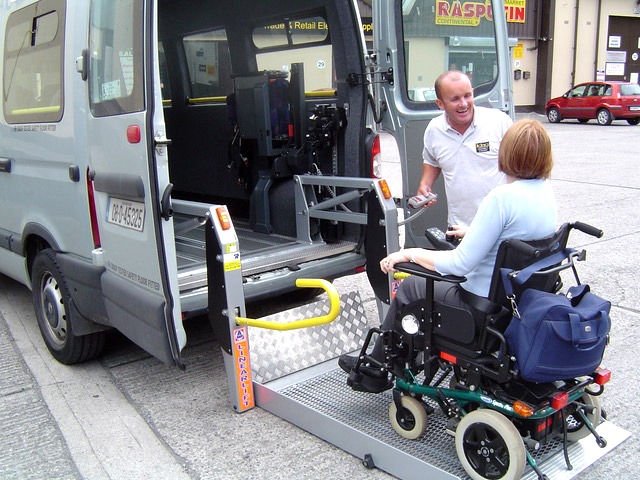
LDAG manager Caroline Brady said, “We deliver wheelchair accessible transport throughout Dublin and surrounding counties (and) because of Covid we experienced a significant reduction in income this year.”
“First, because of Covid-19 restrictions, disability services were closed between March and September, which resulted in no income during this time. Second, because of Covid-19 social distancing, the capacity of the buses was reduced from seven passengers to one passenger.”
“In the meantime, we incurred significant extra costs to get the service up and running safely, for example making the buses safe for both members and drivers, investing in PPE and cleaning materials, as well as continuing to meet our existing obligations like payroll, diesel, CVRT, vehicle maintenance, utilities, rent, technology, etc.”
She said the extra funding enabled the charity to continue to deliver transport when the disability services resumed.
“We modified three buses in September and two in October and are operating with five modified vehicles from our 10-vehicle fleet. This investment enabled our members to access day centres, education, and hospital appointments – much needed after many months of isolation because of Covid. All of this is made possible by the assistance of the Stability Fund, without it, it would not be possible to run the service,” said Ms. Brady.
Download the Dormant Account Action Plan 2021: here
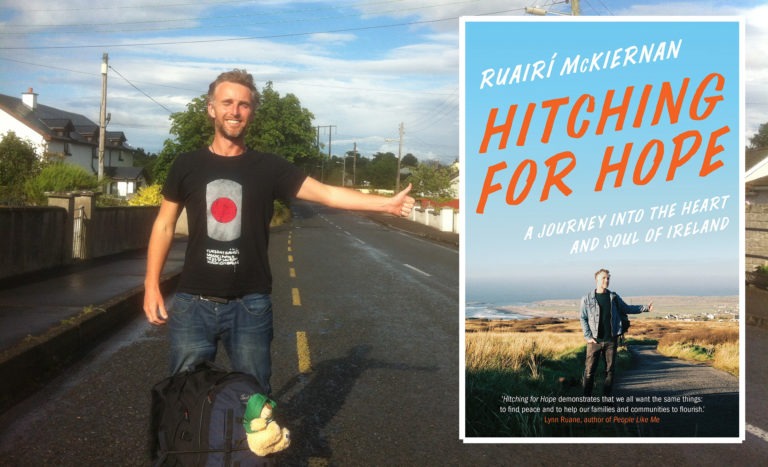
When we see how a dramatic turn of events in the world can really shape things for us, it’s time to reflect. The timing of this book ‘Hitching for Hope’ – published during a global pandemic – has been unexpectedly fortuitous.
What we reflect on while reading this book is how the Irish population rallied together in many towns and cities up and down the country during a particularly brutal recession. McKiernan gives the reader space to explore human nature during tumultuous times. He digs deep and finds resilience and hope at a time when there was little of these. He very carefully and sensitively handles the timely need for community involvement by offering the shared common goal of getting through a difficult time through strength, humility and humanity.
What immediately grabs the reader in this compelling memoir is how Ruairí McKiernan makes no bones about his reason for embarking on a quest for hope in the midst of a crisis during a bruising recession in Ireland.
From the outside, it seemed like he had it all. He was in his early 30s, had achieved a lot of respect as a mental health advocate, having founded the young people’s charity SpunOut, and he was engaged to be married. But he was heading steadily for burn out and this was beginning to impact his outlook greatly.
Now based in Lahinch, Co. Clare, where he lives with his wife – singer and meditation teacher, Susan Quirke – McKiernan is much happier. Before the Covid-19 outbreak and subsequent lockdown, he planned to hitch to the venues around the country where his book would be launched. But instead, he launched the book live on his Facebook page with senators Lynn Ruane and Frances Black along with musician Colm Mac Con Iomaire.
“Matters of hope, happiness and vision for Ireland weren’t going to be resolved through a brief solo hitching trip lacking in any great academic depth; that much was for sure. This was an amateur adventure, and I was fine with that,” he writes.
HE CHALLENGED HIS OWN CORE BELIEFS
The part of his journey which stood out the most was when he challenged himself and his core beliefs. This was particularly striking on his visit to Derry and his decision to attend an Orange parade. Having grown up just a few miles from the border, his sense of ‘The Troubles’ growing up in Cavan has a much more real and personal perspective than most of us have in the Republic.
“There is a desire for people to come together and celebrate their culture and heritage and it’s clear most people are just here for a good day out with the families. Ultimately, I know we’ve more in common than what sets us apart, something we need to remember as we build towards a better future for all on this beautiful island,” he writes.
McKiernan writes in a very accessible way, with an empowering humanitarian vision, referencing the need for community and for elders to be more central in their role of advocacy, especially for young people.
He notes: “Time after time I had seen the need for intergenerational connection – young people who needed guidance from elders and elders who could benefit from the ideas and energy of our youth.”
It felt at times that this concept of hope could be diluted by the overall themes of the book, which included some real gritty details and heavy topics about a country crippled to its core. However, with McKiernan’s honesty and vulnerability weaved into the narrative, this made hope a compelling hook for the reader to grasp and get on board with.
“(While) the sharp decline and the Irish government’s response evoked widespread anger, it also gave way to self reflection. People started to ask bigger questions about the vision we were working towards as a society, and as individuals,” he writes.
What this book does ultimately is take responsibility for how we react to societal issues and political upheaval. Do we allow this to continue to happen or do we stand up to those in power and find our voice in these decision-making processes? Mckiernan’s voice is one that allows these questions to penetrate and sift deep in the ultimate quest for a better world and a more equal role that we all should by right get to play.
‘Hitching for Hope’ is available in all bookshops nationwide and online. #BuyLocal
The Kerry Mental Health & Wellbeing Fest, held annually, was even more important this year in the midst of the ongoing Covid-19 pandemic. Held in October, most of the 59 events were online (40) or outdoors (8) with many completely booked out – from laughter yoga, forest walks and a photography competition to Radio Kerry programmes on family mindfulness.
The South Kerry Development Partnership (SKDP) this year, as always, was a key stakeholder and their rural men’s outreach officer, D.J. Moran, emphasised the special importance of the Kerry Mental Health and Wellbeing Fest in 2020.
“The feedback we got back from the public was great because we had to change a lot of things this year. We were hoping to have everything face-to-face with people out in public in parks, beaches and in every town in South Kerry, but obviously that all changed with Covid-19. So it was a bit of a task to start doing things online. Our fear was a lot of the elderly people would be lost with it because as you can imagine… asking them to go on a Zoom call, they would look at you as if you had two heads. But, in fairness, everyone pulled together. We got to do some outdoor things, even with the restrictions, and they worked well.”
D.J. continued, “Day Care Centres, community events, they’re all gone for now. So there is a large percentage of people that we don’t know how they are getting on and this was one way of reaching out to people.”
Of concern, only 14% of people who took part in Wellbeing Fest activities were men – according to data from the organisers.
D.J. pointed out that isolation is not only a rural problem but an urban one as well. In response, civil society and community groups are endeavouring to provide essential supports in these challenging times.
• Alex Bermingham won First Place (Special Education) with this entry in Mental Health Ireland’s art/photography competition.
The Kerry Mental Health Association is, said D.J., the main centrepoint for information in relation to issues with mental health within the county.
Jigsaw Kerry is an organisation aimed at the youth and it also plays a critical role. As DJ said, “It might be harder to see a mental health problem with a younger person.”
Speaking about Kerry Volunteer Centre, he agreed that volunteering is a fantastic way to become involved within your local community and in turn boost one’s confidence and self-esteem.
D.J. is one of the many community workers making themselves available around the clock. He said, “I am always available by phone so anytime night or day people can ring me.”
The ‘Five Ways to Wellbeing’ were central to the ‘Kerry Mental Health and Wellbeing Fest’.
Time and again, scientific studies have shown that if we regularly practice the following, our mental health and wellbeing improve.
We can all make active and deliberate choices about changing the state in which we find ourselves. We just need to begin.
CONNECT
Lend an ear; Lend a hand; Talk instead of messaging; Share experience.
BE ACTIVE
Move your body; Move your mood.
TAKE NOTICE
Be curious and be aware; How are you feeling? How are others feeling? What can you change?
LEARN SOMETHING NEW
Surprise yourself with what you can do!
GIVE
Your time; Your effort; Your time; Your kindness.
• Best friends relax on the slipway at White Strand, Co. Clare, in August. Kerry is in the far distance! Photo by A. Meagher.
On October 12th, co-ordinators of the Stop Climate Chaos coalition group – Oisin Coghlan and Sadhbh O’Neill – hosted a webinar discussing the recently published Climate Action Bill.
The campaign group includes environmental, overseas aid, youth and faith groups, and it has been calling for a strong climate law since 2007. It co-ordinated the campaign that led to the passing of the 2015 Climate Action Act.
Oisín Coghlan, co-ordinator of the campaigning coalition said:
“This Climate Bill substantially improves the 2015 law, but substantial weaknesses remain that must be fixed by TDs and Senators.”
The webinar panelists also included Dr Diarmuid Torney who specialises in climate politics and Prof. John Sweeney, climatologist.
Climate Action Bill 2020 vs 2015
Dr. Tormey explained how the Climate Advisory Board operates in a similar role to how NPHET does and this, he said, was appropriate. He said the Bill was a marked improvement on the 2015 document. It explicitly sets out a more balanced and more diverse policy planning framework.
However, the fact that there is no obligation by the government to meet the 2050 goal of zero emissions, is a clear cause for concern. There is no legally binding element to this and so the focus seems to be on planning for a carbon budget but with no guarantee that this will be met.
Prof. Sweeny, a climate scientist, dug deep into the language of the Bill and described it as weak. He pointed to the usage of words such as “pursue” being used instead of “achieve” and said, “These action words are necessary requirements for compliance.”
He noted that the word “may” appears 45 times in the document, which really drilled home his point about the use of “weasel words” giving the Bill a lot of uncertainty.
There is also a compliance gap in relation to individual sectors that must play their part to meet the targets. What was most stark of all was his closing piece when he examined what was missing in the Bill:
• No sanctions.
• No criteria for Ireland’s carbon budget.
• No phasing out of fossil fuel cars.
• No international dimension regarding biodiversity.
• Loopholes that give the minister of the day extensive discretion to amend elements of Bill as s/he sees fit.
Returning again to the use of language, he noted we are not required to “achieve” the 2050 target, but to “pursue” it.
To quote the legislation:
“The State shall pursue the transition to a climate resilient and climate neutral economy by 2050.”
It can be fixed
Closing the seminar, Sadhbh O’Neill sounded a more positive and hopeful tone, saying that while there are issues in the Bill, these can be fixed.
She said that climate governance needs joined-up thinking and should include clear obligations. She criticised the exclusion of methane gas as a separate target for agricultural sectors and said that this was a major legal loophole that needed amending.
She said the “wooliness” of the language used was unhelpful and confusing.
She stressed that the highest level of ambition needs to be reflected by this bill and that the definition of the carbon budget needs amending.
People Power
Oisin Coughlan summarised the seminar’s view when he said the Bill is not going to break new ground. He described it as “not bad for 10 years ago, but not enough for now”.
He urged those sitting in on the webinar to engage with their TDs and take action by being part of the movement to ensure these amendments happen.
There are two vacancies to be filled and, for those who fit the criteria and are keen to see the community development landscape improve across the ROI, this is as good an opportunity as it gets.
– Opportunity to serve on board of country’s biggest not-for-profit
In particular, the board is seeking people with professional experience in community development and experience of the sector.
“As an organisation, we fund most of the community development programmes in the country. If you’re interested in that, come on board with us,” says Deiric Ó Broin, chairperson of the board.
Pointing to the potential roll-out of new community development programmes and local development programme, he said, “We are really keen to access the expertise of the broader community sector.”
Pobal, officially a charity, had a budget last year of over €700m and there are many in the community sector with decades of experience who may not have previously considered applying for membership of its board. Practitioners tend to prefer small initiatives, yet Pobal has had a hand over the years in supporting tens, if not hundreds, of thousands of local community initiatives.
– Chairperson Ó Broin wants more community activists
Ó Broin described his fellow board members as “really committed people” from across the country with diverse backgrounds. Current board members already include people with strong community or voluntary backgrounds, although only one (John Redmond) is described as “an activist”.
If you’re one of those on-the-ground, community workers with insights to bring to the table, it could be time to dust off the CV. The process is wide open and competitive and directors are appointed for an initial four-year term. The criteria are explained in full online (links below).
UNIQUE ORGANISATION
The word ‘pobal’ is Irish for “community” or “the people”. The organisation is unique, Ó Broin pointed out: “We look after over 30 programmes for over five government departments.”
He said, “We’re really interested in people from a community development background. Our experience has been that people coming from community development tend to be very resilient, quite innovative, quite entrepreneurial and, at the same time, quite good at managing or overseeing change. That’s one of the big challenges for any organisation like Pobal.”
“We’ve grown dramatically over the past number of years. It’s a very fluid environment for us. It’s not just about Covid-19. For example. childcare is changing and there’s the potential for new community development programmes and local development programmes. So, we’re really keen to access the expertise of the broader community sector,” he said.
THE KEY ATTRACTION
Asked why someone in community development should join the board, he pointed out that Pobal funds “most of the community development programmes in the country” and encouraged people interested to come on board.
“See how the system operates. Bring your own experience,” he advised. “While we don’t design the programmes, we work with government departments, and you can input your expertise, knowledge and awareness into the process over the years. That’s the key thing.”
As to his own experience, he enjoys being on the board “immensely”. “It is really rewarding and it’s an amazing board to be part of”.
The board attracts “really committed” volunteers come from across the country and all have diverse backgrounds.
“Every day you learn something new. I can’t speak highly enough about it,” he said.
In his day-job, Deiric Ó Broin works as the Head of Social Enterprise and as Acting Head of Civic Engagement in DCU.
Interested applicants must include a CV and a cover letter in their submissions which are to be emailed to: pobalboard@drcd.gov.ie.
Closing Date: 3pm on Friday 9th October 2020.
Pobal’s board is appointed by Government and members give their time and expertise on a voluntary basis.
A pre-assessment process may apply depending on the number of applications received. A shortlist of qualified applicants is then put to the Minister for Rural and Community Development.
ABOUT POBAL:
In 2018, Pobal oversaw the expenditure of €729 million while providing management and support services in respect of programmes for Government departments, the EU and other bodies.
Much of Pobal’s focus is on childcare, while it also supports the Social Inclusion and Community Activation Programme, Peace IV, Tús, the Rural Social Scheme; the Senior Alerts Scheme, the Ability Programme, and the new the Covid-19 Stability Schemes, among others. Read more about the programmes.
His company – Photonomi – is one of a dozen sharing facilities in a sparkling, purpose-built centre in Kiltimagh, the Co. Mayo town the Oxford dictionary credits with possibly having given birth to the term “culchie”.
The enterprise centre was built by one of Integrated Resource Development (IRD) Kiltimagh‘s subsidiaries*. Its voluntary director, Brian Mooney, advises allcomers to “get surrounded by good go-ahead people. Don’t listen to the odd begrudger.” His motto: “Let the begrudgers at it, but keep going.”
IRD Kiltimagh was set up in 1989 as a not-for-profit to develop the town and its hinterland. Outwards migration is a big challenge for many towns and – over 30 years – the organisation has established three enterprise centres which, they say, add “substantial value to the small local economy”.
An aerial view of Cairne International Trade Centre, courtesy of Community Finance Ireland. According to Brian Mooney, visitors marvel at the level of investment. (See inside in the video – below).
Just over 600 people today work in companies or projects that are, or once were, in workspace provided by IRD Kiltimagh. Joe Kelly, the organisation’s CEO, put it in perspective for ‘Changing Ireland’:
“The town’s population is around a thousand, or up to four thousand people including town and hinterland. The lesson to take from that is this: If it can happen here, it can happen anywhere.”
THE CAIRN CENTRE
Kiltimagh’s newest enterprise centre is called the Cairn International Trade Centre. It is a high quality building comprising 34,000 square feet of office workspace laid out in 15 open plan suites. It has fibre broadband and “rent is about 10% of the cost of equivalent workspace in the main urban centres”.
“It’s an ideal location for companies looking for additional space to enable social distancing because of Covid,” says Kelly. The centre is also ideal for “companies seeking a low-cost second site outside the main urban centres”.
Cairn International Trade Centre, Kiltimagh, Co. Mayo.
The centre features in a new promo video by Community Finance Ireland (CFI) – see below. It inspires viewers to think outside the box, look beyond Dublin and and consider the potential of rural Ireland’s small towns. It shows how finance for community organisations is available away from the traditional banks and naturally tells a positive story of engagement with CFI. They provided a “sympathetic ear” and the process to get loan finance was, the IRD Kiltimagh says, “straightforward” and “short”.
SCULPTURE PARK
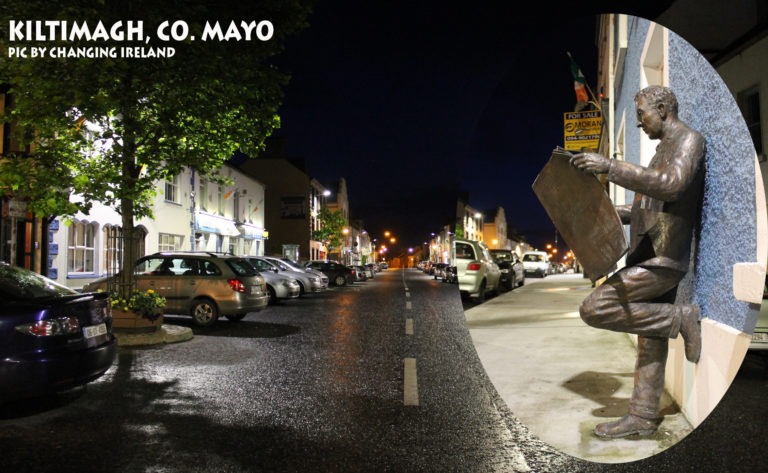
Of course, Kiltimagh has been turning heads since 1993 when it opened a sculpture park. You can’t miss them, as anyone driving through Kiltimagh will know. It sets the town apart.
When I was passing through one night not so long ago, I was so stunned to see a statue of a man reading a broadsheet newspaper that I stopped to photograph it, or I should say “him”; he was so lifelike.
Kiltimagh surely has the best value for suits in Ireland.
I strolled some more. Across the street, suits were on sale in the local St. Vincent De Paul from €5, surely the best price in Ireland. Unfortunately for me, it was well past closing time.
Nothing tastes nicer than a Kiltimagh kebab!
Then I came across the local kebab shop and, being peckish with a long journey ahead, I stopped in to get a takeaway before continuing on my way.
And that’s the idea. IRDK works to develop projects and initiatives that develop the community while simultaneously enticing visitors and supporting local business.
“We always try to be different with every single thing we’ve done,” says Kelly.
A unique project on the disused railway passing through the town is to be launched shortly. (We will follow up with coverage once that happens).
NATIONAL CONTEXT
There are a number of community-based organisations with “integrated rural/resource development”, shortened to IRD, in their title.
IRD Kiltimagh is one of the originals. Their approach was based initially on lessons learned from Spain. Other community-based organisations around the country also take an “integrated” approaches to local and community development. Their work shows the impact of getting the local community, local authority, employers and state agencies to work together.
* Joe Kelly and Kristian Sheridan (above) feature in CFI’s short video about the Cairne International Trade Centre. The centre was established by a subsidiary of IRD Kiltimagh called Cairn Enterprise Hub DAC.
DID YOU KNOW?
Did you know that Kiltimagh had a direct link to the first landing on the moon? It was also home to Antoine Ó Raifteiri, one of the country’s last travelling bards and to world heavyweight boxing champion Gene Tunney. All that and more is celebrated in the local museum.
MORE INFO:
For more information on IRD Kiltimagh’s work, phone 094 93 81494, or email: hello@ird-kiltimagh.ie
Kiltimagh’s main street by night. Photo by A. Meagher.
MEANWHILE…
…TAKE 2 FROM OUR ARCHIVE:
An inspiring craft circle set up by locals in Kiltimagh to nurture interculturalism featured in our summer 2008 edition.
‘Banking On Communities’ was the lead story in our 2016 winter edition. It covered the big picture on financing community initiatives – from minor to major – including Community Finance Ireland’s role.
FINALLY, LISTEN IN!
UPDATE: Community Finance Ireland has just publicised (Fri, Sept 25th) a podcast interview they conducted with Brian Mooney. Over 17 minutes, he talks about how to attract visitors to a town with no obvious attractions to start with. They put their minds to it – with help – and reorientated the town, so much so that people came to stay from as far away as Japan! Listen in here on Soundcloud.
Brian Mooney advises allcomers to “get surrounded by good go-ahead people”.
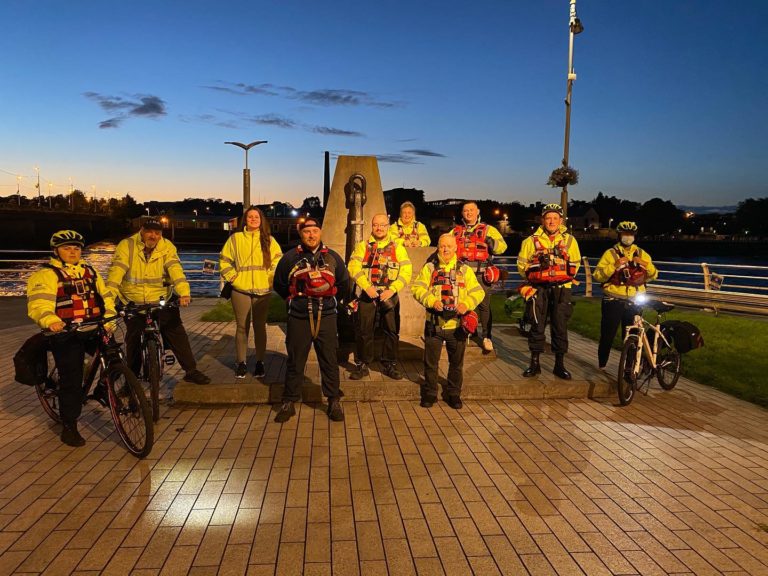
We spoke to Marian McGuane, welfare officer with LTSP, and with Matt Collins, the group’s chairperson. They were friendly, confident and came across as experienced and trustworthy – the right kind of people to quietly help people in distress. On the eve of September 10th, they and fellow LTSP volunteers held a vigil before starting their night patrol on the River Shannon.
At the vigil, LTSP volunteers gave candles to members of the public to remember those who have died from suicide. A song on CD called ‘Made To Live’ was also handed out to those attending. It was written by Marian’s son Tyrone who sings it with his sister Madison (10) and it’s a beautiful melody. It features in the background at the beginning of our video report (above).
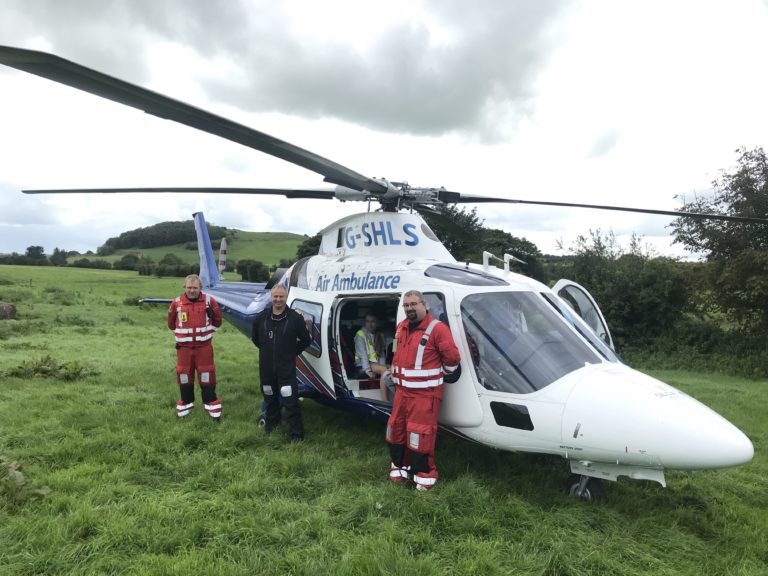
They service has been running for one year now and can fly patients from isolated, rural areas to hospital in 20 to 30 minutes. Our editor, Allen Meagher, didn’t expect to meet them on scene, but that’s the point – you could meet them anywhere.
As well as getting patients swiftly to hospital, founder John Kearney’s vision’s is focused on bringing A&E to the patient – the opposite to traditional thinking. This year, the community-based, not-for-profit air ambulance expects to fly over 500 missions.
“Our job is to stabilise the patient and then transfer them to the (most) appropriate accident and emergency department,” said Peter Delea, advanced paramedic. “We can land nearly anywhere we want to land. For rural Ireland, in places such as Castletownbere where CUH is two hours away by road, we can bring patients to hospital within half an hour.”
The Irish Community Rapid Response (ICRR) is the charity behind the air ambulance and related medical emergency services. It was founded in 2006 by Mr Kearney from Baltimore after a young life was unnecessarily lost due to the ambulance service being unable to reach the victim in time.
It has won awards and accolades as it grew and has been recognised as a vital social enterprise through the Social Innovation Fund and the not-for-profit’s worth has been measured by partners in UCD.
“Out of the 100 emergencies that (our) teams currently respond to per month, six lives are saved,” says the ICRR. As Peter told ‘Changing Ireland’, as well as saving lives, their speedy interventions often result in shorter recovery times for patients and a better quality of life after an incident thanks to being transported to hospital at 300km per hour.
The Millstreet, Co. Cork, based service costs around €2million to run per annum and has just completed its first year of airborne operation. It is supported by and collaborates with the National Ambulance Service, the HSE and the Department of Health.
As the ICRR and others point out, access to medical care within “the golden hour” after an incident can often mean the difference between life and death. In Wales and England, charity-run air ambulances have been around for many years, while Northern Ireland Air Ambulance took to the air in 2017.
The ICRR says that their main call outs are for cardiac arrest, road accidents, stroke, falls from a height, and farming and equestrian related injuries.
The not-for-profit says it has four “asks” of people: to donate, volunteer, fundraise and to tell their story.
• This story first featured in Issue 69, Summer 2020 – full edition available here: https://changingireland.ie/wp-content/uploads/2020/08/Issue-69-32p-Summer-2020-Aug25-2.pdf
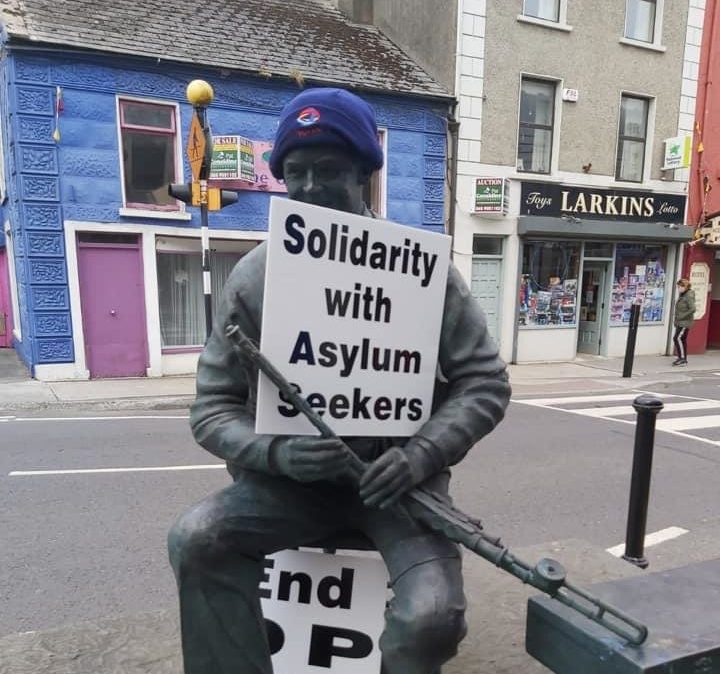
A well-intentioned volunteer initiative to welcome asylum-seekers housed by the Department of Justice in West Clare found itself pushed to complain at the highest level during the Covid-19 lockdown.
Last year, 35 men were given accommodation in a two-star hostel in the town of Miltown Malbay and arrived without knowing a thing about the place.
They were given a great welcome and soon found themselves ceili-dancing, cooking and even swimming in the wild Atlantic with members of a rapidly established local welcome group.
However, the welcome group’s focus switched from support and volunteering to hardline activism this year as it emerged the people they befriended felt they were being woefully treated in their privately-run, State-funded accommodation.
The problems arose before Covid-19 struck and were exasperated by the virus’s arrival.
The Miltown Malbay Welcome Group (MMWG) – speaking on behalf of asylum-seekers afraid at first to speak out themselves – wrote to then justice minister Charlie Flanagan and the matter was later raised in the Dail and Seanad.
The centre was ‘The Central Hostel’ on the main street of the small seaside town.
Conditions in the former tourist hostel were documented by the residents and the support group. The asylum-seekers said, “We feel like we’ve been treated like animals and slaves.” They thanked the MMWG for making their lives outside the hostel “heaven”, compared to the “hell” inside.
• Inside The Central Hostel before the last residents were transferred. Photo: A. Meeagher. • Outside The Central Hostel days before the last residents were transferred.
Together they highlighted issues including:
• Water running down the walls of bedrooms when the shower on the floor above is turned on.
• Ceilings leaking and water running through light fittings.
• A bedroom shared by two men with no door to the en-suite (no privacy).
• Inadequate heating and hot water during the winter months.
• A curfew placed on residents insisting they be in by 10pm. The residents were all adult men.
• Residents felt the food (described) was substandard.
The hostel owner, Pat Kelly, told local media the allegations were false.
‘Changing Ireland’ spoke by phone to Mr Kelly and he was reluctant to talk long enough for us to go through the complaints one-by-one.
“Nobody’s complaining here,” he said.
It was put to him – even going back to last year – that residents reputedly had to be in their beds by ten o’clock at night.
“That’s nonsense, will you,” said Mr Kelly. He laughed at the notion.
“I don’t want to talk anymore about it,” he said, urging us to “contact the Department of Justice.”
He repeated this advice and the line went dead.
In a statement issued to local media a few days later, the Department confirmed the centre in Miltown Malbay was to close. We contacted the Department of Justice and Equality – no further details beyond the initial statement were forthcoming.
Before the residents moved out finally, I visited the hostel. The corridors felt narrow, the air stagnant and the rooms confined. Mr Kelly was not available. An asylum-seeker – one of only seven remaining – was packing to depart and we spoke briefly. While he had poor English, he was clearly looking forward to moving.
• Volunteers in Miltown Malbay became activists. Photo by: Miltown Malbay Welcome Group.
The result of the Department of Justice’s decision – relief for the asylum-seekers and the volunteer group that supported them:
“We enjoyed a hugely successful integration with the asylum seekers, something which we are very proud of. Although we are saddened to think that we are losing the men who have added so much to our small community,” the MMWG said, adding that it was “relieved” that the requests by the residents to be relocated had been approved. The group intends to stay in touch with the former Miltown Malbay residents.
The MMWG was full of praise for new Minister for Justice and Equality, Helen McEntee, for responding to their concerns quickly and effectively.
“We want to thank Minister Helen McEntee for acknowledging our calls that the centre should be closed. She acted swiftly and with compassion.”
The MMWG congratulated the residents for thinking of others and for their “courage” in speaking out: “They collectively decided that they had a responsibility to ensure that the Irish Government knew of conditions in the Centre so that others would not be placed there.”
The residents’ concluded their letter saying, “We are afraid that this letter can interfere in our case. But we cannot take this anymore.” (Letter in full: https://bit.ly/MiltownDP).
Dept. of Justice statement:
In a statement released to local media, including Clare FM, the Department of Justice and Equality pointed out the following:
“Restrictions on transfers were necessary as a precaution during the pandemic. While transfers can now take place in limited circumstances, our ability to respond to transfer requests is contingent on public health advice and subject to availability within the accommodation system.”
Regarding the centre in Miltown Malbay, it said: “In line with the Department’s policy of moving residents from emergency accommodation to dedicated centres as soon as places become available, the residents in Miltown Malbay have been informed this week of their new accommodation arrangements.”
“Following the completion of transfers, the Department does not intend to continue its use of this emergency location.”
priority
It added: “Our stated aim is to reduce the reliance on emergency accommodation but given existing demand, that can only be achieved through increasing the number of dedicated Direct Provision bed spaces. The pandemic has impacted the Department’s ability to open new centres. However, the sourcing and provision of suitable accommodation to facilitate independent living for residents remains a priority.”
Government plans to end direct provision
Cathal Crowe, TD, was one of those who raised the treatment of asylum-seekers in Miltown Malbay in the Dáil recently. On learning they were to be transferred, he broadcast his thanks to Minister Helen McEntee, to the campaigners, and “to the people of Miltown for showing these people a true Irish welcome”.
Saying he was “very glad” of the commitment in the Programme for Government to end Direct Provision (DP), he said: “DP works on a short-term basis, offering safe shelter to people arriving into Ireland fleeing war, famine, oppression in their homelands. But over the medium to long term, DP is dehumanising and anti-families and young people.”
The new government seeks to replace DP with a new not-for-profit approach with human rights at its core. The Programme for Government (PfG) states:
“We are committed to ending the Direct Provision system and will replace it with a new International Protection accommodation policy, centred on a not-for-profit approach.
“We are committed to ensuring that Ireland provides protection to those seeking refuge from conflict and persecution, as is required under international law.”
The PfG says: “This includes vulnerability assessments, the right to work, the ability to apply for driver licences and bank accounts, an independent inspection process, measures to reduce the length of time in processing decisions, mental health services, and the training of managers of Direct Provision Centres.”
The acceptance in the PfG that DP must be replaced by a more humane, non-profit-driven system follows campaigning for many years by activists.
The ongoing plight of asylum-seekers and refugees is a story we will return to. Our next edition will include an article about and by asylum seekers in Wexford who are supported by Wexford Local Development and others.
Around the country, Family Resource Centres, Public Participation Networks and many other groups lend support.
If you wish to contribute, email: editor@changingireland.ie
Since Covid, many people’s lives have changed irrevocably. Thousands of people across Ireland have experienced unexpected bereavement and we sympathise with each family over their losses. Thankfully, through our actions, tens of thousands of lives at risk were also saved.
The lockdown was a time when people across Ireland looked out especially for each other, while trusting that our Government got it right. We looked to family, neighbours, voluntary groups, our community and advocates for the voiceless. Many tens of thousands stepped forward to volunteer, or wished to do so.
All along, I wanted to have a national picture of how communities were doing – and share it – but I was in the dark like others. The pandemic took a stronger grip on me than I could get on the story. Everyone’s experience was different. This was mine.
Episode 1 :“I waved bye-bye to Moyross – with most of the office computer and camera equipment in my car. …In 20 years, I had only once lost the feel for what was happening in Moyross, or in Ireland’s communities at large, or the community sector generally.”
Episode 2 : “Community groups trust ‘Changing Ireland’. They would welcome the attention, knowing we understood. I could see clearly how our journalism might be helpful. But… the relief on those first days of lockdown was shortlived for us. It lasted about 48 hours.”
Episode 3 :“Nationally, we’ve had stellar leadership and I hope that can continue, but even Leo was saying he expects it to get more fractious… There are very big tests ahead for Ireland and community is to the fore. B.S. must be called out and reported. Not everyone is in this equally and everyone’s story is different.”
To everyone in their various struggles over the recent months, I hope you and yours grew stronger from it.
If you have a Covid story to share with ‘Changing Ireland’, email: editor@changingireland.ie
















 Of course, Kiltimagh has been turning heads since 1993 when it opened a sculpture park. You can’t miss them, as anyone driving through Kiltimagh will know. It sets the town apart.