It says that “lasting harm” is caused to people by “prolonged congregated living in Ireland’s international protection system”.
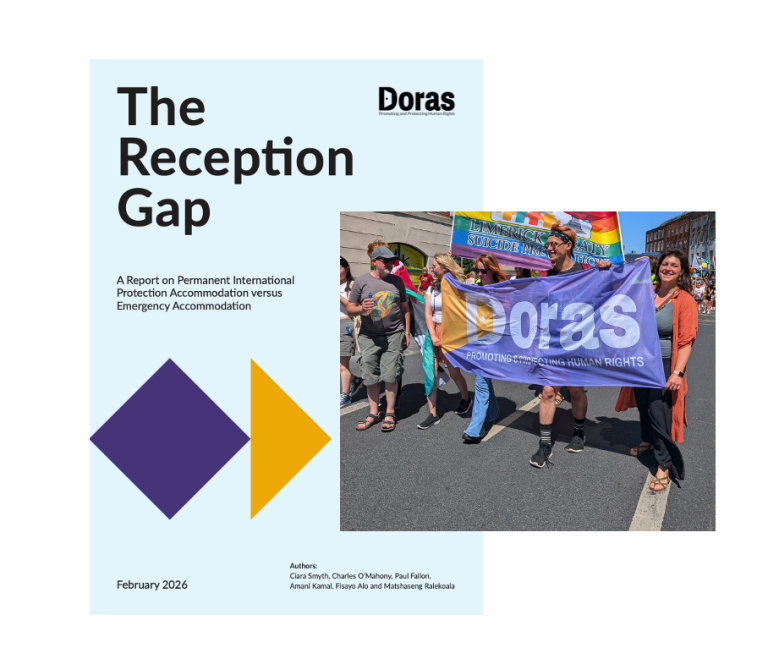
The 170-page report by support group Doras compares living conditions for asylum-seekers in permanent accommodation with the experiences of those who are placed in emergency accommodation.
As Doras also says, “While permanent centres have faced scrutiny in recent years, emergency accommodation, which now houses the majority of international protection applicants, remains largely unexamined, weakly regulated, and without independent oversight.”
“Emergency accommodation was meant to be temporary,” it points out, calling for reform and for full inspections, national standards, and for all asylum-seeker accommodation “to operate within a social care framework”.
“Children seeking safety deserve space to grow, and families and individuals deserve a chance to thrive,” says Doras.
Since the report was published RTE has highlighted how last year more than 1,100 children in Tusla’s care were placed in unregulated emergency accommodation such as hotels and short-term rentals. A large number of these children are asylum-seekers who came to Ireland seeking refuge.
The magazine’s remit, how it looks and its target audience have changed since it was established.
“Previously it was a publication that was been solely there to dispel the myths that surround Travellers; this notion that Travellers aren’t employed, that Travellers don’t want an education. Although there are still issues in those areas, we are not a homogenous group in that regard,” said Michael who is based in Athlone.
“Right now the magazine is more of an aspirational tool for members of the Traveller community. We feature members of the community that are doing really well.
“It is used as an educational tool within institutions as well and knocking on the head the notion that Travellers don’t want an education, don’t want employment,” he said.
He thinks that it helps to show that many Travellers do have an interest in becoming educated, but he feels more schools should read it.
“A lot of people who use that magazine would be surprised that there are so many Travellers in third level education for example.
More primary schools should subscribe to Travellers’ Voice
“One of the things we have struggled with is trying to ensure that the magazine goes into all national schools. We find that within national schools there is sometimes a plateau on people’s expectations of the level of education that Travellers want.
“We find that maybe our young people aren’t doing as well in the education system, but in a lot of cases (while) there is a lot of goodwill towards individuals people think that Travellers don’t necessarily want a junior cert, so they don’t push them as much as they would their settled peers.”
On the issue of with getting national schools to access the magazine he says that schools that don’t have Traveller students often don’t want it.
“In a lot of cases they say they don’t have any Traveller students so there would be nobody benefiting from it. That’s losing sight of the fact that it’s not just for Traveller students but it’s to inform teachers as well what the community is about.”
Shining a light on taboo subjects
As editor he wants to put a focus on certain things that are too often ignored.
“We try and highlight issues within the community that Travellers don’t generally talk about themselves. We speak quite a bit about depression because it affects the community disproportionately, but people don’t talk about it.”
Travellers’ Voice also seeks to highlight the successes of its readership.
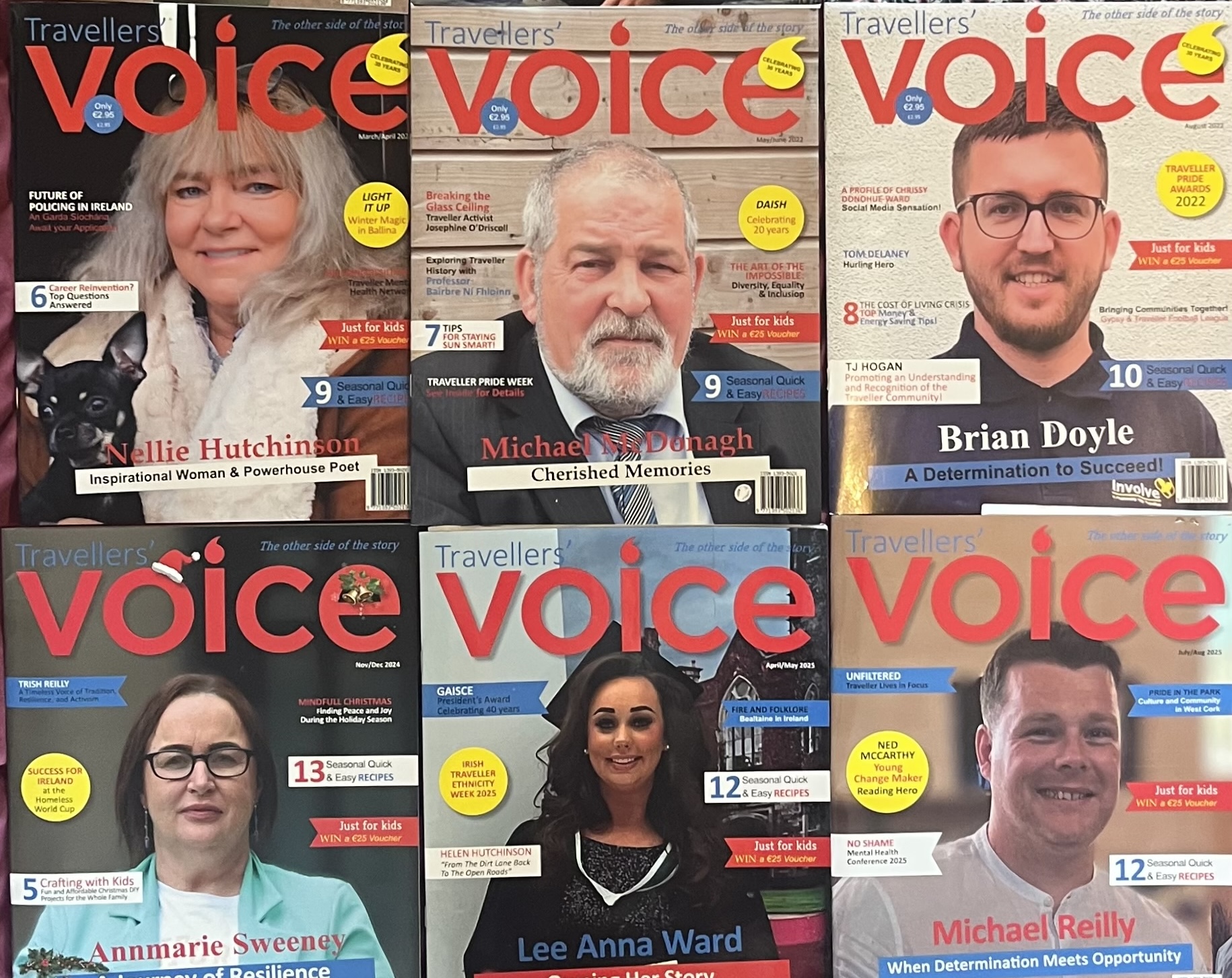
“Within the community, we are so long in existence that we are considered a trusted source. We have people that reach out to us and ask if we would highlight their stories. A lot of our front covers are individuals that come through the grapevine who are aspirational figures.”
Advertising and discrimination
Getting advertising from the private sector isn’t easy.
“A lot of businesses are reluctant to advertise within the magazine because it’s almost seen as opening the floodgates to members of the Traveller community. This is despite the fact that we know that members of the community utilise a lot of the businesses that we reach out to.”
The reluctance of businesses to be associated with it reflects an ongoing discrimination.
“A lot of people that go onto third level mightn’t go through education with their identity intact. In order to get employment after third level education you almost have to change your surname, or use the Irish version of it, to try and conceal your identity as a Traveller. There is still a lot of discrimination out there in terms of Traveller employment. It can be very demotivating when you see members of your family go through third level education and still end up on social welfare,” he said.
Depressingly, some people who feature in the magazine because of their achievements can find that the focus actually works against them.
“We have had people who featured in the magazine previously, and who had their interviews on our website, reach out to us and ask if we could take the interviews down from the website, because when employers google them, that’s what comes up.”
More positively, public sector entities see Travellers’ Voice as a useful means of reaching the community.
What else is in the magazine?
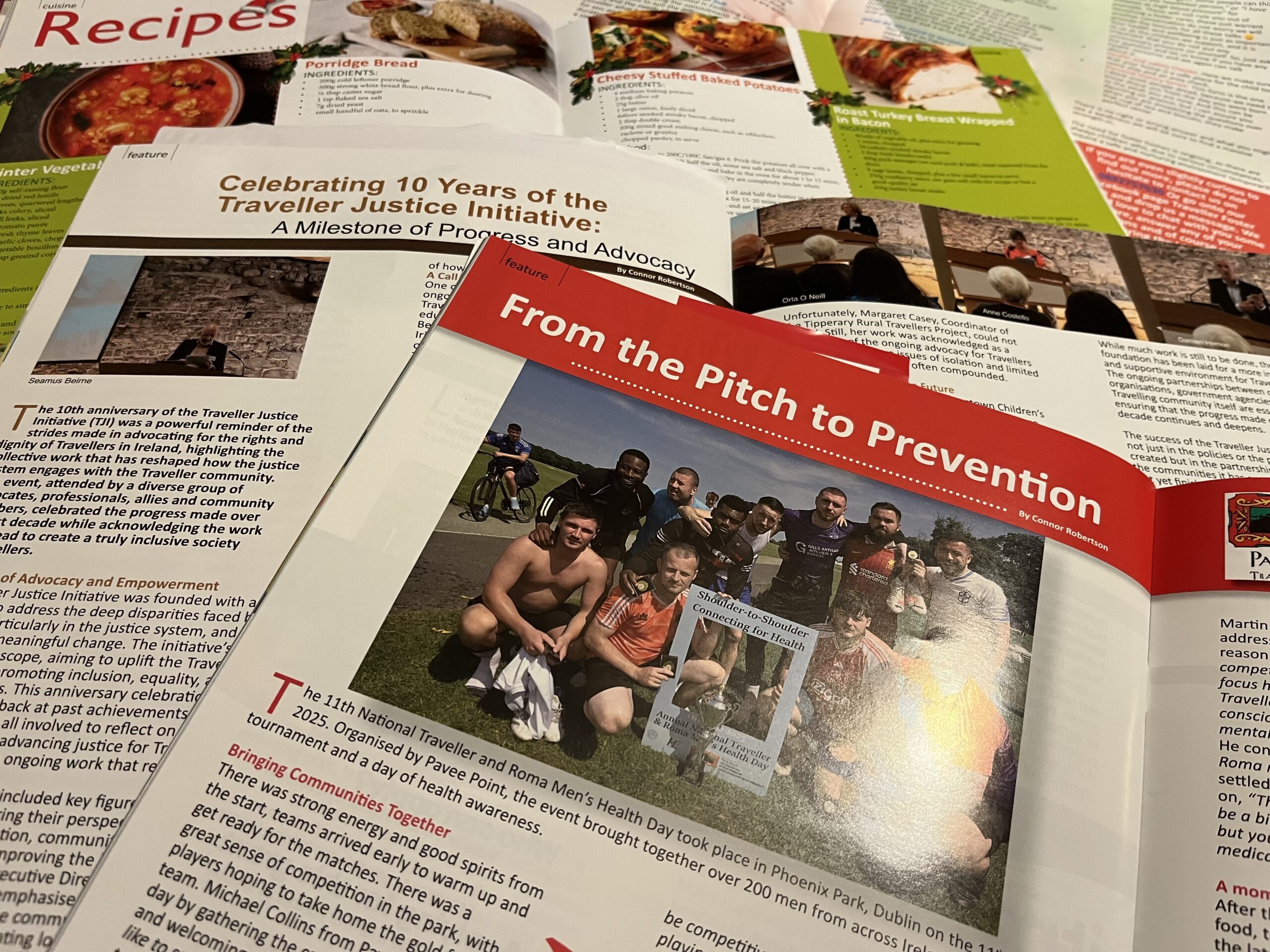
There are serious stories inside, but also a light side. For instance each issue contains recipes.
“We actually get great feedback on our recipes from people within the prison system. The magazine goes into all of the prisons in Ireland and in the UK because there is quite a high population of Travellers in the UK as well. We get correspondence from people currently in the prison system saying they tried a recipe; it’s very accessible to them.
“We want the contents of the magazine to be as accessible to members of the Traveller community as possible, we don’t use jargon, don’t use anything that would be out of reach to the average person,” he said.
Michael’s route through voluntary work to becoming editor
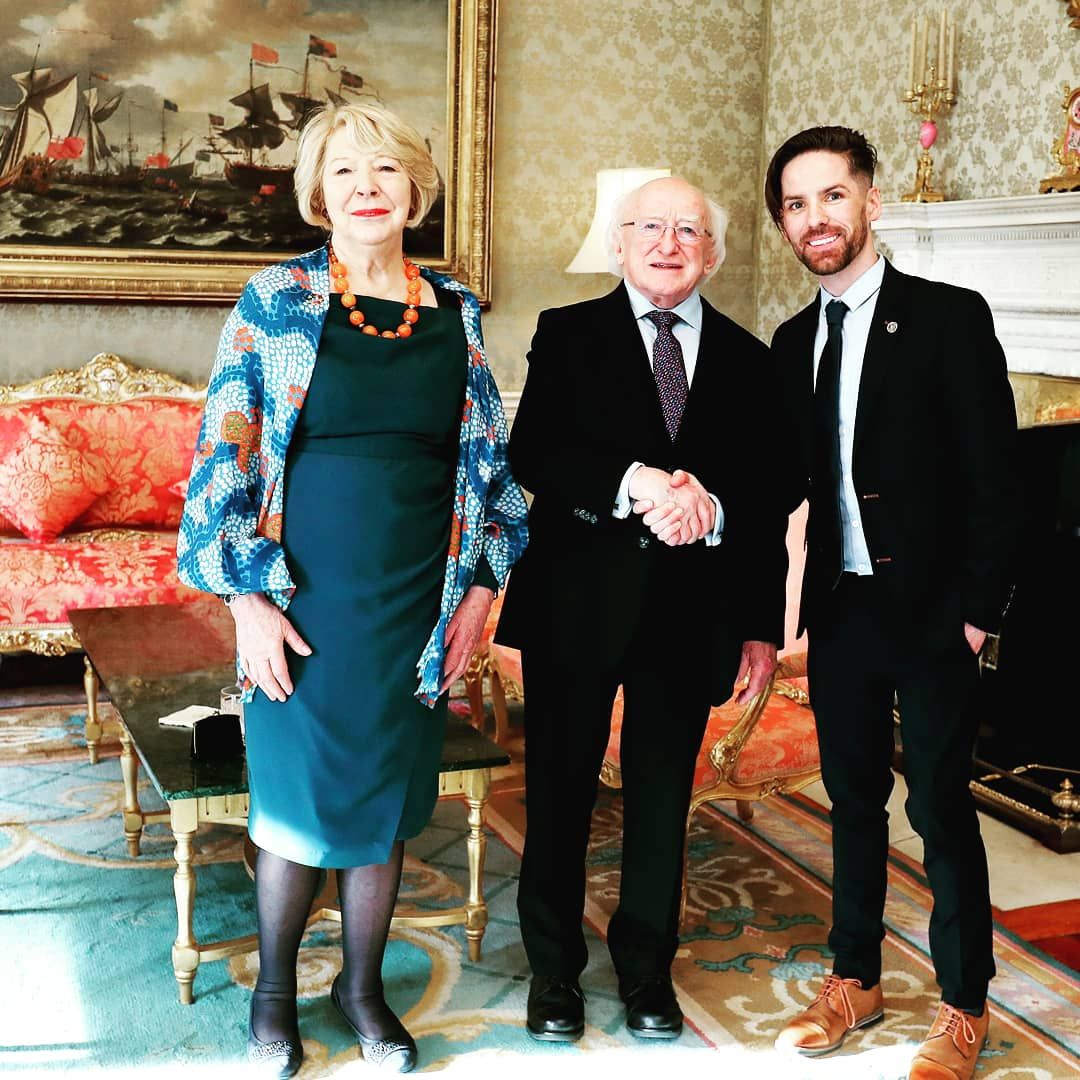
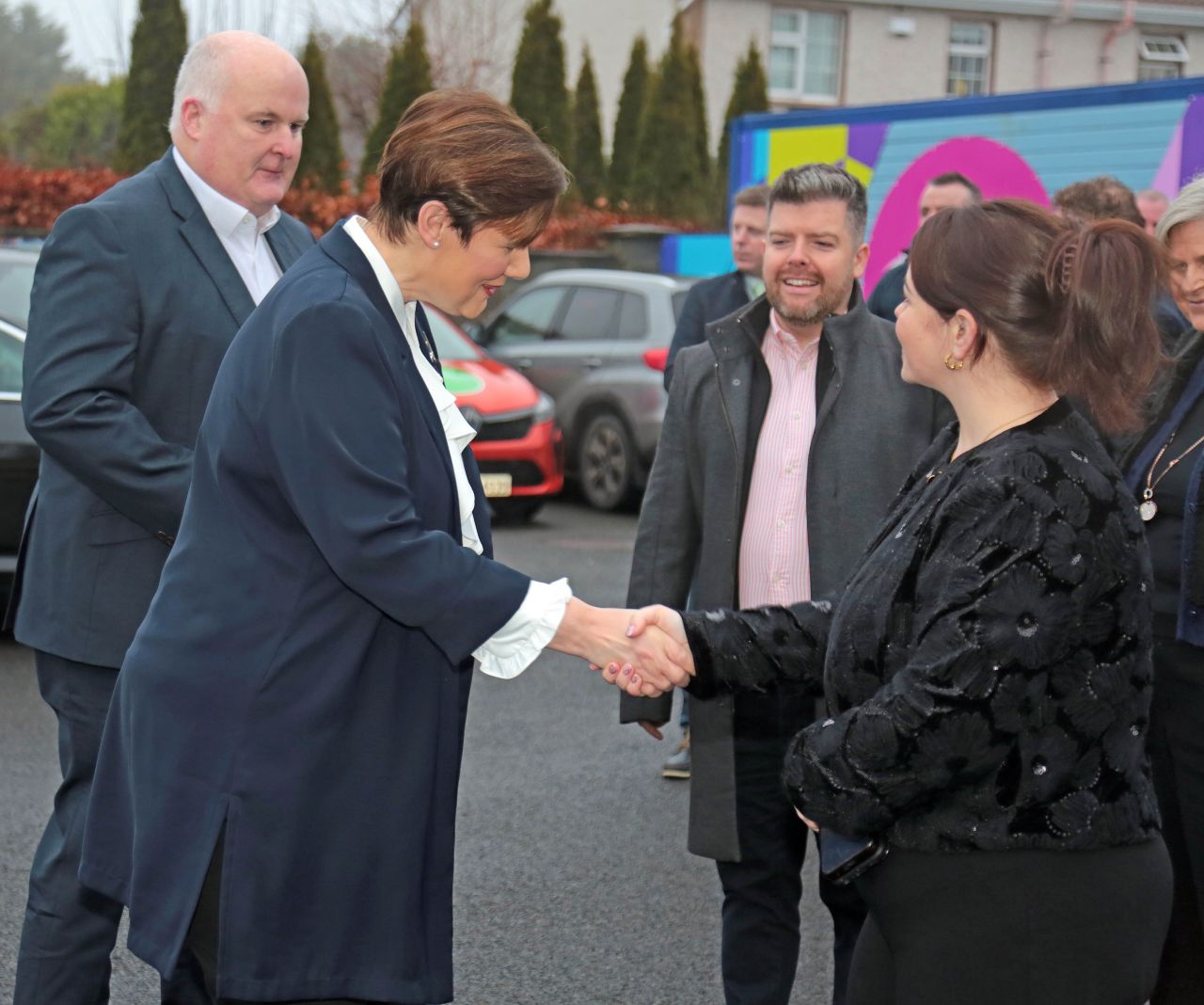
• Sabina Higgins and former President Michael D. Higgins greet Michael Power, editor of Travellers’ Voice magazine.
“I am with Travellers’ Voice for the past 19 years. I’m the editor and I’m also the CEO of the overall organisation Involve,” says Michael Power.
“The magazine is our national platform, but we also run youth services on the ground. We have seven youth locations. We run the STATUS toolkit – STATUS stands for Supporting Travellers Accessing Universal Services. We run a Traveller culture and identity programme and manage the Traveller Pride Week budget on an annual basis.”
Michael started off volunteering with Travellers’ Voice, and has kept moving on within the organisation.
“I’m a member of the Traveller community and I was out of work 18 years ago. I put myself forward for a voluntary position that came up with the magazine, it was sales or subscriptions at the time. This is prior to the magazine obtaining Community Services Programme funding administered through Pobal. I have been in it with different hats on since then.
“I started off in a volunteer role within sales, I then became a reporter, I was really interested in writing, and I started writing articles featuring members of the Traveller community. My approach to features and to the Traveller community has always been strengths based, as opposed to what we don’t have.
“Then in 2015 the role of the magazine manager/editor came up and I applied for that. I’ve been in that role since as well as taking on the broader role in the organisation,” he said.
Michael in a voluntary capacity also sits on the board of directors of this publication, bringing unique expertise to the role.
Michael in a voluntary capacity also sits on the board of directors of this publication, bringing unique expertise to the role.
Travellers’ Voice is supported by the Department of Rural and Community Development and the Gaeltacht and Pobal through the Community Services Programme.
It aimed to connect people who encounter barriers and discrimination with supportive employers. People who have served time in prison encounter more obstacles than most and the event was designed to encourage them – among others – and it showed people real pathways to employment.
Advice was provided by staff and volunteers from Bedford Row Family Project and Northside Family Resource Centre, and by officials from the Departments of Social Protection and the Department of Justice. Also central to the event was the voluntary campaigning, training and support group Spéire Nua.
It is likely that this event, when next held, will attract even more community groups and employers and people who struggle to find work for a variety of reasons.
View these video interviews on our YouTube channel and find out more about the event and the supports that are there that people can tap into today:
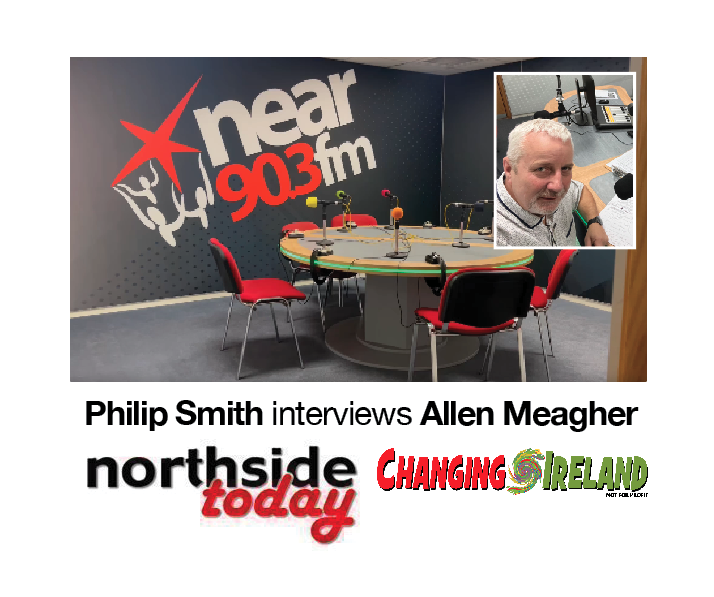
The interview, over 20 minutes, looked at the magazine’s history and its current edition and stories relevant to Dublin readers and to anyone interested in community development.
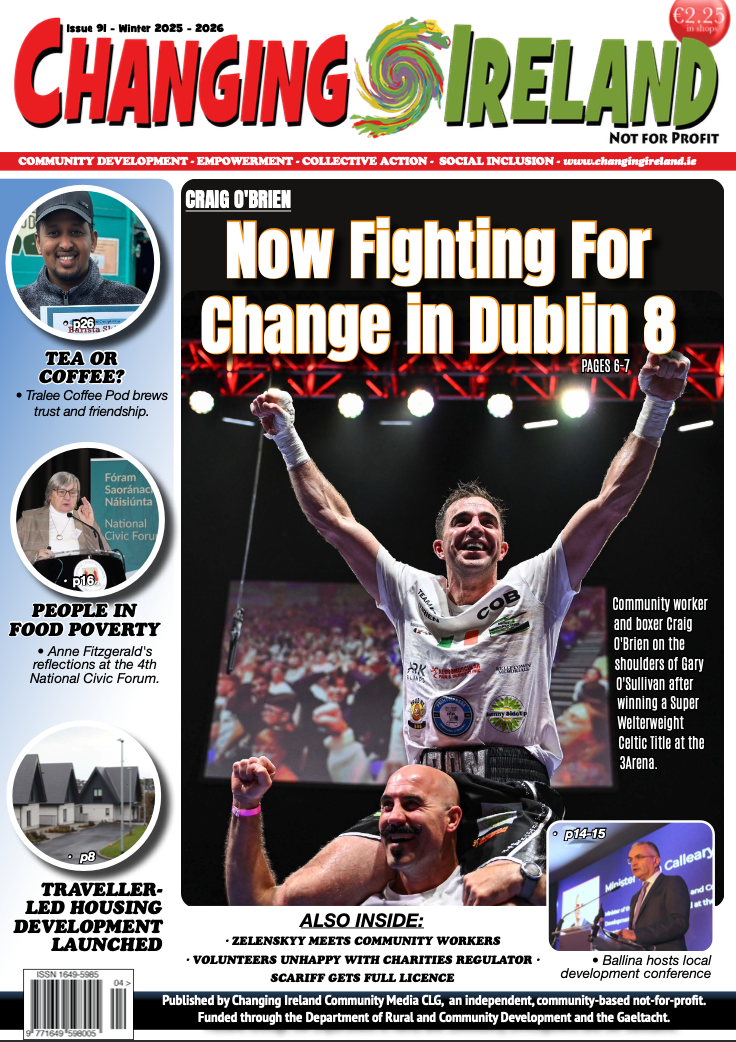
The Near FM discussion looked at the arguments made by youth worker and famous boxer, Craig O’Brien, who as part of his work with the Solas Project has launched a “Fighting For Change” programme targeted at young people in Dublin 8. The challenges are enormous, yet Craig and his team in the Solas project are reaching as many youths as they can.
Philip asked if people can write in with story ideas and suggestions. Allen said that was how many of our stories originate and he encouraged Philip and others to email (editor@changingireland.ie).
The radio show also looked some outstanding stories. For example, from Dublin we had a recent story describing the difficulties facing Tus participants who cannot open bank accounts, preventing them from taking up Tus placements, thereby losing out on potentially life-changing opportunities.
Philip urged people to read the magazine online or sign up to receive it by post. Again, email: editor@changingireland.ie or contact us via social media with your details.
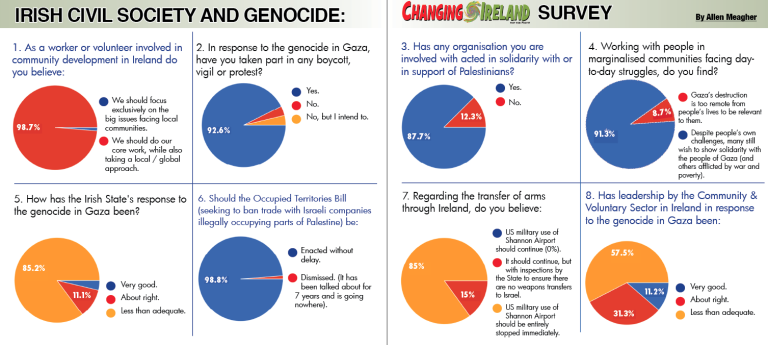
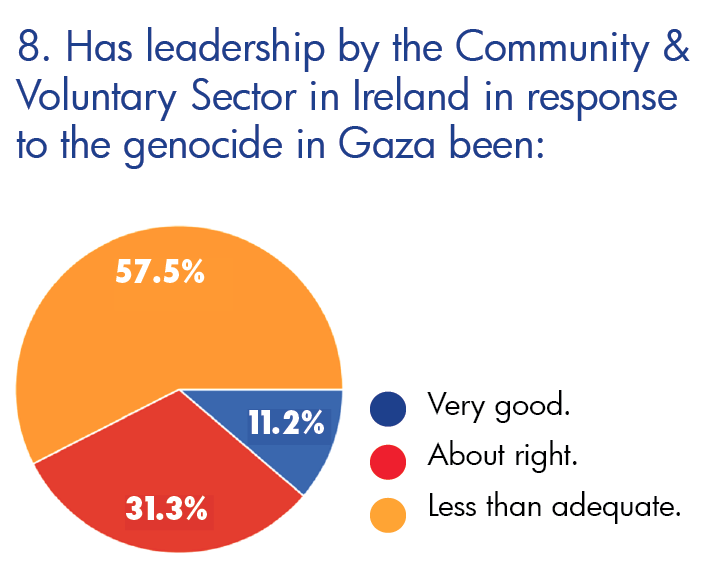
These survey findings were first published in Issue 90 of Changing Ireland. While the survey was conducted last September, prior to a “peace” agreement, the Israeli state’s genocide against Palestine and its people continues on in 2026 and the survey findings remain as important today as when conducted.
Margin of error +/- 11%. For details about how the survey was conducted scroll down.
The survey also produced tips and advice for people wishing to play an active role opposing genocide.
This question identified the strong belief among workers and volunteers in civil society that we should take local/global approach to community development work.
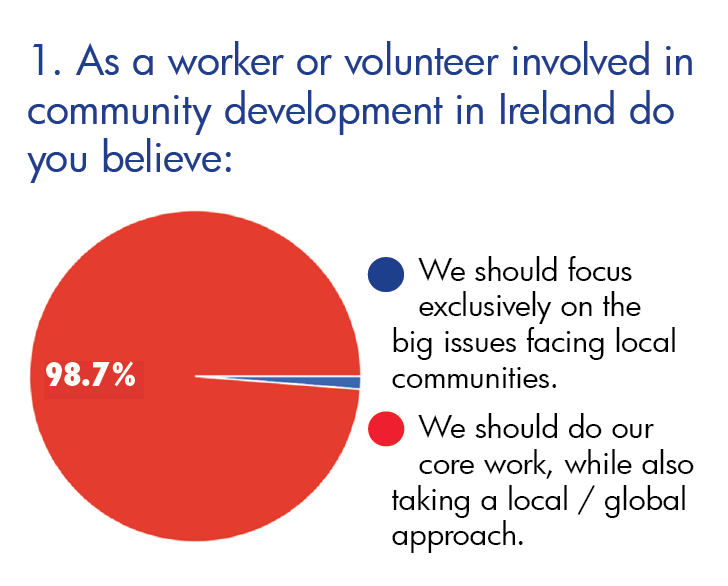
This finding shows how active many people are in opposing the genocide.
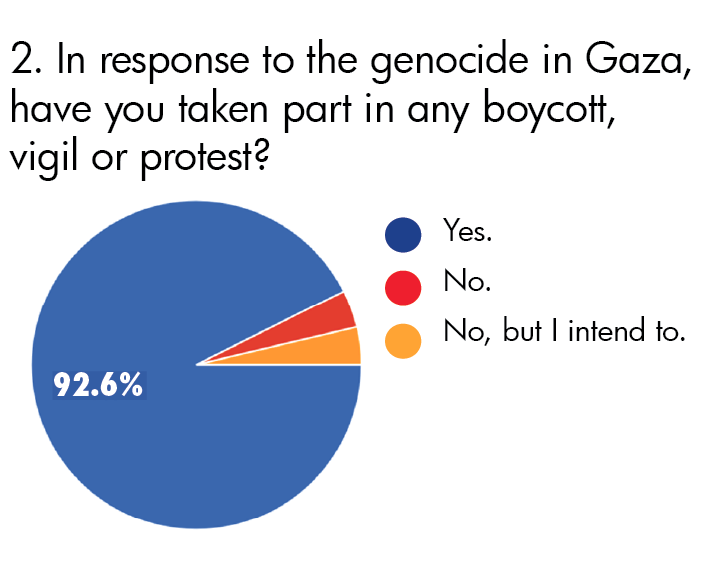
This finding shows how active many organisations are in opposing the genocide.
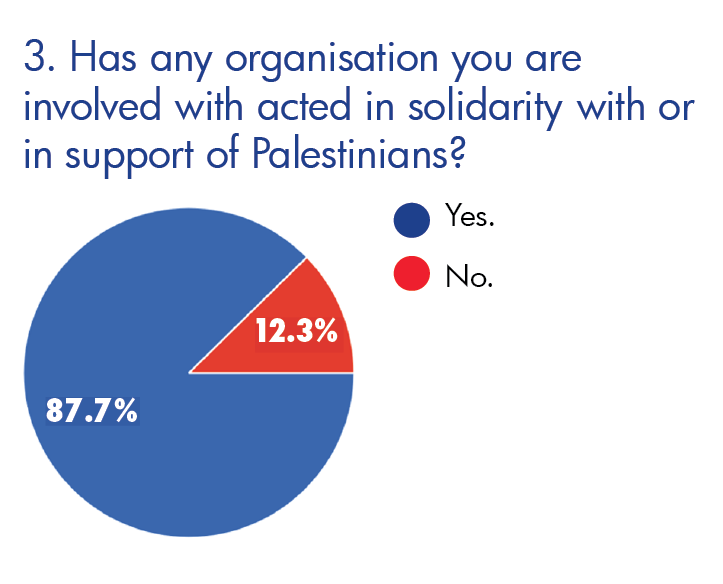
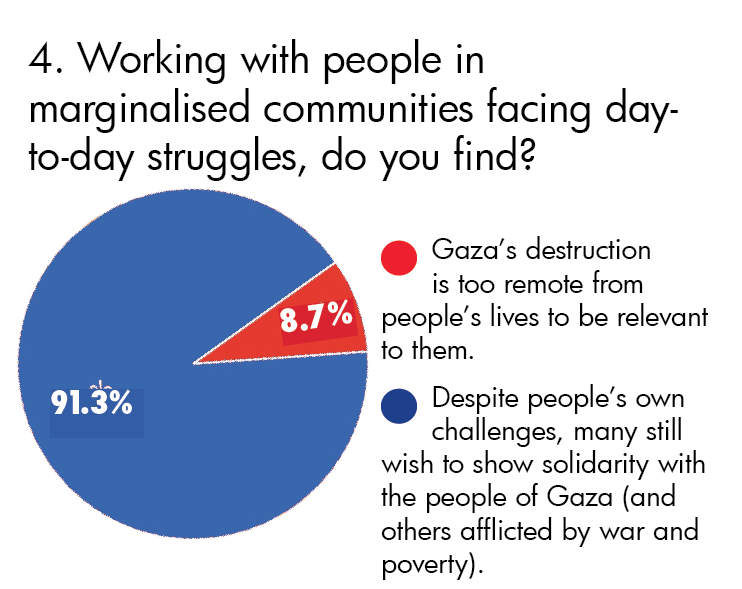
While many people have hour-to-hour and day-to-day concerns, there is room for sympathy and shows of solidarity for others in much worse predicaments.
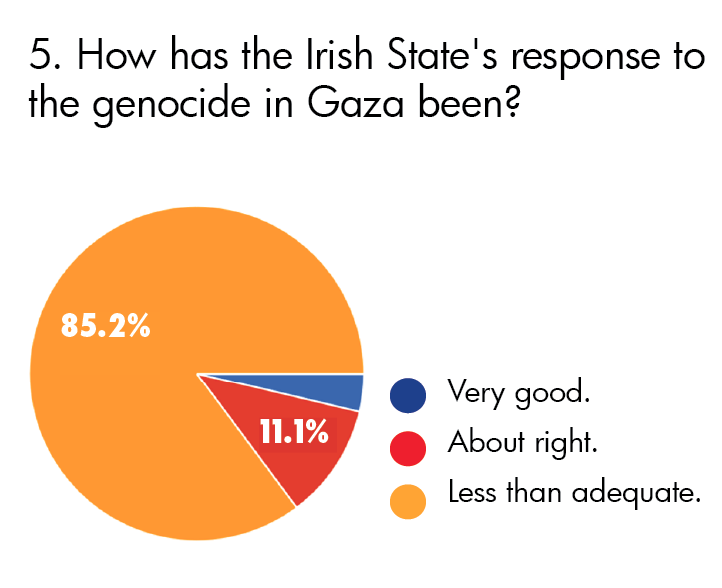
It is interesting that there is not full agreement among respondents in replying to the above question.
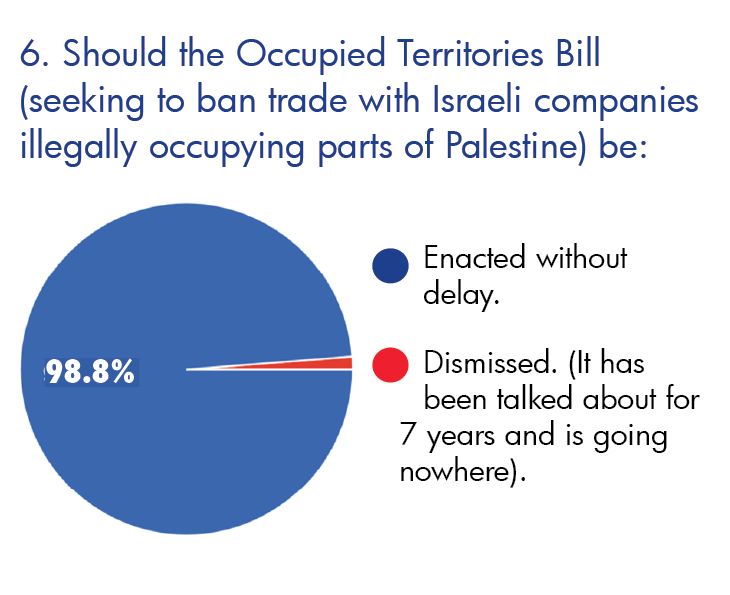
It is interesting that there is almost full agreement among respondents on the above question.
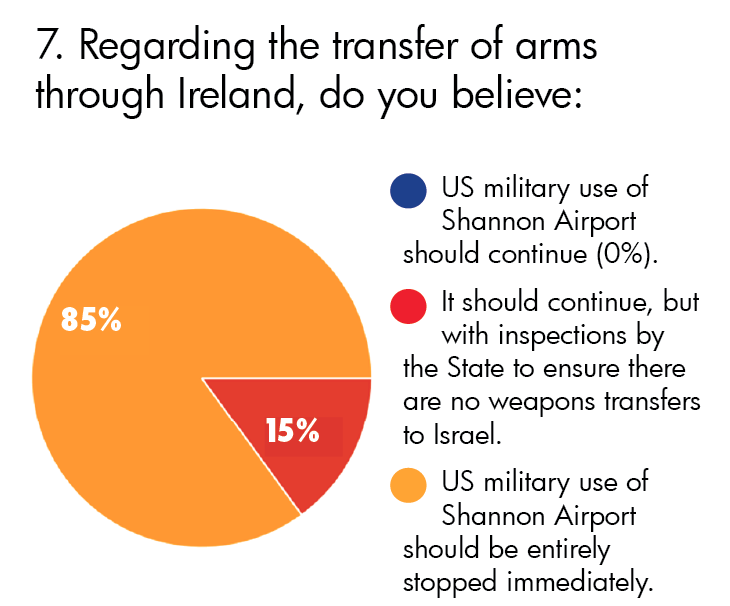
It is notable that no respondent felt that US military use of Shannon Airport should continue.
Irish civil society respondents were generally in agreement regarding 7 out of 8 questions. The above question was the only one to generate a rather mixed response.
About the survey
Sample size: 82 respondents. Target audience of Community and Voluntary sector workers and volunteers. Conducted online in September, 2025.
Given the sample size, the survey’s margin of error is approximately 11%. However, the findings are starkly in agreement on seven out of eight questions.
Respondents could provide their names in confidence or fill out the survey anonymously. Around a fifth of respondents provided their names. A test-question was included to counteract bots.
The survey findings match with the sentiments expressed by a random selection of six civil society interviewees in one-to-one interviews.
Wishing not to influence the responses, we used only two social media posts to promote knowledge of the survey.
Adrianne Murphy volunteers as a presenter on Ros FM, a community radio station in Roscommon Town. She said that, “Marches and gatherings to say we are anti-genocide and we want the war stopped are important.”
“People can get in touch with their councillors, their TDs, to say ‘not in my name’. We need to stand up and be counted. Every individual needs to do that,” she added.
Kelly Earley is a writer from Coolock, Dublin, and she called for civil society groups to take “a unified approach and a standard response”.
Patricia McGrath is a lecturer, co-ordinator and researchers attached to UCC’s centre for Adult Continuing Education. She said, “Just keep highlighting it and raising awareness. The only way to stop all this horror is to stop making arms, but I don’t think anyone in Ireland can do that. Just keep up the awareness and keep protesting.”
Damien Walshe, CEO of Independent Living Movement Ireland, said:
“Local community groups can encourage people to participate in actions (and to) put pressure on their politicians around the Occupied Territories Bill. Also, raising awareness about the Boycott, Divestment, Sanctions (BDS) campaign and staging local actions around supermarkets aimed at stopping produce from the Occupied Territories. We do have a historic track record, when the actions taken by the Dunnes Workers in the 1980s around the apartheid regime had a ripple effect. Economic pressure should be a key driver in bringing an end to the destruction in Gaza and longer-term peace and stability for Palestinians and for Israelis who oppose the genocide in Gaza.”
Maria O’Dwyer, based in Limerick, is the national coordinator of the Prevention and Early Intervention Network. She said local civil society groups can help “by boycotting certain products and services, the AirBnBs, the Coca Colas, don’t supply them in community cafes”.
“I’m really surprised how little flying of the Palestinian flag we see as an act of solidarity. You see it at the big events, but if you’re in communities and at meetings how often do you see it? Something as small as that is significant in terms of solidarity. Plus, it spurs people to ask questions, no more than the Pride flag, people may ask why it’s there, and you tell people,” she said.
Declan Costello is a development worker with Offaly Local Development Company. He said groups can help to “raise funds, raise awareness, try and influence public opinion. Encourage the State to keep taking the steps it has and maybe do a bit more.”
In conducting our wider online survey we asked the same question. Most respondents called for protests and/or boycotts, along with calls to increase local awareness about the international Boycott, Divestment, Sanctions (BDS) campaign and to continue to lobby the Irish government.
These are 15 representative comments from 55 responses on how local civil society groups can take action:
Show solidarity.
Pressure the Government to act, including to enact the Occupied Territories Bill.
Focus on practical supports also at local level, in particularly for Palestinians who find themselves seeking asylum in Ireland.
Lobby TDs and councillors.
Change only happens when those in power are forced to make changes. We should be using more disruptive techniques.
Boycott all things Israel linked.
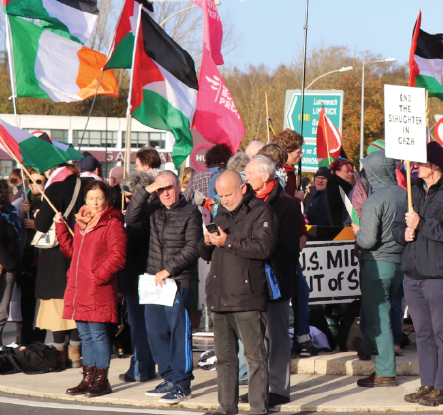
Weekly vigil highlighting the genocide in Gaza.
Organise the delivery of information to communities through leafleting, organising speakers, offering to visit schools.
More visible action, more spaces for conversation, more working to challenge and tackle far right voices which seek to demonise Palestinian people.
Help local people to understand the common ground they have with Palestinians. Inequality emerges in scarcity, functions in separation and results in powerlessness. Civil society groups support wellbeing which emerges in flow, functions in togetherness, and results in choice (based on teaching of Miki Kashtan, convergent facilitator).
Petitions. Vigils. Contacting politicians. Boycotting. Use social media to inform people about local ways to take action.
Make sure everyone understands the dangers of fascism and racism.
Lobby the Government for boycott measures and implement local boycott measures.
Hold events with Palestinian speakers, artists, activists, witnesses.
Reach out and support groups and co-operatives on the ground in the West Bank.
Is there anything else you wish to say on the genocide?
We also asked people at the end of the survey: Is there anything else you wish to say on this subject? These are 15 comments chosen to best represent the 42 responses we received.
List maybe 10 practical things that community development workers/communities can do, no matter how small. People need hope that they can make a difference in some small way.
What happens in Gaza is important for everyone everywhere, because the erosion of international law make everyone less safe. We are back to Might is Right. Gaza holds up a mirror to society and it’s an awful reflection.
The community and voluntary sector, apart from some notable exceptions, has been very weak in its response to the genocide. Why is this?
Leadership from trade unions and umbrella organizations has been less than adequate.
Community development does not stop locally – it needs to look beyond. Thinking it stops locally is a lazy perspective and contradicts any human rights speak you may utter.
I am curious as to whether organisations in the C&V sector in receipt of larger sums of government funding are more restricted in voicing their support.
Highlight all Israeli products so as people can stop using and buying them.
I am only involved in a small way. I cannot give more time to it as I work a lot. I feel torn in two trying to have enough of my own life to sustain myself and remain a competent help to others. But that’s how it is. And that is a first world privileged problem.
Symbolic gestures do matter.
Money talks. BOYCOTT!
Thanks for the opportunity to contribute.
As an FRC we have agreed to abide by the BDS campaign.
Some community leaders have been very strong, others completely silent. We can and should do more in the face of genocide.
This is a struggle for humanity. We can’t afford to be silent.
Civil society organisations need to stand up and add their voices. People hate “seeing it on the news”, but many have no channel for their distaste and so disengage. It’s a duty of civil society to call it out, along with the other systemic injustices like housing and health.
These responses, comments and suggestions were first published in Issue 90 of Changing Ireland. The one-to-one interviews were conducted by Owen Ryan and the survey by Allen Meagher.
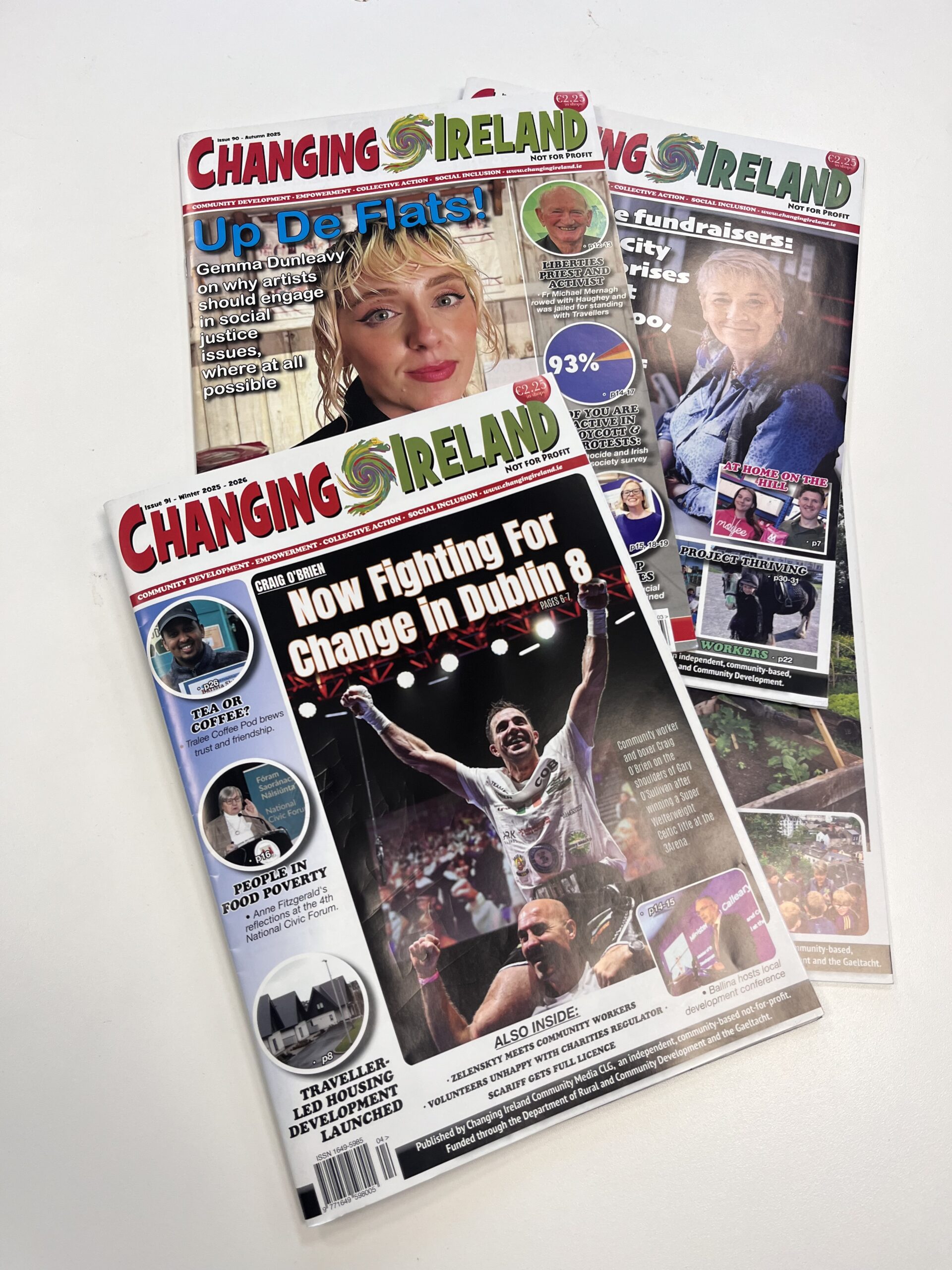
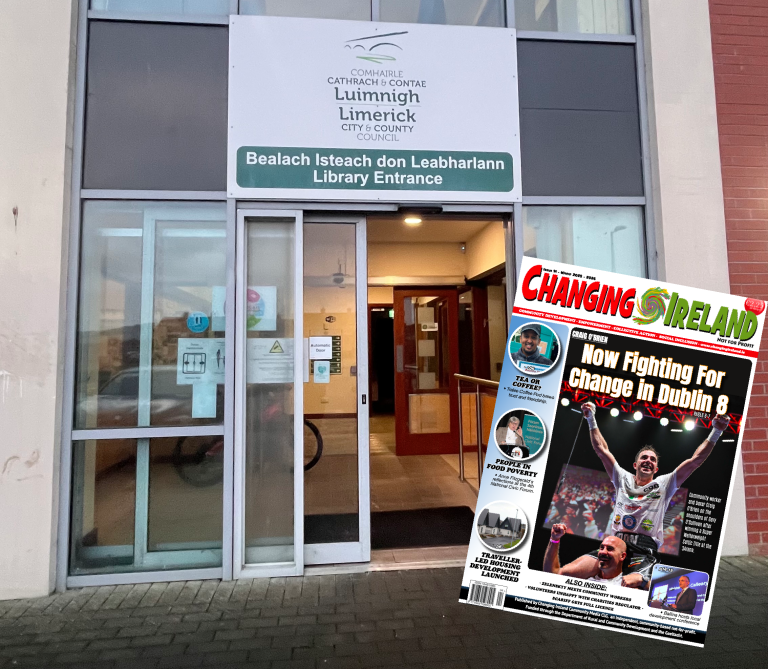
We dropped into our local library in Watch House Cross, Moyross, curious to see for ourselves where it was shelved. Imagine our delight to find the latest edition on show right at the front entrance for all to see!
As editor Allen Meagher notes:
“Every library also has a back catalogue going back over many years – great for students, researchers and aspiring community activists.
“Libraries today, of course, are fantastic community hubs. They have grown and expanded in ways we never imagined when we lived in fear of being fined for late returns. Nowadays, libraries are at the heart of community development, welcoming all and regularly hosting events.
“We are grateful to all the county librarians who help us to distribute Changing Ireland through their nationwide network,” he added.
You will also find Changing Ireland in community centres, family resource centres, local development companies, prison education units, enterprise centres and in the Dáil and Seanad – among other places.
However, it is about more than funding: as one successful group remarked – “It’s about hope, inclusion, and a stronger future for our town.”
The announcement – by the Minister for Children, Disability and Equality, Norma Foley – brings to 136 the number of Family Resource Centres (FRCs) across the country. The ten new groups chosen for admission come from counties Mayo, Donegal, Leitrim, Kerry, Tipperary, Limerick, Wexford, Louth, Longford and Dublin.
Among them is a “delighted” Erris Family and Community Support Centre (FCSC) whose campaign we covered over a number of years.
Chairperson Rosaleen Lally said, “After years of hard work and advocacy, I am thrilled that (we have) finally been granted official FRC status. Having the security of a permanent FRC means long-term support and services right here where we live.”
Erris FCSC co-ordinator Leanne Barrett said the recognition “represents a new chapter” and provides “renewed hope for families and individuals across the region”.
“At the heart of Erris FCSC’s work are community development values and principles – collective action, community empowerment, social justice, sustainable development, human rights, and participation – values which lie at the core of both the national programme and of Erris FCSC’s own mission locally,” she added.
Minister for Rural and Community Development and the Gaeltacht, Dara Calleary – based in Ballina – said: “I have consistently made the case to Minister Norma Foley, and previous Ministers, about the reach and depth of the work in Erris and the need for an upgrade to full Family Resource Centre status. For many years I have met with Leanne Barrett and her team who have campaigned for this. Today is a special day for them.”
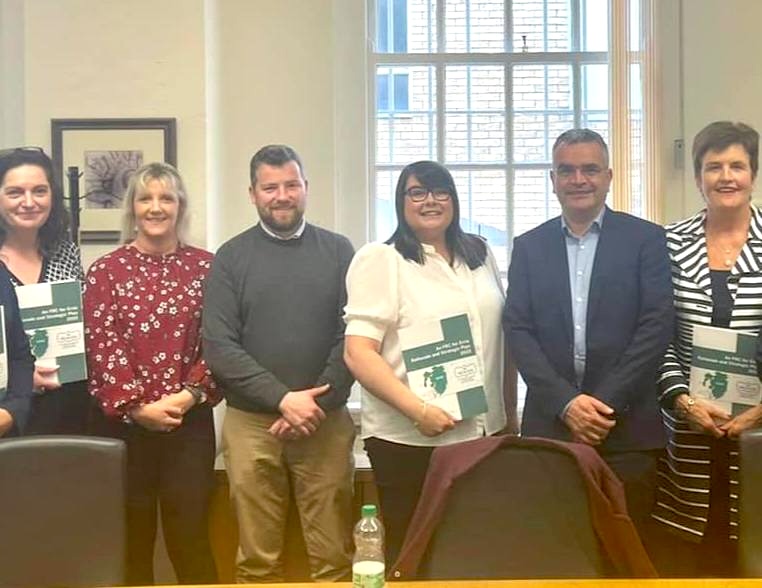
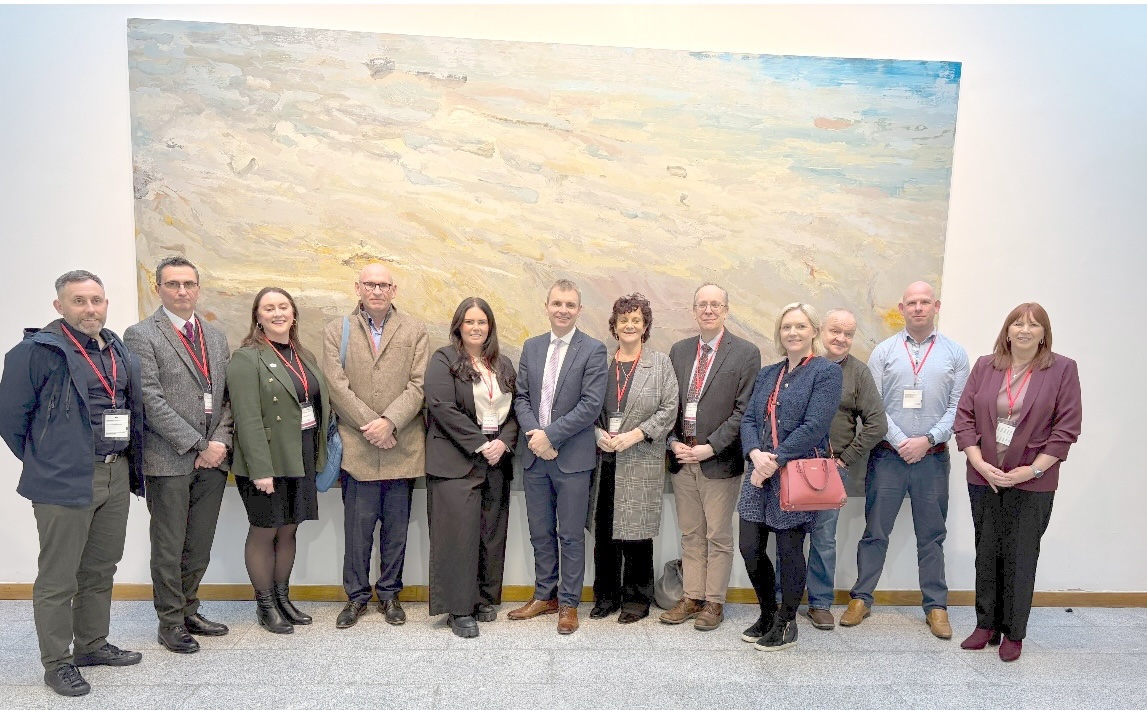
• Erris FRC campaigners – seen here with Minister Dara Calleary – were delighted, albeit after years more campaigning than they had envisaged.
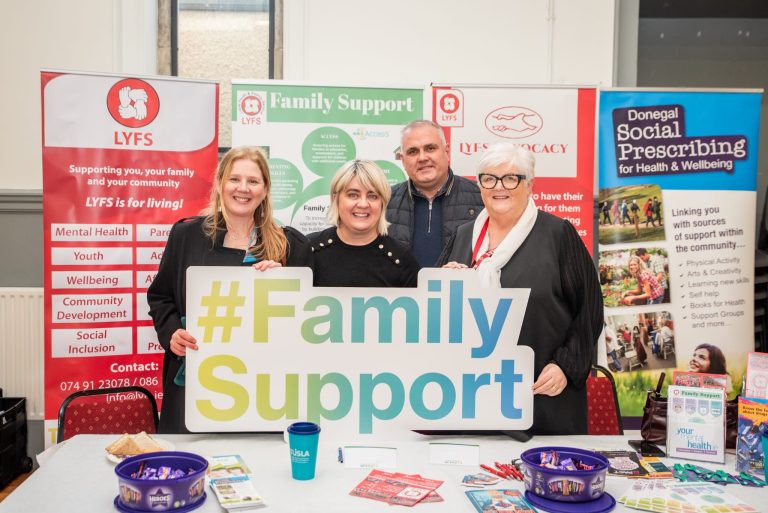
Local Youth and Family Service CLG in Co. Donegal was among the ten. They responded to the news saying, “We are so delighted to be apart of the Family Resource Centre Programme to offer much needed supports across the Northwest/ Gaeltacht.”
In Roscrea, Co. Tipperary, there was also relief and joy after North Tipperary Development Company worked with the local community to make the successful application. They carried out a comprehensive needs analysis and highlighted key metrics on deprivation, employment, the number of non-Irish residents, and education levels in the town.
Longford County Council warmly welcomed the announcement by Minister Foley confirming funding for a Family Resource Centre in Longford town.
“This is a milestone our community has been working toward for many years, with Longford facing some of the highest levels of need in the country. This centre will provide vital, judgment‑free support for children, young people, families, older people, people with disabilities, Travellers, refugees, and asylum seekers,” it said in a statement.
“Based at The Attic House and supported by a dedicated voluntary steering committee and Foróige, the new FRC will offer a welcoming space where everyone belongs,” it added.
Longford-based Senator Joe Flaherty said it was “excellent news” and he was pleased that Minister Foley had visited the town and seen for herself the challenges.
• Senator Joe Flaherty introduces Minister Norma Foley to Longford campaigners for a FRC for the town. Photo source – Longford County Council. Photographer: Shelley Corcoran.
Announcing the 10 new FRCs, Minister Foley said, “I have seen first-hand the incredible work that Family Resource Centres do every single day. They are of the community and for the community and by the community and they represent our ongoing investment in children, families, and communities across Ireland.”
Taoiseach Micheál Martin said the FRC programme is about “strengthening communities at their core – through grassroots action, partnership, and compassion.”
The announcement builds on the 2025 announcement of five new FRCs and follows up on a commitment in the Programme for Government to expand the capacity and network of Family Resource Centres over the lifetime of the Government.
An open call was made to all interested parties, and subsequent submissions were evaluated in a process independently chaired by a representative of the University of Limerick. All the unsuccessful applicants were informed that their application would remain under active consideration should additional funding be secured for further expansion.
In Budget 2026, the minimum funding level for all Family Resource Centres was increased from to €160,000 to €180,000 for 2026.
The 10 new Family Resource Centres are as follows:
– Laois, Offaly and Monaghan groups embrace wellbeing through singing, accessible counselling and volunteering
Connecting people in Timahoe, Co. Laois
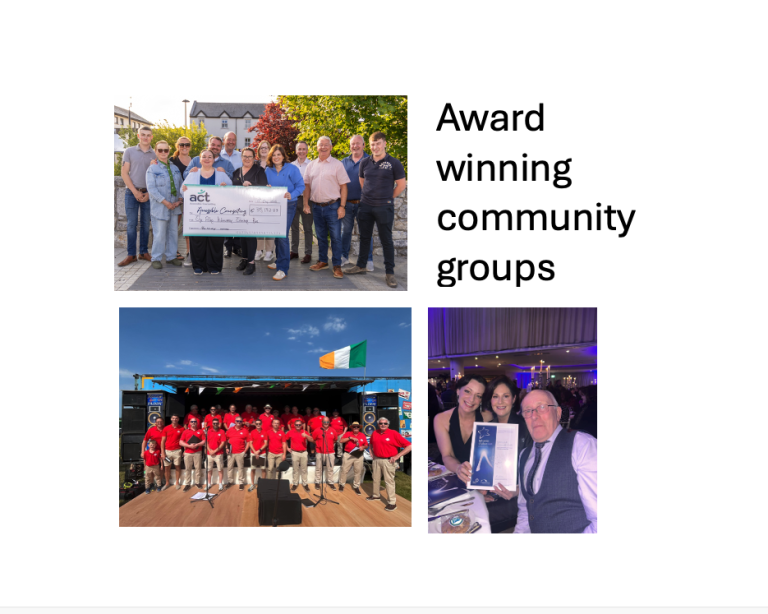
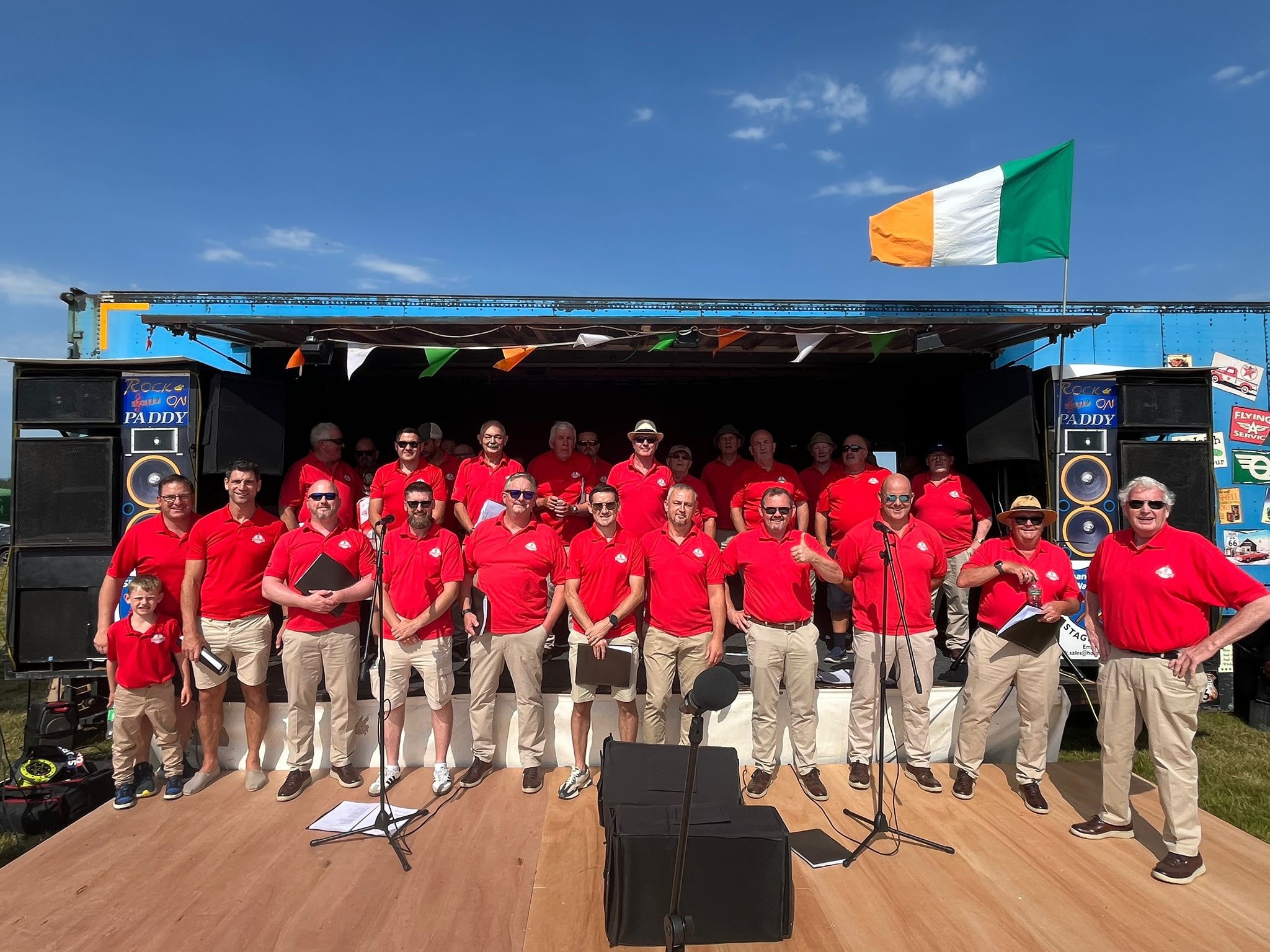
Timahoe Male Choir in Co. Laois was the winner of the Community Wellbeing Initiative: Focused award.
“Initially it was an idea to raise a few pounds for the local national school. A few of us might meet in a pub on a Sunday evening and sing a few songs and have a bit of craic. I had an idea of getting these guys singing in the church. It went from there then, there was a carol service with 20 people and the group has grown up to about 70 people. They’re generally all from Timahoe.”
The group meet every Monday night, coming together in the village’s two pubs.
It has become an important means of connection for many of the members, Damien feels. “We have people from all backgrounds. There are people from 25 up to 80 years of age in the group. There are people who are retired, who are widowed, who are on their own, there are lots of different stories. The benefits for them are far reaching, with loneliness and all of that it is very good for them to connect. There are people there who may have moved to the area and wouldn’t have known anyone. They have now established a circle of friends.”
He feels it has been a great boost to Timahoe.
“What it has done in the community from a vibrancy perspective and people getting to know each other and instilling that sense of belonging in a rural area, has been enormous. It has really connected people.”
While the members are the primary beneficiaries, he says it goes deeper and wider than that. “During the judging one man said that there are 70 of us in the choir, but it’s not only the 70 of us, they have wives and partners and brothers and sisters and children. The thing really covers the whole community.”
They travelled to New York for the St Patrick’s Day parade last year, while they were on the main stage at Electric Picnic a few months ago.
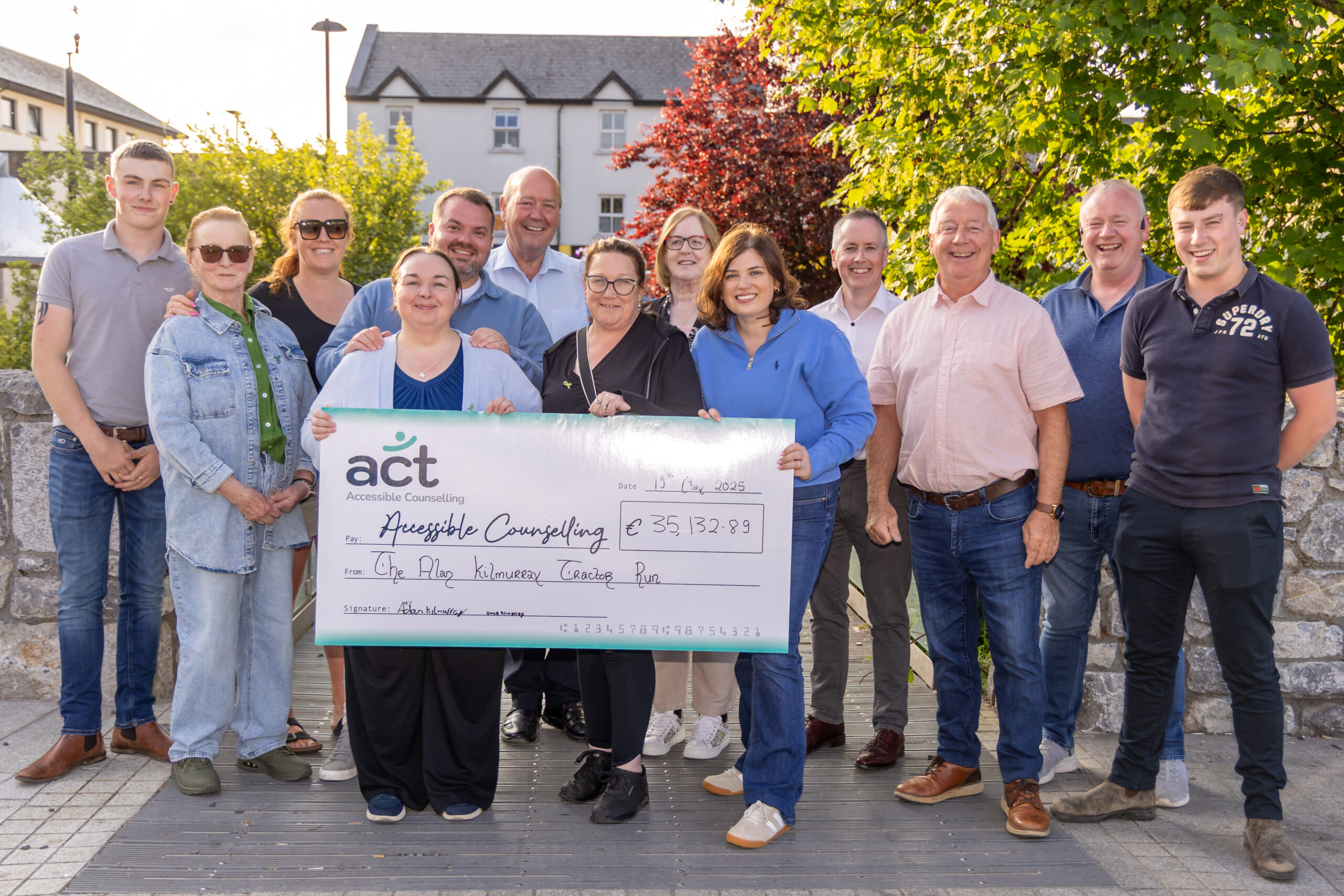
Accessible Counselling Tullamore took a Special Award, which meant a lot to Lisa O’Connor, who helped to found it with her late husband James.
She said that James had become involved with promoting positive mental health some time back. “He would have suffered with his mental health when he was younger, he had a still born baby when he was 19 and not too long afterwards he had a bit of a breakdown and made a very serious attempt on his life. Not a lot of people would have known that. Then about ten years ago two young lads that worked with us at the time died by suicide in quick succession. He decided to share his story and after that he became an ambassador for Sea Change and he got really involved with the Green Ribbon campaign.”
As a result he was invited to become involved with a struggling community counselling centre, serving Tullamore.
“They were actually on their last legs, and he said to me ‘people aren’t going to have anywhere to go, this place is going to close down’, and it did close down afterwards. He asked me would we open somewhere, and that’s sort of how it came about. We were lucky that we owned a fit out company, we were able to fit out the unit that we’re in now, and design it. It’s purpose built, there are seven counselling rooms,” says Lisa.
It has been very impactful in the community since then, having seen more than 3,000 clients, and provided more than 17,000 counselling sessions.
While James became ill and died in 2023, Lisa says his legacy goes on:
“We did a lot of work with the Green Ribbon campaign, we did Turn Tullamore Green and we’ve changed it now to Turn Offaly Green. I think it really has made a massive difference in the community. I just feel people are a bit more open to talking, a bit more open to counselling. Everybody knows about the Green Ribbon and by association they know of ACT. James would have been very well known, everyone would associate ACT with him and the fact that he was able to speak out about his mental health made a big difference,” she said.
600 people a week using Doohamlet Community Centre, Co. Monaghan
Doohamlet Community Centre, near Ballybay, Co. Monaghan, was the winner of a Community Wellbeing Initiative award.
Manger of the Centre Gwen Murphy said that during the judging process, all of the organisations that use the centre helped to showcase its vibrancy.
“We have 27 groups who use our centre and what they did was come in on August 6 and told our story in real time. Basically we have two meeting rooms and a main hall. They came into the first room and they met Doohamlet Bluebells, then I took them to the main hall, there was badminton or bowls on and they spoke to some of the players. In the next room there was someone from AA who’d talk about what they offer. Every time the judges would leave a room the group would clear out, a new one would come in with signage and they’d show the judges what they do and talk to them. They got to meet the 27 groups, it was full on. There were over 200 people here on the day,” he said.
The hall is booked up every weekday evening, with more than 600 people using the facility each week.
Gwen says that having staff supported by a major voluntary effort is a recipe for success.
“We have a lot of volunteers, but we do have somebody there to open the door every single day. We’re able to apply for a lot of funding and to do the work. We have myself, I’m employed through the Community Service Programme, we have a support worker doing 18.5 hours through CSP. We have 20 hours under aJob Initiative and we have a Tus worker doing 19.5 hours, she’s our cleaner. We have a strong committee and a strong board,” he added.
The term has come into vogue in the last four to five years, but like “regenerative agriculture” it doesn’t exactly roll off the tongue. I cannot pronounce “regenerative” without pausing everything. It has six consonants and just too many “e”s. Maybe, being urban-based, I’m too used to talk of “regen” and “regeneration” which is another thing entirely.
Both bio-regioning and regenerative agriculture sound like words made up by an ecologist having a bad day who chewed on a dictionary, choked, and spat out a few random splats of paper.
However, after a recent chat by phone with one Sarah Prosser from Dunhill Ecopark, Co. Waterford, I grew to at least like the concepts. And I now understand both.
Let’s get “regenerative agriculture” out of the way first. It is basically anything farming related that is about giving back, adding to nature, rather than extracting.
I might have understood bio-regioning quickly too if we had begun by looking at maps. We went the long way around.
I thought it best to be frank with Scottish-born Sarah who is the CEO of Bioregioning South East Ireland, the first group of its kind on this island.
I said: “When I hear of “bio” I think of yogurt and sci-fi movies starring Arnold Schwarzenegger. And “regioning” isn’t a word. It’s a noun mangled into being a verb.”
Well, “bio” in this instance means life and nature, she explained. Fair enough. So what is bio-regioning, you might wonder?
“Bioregioning is defined as a holistic, place-based approach to living sustainably within natural boundaries,” said Sarah effortlessly. I liked it. Not too wordy.
However, being a fervent believer, Sarah later sent me a full definition that should really only be used by operators of torture chambers. Here’s a flavour of it: “The unifying thread (of bio-regioning) is a commitment to relocalizing knowledge, governance, and economies based on the unique characteristics of each bioregion.”
You have to forgive Sarah and others for their enthusiasm. They are promoting a new way of seeing the landscape and seascape – that runs contra to consumerism, extractive capitalism and the financialisation of everything on earth.
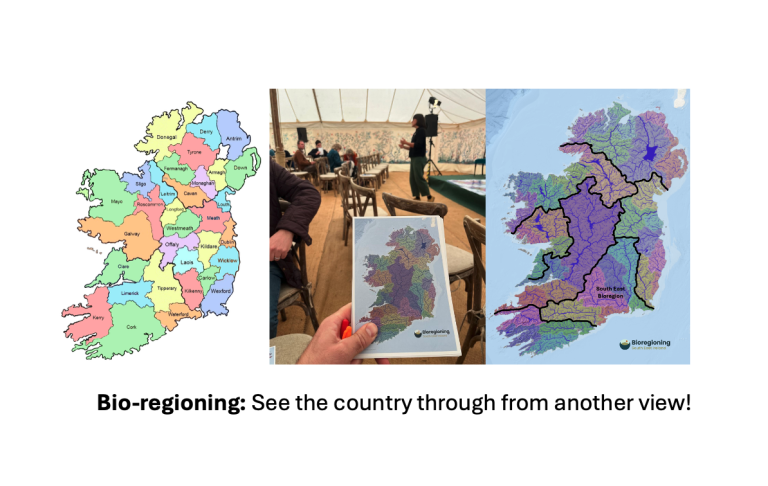
Really, it was only when Sarah pointed to two maps of Ireland – one a county map, the other a map not just of Ireland’s rivers, but of their tributaries and catchment areas, that the penny dropped. Ah, life-regioning.
We’re obsessed with counties in this country, she said.
“Counties are great, they are super for making connections, but you should not rely solely on counties for your view,” she said.
Rivers – at the heart of many bio-regions – often serve, ironically, as county borders.
Broadening its reach, Bioregioning South East Ireland, with philanthropic funding, is seeking to connect with and stir interest in other bio-regions across the island.
And for the record, bio-regioning was first named as a concept in the 1970s by a US ecologist called Peter Burg. It is timely for it to make a comeback. With pollution rising, especially in eastern and south-eastern bio-regions, we need to see ourselves as part of an ecosystem and as part of the solution.
So, next time you see a map of Ireland, ask yourself: Is that the actual landscape I live in or something else entirely?
“I spent since 2011 studying community development, and I couldn’t get a break for over a decade. Galway Rural Development Group were able to see me for the man that I am today, and the skills that I bring, and they invited me into the team,” he said.
“I started on the Social Enterprise Regeneration Project first, which was providing training to social enterprises in Galway, Mayo and Roscommon and I actually started my own social enterprise the same week,” he said.
That social enterprise, Spéire Nua, helps people in the situation he once was in himself, by seeking to help former prisoners to reintegrate into society and work.
At Galway Rural Development he progressed to a role on the SICAP team, working in community education and disability support. “I went for the job, and I got that, and I am a very, very proud member of a team.”
He said that management and colleagues there have had a huge impact upon him and he thanked them all. For a man who worked very hard to get the chance the experience has been transformative.
“It has been an absolute life-changing experience to grow professionally in an area in community development, which I'm very, very proud to be a part of,” he said.
Brooklodge Day Service is located quite near his home, but he didn’t know what was happening there until he came into contact with it through his work.
“I always thought it was the priest's house, but it was actually a disability day service that I never knew about! One of the first things that we did was look at ways in which to empower the individuals and for them to generate a bit of trade income for themselves, and that type of thing.
“We successfully supported them to set up their own coffee shop, the Friday coffee shop, and when they got it all set up, one of the first things they did was to cater for a wedding of 110 people.”
He was also involved in helping to set up something similar in Athenry.
“If you’re ever in Athenry and you fancy spending a few quid socially, pop into the Green Bean Cafe, in Athenry Primary Care Centre and meet the lovely staff. It's one of our favourite projects,” he urged the audience.
He also spoke about social farming and the benefits of that as a programme, while he said a project that involves drumming is one of his favourites.
“Everybody connects to the beat. For any ability, any age, there's nothing stopping you from getting involved in drumming, and it's great to be a part of it. And when you feel the energy, and you see the smiles, you know, it's a really, really nice way to spend an hour or two.”
He said that running a summer camp for children with additional needs, where he observed the joy in the faces of the participants and their families, showed him the importance of the work.
As a child, Damien and his siblings were at times left alone, and he said people from the Travelling community played a major role in helping them, doing more for them than the statutory services.
He said he enjoys working with the community now through his job, for example being involved in the production of a mini-documentary about Traveller culture entitled ‘Life on the Road’.
“We did it in collaboration with the HSE and it actually premiered up in the Dublin International Film Festival. We were really, really proud to play a little part in celebrating life on the road and Traveller culture.”
His work on helping the rehabilitation of people with criminal pasts is continuing.
He spoke about an event called Generation Change where “the whole idea is inviting employers into the room with people with criminal histories. There will be national employers there, and we'll be pulling on all those levers.”
He encouraged community workers who might know somebody who would benefit from interaction with Spéire Nua to contact him: “Let me know and I'll work with you on that.”
He said that his job has challenged him and he said he wanted to challenge his colleagues in the audience.
“My role with Galway Rural Development certainly empowered me and I spend my time empowering them as well. Reciprocity is a massive word; a bit of give and take. They've supported me to do what I want to do. They've employed me, but they're not just employers, they're friends and they're people that challenge me to be the best version of myself every day and I challenge them to be the best version every day as well.
“But I want to challenge you as well. I heard a lot of talk about funding and the need for funding; we go around every day and we empower people, we empower social enterprises, we empower local community groups, but I challenge you to think about how you can empower yourself. How you can identify opportunities to have your local development company grow and to ensure that you're not scrounging for funding when the time comes,” he concluded.
“We’re based in Dublin 8, on the south side of the city,” he says of Solas, an organisation that began in 1998 with a single volunteer giving an afterschool service for local children.
Around its catchment area the aftershocks of the heroin epidemic of the 90s are still felt and Solas is helping with the fallout a generation later.
“I’m in the TRY team, that stands for Targeted Response with Youths. We first started in 2017. There was a lot of addiction. Heroin had been a massive issue. People had kids in that time, and a lot of young people had been just left to roam the streets, causing havoc and anti-social behaviour,” he said.
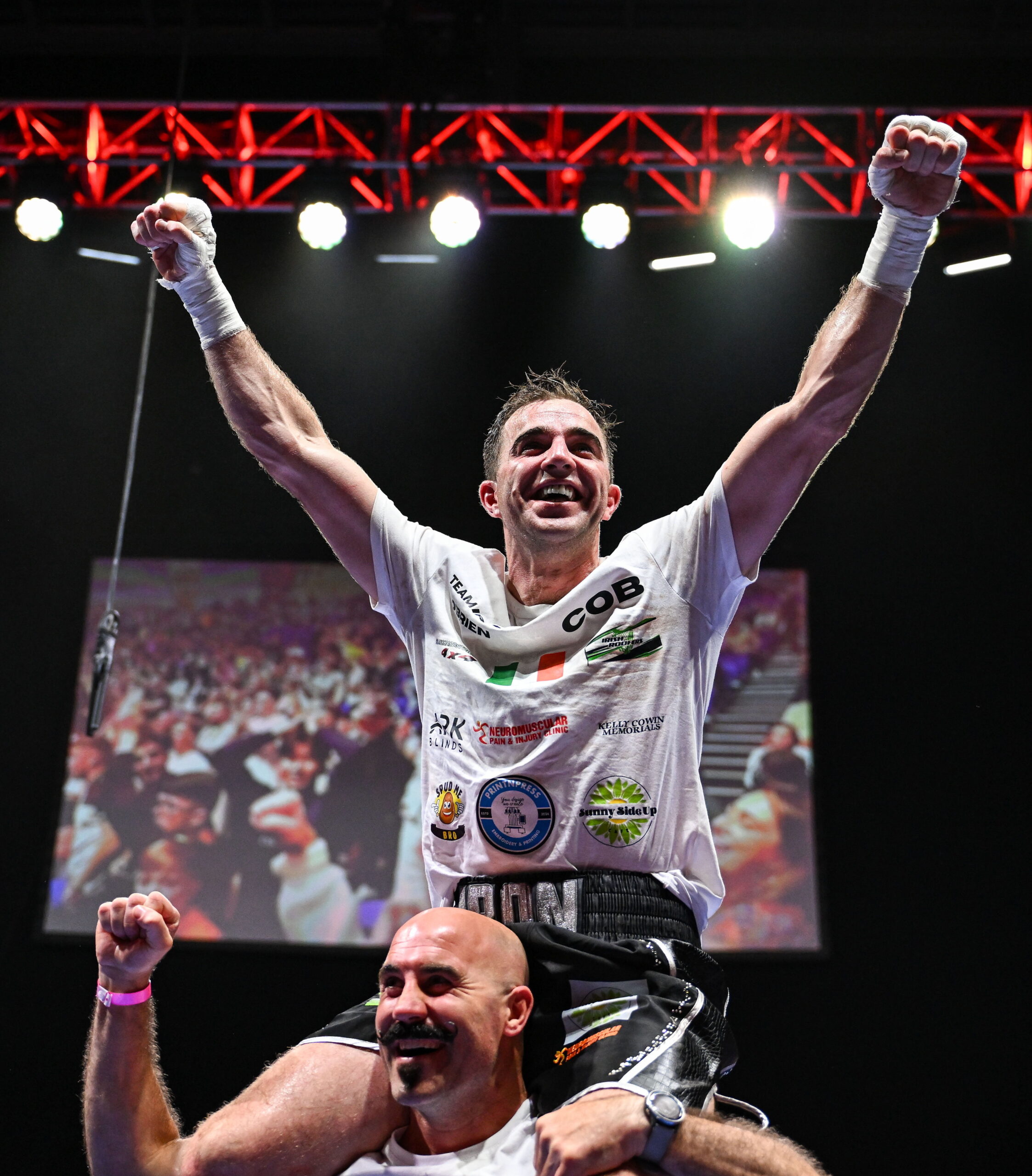
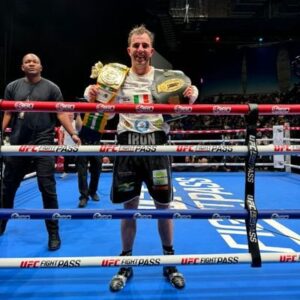
• Craig O’Brien celebrates on the shoulders of Gary O’Sullivan after winning his Super Welterweight Celtic Title bout against Edward Donavan during a Boxing from Dublin event at the 3Arena in Dublin on September 20, 2024. Photo by David Fitzgerald/Sportsfile.
Putting 18-26 year olds on a different path
Eight years ago the response was far less well-resourced than it is today.
“The TRY team started with one worker for eight hours a week and it just grew from that. At the moment there are four full time workers. In 2022 we merged with the Solas Project, under the Justice Department, because the funding was coming from there, and we became one big team.”
While Solas works with children who would still be in national school, its TRY team is for those aged around 18 to 26, many of whom are involved in low level crime, and the aim is to put those young people on a different path.
“A lot of them would be involved in the drug scene and what we do is go out there and build relationships where they’re at. It might be in the flat complex, we go in have a chat, build a relationship. There might be open dealing going on while we’re there, but because they’re not referred and they don’t just show up at our door, that’s where we build the relationships. That’s where the work gets done.”
Small things can be important to young people
When they do start to build a connection with the young people, Craig and his colleagues often help them to do small things in life that are important to them.
“Off the back of that, when we build the relationship they might want a piece of work done, that could be a CV, it could be a theory test, it could be job applications, it could be making a doctor’s appointment. They could be in court and they get involved in programmes, we give them a letter to say they’re attending. It’s right across the board.”
Programmes are run that reflect the young people’s interests, and hopefully give them an outlet away from the pitfalls that are all around them on the streets outside their homes.
Fighting for Change programme
One programme that Craig runs reflects his own passion, boxing, which played a huge role in his journey away from addiction and towards education and work.
“I run the Fighting for Change programme, which runs for six to eight weeks each year. Each week there’s a boxing session and you’ll bring in a person who has faced adversity in their life. We’ve brought in Thomas Carthy (Dublin boxer), Kiefer Crosby (MMA fighter), Willa White (comedian), we’ve brought in people who have been in the Paralympics. They all tell their story about facing adversity and coming out the other side of it.”
Much of the programme takes place at Paschal Collin’s Celtic Warrior Gym, with part of the idea being to broaden the horizons of the young people, who often have little life experience.
“It’s taking them out of that environment into new surroundings, letting them meet new people, see new faces. All they know sometimes is the one or two mile area that they live in.”
People with lived experience
Growing up and as a young man Craig saw very similar problems to those the young people he now works with are facing, and it obviously gives him an advantage in the role.
“I’m 35 now, that was me ten or 15 years ago. I was one of those young people in the flats. There are one or two of the older ones in the flat complex who would know me. A lot of them would know my boxing background, so it is so much easier for me to build a relationship with them. There’s young people who have been in the same situation as I was in.
“People with lived experience are probably best placed for this sort of work, if that makes sense. Obviously you need your education, but I tend to build the relationships so much quicker with the young people.”
Addiction hid barriers
Craig says he had to come out of addiction himself before he really understood the barriers that were in the path of himself and those who grew up around him, and he says those in Dublin 8 also have to negotiate the same kind of issues.
“I didn’t know until I went to college that we grew up in poverty. Our area is disadvantaged. In Dublin 8 it’s a lot similar, they only know what they’ve grown up in. Not many of them venture outside of the area they were born in. They’re caught up in the same things. They don’t have positive role models if that makes sense, they’re not seeing the wider picture of what work does and what it gives you.”
Drugs trade is “alarmingly professional”
He says that the local drugs trade works in an alarmingly professional way, and that many of those who he encounters are very capable, but their potential is being put into the wrong avenue.
“They have shifts in there, the way they work is like an enterprise. These young fellas are very clever, but it’s about taking them out of that environment.”
And sometimes those who have the potential to leave it, and who may even be on the brink of doing so, fall at some of the final fences.
“I had a young person five months ago, good brain in his head, he started his own clothing brand, he had a load of clothes coming that he was after getting made abroad. He was still dabbling a bit, getting a few quid here and there.
“I left him one evening and two hours later he was caught up in an incident, he went through someone’s house after being told there was money there or something like that. It’s like a business the way they structure things there, and he went and did something for a few quid, got arrested. He’s now in custody.”
“It is hard to take them out of the environment. You get some bits of work done, but they tend to fall back into what they know.
“I go and visit him now in prison. I’ve a great relationship with him. He was literally at the turning point, on the cusp of turning and at the last minute, he fell back involved.”
Solidarity run for one young person
He says it is important to take pleasure in “little wins” and the fight always continues.
“We had a young person who was going through psychosis a couple of months ago. He got to be 100 days sober, we got him into Aiséirí down in Tipperary, he did six weeks down there, he came out and we gave him a load of support. He was 100 days sober two weeks ago, we did 100km of a run between us for him. But at the moment you can see him falling back into the trap, which is hard. But we can only do what we can do. We can only put it in front of them and support them.”
At the moment he is working with another young man, a keen boxer, and Craig feels his own example does show him the possibilities.
The young man is training twice a day and is making progress, although Craig knows his transition isn’t complete.
“He probably hasn’t fully come away from it. He’d probably go in to the flats now at 4pm, whereas when I met him first he was there full time. Eventually I built a relationship with him, we got him back training, I was going to Crumlin Boxing Club with him most mornings. On the back of that he has done his theory test, he has done college courses. Like me he was in an amateur boxing club when he was a kid but fell out of it, and my background sort of gives him the belief that he can do it.”
Craig’s redemption
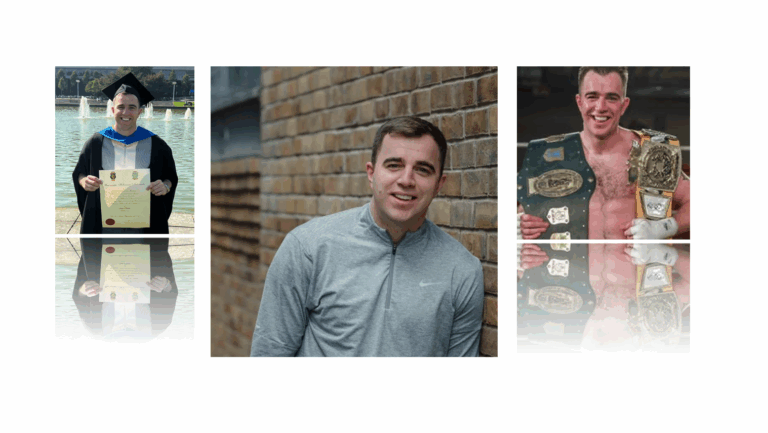
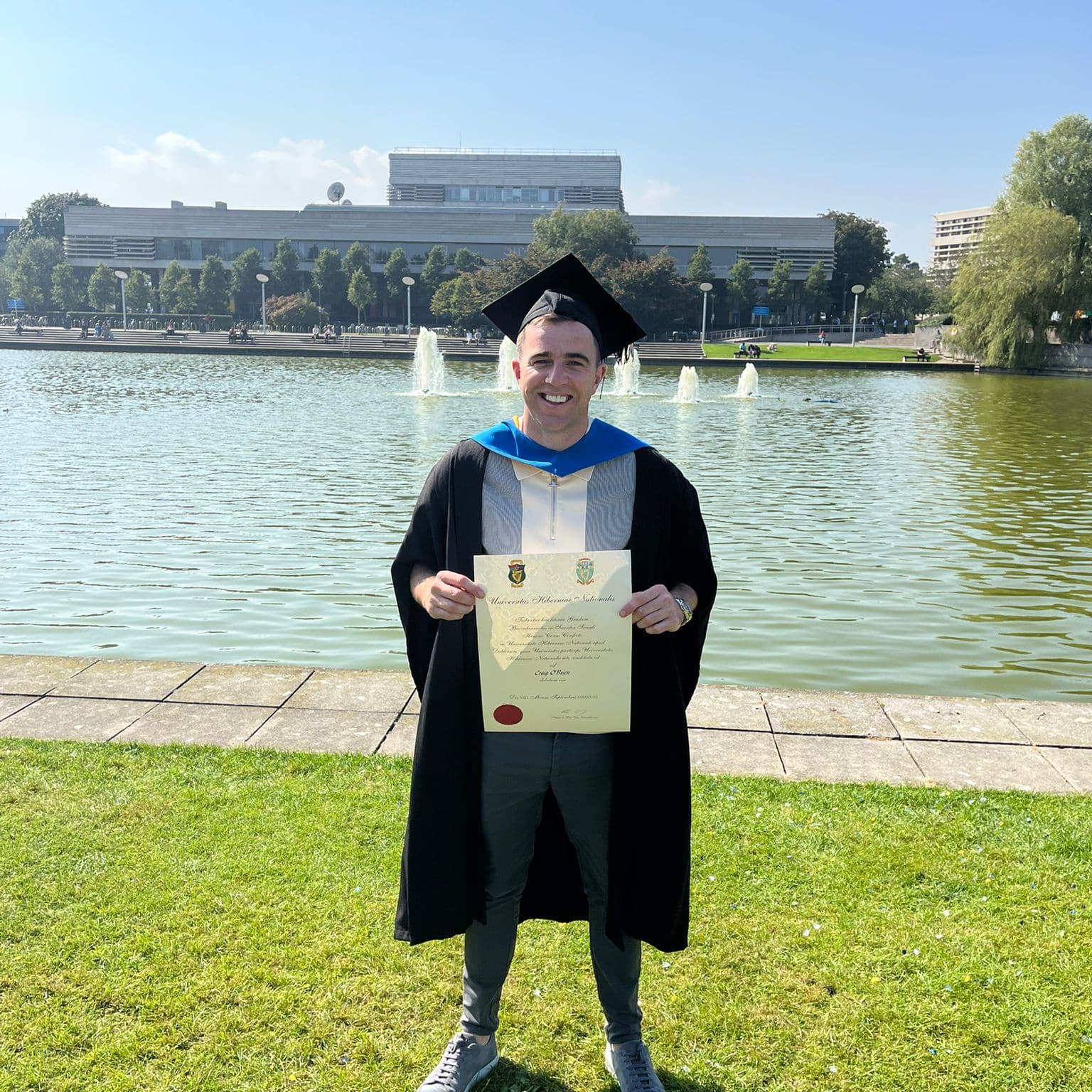
* Craig on the day he graduated from UCD.
His own redemption came after spending time in prison and in addiction as a young adult, before he returned to education and ended up a graduate of UCD, with experience and training to make a valuable contribution to society.
“I didn’t anticipate going to college and qualifying after four years. I didn’t set off that way. I had my own background of being caught up in addiction, I had my cousin Wayne who passed away through alcohol in 2018. My brother was on hard drugs, but he’s sober since November of last year, he’s out running, he’s doing jobs and all, it’s amazing.
“A friend of mine had started the TRY project, and maybe I looked up to him a little bit, he was after doing a Level 5 in addiction studies for drugs and alcohol. Now I was after leaving school at 13, but this wasn’t a full on course, it was part time, you go up, you engage, learn about drugs, what it does to you, harm reduction, the wheel of change, how people go back into addiction. You learn about how your area might be perceived by other places. It just opened my eyes.”
Sociology and policy
“I went and did the level five and on the back of that there was a diploma, I did well in that, started getting used to the assignments, started getting used to the education, started liking it. On the back of that there was an opportunity to go to UCD to do a degree in sociology.and social policy. There were four or five of us who went on and done it.
“While I was there they spoke about work experience. I contacted my friend who was in the TRY project. I had my background and a couple of them were into boxing, I did some padwork with them, I was getting to know them and know the area. I stayed doing the college work, doing the volunteer work a couple of hours a week. When I completed the degree there was an opportunity to start with the TRY team and that’s the way it went.”
Boxing requires “huge discipline and constant effort”
Of all sports, professional boxing requires huge discipline and constant effort, and those are traits that Craig feels helped him get out of the situation he was in when he was a poorly educated young man, who was just after coming out of prison and who had an addiction issue.
“I never knew where I was going to end up, but I was consistent. With the likes of the level five, I showed up and did it. The diploma, I showed up and did it. The degree, I got the bus over every day and did it in UCD. You just don’t know where you’ll end up. I’m sort of in a good position at the moment where I have options,” he said.
Craig O’Brien’s Boxing career
*Craig O’Brien after victory in the 3 Arena in 2024.
Dublin boxer Craig O’Brien has amassed a 15-3 record since turning professional in 2015, after having put a troubled early life behind him.
In 2017 he took the first belt of his career, winning the Boxing Union of Ireland Celtic Super Welterweight title against Alain Alfred.
The following year he defeated Jay Byrne, taking the Irish title in a Dublin derby at the National Stadium in a fight that was televised on TG4.
Also in 2018 he tasted his first defeat as a professional, losing out to the highly rated English fighter Anthony Fowler.
In 2024 he boxed on a Katie Taylor undercard and recorded a memorable victory against Edward Donovan at the 3Arena.
He was injured for much of 2025, but hopes to make a ring return in 2026. He is coached by Pascal Collins (a brother of former world middleweight champion Steve) who has also coached fighters such as Cork’s Gary ‘Spike’ O’Sullivan, Mayo’s Ray Moylette and Wexford’s Craig O’Brien.
“Despite our strong outcomes, Families First remains relatively unknown outside Tusla. We’ve been so busy working on the ground that we haven’t told our story.” – Alice Ann Lee
For almost two decades, I’ve worked with families who are hanging on by a thread. Parents who feel they’ve failed. Teenagers who have lost hope. Families who love each other deeply but can no longer find a way to live together safely.
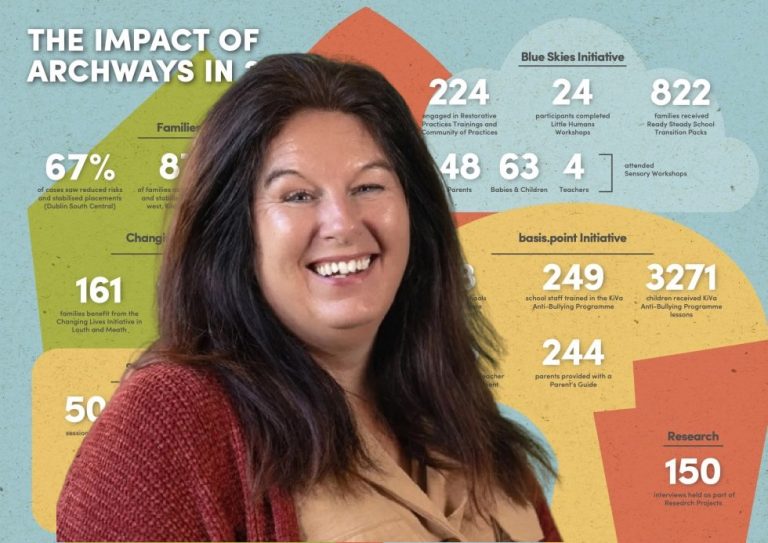
This is the world in which the Families First team operates — quietly, intensively, and often unseen. We’re part of Archways, and for 19 years we’ve been providing an evidence-based, trauma-informed systemic* therapy service to families referred by Tusla. Our work focuses on children on the edge of care or already in alternative placements — those facing the most complex emotional, behavioural, and relational challenges.
While much of Ireland’s focus rightly falls on foster care and residential services, what we do sits one step before that: we help families heal and stabilise so that children can remain safely at home.
What makes our approach different
In Families First, we don’t work with just one person. We work with the whole system: the child, the parents, and sometimes the extended family and foster carers. Every piece of the system influences the others.
Our model combines systemic family therapy and individual psychotherapy with trauma-informed practice. We meet families where they are — literally. Most of our therapy takes place in their homes, because for many of our families, getting to a clinic isn’t realistic. We also offer out-of-hours sessions to match the rhythm of real family life.
Over time, we’ve learned that if you focus only on the young person’s difficulties without addressing the parent’s trauma or the family’s relationships, the change won’t last. Parents often carry their own histories of abuse, neglect, or loss. Unless those stories are part of the work, healing cannot take root.
Two Irish research studies — one retrospective and one randomised controlled trial — have shown significant improvements in adolescent behaviour, emotional wellbeing, and family adjustment for families who complete our programme. The evidence supports what we see every day: this approach works.
Lisa’s story: rebuilding trust through understanding
Lisa was sixteen when she was referred to us. She had autism and severe anxiety, had stopped attending school, and spent most of her time in her room. Her mother, Karen, was exhausted. Every attempt to help seemed to end in an argument.
Over 10 months of therapy, we focused first on rebuilding the relationship between them. We explored how autism and anxiety interacted with family stress and we helped Karen find new ways to communicate with her daughter. Lisa began to express her needs more clearly, and her mother learned how to respond without escalating conflict.
Together, we found an alternative education placement that suited Lisa’s needs. She started attending full-time and began to rediscover her confidence. The change was slow but steady. By the end, Lisa’s family felt calmer and more connected, and Lisa was thriving.
“Lisa became more confident, more open,” her mother told me recently. “Our home is a different place now. I’ll always be grateful for the support we received.”
Harold’s story: healing through connection
Harold entered foster care at age four with his two younger siblings. By sixteen, he was struggling with identity and loss — why he was in care, why his father had denied him, and why his mother seemed distant.
We began by helping Harold tell his story. Using art and narrative therapy, he explored questions about his past that he had never been able to ask. We also supported his mother, who began grief counselling for the first time, and brought both of them together for joint sessions.
Gradually, Harold’s understanding of his life became clearer. His relationship with his mother strengthened. His foster placement stabilised. He began an apprenticeship and started to picture a future for himself.
“For the first time, I felt heard,” he told us. “I understood my story instead of feeling lost in it.”
Why this work matters
This kind of therapy takes time. It takes flexibility, consistency, and a willingness to walk alongside families through chaos, ambivalence, and pain. But when it works, it changes lives — not just for the young person, but for the entire family system.
Our approach also saves public resources. Families First has helped avert out-of-home placements, sustain foster placements, and support safe family reunifications. By addressing trauma, relationships, and practical needs together, we reduce the number of separate services families must engage with — and the risk of them dropping out altogether.
A social worker recently told me, “This service has been life-changing for many families. We’ve seen real reductions in risk and huge improvements in relationships.”
• Representatives from Archway and other organisations pictured after appearing at the Joint Oireachtas Committee on Children and Equality to discuss child poverty on International Children’s Day, Nov 20, 2025.
After nineteen years
Despite our strong outcomes, Families First remains relatively unknown outside Tusla. We’ve been so busy working on the ground that we haven’t told our story. But our work deserves to be seen — because it shows what’s possible when families are met with compassion, skill, and understanding.
As Ireland faces growing pressure on the care system, we need to invest more in prevention and early therapeutic intervention. Families First has shown that when families are supported holistically — not judged, not fragmented across services — children can stay at home, and families can heal.
Nineteen years in, I still believe in the same simple truth that brought me into this work: real change happens in relationships. And every time a parent and teenager start talking again, or a child finds safety in their own home, we’re reminded that this quiet, invisible work matters more than ever.
* “Systemic” work means looking at a person’s family, community and other support networks, rather than solely viewing them as an individual facing a challenge. To find out more, visit: https://archways.ie/. Of note, Queen’s University Belfast teaches a Masters in Systemic Practice and Family Therapy, part-time over three years.
After growing up in a loving family Sabrina became a mother herself at a young age.
“I’ve been married to my husband for the last 20 years, we have two beautiful daughters. I became a mother when I left school at 18 after completing my Leaving Cert. I was very young and it shaped me to be the person that I am today. It was the first time in my life that I experienced stigma, the stigmatisation that comes with being a young parent. But it gave me determination to succeed. To work hard, to give it my all and to prove people wrong; just because you are a young mother doesn’t mean you can’t develop.”
Volunteering
With a baby to mind, thoughts of third level education went on the back burner, but six years ago she started to become active in her community, a decision that changed her life in ways she would never have imagined.
“In 2019 I decided to begin volunteering and I started with a new local women’s group being set up in North West Kildare. That choice opened up a new chapter in my life. Around the same time SICAP was introduced into my life. I met the local community development worker Linda Walsh who was supporting the group with a committee set up, a constitution, provision of workshops and the empowerment of the women living in North West Kildare. To my surprise, in my second week, I found myself becoming secretary of the group.
“If you enlist then you soldier, that was what I was always taught. It was completely out of character for me but week after week we showed up. And looking back now I realise that simple decision not only gave me purpose, but also encouragement and friendship and a sense of belonging that I hadn’t even noticed was missing.”
She feels that the group provided an important outlet for a lot of women.
“North West Kildare is quite a rural area with poor transport links. The women who attended spent their lives at home raising their families, their husbands were out working, the families were raised now, and what do you do? They found themselves a little bit lost. This group has been a lifeline for so many people. It celebrated its sixth birthday on November 3 and it has grown now to approximately 50 women who meet once a week. It’s going strong and I’m immensely proud that they’ve carried on even though I’ve stepped away.”
Education
Getting back into education wasn’t on her horizon at all, until suddenly it was.
“I was not aware of adult education. I didn’t think that I’d be eligible to go back to college or that there was an opportunity for someone like me. In 2020, County Kildare LEADER Partnership in association with NUI Maynooth were offering a certificate in community development and leadership. I was asked if I wanted to interview for a place on this course. I did the interview and I got my place.”
Nonetheless, she was a little uncomfortable talking about what she was about to embark on.
“My husband and my kids knew but I didn’t tell my parents because I thought they might think that I had notions. Who did I think I was going off to Maynooth? I never got to Maynooth because Covid struck and it was all online!” she laughed.
While it was supposed to be one cert, she ended up studying until this year, picking up a degree and other valuable qualifications and experience on the way.
“I had incredible support from CKLP (County Kildare LEADER Partnership) and Sinead Bashir, our community education and support worker,” Sabrina commented.
Those who worked with her helped transform her life, she feels.
“To see the transformation, I don’t even recognise myself now from the person I was in 2020. I couldn’t work a computer, couldn’t use Zoom, I didn’t know what Zoom was. I didn’t realise the technology involved, but the empowerment they gave me and the confidence to stand up and do this, to show my daughters I could do this…”
Working
Improving her education and her level of activity in the community were huge steps, but there was even more.
"In September of 2023 I started working full time with County Kildare LEADER Partnership as a community engagement worker. It's incredible. It baffles me that I can stand here and say that I work with the people who encouraged me and came out and saw that spark in me that I didn't see in myself."
She loves the job, and the chance to help people as she was once helped.
"It's a privilege that I have that role to support people and build capacity in communities, strengthening their approach and most importantly developing their self belief. It's a privilege to go in and work within communities to identify those people and show them that it is possible, we can do this, our journeys can change significantly."
Looking back on the last few years, she is delighted with the support that was there for her. "I had incredible support to become a community engagement worker through SICAP. I have incredible guidance from both County Kildare LEADER Partnership and our colleagues in Kildare County Council. I really was very lucky in my journey."
SICAP has really played a huge role in changing her life for the better.
"Behind every success is a web of support, be it family, be it friends, community, or in my case the valuable help of SICAP. It was more than a programme for me, it was a lifeline when I didn't know I needed one. It empowered me and it continues to empower people to take the next step, to believe in themselves and to see the possibilities where once there were barriers. It invests in people and by doing so it strengthens entire communities."
It is important to remember that with the right backing people can do a lot more than might seem possible, she added.
"I want to share a final thought; I strongly believe that every community and individual you meet has potential. Sometimes all it takes is a word of encouragement or a spark or a volunteering opportunity to get the right programme of support to unlock the potential that is simmering away beneath the surface. For me volunteering lit that spark but SICAP gave me the tools and the belief to turn it into a flame."
"Believe in people, invest in community and never underestimate the power of support. Through kindness, care, compassion and programmes like SICAP ordinary people can achieve extraordinary things."
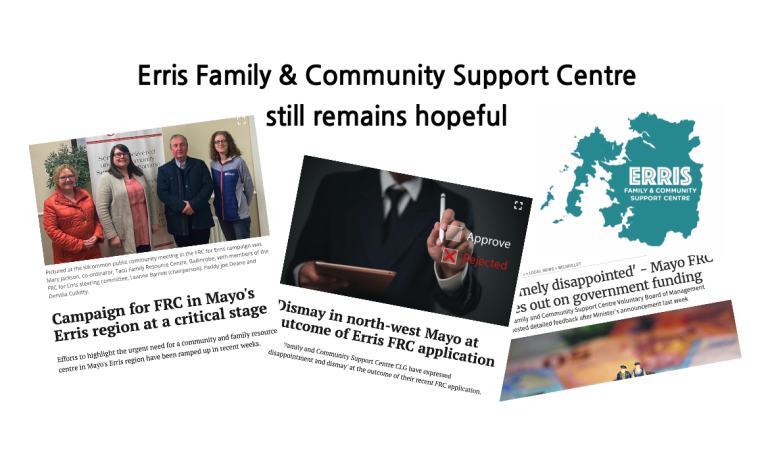
Erris Family and Community Support Centre expressed “disappointment and dismay” in September after losing out for a second time in three years to become a fully-fledged Family Resource Centre (FRC).
The Erris area is one of the most remote and disadvantaged rural areas in the country and the application was viewed by independent adjudicators as being exceptionally strong.
However, only five new projects were accepted into the National Family Resource Centre Programme and Erris’s strong presence on the ground and impact may, ironically, have gone against them. They currently receive core funding support from Tusla and employ a co-ordinator and a part-time administrator. Following the first unsuccessful FRC application, they also took on a family support service previously set up in 2018. This service is also funded by Tusla.
Full FRC recognition would enhance their ability to deliver for communities across Erris.
“The application was really strong and we were really happy with it. So it was a big shock and we were really disappointed,” said project co-ordinator Leanne Barrett. “We asked for feedback and we scored highly on all criteria, but what went against us was that we were already providing the service.”
In September, it was announced that five new FRCs – in Dublin, Monaghan, Louth, Kildare and Galway – were to be admitted into the national programme. With this expansion, the number of Family Resource Centres has increased from 121 to 126.
“While we welcome the addition of new FRCs and are pleased for the new communities that are going to benefit, we are extremely disappointed and surprised by the outcome of our application,” the board of the Erris group said in a statement issued immediately after the announcement.
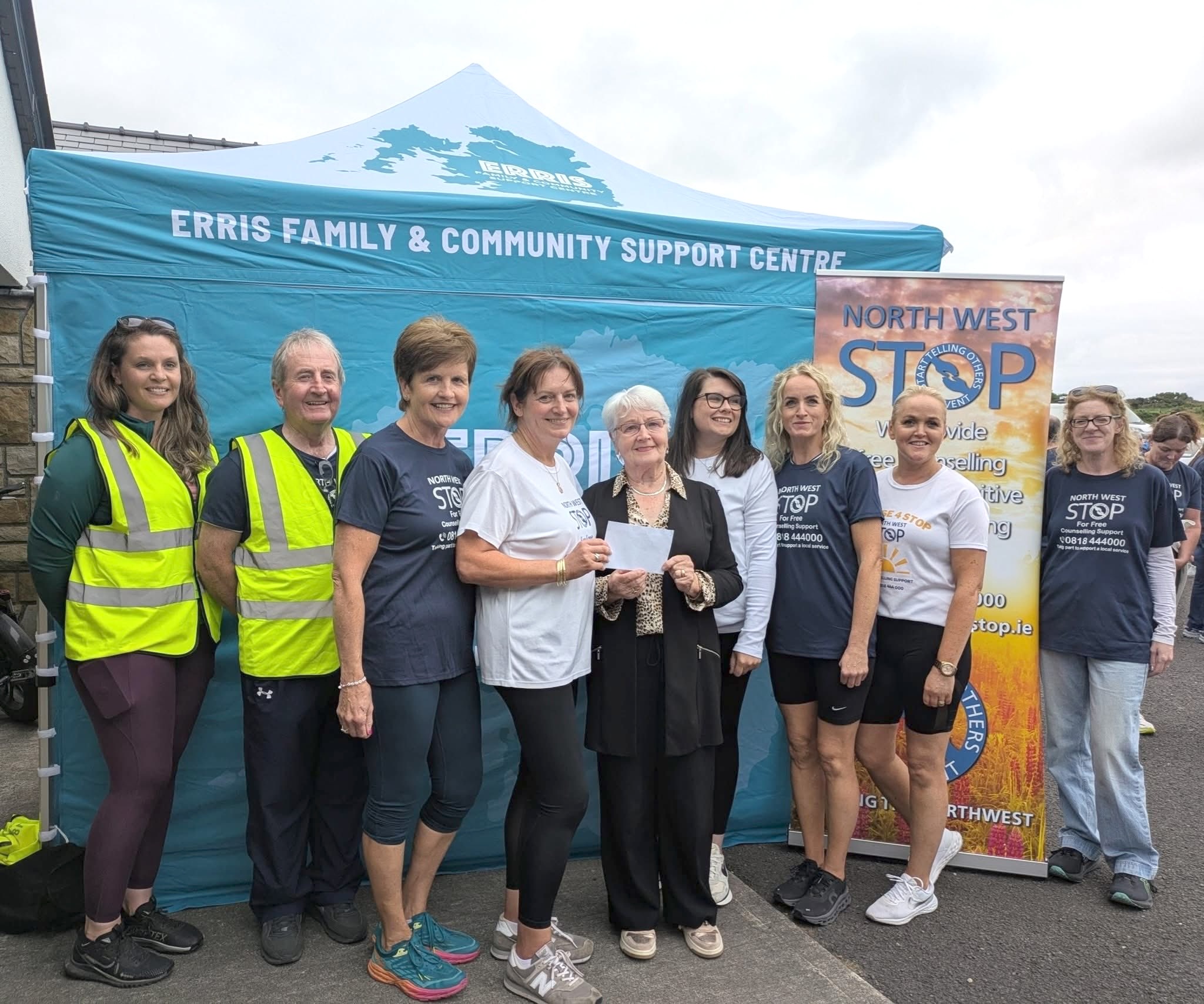
• Leanne Barrett (4th from right) pictured in September with volunteers and supporters who helped to raise €2,000 to provide counselling through Erris Family and Community Support Centre. They are pictured at an event organised in collaboration with the local branch of North West STOP-Suicide Prevention.
Now, hopes are higher. Speaking to Ms. Barrett in December, she said, “We took it on the chin, because they recognised the good work being done and were complimentary about the application.”
“Tusla said that our plan was robust, it was well evidenced, that it aligned with both the community needs and community development approach, and also the kind of commissioning priorities that they would have.
“They hope to be able to meet with us in the new year to explore opportunities and how we might align and integrate the funding we have with the national FRC model,” she said. Erris has a “very good relationship” with their local Tusla office also.
Leanne pointed hopefully to plans laid out in Budget 2026 to expand the national programme by adding 10 new centres to bring the total number up to 136 FRCs by year’s end.
For Erris, one of the most important elements of their work is community development. The area had gaps in terms of services and suffered from generational disadvantage, while cutbacks over a decade ago had taken a heavy toll.
Leanne believes capacity building and empowerment work is needed “to get people engaged and involved”. The area has an aging population, services are far away and unemployment is relatively high. She spoke of the need “to give people spaces so they can come together collectively and look at what the needs are, and to give them the skills and capacity to actually do something about it – that it’s not just about services”.
“It’s important to not just focus on the need and disadvantage in Erris. It’s actually about taking the good things we have, the strengths and using that. We have always said: Give us the funding and the resources and we will work to make sure that we can meet our needs and respond to our needs,” she said.
They thought they were nearly there when we reported on their progress in 2023 – see report here: