SVP said that the cost of living package will help people get through this winter, however next year people on low incomes will be “pulled further into poverty due to inadequate social welfare increases and a failure to increase or expand the Fuel Allowance to families on the Working Family Payment”.
Dr Tricia Keilthy, SVP Head of Social Justice said the cost of living measures such as the one-off Fuel Allowance payment and double social welfare payment will help low-income households during what will be a very difficult winter, but they are only temporary. The increases in core social welfare rates do not cover the rise in the cost of living. This means a real-term cut to welfare for those already living below the poverty line.
“The failure to address the impact of inflation on low-income households beyond short-term measures puts many people at risk of being pulled further into the kind of grinding daily hardship that is very difficult to escape,” she said.
Dr Keilthy continued: “The decision not to extend the Fuel Allowance to those in receipt of the Working Family Payment is very disappointing. This is a targeted measure that would have benefited just over 50,000 low-income families and protected them over the winter months from going without adequate heat and light.”
Welcoming the extra temporary payments for carers and people with disabilities, SVP nonetheless regrets that the Government did not introduce an ongoing weekly cost of disability payment.
With 70% of calls to SVP coming from households with children, child poverty is a pressing issue for the organisation.
SVP said the increase in the thresholds for the Working Family Payment was welcome, as is the increased investment in childcare will benefit many families. However, it is concerned that the increased investment won’t reach the most disadvantaged children.
The charity says the double child benefit payment is poorly targeted.
On education, SVP said the increase in support under the SUSI scheme is positive, but it won’t be enough to address the real cost of attending third-level education. Since 2011, that cost has risen by 25%. It still wants access to SUSI granted to those studying part-time.
SVP welcomed steps taken to address school costs. It received up to 30 calls per hour in August from parents worried about school costs.
Rose McGowan, SVP’s national president said: “For many families fees, uniforms, transport, books and digital tools are a source of constant stress. The decision to provide free school books to all children in primary school is very positive and is something we have campaigned on for many years.”
On housing, SVP says the best way to ensure stability and security for individuals and families is to increase the supply of social and affordable homes and it wants Housing for All to deliver on its commitments. However, it says the overall budget allocation for homeless prevention is inadequate.
St Vincent de Paul – Pre-Budget Submission
The Society of St Vincent de Paul (SVP) cited a weekly gap of €49 between core social welfare rates and the cost of a minimum standard of living, and pointed out that some 200,000 children are now living in deprivation.
Dr Keilthy said: “Investment in essential services like housing, childcare and education must go hand in hand with a social protection system that is strong enough to keep people out of poverty while out of work, living with an illness or disability, caring for a loved one, on low pay or in retirement.”
THE Irish Traveller Movement welcomed a number of initiatives announced in Budget 2023 last month, but warned that some won’t go far enough.
The ITN said the measures won’t address the investment advocated for to support Traveller inclusion, and to improve outcomes – especially in the areas of accommodation and education.
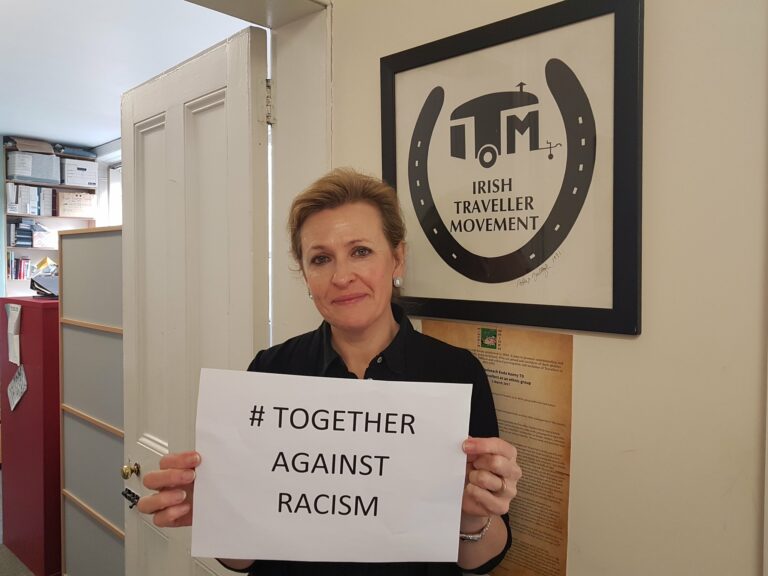
Jacinta Brack, ITM Political Advocacy, Communications and Policy Coordinator said: “Despite a €2 million increase to Traveller accommodation this year, the allocation for the five-year programme will be approximately €82 million, compared with €127 million for the first programme, resulting from local authority underspending and under delivery.”
The ITM also stated that the lack of any commitment to resource and establish the Traveller Accommodation Authority, to oversee Traveller accommodation delivery, and redress chronic overcrowding and homelessness was a cause of concern.
“It is difficult to understand the rationale for the paltry increase by five per cent, amounting to €283,000 for Traveller and Roma initiatives, to the scale of investment needed, and which also does not address the increases in energy, cost of living and knock on effects on staff recruitment and retention, and in view of pay parity inequity in statutory funded organisations,” added Ms Brack.
With regard to education, ITM said that fundamental measures to bring Traveller pupils into equivalence with other learners are not evident, and a Traveller Education Strategy called for since 2006 to be resourced with dedicated staff, has not been included.
In 2020/2021, just 33 Traveller students started undergraduate degrees, however, there is a plan to increase participation levels to 150 via a three-year pilot of €450,000 per year.
Ms Brack warned that “without vital attention to the retention of Travellers in post primary, the gateway to third level, early school leaving continues”.
An incentivised scheme via a higher rate of Jobs Plus subsidy for employers hiring candidates from disadvantaged and minority backgrounds has the potential to bolster diverse recruitment.
But, ITM noted that the Programme for Government commitment to a Traveller employment action plan has not been forthcoming, and believes that the portion of the 5% increase of €283,000 to be shared with education supports will not address the 83% unemployment rate in the community.
ITM said the first investment by the State towards Traveller mental health was significant, with Travellers now included in a €7 million package to expand community and residential addiction services, and to improve access to healthcare service.
However, “further clarity on those measures and allocations is needed, such as whether ring-fenced and distinct actions for Travellers are promised, including measures to address suicide in the community, rather than a reliance on inclusion within mainstream services, which has not remedied crisis points to now,” according to Ms Brack.
The Irish Traveller Movement’s Pre-Budget Submission titled ‘Progressive Realisation for Travellers of Budget 2023’, is available on their website: www.itmtrav.ie
THE new Community Centre Investment Fund (CCIF) will support groups in every county to carry out refurbishments and improvements of their local community facility.
Grants of up to €25,000 will be provided to almost 600 groups in both rural and urban communities.
The funding will see improvements to community centres, GAA clubs, parish halls, youth centres, men’s sheds and facilities used by elderly people.
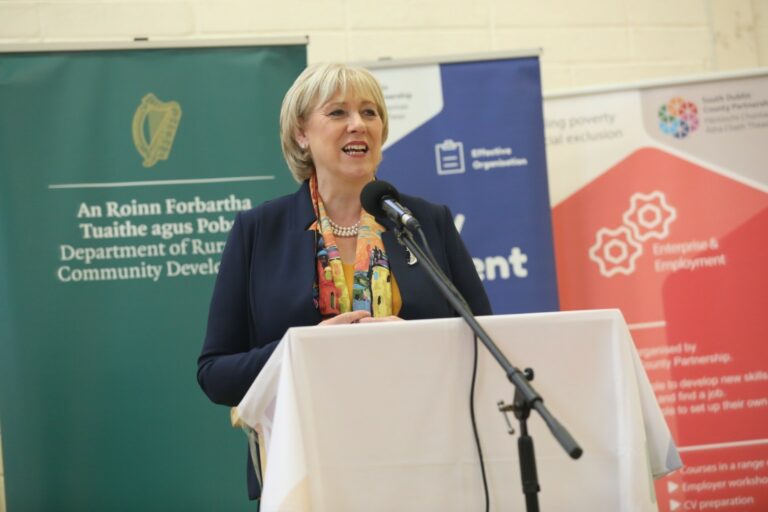
Minister Humphreys announced the funding during a visit to the Fettercairn Community and Youth Centre in Tallaght, which received Category 1 Funding.
She said:
“The local Community Centre is at the heart of our towns, villages and parishes all across this country. They come in many different shapes and sizes and are a place for people of all ages to meet up and socialise with friends, old and new.
“I want to support these great local facilities and that’s why I launched the new Community Centre Investment Fund earlier this year. The level of interest has been unprecedented under any scheme previously ran by the Department of Rural and Community Development.
“I want to congratulate all of the successful groups who are receiving funding, which I know will benefit local communities for years to come.”
The Community Centre Investment Fund represents the largest single investment in community centres in decades.
The works that will be carried out include upgrades to heating systems and kitchen facilities, better disability access, essential maintenance works such as roof repairs, works to provide additional services and the development of social hubs.
Today’s announcement of successful applicants will be followed by further funding announcements for larger scale projects in the coming weeks. Examples of successful “Category 1” applicants include:
Tus Nua Artane Coolock Family Resource Centre, Dublin – €25,000.
Bweeng Community Hall, Co Cork – €25,000.
Cara House Family Resource Centre, Letterkenny, Co. Donegal – €25,000.
Mulcair Men’s Shed, Co Limerick – €17,517.
Merville Youth & Community Centre, Co Sligo – €25,000.
Minister of State Joe O’Brien added:
“I spend a significant amount of my time out and about visiting community groups throughout Ireland and I see first-hand the importance of community centres – that shared community space where people can gather to support each other, to work, to socialise, and to help to continue to develop their local community.”
A full list of the successful projects under Category 1 of the Community Centres Investment Fund is available here.
“Congratulations to chairperson Shane O’Sullivan and his board and staff for managing and supporting an unique project now publishing for 21 years. It is all the more important today to have trustworthy media,” said Minister O’Brien.
He added:
“‘Changing Ireland’ has a track record in promoting community development, giving marginalised communities and people who are hard to reach a voice, and highlighting positive local and national initiatives. It is also at times critical and that is to be welcomed.”
The minister was welcomed to Moyross by Shane O’Sullivan, chairperson of Changing Ireland Community Media CLG, the not-for-profit company that publishes the magazine with support from the minister’s Department and with a small amount of funding earned from social enterprise activities.
The minister was shown the bungalow in Sarsfield Gardens where the magazine was based for its first 17 years before it moved into new offices in Moyross Community Hub.
“Being part of the community has always been core to the ‘Changing Ireland’ project,” said Mr. O’Sullivan. “The project is rooted in Moyross and gives as well as receives support locally.”
The magazine employs one person as editor/manager and engages reporters on a freelance basis.
“Our work is underpinned by Community development principles and the company is managed by a voluntary board. Now, Changing Ireland is the most popular and longest-established Community and Voluntary Sector magazine published in Ireland. It is a trusted and valued news source,” said Mr. O’Sullivan.
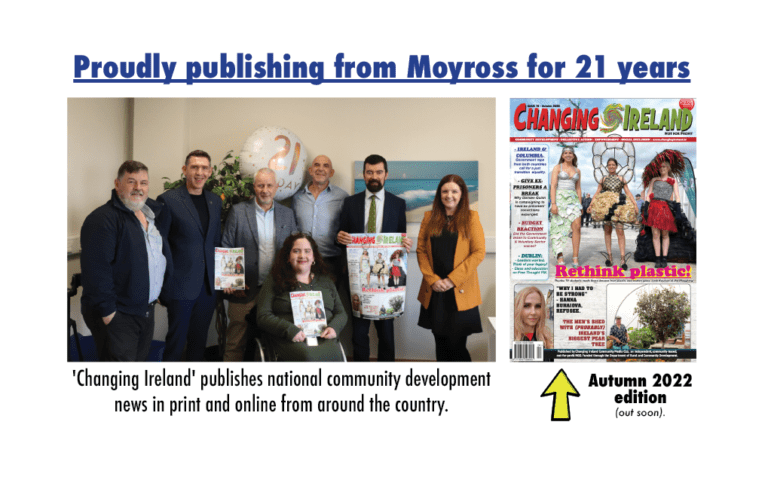
ABOVE: Minister of State Joe O’Brien visited Changing Ireland on Monday as the magazine celebrated its 21st birthday. Pictured are: Board members Andrew O’Byrne and George Clancy, editor Allen Meagher, student on placement Caoimhe Lalor, founding member Viv Sadd, Minister Joe O’Brien and journalist Kathy Masterson.
Editor Allen Meagher said,
“The magazine was first spoken of in 1999 and two years later a community project in Moyross won the national contract and ‘Changing Ireland’ was born. Constant negative headlines and stigmatisation which Moyross people face prompted local activists at the time to get behind the project. People need to hear of the positive initiatives happening nationally in communities around Ireland – including Moyross.”
He thanked everyone behind the venture including community workers nationally, activists in Moyross since the beginning, the Department in its various iterations through the years, current and past board members, editorial team members, reporters and readers.
Among those to have featured in the magazine over the years are Mary Coughlan, Seán Óg Ó hAilpín and Bernadette McAliskey. However, most covers feature ordinary folk doing extraordinary things in communities. The first edition featured a nun, Sr. Mary Carmel, from Thomondgate, Limerick, disguised as a man as part of a ‘Challenging Stereotypes’ project.
By year’s end, Changing Ireland Community Media CLG is due to complete a strategic plan for the coming years – with part of that vision being to increase the level of news output and improve the publication’s online presence and appeal.
• Sarsfield Gardens, Moyross: From 2001 to 2017, ‘Changing Ireland’ was based in a refurbished bungalow, a locally-led early example of regeneration.
Call to visit us – just ask at reception or knock on the door or better still email or ring in advance. We are now based in Moyross Community Hub, pictured below.
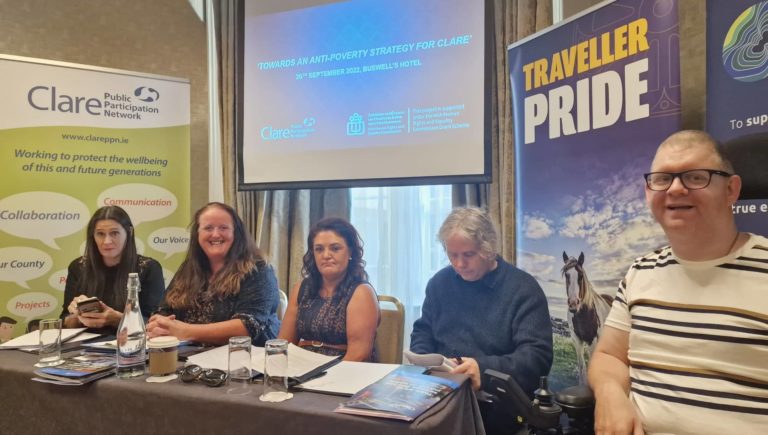
The report, ‘Towards an Anti-Poverty Strategy for Clare’, by economist and researcher Dr Conor McCabe, also found there is a chronic lack of county-level data or research on poverty and marginalisation in Clare.
The nine-month participatory research project, the first county-level research of its kind in Ireland, was undertaken by groups led by people who experience poverty and social exclusion in Clare.
Under the umbrella of Clare Public Participation Network (PPN) they secured funding from IHREC’s Human Rights and Equality Grants Fund. With the guidance of Dr McCabe, they used their own lived experience and perspectives to analyse poverty in Clare and the policy context in which it happens.
The report found that although Clare is experiencing a severe housing crisis, there is a housing vacancy rate of 17%. It also revealed that 33% more GPs are required to bring Clare in line with the national average.
Mary O’Donoghue of West Clare Family Resource Centre said “As one person involved in the project commented: ‘Clare is not Alaska – we’re an hour from two major cities and three hours from the capital, with a growing population. There is no reason services and infrastructure can’t or shouldn’t be provided here.’”
She continued: “We don’t want to be running food banks, we want solutions and a fair chance for all the people in our communities. Our organisations can advocate for social welfare increases and we can do our best to plaster over the cracks, but this won’t compensate for a lack of equal access to health services, transport, housing, childcare or sustainable employment. The report shows us that even to be on a par with the national average we need 50 per cent more dentists and 33 per cent more GPs in Clare.”
Bridgie Casey, Co-ordinator of Clare Traveller Community Development Project, expressed her shock at the high housing vacancy rate uncovered in the report: “We have families in Clare living in overcrowded conditions, children growing up in hotel rooms, or without running water, and to learn that there are more than 10,000 houses lying idle around Clare at the same time really tells us the system is not working for the people of Clare.”
Sarah Clancy, Co-ordinator of Clare PPN, noted: “With the focus now on regional development the specifics of local situations find little reflection in policy. Strategies that tell us that the Mid West is doing well don’t reflect the situation in our small towns and rural communities.’’
The topic of housing dominated the group interview sessions, with one participant in Kilrush commenting on the issue of house prices rising in seaside towns popular with holidaymakers.
They said: “‘First of all you can forget about buying a house in West Clare. You would want to be on a CEO’s pay, you’re not going to get it. The price of houses is shocking high. I’d say in west Clare there’s about a 1,000 [houses] that would be holiday homes, but there’s no proper social housing at all.”
Kathleen Sherlock of the Minceir Whidden group said in 2021 that as many as half of the people declaring themselves as homeless in the county were from the Travelling community, despite Travellers accounting for less than one per cent of Clare’s total population.
The suicide rate among Travellers is also seven times that of the settled population. One survey participant talked of how Traveller children are playing ‘funeral’ with their toys: “On one particular site where there have been a lot of suicides, I’ve seen children, six, seven, eight, nine years of age, putting on an act with a cardboard box, putting a doll into the box, pretending that it was one of their children, and they’re carrying the box over their shoulder, pretend crying, saying ‘please get up, please get up’. These are children watching what they’ve seen and play-acting it.”
Regarding the shortage of dentists in the county, another Kilrush resident told researchers: “At the moment you can’t get a dentist in west Clare. If you’re on a medical card it looks like the nearest dentist that will take you on if you are new to [the scheme] is in Limerick. They’ve stopped taking medical cards full stop.”
Another said: “Doctors are not taking people on. I know one family that just moved [into Kilrush], they tried every doctor, they can’t get one.”
The downgrading of Ennis hospital and the relocation of services to UHL in Limerick was another issue raised by participants.
“There are no Clare babies anymore, it’s either Limerick or Galway for the maternity depending on where you live. And this is not something that happened yesterday. You’re talking about over a 20-year period. In general for medical services it’s Limerick or Galway, or if you’re in East Clare you go to Tipperary for your healthcare,” said one Ennis resident.
The groups involved in the report included: Clare PPN, Women’s Collective Ireland Clare, Clare Immigrant Support Centre, Clare Leader Forum, West Clare and Shannon Family Resource Centres, and Clare Traveller Community Development Project.
To read the report in full, go to: https://clareppn.ie/towards-an-anti-poverty-strategy-for-clare/
The key findings of the report included:
The population in almost all areas of Clare is growing but policy-making in relation to Clare does not yet reflect this.
There is a lack of information on, and future planning for, the sustainable livelihoods and wellbeing of the people of Clare as apart from the ‘Mid West region’ or ‘southern assembly region’.
From the perspective of those who experience socio-economic exclusion, County Clare is being poorly served by policy-makers at national and, as a result, at local level.
A person’s socio-economic rights in Ireland are affected by their location in the country – with basic services, infrastructure and opportunities unavailable in some locations and available unequally in others.
There is a crisis in all types of housing in Clare – social, rental and privately owned.
There is a particular crisis for the Traveller community who face particular discrimination in accessing services, housing and supports.
There is no national, regional or local policy for achieving a real ‘just transition’ as Ireland navigates its way towards lower carbon emissions, and Clare is one of the counties most likely to experience poverty-exacerbating effects from this transition.
There is an inequality in provision of health services between Clare and other regions, with 33% more GPs and 50% more dentists needed even to put Clare on a par with the national average.
There are stark differences in how health and care services are delivered in Clare and other counties.
There is no evidence that the gendered nature of poverty in Clare receives special attention in policy-making.
Disabled people in Clare are at particular disadvantage because of failures in national policy to guarantee their rights – in particular as regards accessible public transport and transport funding supports.
In many areas of Clare there has been a diminishment in and centralisation of services and supports available to marginalised groups with negative consequences.
There are key failures at national and local level in measuring poverty.
The report made the following proposals:
Identify and remedy the gaps in information and data relating to Clare; policies should be based on evidence, and data gathering should be underpinned by a commitment to protect and enhance human rights, including socio-economic rights.
Review the National Development Plan as it relates to Clare, a regional approach as currently mandated serves to disenfranchise large areas of Clare from accessing the investment and sustainable economic development needed.
Clare needs a dedicated social housing action plan. The housing situation outlined in this report is chaotic – a story of record homelessness alongside thousands of vacancies in the county. This action plan must include planning for population increases and changing demographics including the needs of ageing rural dwellers.
As agreed in the programme for government the Direct Provision System must be phased out and replaced by adequate supports for those seeking protection here to live independent lives – it in itself is a direct cause of poverty, child poverty and marginalisation, particularly in rural areas.
Health services in Clare need to be localised or re-localised, and commitments made by Government to ensure that the people’s right to health is realised through sufficient provision of the service levels enjoyed in other counties.
The charity model of service provision needs to be replaced by a human rights-based model where all public and publicly funded bodies are designed to meet the needs of individuals and their communities.
Clare needs a jobs investment plan – in social services and green transition there is work that needs to be done in Clare, this must be provided for in terms of creating sustainable decent work for people living in Clare.
Clare needs to adopt a model of development which ensures a properly defined just transition strategy – in particular for farming communities but also for all those likely to be adversely affected by climate action or climate change.
Clare needs a county-wide effective and accessible public transport system.
The festival line-up includes more than 80 events throughout Ireland, both in-person and online, aimed at celebrating the extraordinary work of human rights defenders, past and present, in Ireland and around the world, and highlighting climate change, political violence and mental health, amongst other critical issues.
The Dublin Arts and Human Rights Festival runs from October 14 – 23, and most events are free to attend.
The programme features acclaimed Irish and international artists and guest speakers, who perform exciting and innovative events which promote equality, human rights and diversity through the arts reaching audiences locally, nationally, and internationally.
Artistic curator for the festival, Mary Moyinhan, explained: ”The Dublin Arts and Humans Rights festival showcases the extraordinary work of people who defend human rights in Ireland and around the world, and the role of the arts and artists in promoting human rights today. We have been growing year on year to make this, our fourth event, the biggest, most innovative festival yet.”
The theme of the 2022 festival is ‘In Solidarity: A Celebration of Human Rights’, a celebration of community connections and a world where all people are treated equally with dignity and respect.
The annual international festival is organised by Smashing Times International Centre for the Arts and Equality and Front Line Defenders in partnership with a range of organisations across Ireland, Europe and Internationally.
The festival links the arts to civil society, active citizenship and politics through interdisciplinary performances, film screenings, documentaries, theatre, music, dance, visual and digital art, poetry, literature and historical memory.
It features creative conversations, panel discussions and arts-based workshops with Irish and international artists and guest speakers celebrating and promoting dignity, human rights and respect for all people equally.
Freda Manweiler, company manager at Smashing Times, said: “We are delighted to partner with some incredible organisations who lead the way in speaking out against human rights abuses, such as Amnesty International, Fighting Words, Irish Council for Civil Liberties, National Women’s Council of Ireland, Trócaire, and Poetry Ireland.”
Michael McCabe, compère for the show, ‘State of the Art: Transformative Memories in Political Violence’, commented: “It is wonderful to be involved in such an extraordinary exhibition, exploring themes of grief, disappearances and remembrance and how the arts can transform memories, exploring our collective knowledge.”
The 10-day festival will see over 80 acts perform, with more to be announced, throughout Dublin, Kerry and Antrim with artists and performers from over 17 countries.
Most events are free of charge, for more information and to book tickets go to www.smashingtimes.ie
The Roadmap for Social Inclusion is a whole-of-government strategy for addressing poverty and social exclusion.
It contains targets to reduce consistent poverty to 2 per cent or less by 2025, and to position Ireland within the top five countries in the EU under a number of social inclusion measures.
The purpose of the review is to evaluate progress in implementation, assess the roadmap’s ambition, its goals and its commitments in the current environment, and examine the existing roadmap indicators.
The Minister says he is keen to hear the views of the public, particularly people experiencing poverty and social exclusion, and the groups that represent them.
He said:
“As we strive to fulfil the commitments outlined in the Roadmap for Social Inclusion, we seek feedback at its mid-point on its effectiveness from those most impacted by poverty and social exclusion.”
Minister O’Brien is asking for people to reflect on their experience, or that of the people they represent, of poverty and social exclusion, and the ways in which this situation could be improved during the remaining period of the Roadmap to the end of 2025.
He has pledged that the submissions received will impact the future direction of the Roadmap:
“The results from this public consultation will provide a guide in how best to focus our work towards reducing poverty and social exclusion for the remaining duration of the Roadmap – so that the most vulnerable members of our society can reap the benefits.”
A link to the consultation is available at www.gov.ie/RoadmapConsultation and will be open until Friday, 7 October 2022.
The Department of Social Protection has contracted Ipsos, an independent research company, to collect data to inform the Mid-Term Review and submissions can be made by email (only) to IE-PA-Midtermreview@ipsos.com by 7 October.
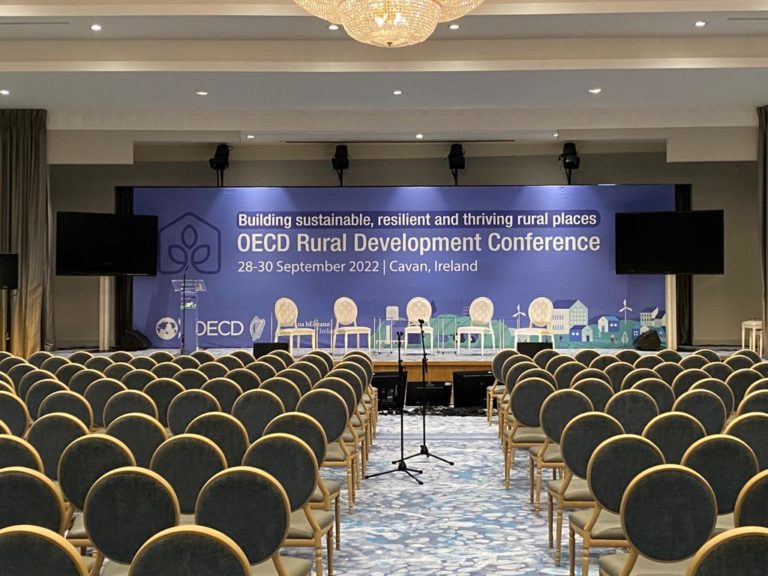
The only Cavan man at the conference – Terry Hyland, CEO of Cavan County Local Development (CCLD) – gave a rousing welcome to all the delegates and congratulated the Department on attracting the conference to his native place. He was very appreciative to have the shortest commute of all 400 delegates. (Attendees have travelled from as far away as Korea, Colombia and Latvia).
Whilst addressing the subject of social inclusion and introducing the framework for its achievement in Ireland, he gave an incisive account of the achievements and challenges for policy makers and implementing bodies today.
• Proud Cavan man Terry Hyland, pictured on the right, welcomes the 400 OECD delegates to his native county. Photo by Joe Saunders.
Delegates were also presented with the Cavan case study of how the COVID emergency landed in the country and how a multi-sector response was swiftly mobilised involving CCLD, Civil Defence, County Council, schools and other agencies to address the food crisis in the county.
The attraction of the prestigious OECD conference and its 400 senior international delegates puts a valuable focus on rural policy here and across the globe.
• Mihail Dumitru, Deputy Director General, DG AGRI, European Commission, joins Carol Baumann, CEO of the Irish Local Development Network, and CEOs of local development companies from around Ireland at the OECD Rural Conference today. Photo by Joe Saunders.
Ireland and IDA Ireland are also here with trade stands to promote the wider message to delegates that Irish tourism and inward investment policies are also open for business.
• Former CEO of Clann Credo Paul O’Sullivan addresses a question to Mary O’Shaughnessy of UCC at the Social Economy session. Photo by Joe Saunders.
The theme of the Conference is ‘Building Sustainable, Resilient and Thriving Rural Places’. In the opening sessions, DRCD’ s Assistant Secretary, Fintan O’Brien outlined Ireland ‘Our Rural Future’s policy and emphasised how it has been adopted by the Government as a national policy rather than as an isolated piece of rural strategy.
The policy’s vision is for a thriving rural Ireland, guided by the needs and aspirations of people, rooted in the diversity of places and inspired by the many possibilities ahead and Fintan discussed the challenges and opportunities in ensuring a whole of government approach and some of the successes so far, particularly in the COVID and recovery environments.
The Conference was formally opened by Minister Heather Humphries this lunchtime and will be addressed by the Taoiseach tomorrow.
Opening the conference, Minister Humphreys said:
“The opportunity to host this important Conference reflects the ambitious nature of rural development in this country, with Ireland, and the Our Rural Future policy in particular, seen as a fine example of rural policy-making in action. I am very excited about Irish rural stakeholders having a role in shaping international rural development policy priorities.
• Minister Heather Humphreys greets Korean Minister Dae Chol Kwon.
Minister Humphreys added:
“We still have much to learn from our OECD colleagues, and I look forward to meeting our friends from all over the world, to exchange our views and ideas on the shared challenges and opportunities facing rural areas.”
• Minister Humphreys and staff from the Dept. of Rural & Community Development give LEADER the thumbs up at the Ploughing last week. Photo by Changing Ireland.
“I hope policy makers grab the opportunities brought by long-term transformations and short-term shocks to work together across policy areas and levels of government to take action for thriving rural places”.
More information
(Source: Statement issued Sept 26th by Dept. of Rural and Community Development)
Our Rural Future
Our Rural Future is the whole-of-government policy for rural Ireland for the period 2021-2025. It represents a new milestone in the approach to rural development policy for Ireland and adopts a more strategic, ambitious and holistic approach to investing in and maximising opportunities for rural areas. The policy’s objectives will be achieved through the delivery of more than 150 commitments to be implemented across a range of government departments and agencies.
OECD
The OECD is an intergovernmental economic organisation with 38 member countries, founded in 1961 to stimulate economic progress and world trade. It is a forum of countries committed to democracy and the market economy, providing a platform to compare policy experiences, seek answers to common problems, identify good practices and coordinate domestic and international policies of its members.
OECD Rural Conference
The OECD Rural Conference is a high-profile international policy and political forum for OECD member countries to discuss rural development in a holistic manner, with each conference having a specific thematic focus. The most recent was held in Korea in 2019 and focused on Rural Well-Being.
The conference will cover many topics including the profound impact on rural areas of Russia’s war on Ukraine, the acceleration of remote working and the urgent need to invest in net-zero energy sources.
The three-day event is being hosted by the Irish Government and is the 13th such conference by the Organisation for Economic Co-operation and Development (OECD). It is being held in the Slieve Russell Hotel from Wednesday, Sept 28th to Friday, Sept 30th, and An Taoiseach Micheál Martin is among those expected to speak at the event.
Also taking part from Ireland are Minister for Rural and Community Development, Heather Humphreys, who is from Cavan, Minister of State for Rural and Community Development, Joe O’Brien, and agriculture minister Charlie McConalogue. The ministers will meet counterparts from other countries including Scotland, the USA and the Czech Republic.
In a statement yesterday, the Department of Rural and Community Development noted, “It is the first time that Ireland has hosted such a conference and follows on from the publication of the Government’s rural development policy, Our Rural Future.”
• All is ready for Irish practitioners to showcase rural development work in this country at the OECD’s 13th rural development conference – being held in Co. Cavan. This photo and main photo by Joe Saunders.
Earlier, the OECD said of its 2022 conference – “It is more important than ever for governments to put in place ambitious policies to leverage the transformative role of rural regions in keeping recovery from the pandemic on track and preparing for shocks.”
It said the main policy focus in Cavan will be on “anticipating and addressing risks, maximising development opportunities, mobilising citizens, and building long-term resilience in rural regions”.
The following are among those due to speak in Cavan.
• Speaker photos from OECD pre-event publicity material.
More information
(Source: Statement issued Sept 26th by Dept. of Rural and Community Development)
Our Rural Future
Our Rural Future is the whole-of-government policy for rural Ireland for the period 2021-2025. It represents a new milestone in the approach to rural development policy for Ireland and adopts a more strategic, ambitious and holistic approach to investing in and maximising opportunities for rural areas. The policy’s objectives will be achieved through the delivery of more than 150 commitments to be implemented across a range of government departments and agencies.
OECD
The OECD is an intergovernmental economic organisation with 38 member countries, founded in 1961 to stimulate economic progress and world trade. It is a forum of countries committed to democracy and the market economy, providing a platform to compare policy experiences, seek answers to common problems, identify good practices and coordinate domestic and international policies of its members.
OECD Rural Conference
The OECD Rural Conference is a high-profile international policy and political forum for OECD member countries to discuss rural development in a holistic manner, with each conference having a specific thematic focus. The most recent was held in Korea in 2019 and focused on Rural Well-Being.
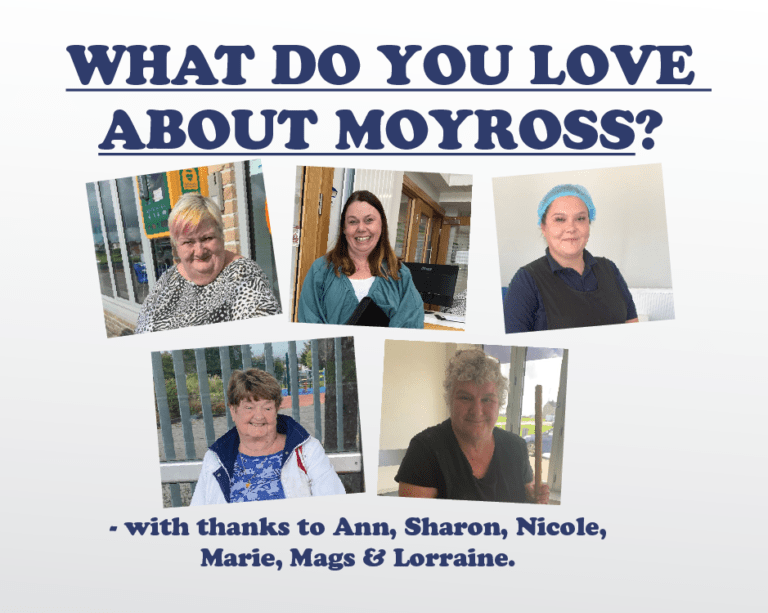
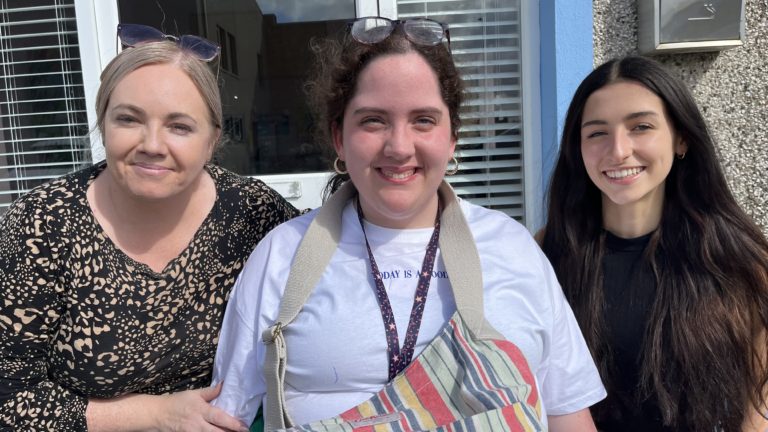
ELLA JONES-BOURKE met three visitors to the local café and nearby playground and here’s what they told the young reporter they like most about Moyross:
Lorraine said, “My three favourite things are the community, the community centre and the school. They do a lot for the young people and the services. They help everyone. I’m here over 20 years and I wouldn’t change it.”
She added, “The residents are all fab. They all stick together.”
Lorraine preferred not to be photographed or give her surname.
Marie Quinlivan was happy to talk. She is a regular at the community café in Moyross – called ‘MoyCafe’ – and said that, despite not living here herself, it was clear to her “from the people that I know that live here, that they find the community very good, and they have good neighbours.”
She said, “The community café is excellent. You would never meet better or nicer people, the food is always fresh, the staff are nice, and the food is never overpriced.”
Sharon Benson is a Sinn Féin Councillor for Limerick City North and she runs a clinic in the centre every Friday morning . Her “favourite thing about Moyross” is the community spirit.
She said, “The biggest thing here is the old-school, community spirit that used to be all across Limerick years ago. It’s slipping away now, but it still holds strong here in Moyross. It’s all about the people and the community.”
“And I recommend everyone come and get a breakfast here in MoyCafe,” she added. “It’s the best breakfast in town.”
* * * * *
CAOIMHE LALOR askedthree staff members in Moyross Community Centre what they had to say about their beloved community:
Ann N Wadi works as a receptionist at Moyross Community Centre. Although not a local Ann enjoys working in Moyross:
“The people here I love and the people I work with I love.”
She described the atmosphere in the community centre:
“It’s a happy community centre and everyone is friendly and everyone is accommodating. If you go to the right people they will help you”.
Margaret (Mags) Fitzgerald works in Moycafe and she said:
“The best thing about Moyross is the community and the community spirit. They look after everyone here. And the sports.
Nicole Hogan also works in Moycafe and she said her favourite things about Moyross are:
“The community and the people in it when it comes to helping each other out. And working with Mags!”
How is Moyross changing?
Several new and refurbished projects have opened in the community of Moyross, Limerick city, over the past decade. They include a lively community centre, a bustling community café and a refurbished playground and expanded childcare facility. The school has also expanded and ‘The Bays’ have been transformed into Moyross Youth Academy.
While whole estates within Moyross have been almost completely leveled through “regeneration”, new apartments have been built and more housing is under construction. While smaller in terms of population, you can sense an optimism about the neighbourhood.
On Wednesday, Sept 7th, the Government signed off on an Employment Regulation Order that will quickly introduce higher minimum wage levels for staff in the Early Years Childcare Sector. So, how was the announcement greeted at community childcare level?
It seemed that the protests from the professionals caring for the nation’s children and trade unions such as SIPTU were finally heard.
Caoimhe Lalor and Ella Jones-Bourke interviewed Lisa Flanagan of Little Seeds Childcare in Moyross to gain an insight into how those working in the sector feel about the change:
Leesa is utterly dedicated to early years education and she termed this week’s announcement “historic”.
THE NEW RATES
Leesa and her colleagues in Moyross include many who took part in the massive protest held in Dublin, in February 2020, over early years pay. Over 30,000 workers and voluntary management members were estimated to have joined the march. (It featured on the cover of ‘Changing Ireland’, Issue 68).
Leesa is a former manager of Little Seeds Childcare and has 17 years of experience in the sector and on this issue. Throughout her career, she saw the campaign grow.
“This is an historic moment for childcare providers,” she said.
• For years, workers and their trade unions had called for an improvement in pay and for other changes.
POSITIVES
Leesa was very clear in her view that even though the new regulation order is only a “stepping stone”, it is most certainly a significant move in the right direction. She sees the importance of “embracing and acknowledging the positives” that will emerge as a result of increased wages.
Some of these positives include an increased scope for quality within each room in the creche and the ability to hire experienced room leaders. These changes will enhance the standard of care within early years education settings, in Leesa’s opinion.
MOTIVATION
Leesa is currently studying for her PhD on Mindfulness in Early Years Education and holds the title of Family and Community Engagement Co-ordinator at Moyross Community Enterprise Centre which supports Little Seeds Childcare.
She is driven by the motivation to “provide a quality, nurturing environment,” particularly as Moyross is “deemed a disadvantaged area.”
Through her family outreach, she aspires to make a difference in the lives of not only the child, but to the family unit – by offering support to parents and guardians around the care of their children. This is especially important post-Covid-19, where she has witnessed children with “increased anxiety and being behind developmentally.”
Like many childcare workers up to this point, her “intrinsic motivation” to provide a multifaceted education to young children kept her in the sector – despite the inadequate pay. However, many were forced to quit for better pay elsewhere.
• Leesa Flanagan of Little Seeds (Community) Childcare, Moyross, has set up a new project called Family Space.
Leesa said the increased funding though welcome, is definitely needed – especially post-Covid – to support staff and childcare.
SIPTU had warned in August that the sector was in danger of collapsing and it called on the Government to invest an additional €150m in childcare, split between pay and affordability issues:
“If Budget 2022 does not increase investment in the sector, specifically for salaries, then the consequences will be a significant collapse of service provision.”
In a statement this week the trade union welcomed the Government’s announcement of a pay deal. The agreement was negotiated by SIPTU organisers and activists on behalf of the union’s 6,000 members in the sector and will set legally binding rates of pay. The agreement was announced on Wednesday by the Minister of State for Business, Employment and Retail, Damien English.
Minister English said:
“The proposals submitted to me will apply to some 27,000 staff and are a welcome acknowledgement of the importance of the work carried out by everyone working in the early learning and childcare sector.”
• Joe O’Brien, Minister of State for Community Development, and Damien English, Minister of State for Business, Employment and Retail, visiting a family support facility in Navan earlier this year. PHOTO: Changing Ireland.
SIPTU Head of Organising, Darragh O’Connor, said:
“This pay deal, and future pay increases, means that Early Years professionals can plan to stay in their chosen profession in the long term. These incredible union activists and members are an example to all low paid workers.”
Mr O’Connor added:
“This is our first pay deal, not our last. The campaign for recognition, respect and professional pay and conditions will continue.”
• SIPTU Head of Organising, Darragh O’Connor, said low pay had caused a staffing crisis in Early Years as services struggled to recruit and retain staff. He said the Government acceptance that wages had to rise “shows that when you get together and organise a union you can change things for the better.”
CHALLENGES REMAIN
And despite the announcement on salary increases being a tremendous achievement for all the early childhood educators, the funding presents challenges.
Leesa referred to a lack of notice and information from the Government. The implementation of funding on the 15th September has created a difficulty because contracts would ideally have been finalised before the commencement of the academic year.
Additionally, Leesa feels that if there was “one unified group”, instead of segregation across several trade unions and representations, the wait for the pay increase may not have been so long. She would like to see one umbrella group for all childcare providers to unify and strengthen workers’ voices.
HOURLY PAY WILL RISE TO €13.31 / €15.50
While the Government has long recognised that a child’s formative years are the most important in their development, it took until now for wages to come close to matching those of primary school teachers.
Figures from SIPTU show:
– the average wage currently for a QQI Level 5 Early Years Educator is €11.57 per hour, which is significantly lower than the Living Wage of €12.90.
– For an Early Years Room Leader with a QQI Level 8, the present average is €13.21 per hour.
The new order will see these rates rise to €13 per hour for the former and €15.50 for the latter. The pay deal comes into effect from Thursday, September 15th.
The Early Years Sector is 98% female.
READ MORE
– SOME PREVIOUS EARLY YEARS NEWS REPORTS FROM ‘CHANGING IRELAND’:
• Staff and supporters of Togher Family Centre, Cork, at the national childcare march held on Feb 5, 2020.• For years, workers and their trade unions had called for an improvement in pay and for other changes.
The cost-of-living crisis is dominating discussions in the run-up to Budget 2023 and community and voluntary organisations have once again been very active in advocating for measures to protect their members and the people they serve.
Whilst many submissions rightly focus on the income, housing and health needs of the most vulnerable, the capacity of community and voluntary groups themselves is under pressure at a time when they are needed by a growing proportion of the population.
The need to protect and promote community services at this time is summarised in the Irish Local Development Network’s submission (see below). It says:
“Whilst inflationary pressures are posing serious challenges for disadvantaged, low-income individuals and families that require an appropriate exchequer response, community services also require protection and promotion given their key role in identifying, reaching and supporting the most vulnerable in society.”
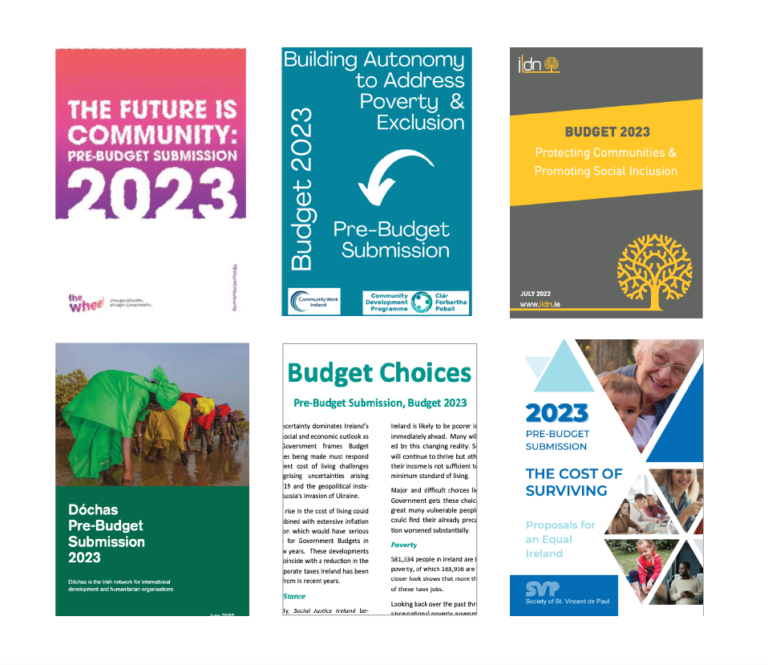
Here is what six organisations have to say in advance of Budget 2023:
New Social Contract Needed: Proceeding as before will not do
SOCIAL JUSTICE IRELAND’S SUBMISSION – click cover to read the document.
Social Justice Ireland (SJI) points out that 581,334 people in Ireland are living in poverty and believes that Budget 2023 should be guided by one core principal – the protection of the poorest in Irish society.
It says that proceeding as we have in recent years will not address the challenges Ireland faces, challenges that existed before the arrival of Covid‐19:
“A new Social Contract is needed. (it) should have five core goals: to deliver a vibrant economy, decent services and infrastructure, just taxation, good governance and sustainability. Crucially, however, these five outcomes must be addressed simultaneously.”
SJI also proposes a €477m package under the budget’s Regional, Rural and Community provision. This includes a call for additional supports under the Community Measure for Public Participation Networks (PPNs), the Social Inclusion and Community Activation Programme (SICAP), the Community Services Programme (CSP) and LEADER.
The Cost of Surviving V. Enforced Deprivation
VINCENT DE PAUL’S SUBMISSION – click cover to read the document.
In its pre-budget submission, ‘The Cost of Surviving,’ the Society of Saint Vincent de Paul cites a weekly gap of €49 between core social welfare rates and the cost of a minimum essential standard of living. It points out that 200,000 children are living in enforced deprivation and over 250,000 customers are in arrears on their electricity bills.
• Dr Tricia Keilthy.
Dr Tricia Keilthy, SVP Head of Social Justice said:
“Investment in essential services like housing, childcare and education must go hand in hand with a social protection system that is strong enough to keep people out of poverty while out of work, living with an illness or disability, caring for a loved one, on low pay or in retirement.”
We must get SICAP Back to Pre-Crash Levels
THE ILDN’S SUBMISSION – click cover to read the document.
The main focus of the Irish Local Development Network’s submission is the restoration of the SICAP budget to pre-crash levels when it was halved. Chairperson Jim Finn stated that:
• Jim Finn.
“Despite the fact that the programme’s target groups are experiencing intense food and fuel poverty – due to rapidly rising prices – and finding great difficulty in securing affordable homes, the current budget level for the programme is approximately half of the €85 million level in 2008.”
He called for Budget 2023 to take a significant step towards restoring the budget back to this level:
“The budget for SICAP needs to reflect a sense of real urgency in addressing the various crises affecting those excluded from the mainstream.”
The ILDN is also calling for an increase in the annualised LEADER budget, stating that the current “reduced income for the programme will lead to reduced funding for community infrastructure and enterprise development in rural areas – this at a time of severe pressure on the rural economy due to the impact of fuel inflation. It will lead to staff lay-offs by Local Development Companies too.”
Developing the Community Development Pilot Programme
COMMUNITY WORK IRELAND’S SUBMISSION – click cover to read the document.
The focus of the Community Work Ireland submission is on the Community Development Pilot Programme in which there are currently seven projects operating on a budget of €135,000 each per year.
CWI are calling for an immediate 8% increase in each project’s budget and a doubling of the number of pilot projects from seven to fourteen in 2023. They then want to see an additional seven projects introduced each year until 2027 which would bring the total number to forty-two and require a budget of €9.52 million.
The Wheel Wants Action on C&V Recruitment & Retention Crisis
THE WHEEL’S SUBMISSION – click cover for more info.
The Wheel’s submission leads with human resources challenges as the sector is becoming less attractive due to inflation whilst other sectors move faster to ensure competitive salaries.
A central focus is, therefore, the request for increased funding to enable community and voluntary organisations to address recruitment and retention problems in the sector.
In a related request, the Wheel is seeking resources for a comprehensive skills development strategy for the Community and Voluntary sector workforce.
They also urge action on commitments for multi-annual funding to allow for better planning.
The entire sector is aware of the mounting burden and cost of compliance required by funders and regulators. Whilst these ensure continued confidence in the sector, their growing cost is often not borne by funding agencies. The submission is seeking greater provision for compliance costs whilst also requesting a streamlining of regulatory and funding-related requirements.
Finally, extra dedicated resources are sought to deliver the commitments made in three important national policies (see below) developed by the Department of Rural and Community Development in recent years.
3 KEY POLICY DOCUMENTS (covers) • Sustainable, Inclusive and Empowered Communities – A five-year strategy to support the community and voluntary sector in Ireland 2019-2024. • The National Social Enterprise Policy for Ireland 2019-2022. • The National Volunteering Strategy 2021-2025.
Dóchas wants Government to scale up its response food crisis
DOCHAS SUBMISSION – click cover to read the document.
Dóchas, the network of international development and humanitarian organisations, has put the spotlight on the impact of what it calls “extraordinary global events” on low-income countries. Conflict, climatic shocks, Covid-19 and economic pressures are mounting in areas that were already experiencing humanitarian crises.
Dóchas is asking the government to use its influence in its remaining few months on the UN Security Council to push for greater action on the structural causes of extreme poverty, inequality, conflict, the climate emergency and hunger.
Within the government’s more immediate control, Dóchas points out that progress towards the state’s commitment to providing 0.7% of Gross National Income annually to Overseas Development Assistance is slow and is currently at 0.32%.
They are requesting an increase of €233 million to bring it to 0.37% in 2023 and chart a sustainable path to reaching the target by 2030. The increase is aimed at four priorities: fighting hunger, tackling the climate emergency, addressing conflict and responding to the Covid-19 pandemic.
Such funding should be targeted at civil society groups, particularly women’s organisations, in the least developed countries and fragile states “to ensure that universal human rights and minimum standards are being fulfilled, including access to food, water and healthcare”.
MORE PRE-BUDGET SUBMISSIONS
EDITOR’S NOTE: Other important C&V sector submissions were published as the above article was being written. They include three from Inclusion Ireland, the Irish Traveller Movement, and the Oireachtas Joint Committee on Social Protection, Community and Rural Development and the Islands.
The Irish Traveller Movement published its Pre-Budget Submission titled ‘Progressive Realisation for Travellers of Budget 2023’, available HERE.
• There is an easy to read summary of Inclusion Ireland’s submission HERE.
Inclusion Ireland – the national association for people with an intellectual disability – also recently published its Pre-Budget Submission – DETAILS HERE.
Finally, the Oireachtas Joint Committee on Social Protection, Community and Rural Development and the Islands published its Pre-Budget Submission and presented it to the Department of Rural and Community Development
Changing Ireland will report after the Budget on the impact on social inclusion services and targets groups.
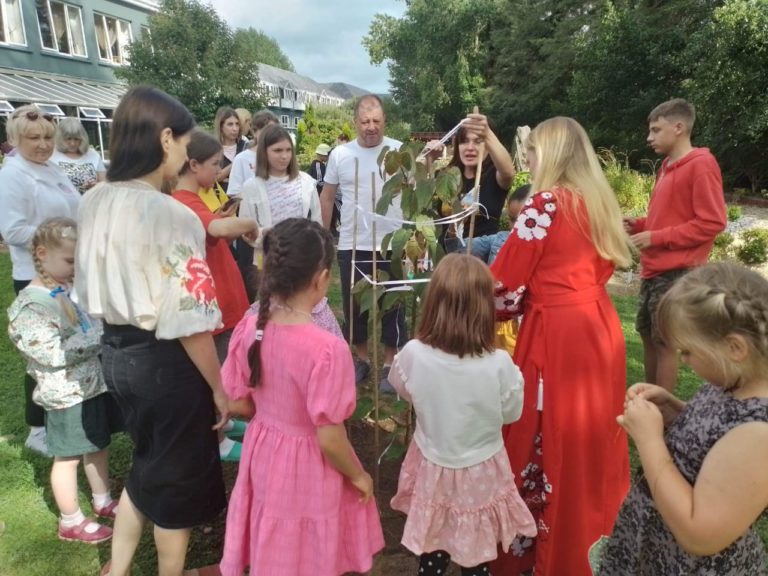
The event occurred on Ukraine’s Independence Day – on Thursday, August 24 – and followed a concert performed in the hotel yard by Irish and Ukrainian singers. On that day, the refugees wore national embroidered clothes and held Ukrainian blue and yellow flag.
• To buy the tree, Ukrainian hotel residents gave donations.
Planting the tree, kids and adults sang the patriotic Ukrainian song «Ой, у лузі червона калина» (English title – “Oh, the Red Viburnum in the Meadow”). This old song gained international attention after the Russian invasion of Ukraine started. The red viburnum (in Ukrainian – the “chervona kalyna”) is a national symbol represented throughout Ukrainian folklore. The song by itself became a symbol of courage and bravery of Ukrainian people in their fight for independence.
It is interesting to know that davidia is a very rare tree. It is named after Armand David, a French missionary and naturalist. Victoria Keane, who works at Liscahane Nursery and Garden Centre, said a monk brought this tree to Europe from China in the 1800s. Davidia flowers have big beautiful white petals which look like dove wings. That is why it is also called the dove-tree. And, as we know, the dove is a symbol of peace.
Davidia planted in the hotel garden will bloom the next year. While the tree does not have flowers, Ukrainian children and adults decorated it with hand-made doves. The most they want now is victory and peace. Peace for their country and peace for every heart.
As the song goes:
“Oh, in the meadow a red kalyna has bent down low,
– In October, youth leaders in Dublin will plan their legacy for the city
• JOE SAUNDERS REPORTS
The Legacy Programme is a global campaign by the Common Purpose organisation which brings together young people aged 18 to 25 and facilitates them to think 20-30 years ahead and plan their legacy for their city.
One hundred young leaders will meet in locations around Dublin, including Google’s building – The Foundry – to address the question “How can we make this a city for all?”
Over three days, from October 26th to 28th, they will explore the future of their city in terms of their human, social and civic impact. Reimagining the community, the workplace and the environment twenty years from now, they will be challenged to come up with solutions that are rooted in inclusion and purpose.
Legacy Dublin 22 is sponsored by IDA Ireland, the Department of Rural and Community Development (DRCD), Foróige, Google and others.
• Sir John Gray on his perch on O’Connell St, Dublin. He led work to bring piped water to Dublin. What will your legacy be? PHOTO BY: Changing Ireland.
CEO of Common Purpose Ireland, Dara Connolly, says that the demand for effective leadership has never been greater and he predicted:
“The ideas that come from these three days will be incredible, as they have been to date around the world.”
He said:
“Legacy is a unique initiative for empowering young people to have a voice in their future. It has already run in 15 locations around the world to date including Boston, Chicago, Singapore, London and soon to go live in Bangladesh, India and Germany. We are excited to see it taking place in Dublin in 2022, the year of the centenary of the state, a suitable time to look forward as well as back.”
He added:
“Common Purpose and its partners will bring a really diverse group together: some in employment, some not; some studying, some volunteering, some new to Ireland. The key is for this programme to be as inclusive as possible, allowing the participants to listen and learn from their peers and work on projects together to imagine a city for all”.
COLLABORATION
Common Purpose and the Department of Rural and Community Development have been in discussion to ensure that those attending this year’s event are truly representative of all Dublin communities.
This has led to the Department sponsoring up to 20 places for those who participate in the Social Inclusion and Community Activation Programme (SICAP) across the city.
• Minister Joe O’Brien. PHOTO: Changing Ireland.
Minister of State for Community Development, Joe O’Brien, welcomed the involvement of those from SICAP initiatives in the Legacy Programme. He said,
“We all need to reimagine our capital city and plan for its sustainable, inclusive future. Such a conversation cannot happen without young people from communities where SICAP plays such a big role. I am pleased to support SICAP’s involvement in the Legacy Programme in order to ensure that the voice of all young people is heard and valued.”
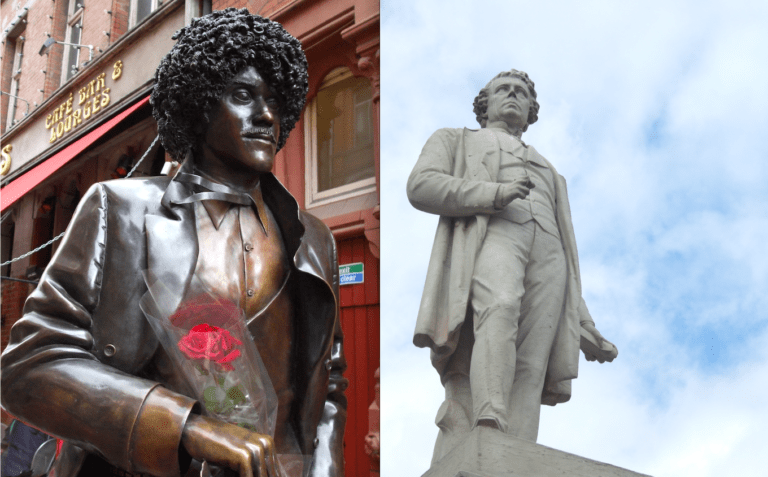
• Phil Lynott grew up in Dublin in the 1960s. The singer and musician led the way for others. What will your legacy be? His statue, here adorned with roses, is just off Grafton St. PHOTO BY: Changing Ireland.• Una Lowry, CEO of Dublin South City Partnership.
Local Development Companies across the city are coordinating the participants from SICAP.
Una Lowry is the CEO of Dublin South City Partnership and she says it is vital to provide appropriate supports to the young people:
“The format of such events is often off-putting to those from disadvantaged communities but it is vital that their voice be heard at influential gatherings,” she said.
“In our work, we come across so many examples of inspiring leadership and potential within our SICAP groups and so we have come together to give them maximum support to participate fully in Dublin’s Legacy Programme this year,” she said.
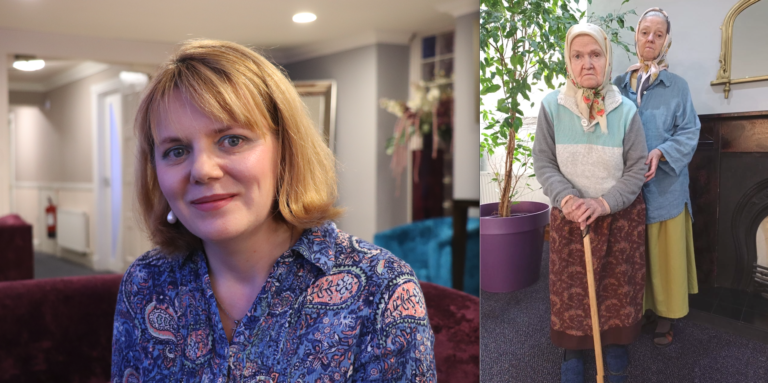
CAPTION: Journalist Olesya Vasylenko (left) and her interviewees Halyna and Svitlana (right). All three are from Ukraine and are among the millions forced to flee Russian bombs. They now live in Co. Kerry.
– Interview by journalist Olesya Vasylenko
Halyna was born in the Sumy region (northeast of Ukraine) in a family of peasants. Her grandfather lived in a homestead inherited from his father. The family had a big garden with apple and pear trees.
“There was no such a big garden in the whole area,” Halyna recalled. Her grandfather’s brothers lived on the same street. Before the Russian Revolution he owned a lot of land. Her grandfather, Halyna said, was a very industrious man who reaped great benefits from his hard work. The family had a big field. In half of it they planted potatoes and other vegetables. In the other half they grew wheat and rye which gave a decent harvest.
During difficult times in his country, Halyna’s grandfather tried to save grain for the future. So he put vats in large pits dug out in the earth and covered them with wooden boards and dense homespun tablecloths. In those hidden vats, Halyna tells, the grain was stored.
The Famine – the Holodomor – which came upon the land of Ukraine in 1932 brought great distress. Starvation was caused artificially by Stalin regime. According to a recent study “Genocide of Ukrainians in 1932-1933 based on the materials of pre-trial investigations”, the number of victims of the Holodomor is 10.5 million people. It was terror by famine.
Soviet government representatives came to each house and took away all the grain from Ukrainian peasants.
It was almost a miracle the wheat hidden in large vats in the earth wasn’t found out. Halyna remembers that time. Her mother got up at four o’clock every morning. She stoke the stove and baked bread for the family. Later, going to work, she cut off half of a fresh loaf and handed pieces out to her relatives who faced starvation and could hardly move.
To survive, they also picked meadow flowers near the river, ground them and baked so called ‘bread’. It looked like a loaf but it hardly gave any nutrition.
While Halyna’s mother rescued their relatives from starvation, unfortunately, Svitlana recalls, the family couldn’t help other people in the village. Her grandmother was afraid the grain would be found and taken away. So she gave bread only to close relatives who wouldn’t tell their secret.
When the Second World War started, Halyna’s father went to the front. Three sisters stayed with their mother. Difficult times came again and people began to steal sheaves of wheat in the fields. So her mother spent nights sitting near her sheaves and guarding them. In the mornings she had to go to work.
• Halyna (90) and Svitlana (66) now live in Co. Kerry.
Occupiers conscripted young Ukrainians for forced labour in Germany. To avoid this, Halyna’s older sister and her friend hid in the woods. As Svitlana tells, their mother brought them food. She did it at night so no one would see. Because partisans put up a resistance, German occupiers conducted raids throughout the area. They controlled the locals to stop them bringing food to partisans.
One November night, Halyna’s mother, as usual, went to the woods to feed the girls. To get there she had to go through riverside meadows with large water-filled pits made by explosions. Suddenly she heard the sound of a German car. She jumped into a pit and stood in ice-cold water for a long time waiting for the Germans to leave. Halyna was happy that her mother didn’t drown and didn’t die of hypothermia.
During the Second World War, as Halyna tells, her father was wounded three times. But his ingenuity helped him to survive at the front. During the war it wasn’t always possible to deliver provisions to soldiers and they starved, so Halyna’s father cut the meat from the slaughtered horses and cooked chowder for himself and for others. During the (WWII) battle for Kyiv’s liberation he received a heavy injury. Despite being seriously wounded he ran and after covering a distance he fainted and woke up in a different city. He was taken to the hospital where he spent a lot of time recovering.
After so much hardship, Halyna and Svitlana never thought that war would touch their lives again. That they, in their 90s and 66, would flee its horrors to another country. They took a very long journey to Ireland.
The women don’t know what the future holds for them but at least for now they are safe. Halyna and Svitlana are very thankful for love and care they receive here in Ireland. The Ukrainian mother and daughter pray for all their benefactors every evening.
“The Irish are probably the kindest people in the world and we’ll be grateful to them for the rest of our lives,” Svitlana says.