Friday, July 3, 2026
Home Blog Page 21

Phil Coulter loved Terry’s idea to join Ukrainian choir to release new version of ‘Steal Away’

0

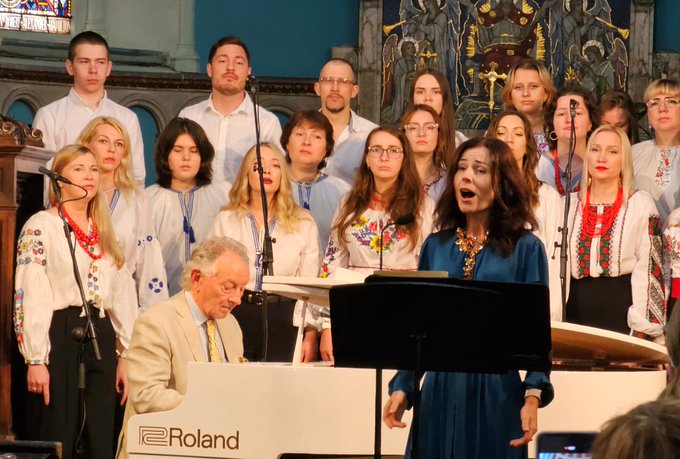
The song was partially translated into Ukrainian and a national Ukrainian choir in Ireland was formed with support from local development companies after a Cavan community worker came up with the idea some months ago. Since the song’s launch yesterday, the initiative has won widespread media coverage, helping to highlight community work to integrate and support Ukrainians in Ireland.

Speaking just before the performance at Saint Stephen’s Church, Mount Street Crescent, Dublin, yesterday, Phil Coulter said that the rehearsals and listening to the choir sing Steal Away in Ukrainian “was the most uplifting experience I’ve had in all my years”.

The initiative was the brainchild of Terry Hyland, CEO at Cavan County Local Development, and was put together in collaboration with Phil and Adeline O’Brien, CEO at Empower, the local development company for Fingal; and was centrally co-ordinated by the Irish Local Development Network.

The collaborative project brought Ukrainians together from across the country to express themselves through music and song and some of the national choir members have now started their own choirs locally.

Terry Hyland told Changing Ireland: “Local development companies around the country are at the coalface in terms of supporting displaced Ukrainian people coming to this country, on the health and wellbeing side of things as well.

“One of the things we set up here in Cavan through our Fáilte Isteach programme was a choir. The whole idea of it was is that people could mix with Irish people, sing in the choir, improve their English. But also mentally it’s good to sing, it’s good for the soul.

• Terry Hyland speaking at the launch of the song in Dublin. Photo courtesy of Michelle Mulally from the ILDN.

“Then I had Phil Coulter on the radio in the car, it was Steal Away. And I thought, this song has a lot of connotations of what Irish people went through in our recent past in terms of conflict with a bigger, more powerful neighbour and the history of people having to leave Ireland.

Steal Away is essentially about people fleeing the Troubles in Northern Ireland. And I thought that it resonates exactly with the plight of Ukrainian people.

“And there’s a lot of fatigue out there amongst the Irish population in terms of the war on Ukraine, this perception that accommodation is being taken up by refugees that could be used to house homeless people. There’s a whole right-wing agenda that’s out there.

“So I thought that maybe this song could be used in a way that might help to win back the dressing rooms, so to speak, in terms of the Irish people, and get people to think about ‘Yeah, we went through this ourselves’. And then see how people can relate to the plight of the Ukrainians coming here, and what their needs are, what they’re going through. And it’s a good opportunity for Ukrainian people to understand the Irish history as well.”

Terry was introduced to Phil Coulter through a friend of his, Young Wolfe Tones singer Andreas Durkin.

When Terry put the idea to Phil about a Ukrainian choir recording a new version of his song, luckily he was “hook, line and singer”.

“He thought it was a brilliant idea, a lovely concept to explore. And Phil jumped in with us from day one. He’s doing this on his own back, his own time – we’re not paying Phil to do this,” revealed Terry.

He added: “What’s also happening now is that new choir groups are out performing around the country in their local areas as a result of this. So not only have we formed a strong choir, but also we’ve been able to get new choirs set up in other parts of the country.

“I think they (the Ukrainians) are getting a real kick out of it, it’s very special and they feel like they’re doing something worthwhile.”

The choir’s journey and the process of recording the song has also been documented by a film crew. The group hope to launch the documentary in September.

Terry concluded: “There is a fatigue out there. The war continues on, and there are other natural disasters and things happening. So it’s just to keep the focus on the war on Ukraine and that we do have 80,000 people in the country here. They’re doing their best, and we’re doing our best for them as well.”

Promoting inclusive communities

Speaking at the launch, Adeline O’Brien, CEO at Empower, local development company for Fingal, said:

“Our community is always at the heart of what we do in local development companies and our goal is to deliver positive change for individuals and marginalised groups in our area. We wouldn’t be able to do this work without SICAP funding from the Department of Community and Rural Development.”

“The lyrics of the song are just as powerful today as they were in 1983 when the song was originally released. The choir has provided a safe space for those fleeing the war in Ukraine to express themselves, to find friendship, to seek out new opportunities and to learn English,” she said.

• Carol Baumann.

Carol Baumann, CEO at the Irish Local Development Network (ILDN) said she was “delighted” to have been able to co-ordinate the initiative in conjunction with Local Development Companies across the country.

“The single ‘Steal Away’ is just one positive outcome from this initiative. The most important outcome is the impact on the community. Some of our national choir members have started their own choirs locally providing an opportunity for further integration.

“Along with initiatives like the Ukrainian National Choir, local development companies assist communities and disadvantaged individuals and groups with personal development and well-being; education and training; employment services; family supports and urban and rural development. Our LDCs are doing remarkable work across the country, and we hope to continue to help build inclusive communities where all members are valued and supported,” she said.

Steal Away was first released by The Furey Brothers and Davy Arthur in 1983. Watch their recording here:

Lyrics and chords here: https://www.irish-folk-songs.com/steal-away-lyrics-and-chords-by-the-fureys.html

And here is Phil Coulter singing the song beautifully some years ago:
Eligible groups urged to apply for PEACEPLUS funding

0

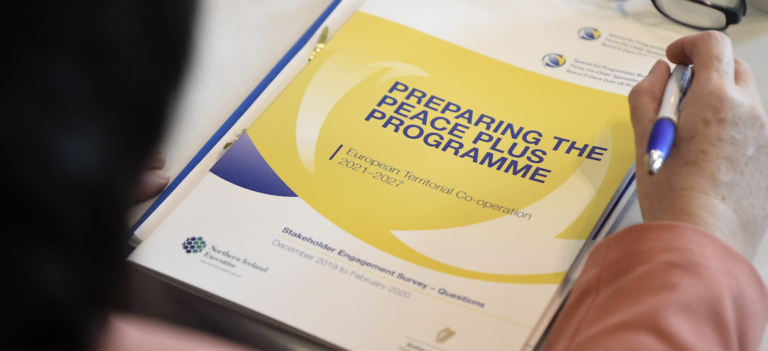
A total of €75 million in funding is available for eligible groups in the Re-imaging Communities investment area of Northern Ireland and counties Cavan, Donegal, Leitrim, Louth, Monaghan and Sligo under the programme.

The funding will support the creation of new builds, or the reimaging, regeneration or transformation of existing spaces, for shared usage.

The new shared spaces will aim to bring together all communities, while having a transformative effect on the region, creating a lasting legacy within the communities they serve.

The Department is providing funding to support projects under Investment Area 1.4 of the new PEACEPLUS programme: Reimaging Communities, which is 80% funded by the EU.

The Department will be partnering with the Department for Communities in Northern Ireland and the Special EU Programmes Body (SEUPB).

A statement from the Department of Rural and Community Development said: “This area of the programme will create a more cohesive society through an increased provision of shared space and services, which will benefit and embed peace and reconciliation.

“This will result in more people regularly accessing shared spaces for recreational purposes or to access services. These shared spaces are co-designed on a cross-community basis.

Minister for Rural and Community Development, Heather Humphreys commented: “These shared spaces can come in many forms including land, buildings, infrastructure, parks and peace line interface barrier regeneration, and so you need to consider what are the current needs in your area that would have a long-term and lasting impact on everyone involved and benefit society as a whole.

 “I wish all applicants every success in their endeavours.  Please ensure that you avail of the essential guidance that is available to all potential applicants on the SEUPB’s website.”

The closing date for receipt of applications is 5pm on Thursday September 7.

 Full details on who is eligible to apply and how to apply for funding under this investment area are available on the SEUPB website here


€2 million CLÁR funding to provide minibuses, ambulances and more for rural communities

Minister for Rural and Community Development, Heather Humphreys TD has announced over €2 million in funding for 37 vehicles to transport people who have mobility issues, cancer patients, or for search and rescue services.

The €2,026,853 funding, provided under Measure 2 of the CLÁR Programme, will allow community groups in rural areas to purchase the much-needed vehicles.

Community groups that perform roles such as transporting blood samples from hospitals and delivering medication are also supported under the initiative.

One of the successful projects is Spraoi agus Spórt Family Centre in Co Donegal, who said they were “delighted to share that we’ve been awarded over €77,000 in funding for a wheelchair minibus to improve access to services in Inishowen for those with mobility challenges”.

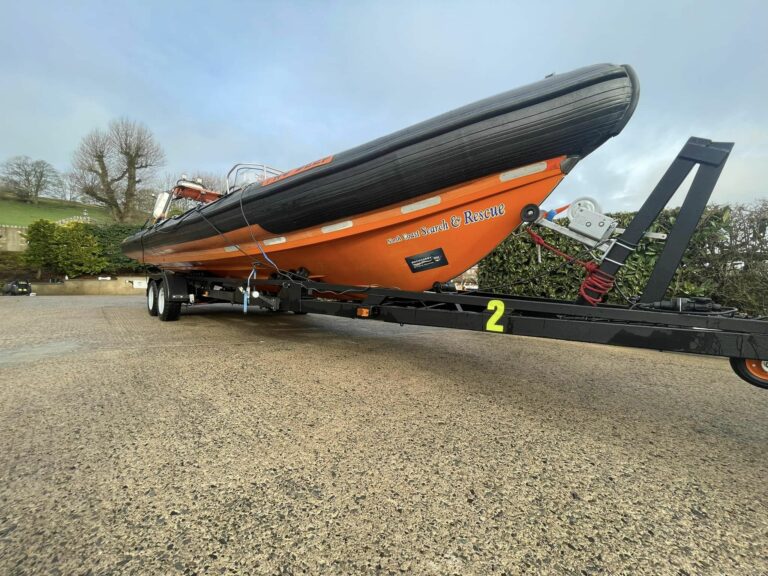
Another is the Monaghan-based Rockcorry Divers & North Coast Search & Recovery, which was awarded €55,848 for the purchase and fit-out of a four-wheel drive first responder emergency vehicle.

Chairman Frank McDermott commented: “Sincere thanks to everyone at CLÁR and also Minister Humphreys for your generous assistance with the supply of a first responder unit for Rockcorry Search & Recovery.

This asset will be of invaluable assistance to Rockcorry by providing additional reliability and spreading the workload.”

Other projects to receive funding include River Moy Search and Rescue in Co Mayo, which was awarded €98,237 for a search and rescue vehicle, and Banna Rescue in Co Kerry, which was granted €100,000 for the purchase of an in-shore lifeboat.

Order of Malta organisations in Westmeath and Roscommon will also each receive €65,000 for use in providing a community ambulance.

The full list of projects can be found here.

Minister Humphreys commented: “Each of the recipients of funding today play a critical role providing essential services to members of the public who are most in need, including by bringing them free of charge to cancer treatment and to day care centres.

“They also provide essential transport services for blood samples and medication and, equally important, delivering search and rescue services. We owe a huge debt of gratitude to these organisations and the individuals who work with them and it is my great pleasure to support them through this investment.”

The measures being funded under the 2023 CLÁR Programme are:

  • Measure 1: Developing Community Facilities and Amenities
  • Measure 2: Mobility, Cancer Care and Community First Responders Transport
  • Measure 3: Our Islands

Successful applications under Measures 1 and 3 of CLÁR 2023 will be announced at a later date.


Communities invited to apply for EV charge point funding

Pobal will hold an online information session on August 10 at 10am about the scheme and how to apply.

Community centres, public libraries, enterprise hubs, primary healthcare centres and public recreation amenities in the region are some of the community facilities eligible for the funding.

The Scheme will see €15 million invested in the provision of fast charge point infrastructure at community facilities in counties Laois, Longford, Offaly, Westmeath, Roscommon and municipal districts (MDs) of Ballinasloe (Co Galway), Athy, Clane-Maynooth, (Co Kildare) and Carrick-on-Suir and Thurles (Co Tipperary).

The EU Just Transition Fund (JTF) Community Facilities EV Charging Scheme is funded through the European Union’s Just Transition Fund, which is co-financed by the Exchequer of Ireland and the European Union and is administered by Pobal on behalf of Zero Emission Vehicle Ireland (ZEVI).

The scheme aims to support regions that are experiencing the negative impacts from the transition away from fossil fuel-intensive or greenhouse-gas-intensive industries, such as the using peat for energy generation.

Applications will be gathered and assessed by Pobal, who will provide guidance on the scheme generally and who will offer direct support to applicants.

Applications are currently open and will close on September 28 at 5pm.

To read the scheme guidelines, click here.

To register for the online information session, go to: https://ti.to/pobal/zevi-ev-chargers-ni-clubs-information-session-copy-2/with/zevi-ev

Honey co-ops could transform Irish landscape and fill producers’ pockets

Ireland does not yet have a honey producers’ co-operative, but that could change if farmers listen to Cork students.

A group of UCC students this year set up a hypothetical co-operative to find out if small Irish honey producers would be better off working together, as they do in other countries.

The findings are encouraging and farmers could join the proposed co-op by setting aside land for beehives, earning more income in the process and contributing more to biodiversity.

The hypothetical honey co-op was set up using guidelines from the Irish Co-operative Organisation Society and its aim was to buy honey from co-op members, package it, and create a high value honey brand to be sold. The students found that at least seven people with similar economic needs would need to come together if the proposal was to work.

The test run was conducted by four students from UCC’s Centre of Co- operative Studies who are studying regenerative agriculture, a type of farming that increases biodiversity, enriches soils, improves watersheds and boosts ecosystems.

Bee Co-Ops common in other countries

Celia Cremin, Sophie Sibanda, Ignitious Moyo and yours truly found that the success of the honey co-op model depended on whether or not it would give its members a return on their investments. Expected sales generated from 20 hives could amount to €3,314 per year.

Laura Byron is studying for a MSc in Co-operatives, Agri-Food and Sustainable Development in UCC

“The results of this research may pique the curiosity of farmers and beekeepers alike. In the face of the threats posed by climate change, regenerative agriculture may prove pivotal in securing a sustainable food system for the future,” said Celia.

“Integrating honey production into farming systems would not only enhance soil function and biodiversity, but also provide farmers with an additional source of income. Despite there being multiple thriving cases of honey producer co-operatives in other countries, there has yet one to be formed in Ireland,” she added.

Sophie commented: “There is a shared need in the farming community to address biodiversity decline, and honey production could deliver on this while also providing an additional income support to producers.”

Regenerative agriculture has amassed a considerable following across the globe, with large corporates like Danone and Nestlé now rewarding farmers who adopt regenerative practices.

Research quoted by the UCC students included 2019 data from the Food and Agricultural Organisation of the United Nations highlighting the role played by pollinators and how honeybees in particular can help regenerate land and are an indicator of environmental health. Their decline is often a sign of wider environmental problems.

The students proposed that farmers who dedicate land for honey could become co-op members. Beekeepers would also be welcome.

The students are convinced that co-operative business ideas have the potential to advance regenerative agriculture in Ireland.

• Laura’s article summarises findings from an academic assignment she wrote titled ‘Sweet Partnership: Honeybees, Regenerative Agriculture, and the Co-operative Business Model’.
• For more on UCC’s Centre for Co-operative Studies, visit: https://www.ucc.ie/en/ccs/
• Twitter: @UCCCoopStudies. Also on Facebook and Linkedin.


Cultural Champions provide the missing link between services and those who need them

A network of Cultural Champions in Cavan and Monaghan, who speak more than 20 languages between them, are working with the child and family agency Tusla and others to reach out to people new to Ireland.

In these two counties, Cultural Champions from countries in Eastern Europe, the Middle East, Africa and Asia now help to bridge the gap between newcomers here and service providers.

The work (see opposite page) involves showing families how to access supports and services available to them and their children, and providing a translation service.

One of the project’s aims is to ensure early interventions are made with vulnerable families to help prevent family breakdown and reduce the number of children being taken into care.

The project began in Monaghan in 2018 after Monaghan Integrated Development became aware of issues, while conducting work under the Social Inclusion and Community Activation Programme with Fáilte Isteach and Tusla.

The project has since been established in Cavan, where there are now more than 20 Cultural Champions. It is supported by Cavan County Local Development and also has the backing of Cavan Cross Cultural Community (4C), an association that works to promote interest in multicultural development.

Champions are garda vetted and given training in parenting, child protection and advocacy through Cavan Monaghan Education and Training Board and Tusla. Each cultural champion is urged to establish support groups within their respective ethnic communities. They are paid an hourly rate for the work.

The project has received much praise from state agencies and other services and has produced tangible results. Tusla has said: “The work the cultural champions do helps keep families together. We know that in some cases some children may have ended up in foster care system but the work Cultural Champions has done has helped those families to stay together.”

Tearmann Domestic Violence Service in Cavan are on the record saying how the cultural champions assisted domestic abuse survivors in making formal complaints in a number of cases that came before the courts.

– Cavan Cultural Champion Tinko Tinev

Tinko Tinev is a cultural champion in Cavan. Originally from Bulgaria, he lived in several countries during his youth, including Ethiopia and Iraq, due to his parents’ diplomatic work. He says this exposure to new cultures at a young age helped him to “break down stereotypes”.

Happily for Tinko, his experience of moving to Ireland was very positive. He said: “I didn’t just feel welcome, I felt at home. I don’t know what it is. Ireland just made a lot of sense very quickly.”

Social issues

Since becoming one of Cavan’s 20 part-time cultural champions, Tinko has mainly worked with members of the Roma community from his native Bulgaria. The project he works for is backed by Tusla and Cavan County Local Development.

“The cultural champions project helped us prepare, as representatives of our communities, to deal with the social issues. I set up small groups with the Bulgarian Roma. They are very underprivileged in my country, and many of them have very poor education. The list of needs they have, it’s just unbelievable,” he said.

The work the cultural champions do is not just limited to translation and linking people with services. For instance, they have often helped families to acquire basic food items and furniture for their homes.

Good practice

Tinko believes the project is the missing link between the services and the people who need them. “The social welfare services, they’re very institutional. They’re limited in how they can approach service users. And we are not; we are there and assessing the needs and reporting the needs, most of the time this is missing. We’re building very good practices, this could be multiplied in different areas.”

Tinko also teaches English classes as he believes the lack of English is the biggest challenge facing the Bulgarian Roma. He remarked: “They can’t function in the community for such basic things. If they had basic English that they would be able to manage 90 per cent of what they’re calling me for.”

“They don’t go shopping. They don’t have a social life. They don’t go anywhere because their funds are so limited. They’re barely surviving. They don’t get social welfare. Many of them don’t get even child benefit.

“It’s just astonishing when you look at them and you realise the amount of services they should be getting, and they’re not,” revealed Tinko.

“When you’re with limited income, living isolated, you feel like you’re not really at home here. And now all these people from the HSE and the social welfare, they’re coming to our meetings, and talking to them and assessing their needs. It’s a huge confidence boost. Some of the families have qualified for a family income supplement. And suddenly it makes a huge difference to have that extra bit of income.”

“If you live in isolation, like the Roma community, they would never meet HSE representatives on their own, and the HSE would never even find their needs,” he said.

Integration

Does the project also provide a way to encourage integration between locals and new communities? Tinko says that aspect “is not a target”, but happens naturally as families benefit from the extra supports.

Tinko is a long-serving member of the board of the Cavan Cross Cultural Community (4Cs), which incorporates more than 108 nationalities, and oversees work by him and the other cultural champions in the county.

“With the 4Cs, we showcase the migrant community to the local community with different events; through food, song and dance, and doing presentations in schools. So in the minds of local people, we’re not people that came to eat the bread or steal the money of the Irish people. Everyone is here just to work and pay taxes like everyone else,” he explained.

“Every nationality is kind of locked within its own group. Taking them out from their comfort zone and bringing them to an international event, and inviting Irish politicians and Irish community groups (so they are) facing each other and trying each other’s food and trying the dances – it kind of melts things. You know each other afterwards. It’s easy to respect a person, instead of an unknown group of people.”

New bursary to help community workers gain qualifications

The Department of Rural and Community Development (DRCD) has provided the funding for the bursary to the All Ireland Endorsement Body (AIEB) for Community Work Education.

The fund was established to meet a commitment under the government’s five-year strategy for the Community and Voluntary sector: Sustainable, Inclusive and Empowered Communities.

An AIEB assessment of education and training needs had previously called for affordable and accessible professional community work education for people with degrees already employed in community work jobs.

The bursary will be available to managers of community organisations, community workers and those who undertake community work duties in associated roles who have graduate degrees but no professional community work qualifications.

It will fund places on the Masters in Community and Youth Work Programme at Maynooth University, which will be offered on a part-time basis.

AIEB is also currently developing a pre-professional training initiative for people with no qualifications.

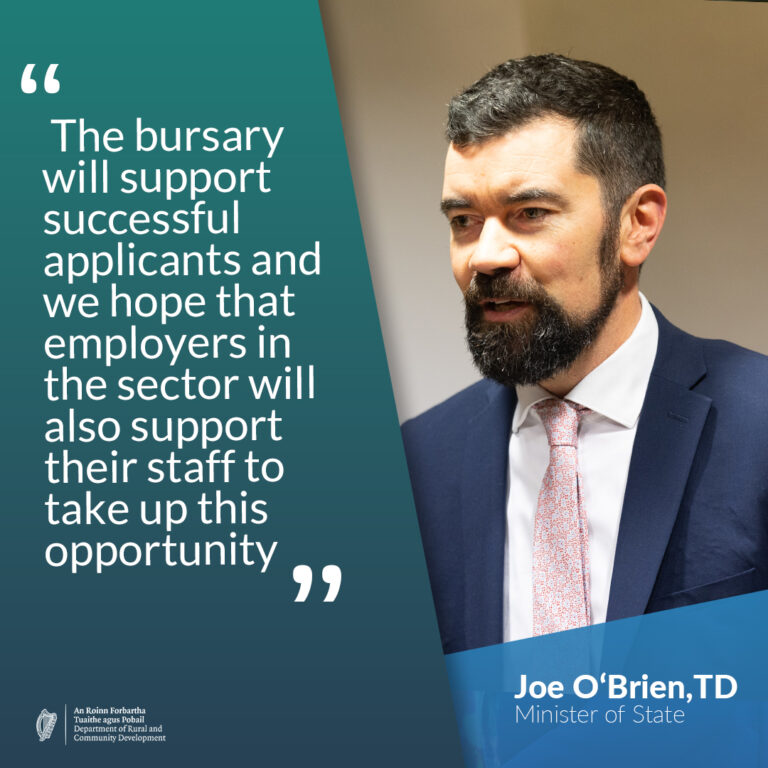
Minister for Integration, Community Development and Charities Joe O’Brien said: “The bursary will support successful applicants and we hope that employers in the sector will also support their staff to take up this opportunity.

“My department is currently engaging with AIEB on further proposals to support people employed and involved in community work who do not have any qualifications.”

Information about the bursaries is available from bursary@aieb.ie. For information about the programme, contact the Department of Applied Social Studies in Maynooth University.


New project to retrofit homes in rural counties passed over by private sector providers

However, a solution is on the way in four rural counties; led by community champions and technology advisors who hope to encourage rural homeowners to band together and retrofit their homes.

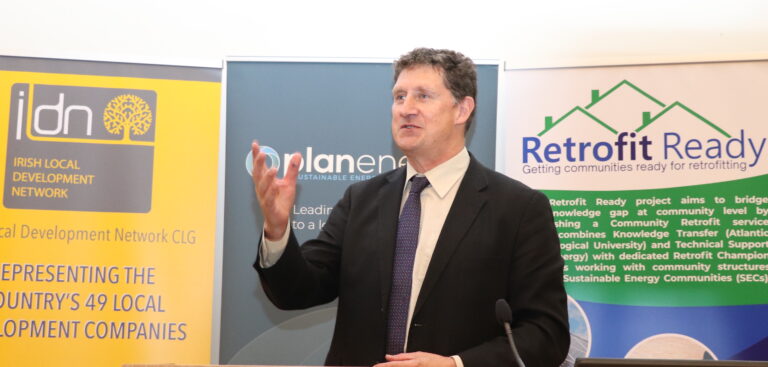
The scheme is one of 17 projects backed by the Government’s Community Climate Action Programme (Strand 2) and it was officially launched by the Minister for the Environment, Climate and Communications, Eamon Ryan, on May 5.

If the scheme being piloted in counties Cavan, Leitrim, Monaghan and Sligo proves a success, it will be expanded to take in counties Galway, Mayo and Donegal, quadrupling its impact. It hasn’t happened before now because – with the best will in the world – there was nobody to do the heavy lifting.

Gavin Forkan, managing director of PlanEnergy which employs 20 technical advisors on renewables and energy efficiency, spoke at the launch, which was held in the Atlantic Technological University in Sligo (where his company is based).

“The dispersed population means that it’s less attractive for retrofit contractors to do a bunch of houses in for example rural County Leitrim than it is in urban areas,” he said.

“The core of this project is that we will develop a community-led retrofit service – with the materials, tools and techniques developed in the communities for communities to run retrofit projects, overcoming the barriers that they currently face.

Retrofit Ready is spearheaded by a consortium led by the Irish Local Development Network with PlanEnergy, Sligo ATU and four local development companies – Sligo Leader Partnership, Leitrim Development Company, and Cavan County Local Development. It will be administered through Pobal.

“We’re focusing on four counties that have around 110,000 homes and, if we’re to align with national targets for retrofit, then 25,000 homes in those four counties need to be upgraded by 2030,” said Forkan.

Paul Skinnader, executive director, Pobal, said Retrofit Ready is one of the 17 projects funded under the Community Climate Action Programme, administered by Pobal.

Stumbling Block

“The aim is to transfer technical knowledge to the community retrofit champions. Those people have the key role. Owen McConnon (Cavan/ Monaghan) and Kyle Flynn (Sligo/ Leitrim) are our local champions,” continued Forkan.

“This is a full-time paid resource in the counties where we didn’t have that resource before. It was always a stumbling block when we came to executing a project at local level.

There was nobody to lift phones, there was nobody to drive a project forward. And this is the point of this role,” he said. “We’ve got a busy couple of years ahead. Phase one is underway, the initial assessment of where we stand – analysing the knowledge gap in local community,” he said.

That means talking to retrofitting contractors and understanding the challenges facing communities – some being poorer than others.

“Not every solution fits every house or every family, so it really needs to be very flexible and that’s phase two – bringing together groups of homeowners for funding applications.

Some communities will be quite wealthy and they’ll be well able to execute a project, so we need to have a different set of messages for those communities as for other communities.

“We see knowledge going in two directions. We’ll be learning how to establish community-centred energy working groups. Communities will be learning by doing a lot of the work themselves. We’ll be guiding them, but they’ll be doing much of the work.”

Developing a toolkit that captures the learning was important. “Then we’ll have the ability to replicate in Donegal, Mayo and Galway, and that would quadruple the number of homes we can target.

“This project could lend itself pretty well to other sustainability initiatives around community-led biodiversity,” he concluded.

– The Retrofit Ready launch took place in the Atlantic Technological University, Sligo


Minister’s Forecast

Minister Eamon Ryan believes that the narrative on climate action is about to change. “Mark my words – things are about to change. It’s changing here now,” he said. “We got the first quarter figures last week and ten thousand houses have been retrofitted, ahead of where we said we’d get as we ramp everything up.”

“Watch the solar panels go up right across this country. Changes in agriculture will happen, because the myth that farmers are against this is not the case. This urban versus rural green nonsense – it will stop. And we need to change the transport system. That’s probably the hardest part,” he said.

Speaking of “green energy, green agriculture, green jobs”, the Minister added, “When people hear ‘We need to act on climate change’, some ask ‘Why should I do it? The Chinese aren’t doing it. Why should I do it when we’re so small?’”

“I say, ‘That doesn’t matter – our size. And that’s not true that the Chinese are not doing it.” The Minister for the Environment, Climate, Communications and Transport was impressed at what he saw during a visit to China in March.

“We met one company in China delivering 45 gigawatts of solar. I spent a fantastic 10 days there, in honour of Saint Patrick, and we were blown away. If we think Europe is going in this direction and so is America – well, we’re only catching up with China where seven million engineers a year graduate.”

Maureen’s Kitchen

“The great thing about taking action is that everywhere is central, everywhere is on the front line, everywhere has the same opportunity to be centre stage, because it’s local as well as global.

“And we in this country have every chance to be good at this,” he said. Earlier that day, he met a homeowner who retrofitted her house.

“We were in Maureen’s kitchen, she’s going on 69 and she’s just got the house done up, with the heat pump outside.” He remarked on the relationship she built up with the development worker who persuaded her “to get out of the house and let them put in the insulation, put in the heat pump”.

“She spoke such simple truths about the benefits, saying ‘I should be paying 70 euro a week’ (for heating). Instead, she was saving money.

“It’s hard for that lady Maureen to change, to get out of the kitchen for two months, at a cost of 60 grand, but she did it,” said the Minister, wishing the Retrofit Ready Scheme well.

“Community development saved my life” claims Senator

Senator Eileen Flynn, addressing SIF 2023, said she “started as an activist at 18”, yet never thought she would end up working where she does now. It saved her life, she said.

“I never wanted to be a community development worker or a youth worker,” she told the 130 attendees.

“I thought community development was all about sitting around drinking cups of tea, but that is part of the work, bringing in somebody, speaking with them, showing them the light, giving advice.”

“A lot of people who are in addiction, homeless, on the edges of Irish society, they don’t need your help – they need support to be empowered in their own lives to work for themselves and for their own communities,” she said, calling for more investment in community development.

She herself went back to college at 25 years of age, as a mature student, and graduated with a degree in community development.

“I felt my passion to do something in life that would bring about social change, not just for the Traveller community, or for myself.

Community development is not about change for the few, but for the many.”

Run-ins with Department

She thanked the Department of Social Protection for the invitation to speak, because she had “many run-ins with the Department trying to bring about meaningful change for people suffering from economic disadvantage”.

She spoke about empowering people and taking collective action where she grew up, in Labre Park, Ballyfermot, the country’s oldest halting site in Ireland.

Where previously people with a problem with the local authority would ask community workers to make a call, now they make those calls themselves. “That’s empowerment,” she said. “Community development creates the spaces for it to happen.”

“We don’t see the change in a week or a year,” she said, but it was evident.

Campaign win

She recalled being part of a campaign led by Migrant Rights Centre Ireland to get state recognition for undocumented people.

“In 2022, they got documented. I was so privileged to be part of that campaign – to learn about the others in our society. It brought about change for a few thousand migrants in our country,” she recalled.

The SIF discussed how to overcome ageism and how older people could live life to the full. Senator Flynn viewed the discussion from a Traveller perspective: “When I think of older people – I’m 33 – if I got a health evaluation they’d mark me down as a 45-year-old. Travellers don’t have the privilege of living into our 80s and 90s.”

Jobs are a route out of poverty

Another theme looked at through SIF was education and employment. “A long-term sustainable job gives you a route out of poverty,” said Senator Flynn. “And community development does that work with poor communities.”

Recalling how for some years after 2009 the community sector was “cut, cut, cut” she called for more investment now. “We don’t value community development work, yet when community development is done right, 150% it can work and does work.

Considering the impact of the cost of living crisis on communities, she said, “Now more than ever we should be investing in community development work.” She also pointed out, “It is a profession. People study it for years and it does change lives.”

And it goes beyond simply changing lives. “For me, community development saved my life. It saves many Travellers’ lives – when people see a way out, see they do have a voice.”

Pointing to successes because of community development in St Michael’s Estate, Inchicore, she said, “It can work, it is a way out of poverty.”

In regard to inclusion, she said instead of just talking about it, “we should be seeing inclusion – in the Dáil, in supermarkets, in our hospitals and all our services.”

She drew attention to the launch recently of the National Action Plan Against Racism by Minister of State, Joe O’Brien. “We also need to see an equality strategy,” she concluded.

Galway’s new anti-racism network calls for solidarity and housing action

He was speaking as a member of the newly-formed Galway Communities Against Racism and Discrimination (GCARD) network. It held a rally on March 25 to mark UN International Day for the Elimination of Racial Discrimination, and, more recently, it stood in solidarity with people seeking international protection in Galway.

In May, over 150 people were relocated from an emergency direct provision centre in the Travelodge Hotel, Galway city, with only days’ notice of the move. “It tore apart their plans and lives built in the city. This kind of treatment is unacceptable and inhumane,” said GCARD.

GCARD was joined by Galway City Community Network in calling on the Government “to live up to its responsibility to keep people seeking International Protection safe”.

Nora Corcoran is the co-ordinator of the Galway Traveller Movement Traveller Homes Now Campaign. Speaking for the group, she said: “It was a horrendous scenario – so many people uprooted without consultation. Vulnerable residents who had only recently managed to gain confidence to engage with services were relocated to areas with limited services. There needs to be a better, more transparent communication system.”

The founding groups of the new network include: Galway City Partnership, Galway City Community Network, Galway Traveller Movement, Galway Council of Trade Unions, Galway Anti-Racism Network, Amach! LGBTI+ Galway, University of Sanctuary Galway, Community
Knowledge Initiative, and the University of Galway.

– Members of Galway’s African diaspora attending their Afrika Abú event last summer

Speaking at the launch, in March, Islammiyah Saudique Kadejo, CEO of Galway-based Gocom Radio, Ireland’s first ethnic minority interest community radio station, said, “We all need to understand that implicit bias can form the bedrock of racism so it needs to be named. Anti racism training needs to be mandatory in all workplaces.”

Nora echoed his views: “It is not up to the groups who experience the racism and discrimination to come up with the solutions, but it is up to the majority population to ensure that racism and discrimination is eradicated. Institutional racism and discrimination must end.”

Also speaking for GCARD, Imelda Gormally, a community development worker with Galway City Partnership, called “for an end to discourse that is based on a racist, sexist, regressive narrative that is targeting migrant/ refugee communities and hindering the attainment of rights and inclusion for minority communities such as the LGBTI+ communities.”

She added, “The group is further concerned about the take-up of these views in the general community given the long-standing experience of racism by the Traveller community…This narrative is hijacking underlying inequalities… based on failed government policies.”

Instead of sowing discord, solidarity is required. GCARD wants the State to invest in addressing racism and discrimination, saying, “This needs to start with naming a housing/accommodation crisis.”

National Plan

The group welcomed the Government’s launch, in March, of the National Action Plan Against Racism. GCARD wants socio-economic status added as a tenth protected ground for discrimination, adding to the nine existing protected grounds, namely age, disability, family status, gender, marital status, membership of the Traveller community, race, religion and sexual orientation.

The network is interested in hearing from similar networks that may have been established in other parts of the country. Call Imelda Gormally on 091-768305 or email imelda@gcp.ie.

Warnings to increase funding for volunteer-managed projects “before they collapse”

“We have entrusted delivery of services to the wonderful volunteer-led local and national groups. We have to recognise their realities before they collapse. We can’t have quality services on the cheap,” he says.

He and others, including national networks and trade unions (see Issue 79, Changing Ireland) have sounded an alarm over low pay, high staff turnover and high vacancy rates in projects that communities rely on for support.

“In the past, most of these organisations had salaries pegged to public service rates and there was a real recognition from state-finders of non-salary costs. Since the banking-caused crisis, these relativities have been broken and the only way salaries and overheads can now be met is by cutting services,” added Senan.

Senan previously worked for Area Development Management (now Pobal) and as a director of services with Fingal County Council. He has experience serving on the voluntary boards of at least 16 organisations, including Fingal Age Friendly Alliance, the Ballymun Social Regeneration Fund , the Citizens Information Board, Waterford Area Partnership, Dóchas and the Charities Regulatory Authority.

“Staff must be treated fairly or they will seek employment elsewhere and what will we do then to assist people with health and age challenges, who will run youth, social inclusion, education, drugs, homelessness, sports or arts programmes? Respect our volunteer culture. Fund it properly as we depend on it for so much,” he appealed.

Senan Turnbull, former director of services with Fingal County Council

Welcoming the report on the issue from The Wheel/TASC, he said, “Without proper staff remuneration and a recognition of increased operating costs the not-for-profit sector, which delivers so many essential services, will not be in a position to continue to deliver quality or quantity in the future.”

Some organisations had already “drastically cut services” to pay overheads”, Senan warned.

Catherine Kelly, Deputy CEO of WALK in Dublin, also welcomed the publication of the report by The Wheel and TASC.

“The staff of these community and voluntary organisations work so hard. They are underpaid and undervalued by the State. Their commitment, dedication and level of performance is immense. These services will close without them.

“We are constantly in staffing crisis and vulnerable people and families suffer as a result. It is so important that we keep this conversation going,” she said.

Helen Buggle, residential care manager at Smyly Trust Services, agreed: “If the voluntary organisations continue to lose their people, vulnerable service users and their families will be left exposed to more suffering. The staff in many of these voluntary organisations do not want to leave, but we are working on 2010 pay scales,” she said.

“We were deemed public servants when we were asked to bail out the banks and were told our pay would be restored when the economy got back on its feet. However once that happened we were no longer seen as public servants,” she said.

Music to their ears – Donegal teens jam with Dutch and Polish peers with Erasmus+

Over 150 students from eight schools made new friends locally and internationally and become musical wizards thanks to an Erasmus+ programme led by Inishowen Development Partnership.

The project exceeded its goals and was “an apex experience” in the lives of the students, according to one facilitator. The final report, just published, is overwhelmingly positive.

Over the two years up to May 30 of this year, 76 jam sessions took place, 11 tunes and songs were written, six bands were formed, and three international exchange visits took place involving teenagers from Ireland, Poland and Holland. 40 virtual jam sessions were also held, as Covid showed everyone how to link up musically online.

In the project’s first year, transition year students from secondary schools in Moville and Carndonagh, County Donegal, took part.

Throughout the project’s second school year, students from Scoil Mhuire and Crana College, both in Buncrana, rehearsed with musical facilitator Seamus Devenney. Their hard work paid off with a stunning performance in The Glassworks in Derry in March.

(You can watch videos of StagePass performances on their Facebook page: https://www.facebook.com/stagepasseu/)

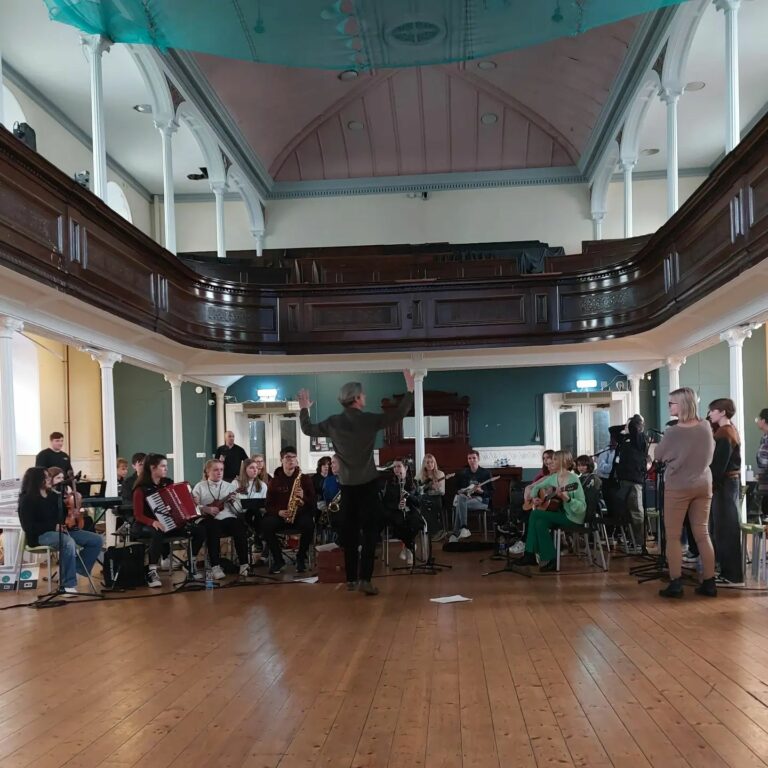
Students from Donegal, Poland and the Netherlands taking part in the Erasmus+ StagePass programme

Young people attending the nearby schools in Buncrana didn’t actually know each other much better than the students they met from Holland and Poland.

Scoil Mhuire student Kayla and Crana College student Jade both said they loved meeting people from the other schools.

“We go to school minutes apart, but we didn’t know each other or speak to each other. Now we are all so close,” said Kayla.

“The students worked so well together and Seamus really brought out the best in them,” said Katrina McGonigle, programme co-ordinator at Scoil Mhuire. She said it was “fantastic”.

“We are appreciative to IDP for giving us this opportunity,” she added.

Musical facilitator Seamus Devenney from Carndonagh, Co. Donegal, said, “It has been an amazing experience and the concept of this project is reaching far beyond its original goal.

“It will continue to have a profound effect on these young people’s future – it is an apex moment in their development into adulthood and will help shape the adults they will become in the future,” he added.

IDP’s StagePass co-ordinator Tracey McRory said IDP were delighted to again have the opportunity of collaborating with European partners. However, it was the students and the music they made that delighted her the most.

“They were up every day for rehearsals, no complaining, they are amazing ambassadors for their schools and their communities. Seeing their smiling faces and music in their hearts every day was just amazing,” she said.

“StagePass is a lot of work and even though it is ending for now, the future of creativity and music in Inishowen is safe in the hands of our schoolkids,” said McRory.

StagePass

StagePass aimed “to develop their core competencies and skills through the medium of music and in line with entrepreneurship education and performing arts”.

The exchanges involved visits to Gdynia in Poland, Leeuwarden in Holland and Derry.
W: https://stagepassmusic.eu/about-stagepass/

– Students from Donegal, Poland and the Netherlands taking part in the Erasmus+ StagePass programme

Erasmus+

The StagePass project was funded under ERASMUS+ through Key Action 2 which supports strategic partnerships in the field of education, training and youth.

According to Erasmus+, projects funded under ‘Key Action 2 – Co-operation for Innovation and the Exchange of Good Practices’ should result in the development, transfer and/or implementation of innovative practices at organisational, local, regional, national or European levels.

W: https://www.iky.gr/en/erasmus-plus-ka2eng

DFI warns of “unprecedented threat to essential disability services” as pay talks postponed

Disability organisations providing services nationwide under contract from the HSE say they are “gravely worried” following a further postponement of the Workplace Relations Commission (WRC) talks between trade unions and the government.

Reacting to yesterday’s postponement, Disability Federation of Ireland (DFI) CEO John Dolan said: “Disability organisations were relying on a positive outcome from today’s talks to reassure them that essential services will continue to be provided to disabled people.

“The non-reversal of deep cuts to pay and services during the recession, which ended in 2013, is not news to government. This situation has been festering for over a decade and it is compounded by a crisis where staff are leaving to simply move to the HSE and elsewhere to get the government agreed pay and conditions. Consequently, services to disabled people are being further restricted and downgraded on a daily basis for some time.”

Mr Dolan continued, “The government knows what needs to happen to properly resolve this crisis in critical services that disabled people and their families depend on. In fact, in the past month alone a DFI email campaign to TDs and Senators has seen 3,200 emails sent from across the country from individuals, families and disability services, all of whom are concerned about this crisis in their services.

“To put it plainly and simply – there are pay differentials in the region of 15% in this government sponsored two-tier pay system for staff who are doing similar or identical work to the same client group.”

He concluded, “A resolution is needed now – within days and weeks rather than months and years, so as to give confidence and assurances to disabled people and their families that these vital services will continue.

“Today’s last minute postponement of negotiations by the government side is further destabilising and causing fear and anxiety to disabled people and their families.”

Dorset Street community unites to build a better place to live and work

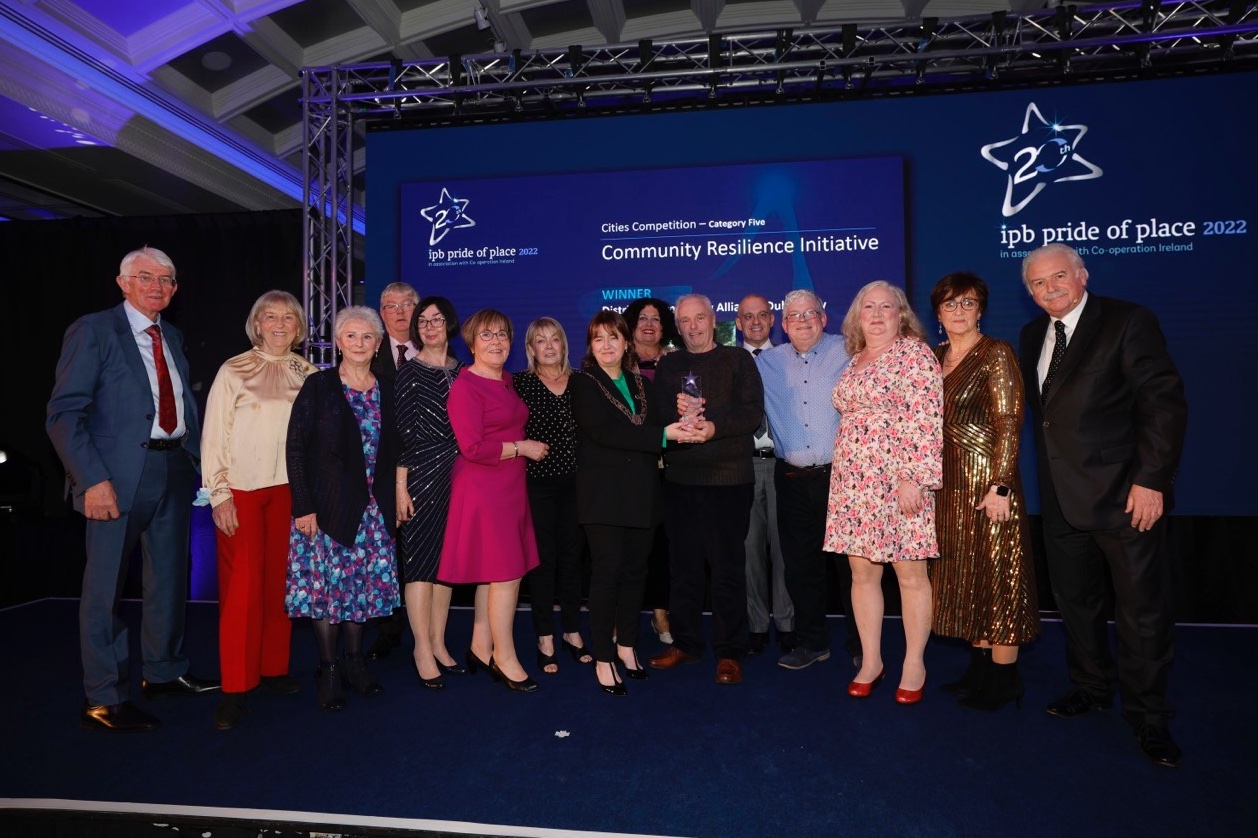
The District 7 Community Alliance, which represents seven residents associations in the inner city area, won the Community Resilience (City) Category.

Since 2017, the group has been working on plans to rejuvenate the locality and create a vibrant urban village.

“There was a big concentration of massage parlours on Dorset Street – there were about nine of them along the road. One day, the kids were getting off the bus and there was a man getting serviced by one of the women in a lane.

“The residents said enough is enough, and we got together and picketed every one of the parlours. The guards got involved and the last parlour was raided by the gardaí, immigration, Dublin City Council and the Revenue,” revealed District 7 Alliance chairman Tony Kelly.

Encouraged by the success of that campaign, residents contacted their local public representatives to find out what else could be done to improve their neighbourhood.

Members of the District 7 Community Alliance accepting their Pride of Place award earlier this year

Tony continued: “We had a meeting with Brendan Kenny (former Deputy Chief Executive of Dublin City Council), the residents and business association, and told him how we thought the street was going. He told us: ‘I’m going to put €25,000 on the table for you to get an architect and put a plan together for Dorset Street from the ground up’. He saw that we had something rare in the city – the businesses and residents working together.”

Together with local architects Kelliher Miller, who Tony says have “a great grá for the area”, the group put together the Dorset Street Together Plan over the course of 18 months.

In October 2018, an exhibition was held at 54-55 Upper Dorset St to present the draft Community Plan and invite feedback from the wider community. The pop-up shop ran for two months and was visited by over 700 people.

“Too many chippers”, unattractive shopfronts, a lack of on-street parking, the closure of two community centres, and traffic problems are just some of the issues that the plan set out to tackle.

Tony remarked: “We lost both of our community centres during Covid. One was sold and the council closed the other one. You have TDs and councillors saying we have to integrate, but where are we supposed to do it? That’s another battle for another day. We’re hoping to get the council community centre reopened.”

Locals attending the ‘Gateway to the City’ festival on Dorset Street in 2019

The concrete central median strip along the street is also “a bone of contention”, according to Tony. The plan suggests removing the central median to create space for wider footpaths, new cycle lanes, and parking bays.

It also suggests guidelines for improvements to shopfront designs and facades, and measures to restore and conserve the area’s Georgian and Victorian architectural heritage.

The creation and improvement of green spaces in the district forms a core part of the plan, including the development of a mini plaza, a micropark, and a ‘quiet village centre’.

The plan also includes a proposal for the creation of a ‘National Botanical Way’, which it describes as “a specially enhanced pedestrian route from Parnell Square linking to the Botanic Gardens via Blessington Street and Basin”.

The document raises the issue of ‘transience’ as one of the challenges facing the neighbourhood, pointing out the high number of AirBnb properties and student accommodation around Dorset Street.

It also lists the “lack of mixed-use” businesses as a problem in the area, alongside photos of several local takeaway shopfronts.

A 2021 article by the Dublin Inquirer highlighted concerns from the proprietors of some migrant-run food outlets, where they spoke of a lack of consultation on the Dorset Street Together Plan.

According to Tony, the businesses are “well-represented” on the business association by local restaurant and deli owner Tom McKeon and were given the opportunity to join the association.

“When we held the open days, a few of the businesses were worried it would cause their rents to go up. We told them we want to try to encourage more businesses to open up on the street. A few of them don’t want to see any change happen on the street.

“Dublin City Council even introduced them to their Shopfront Improvement Scheme, but there was very little take-up of it among the takeaways,” he said.

As Dorset Street is one of the principal thoroughfares to the city centre from Dublin Airport and the M1, the group also came up with a concept for a ‘Gateway to the City’ festival.

“In 2019 We went back and asked Brendan Kenny if we could have a festival, and he said ‘No problem’. So we established the ‘Gateway to the City’ festival for Dorset Street and the area around it. We expected about 1,000 to 1,500 people, but about 6,000 people attended,” explained Tony.

The festival has not been held since 2019 due to the pandemic, but Tony says Dublin City Council “has promised that the Gateway to the City festival will be back up and running”.

The implementation of the plan has faced a number of setbacks. As well as a global pandemic, a shakeup of electoral areas saw the District 7 neighbourhood moved to the Cabra-Glasnevin district. In early 2022, the Greater Dorset Street Together Plan was again put before the local authority, and was approved by the 14 councillors from the new electoral division.

Dorset Street certainly lives up to its ‘Gateway to the City’ label, and features in both Bus Connects – the National Transport Authority’s plan for a new bus network around the city – and Metro North plans, which complicates matters slightly.

Therefore, a working group made up of representatives from each of the groups and organisations was established.

“We had our first meeting before Christmas where we went through the plan. Bus Connects is specific to Dorset Street so a group was set up for Dorset Street separate from the other areas around it.

Bus Connects and the traffic department took away the plans and they’re going to come back to us and see what can be done,” said Tony.
After several years of planning, campaigning and setbacks, residents are yet to see any of the points on the plan make the transition from paper to pavement.

Some of the images taken from the Dorset Street Together plan

With all the relevant groups now finally taking the Dorset Street Together Plan into consideration, those living in this much-loved part of Dublin are hopeful their vision will eventually become reality.

Tony concluded: “This has been going on six or seven years now. Brendan Kenny had a vision from the beginning, and the architects are still on board with us.

“It’s a very strong community. A lot of us have been here a long time. My wife’s family are here three or four generations. People have deep roots in the area. And then you get new people coming in, and they bring a new aspect to it too. There’s a real love for the area.”

Dublin Theatre Festival is ‘All In’ for universal access

0

Now is a good time for community groups to start planning ahead for the autumn, and any community group in the wider Dublin area should consider attending the Dublin Theatre Festival (DTF) as it aims to be super-inclusive and participatory.

10% of tickets for selected festival productions will be made available for €10 to under 30s, unwaged, freelance artists and arts workers. Last year, 596 people registered for ’10 for 10’ tickets. This year’s festival runs from Sept 28 – October 15.

Meanwhile, the festival’s Access Programme aims to boost participation and access and, last year, 18 assisted performances were programmed in the festival.

Sharon White, audience development and sales manager, Dublin Theatre Festival
– Sharon White, audience development and sales manager, Dublin Theatre Festival

All In Access

As Sharon White of DTF says, “We recognise that there are barriers to attending the festival and the All In Access Programme aims to eliminate obstacles, and promotes and creates inclusion in the festival.

“We provide ISL interpreted, captioned, audio described, and relaxed performances for a range of shows in the festival,” she said.

To encourage wide society participation DTF offers:
• Assisted performances for audiences with some types of sensory disabilities or impairments.
• Free companion seats for individuals who need company or assistance to attend a show.
• Access passes which are designed to simplify the booking process. This allows people to book wheelchair spaces and reserved seating in advance. If you or your group registers for access passes, you receive automatic discounts and, if helpful, complimentary companion tickets.
• Access guides provide full venue and location details.

DTF will also try to provide additional services (eg transport) in response to individual needs.

The festival programme will be published at the end of July and registration opens for the various initiatives around that time, or make an early enquiry with DTF now (details below).

The assisted performances are programmed in conjunction with DTF’s venue partners and, says White, “Early registration enables us to identify other services or opportunities to develop the programme.”

All In Ticket Initiative

DTF is also seeking expressions of interest for participation in its All In Ticket Initiative, a scheme that provides groups and individuals with access to the festival with significantly discounted and complementary tickets.

The All In Ticket Initiative is available (but not limited) to the following organisations:
• People with disabilities / groups or individuals and their carers.
• Welfare groups.
• Immigrant, integration and refugee associations.
• Community groups

For more information, email: access@dublintheatrefestival.ie
T: 01 677 8439.