Friday, July 3, 2026
Home Blog Page 20

We go to the doctor for a medical prescription, but sometimes it’s a social prescription we need

0

A survey carried out by AXA earlier this year revealed that loneliness was a major challenge for many Irish people, with 60% of men and 67% of women saying they had felt lonely during the previous four weeks.

Google ‘the effects of loneliness on health’, and a list of scholarly articles appears featuring some alarming statistics, with one piece of research even stating that it increases the risk of early death.

Loneliness has also been linked to a higher risk of dementia, mental health conditions, and even cardiovascular disease and stroke.

It’s no surprise then that public health workers in Ireland have begun taking it seriously in the last five years.

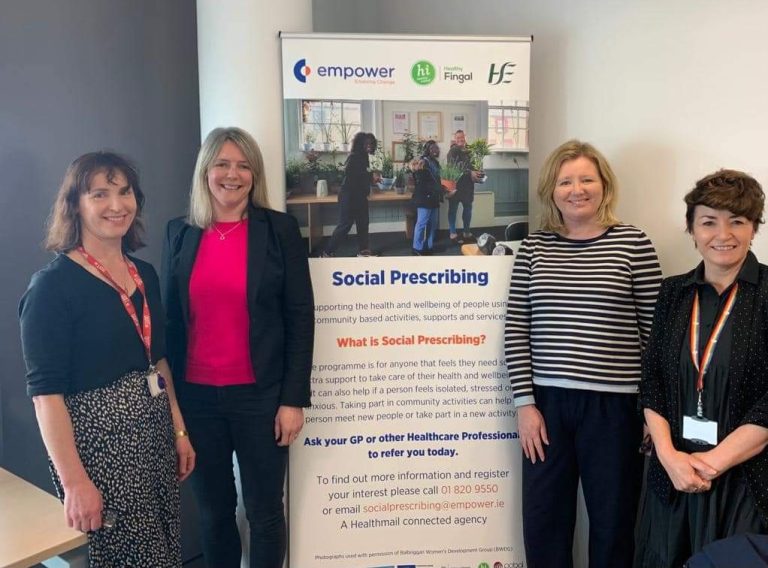
There are now HSE-funded social prescribing services available in 30 locations nationwide, where GPs and other health professionals can refer patients who are struggling with social isolation.

Pauline Mangan is a social prescriber and community development worker with Empower Local Development in Dublin 15.

She told Changing Ireland: “The idea is that it’s a kind of social prescription. So it’s for people that may go to the GP for various reasons. And really what they need is less a medical intervention, but more a social intervention. A lot of the time people go to GPs for loneliness, for mental health issues and stuff like that, or because they’re isolated or whatnot, and obviously that contributes to their health and wellbeing.

“A GP can refer someone to a social prescriber in their local area, and the social prescriber would work with them and develop a health and wellbeing plan, looking at what matters to them. The wording they use in the HSE is: ‘You go to your GP to see what’s the matter with you, whereas a social prescriber asks: What matters to you, what’s important to you, and what has happened that’s brought you to us?’.”

“We develop a health and wellbeing plan, look at what their needs are, what their priorities are, what goals they may have. From that we will develop some actions based on what their interest is in, what’s available locally, and we would support them to engage in different activities and groups and courses. It really is as simple as that, but it’s done at the individual’s pace.

“The support is as much or as little as the individual might need. Some clients have very little confidence or have been socially isolated for quite some time, so they may need a little bit of handholding. You may go along with them to a group. Others just need a bit of signposting and they’re perfectly able to go off and sort things out for themselves.”

Many of Pauline’s clients are recovering from mental health issues, or became isolated because English is not their first language.

“The reason that people tend to get referred to us will be loneliness and social isolation, depression, bereavement, recovering from addiction, physical inactivity. After Covid-19, particularly for older people, it was a struggle getting the confidence to go back out again and engage. People with intellectual disabilities often find they’re quite isolated once they finish the State schooling and the support that they’ve had. People who are unemployed, people who have long term illnesses (also avail of the service).”

She continued: “A lot of the time it’s around finding a local group that they can get involved in, or an activity such as arts and crafts. A lot of people like to do an activity as a way of getting in there first because they don’t feel under pressure to talk in a group.

“It’s looking at what the local community centres are offering, what adult education are offering, local activities and courses, women’s groups, volunteering, parent and toddler groups – anything that people really feel they need. English language classes, even walking groups.

“Other times people need a lot of help navigating the State services. Whether it’s to do with housing, benefits, sometimes you’re supporting them with that kind of stuff first.”

The service has received overwhelmingly positive feedback from both referrers and service users.

Pauline revealed: “I did a case study last year with one of my clients who had done quite well. She said she felt she got her own voice back, she’d started to see that she is ‘worth something again’. And she said: ‘I’d probably be circling around my own apartment. I wouldn’t know where to go, what door to knock on, that (social prescribing) gave me opportunities that I didn’t know existed’.”

IPS is good news for expanding mental health supports

Regardless of a person’s job readiness or personal situation (eg homelessness) David and 40 other employment specialists around the country support people to find work.

The Individual Placement Support (IPS) service they provide has proven a success abroad and is backed by the HSE since a pilot showed its worth in 2017.

At work, David has used his own experience with mental health challenges to assist his clients in gaining employment and moving forward in their recovery. Here, he talks about IPS supports and how they work:

The initiative supports people who are engaged with Community Mental Health Teams to find employment, and support them on their journey to full employment. Or, in many other cases people might be already in employment but might be out on illness because of their mental health conditions, and are linking in with myself to support them on their return to employment.

IPS is funded by the HSE and a host company hosts the service. County Kildare LEADER Partnership host IPS in my case. The local development companies are brilliant because it’s like a wraparound service. So if I’m working with Mary, who has never worked before in her life because of mental illness, I can refer Mary to (someone else in the organisation) for help with her CV, or a women’s group, or a workshop, things that to get her outside and into the community.

– David Doran, former employment specialist with County Kildare LEADER Partnership

The main goal is to find mainstream employment, but we cater for everything else that the client wants to do. It’s individual-based; it’s totally what the client wants. If someone comes to me and they want to find a job working as a postman, we go that road. I started the service during Covid time, so it was quite difficult. But since then, about 120 clients have passed through IPS. About 60 of them have returned to employment, 20 returned to education. Others have gone into, for instance, a CE scheme or social farming.

In the last two years, it’s really taken off and we’ve received more funding to hire more employment specialists. I’m speaking from my experience of my own mental health too. You can tell clients your story of where you came from, how you got here, and what a difference it made for you to return to work and have a purpose.

If someone’s referred to me, I sit down with them and I give them the spiel of what I do, and the different supports that I can provide, for instance linking in with employers, doing interview practice, building CVs, motivation and confidence-building.

NO EXCLUSION

There’s no exclusion here, no matter how ill the client – once they want to return to work, they’re referred to me. There’s no: ‘Well I don’t think you’re ready right now’. For instance, I was working with a client who was a very, very paranoid gentleman. He wanted to find work but he didn’t know how to go about it. This guy couldn’t go outside his door, but eventually we worked with each other on a career plan, step-by-step.

I suggested: ‘Do you want to do some volunteering first? Or social farming?’ So, we got him into some social farming. He spent 12 weeks doing that one day a week. He absolutely loved it. He came out of his shell, he enjoyed being outdoors, and got into horticulture. Now he’s doing a CE Scheme.

He absolutely loves it, he does his three days a week, he gets his qualifications. He said to me: ‘I might come back to you during the summer and we might actually look for mainstream employment’. This is a guy who, the team even said, he wouldn’t come outside his house, wouldn’t answer his phone. But we worked together, we stuck with it. He’s a prime example of someone using other services, returning to IPS, and now he’s ready to go into employment. So the outcomes have been brilliant.

TEACHERS, ACCOUNTANTS TOO

People ask: ‘What kind of jobs are they, warehouse jobs? Menial jobs?’ And yes, they are, but I have also worked with teachers, accountants, with media producers, people high up in tech. It’s a mixed bag of people you’re working with. And returning to work is part of recovery. You say to people when you’re working with them: ‘You’re the captain of your ship. I’m your shipmate, just guiding you along the way, it’s totally up to you where we go with this’.

We try as many different jobs as possible, and if they don’t work out, fine. Let’s move on to the next one. That’s comforting to people. It’s long-term support. It’s great when you don’t really hear from them, because that often means their life is brilliant again. But we do check in with them. There might be people who are gone off the programme two years, but I’ll drop them a text.

We abide by a handbook on IPS, which has its items and principles; that’s brilliant because you can’t sway off. I think that’s what makes it a success as well. An employment specialist has a maximum of 20 clients on a caseload at any given time. That’s what the rules say, because you’re not going to provide a good service to people if you go over that, someone’s going to miss out on something.

NO NEGATIVITY

Thankfully, I haven’t had any negativity. I do say to clients: ‘If you don’t get the job, or if they have an issue regarding mental health or whatever, then it wouldn’t be a nice place to work’. And that sells it for the client. I’ve had employers give guys a couple a chances. You work with people with serious mental illnesses and they could have aggression or serious things going on in their lives, and they (the employers) have been very catering.

It’s catching on. It takes the pressure off the mental health team as well. We hope this year we’ll have a national event in Croke Park. In America, they’re working with people with severe disabilities, physical disabilities, early school leavers, people who would have substance issues.

I’d like to see it spread out beyond the mental health side of things. It is very positive that the funding is there. It’s continuous roll-over funding, it’s embedded in the mental health services. It’s an exciting time to be working in the area. And you feel great because you’re helping someone, it’s very rewarding. – In conversation with Kathy Masterson

WHAT IS: ‘Individual Placement and Support’

Individual Placement and Support (IPS) supports people with mental health difficulties to find work. After over 30 years of research, it is considered the most effective way to support people with mental health conditions to find and maintain the right employment for them.

Currently, 41 IPS employment specialists are work with Community Mental Health Teams (CMHTs) covering all 26 counties. Another 11 IPS employment specialists are to be recruited later this year.

IPS’s unique approach involves integrating the employment specialists into the CMHTs. It has been used in labour markets in many different countries, in various settings, including: community mental health centres, rehabilitation programmes, supportive housing programmes.

In Ireland, IPS employment specialists work in partnership with the person, the employer, the CMHT, and the Local Employment Services.

They will help anyone availing of CMHT services who wishes to work, regardless of their job readiness, or factors such as homelessness, work history, substance abuse, mental health symptoms, a history of violent behaviour, cognition impairment, not adhering to treatment, being engaged by the legal system, and personal presentation.

Some people try several jobs before finding employment they like. Each job is viewed as a positive learning experience. The service helps clients to make a CV, search for a job, prepare for interviews, and supports them along the way. The employment specialists, with permission from clients, make the approach to employers.

The service is advertised in HSE clinics and services. HSE mental health workers can refer people to IPS. The first steps involve three or four sessions. Ideally, the job search will begin then and clients can continue to avail of IPS supports for as long as they need. 


Trishaws give people the chance to feel the wind in their hair again

0

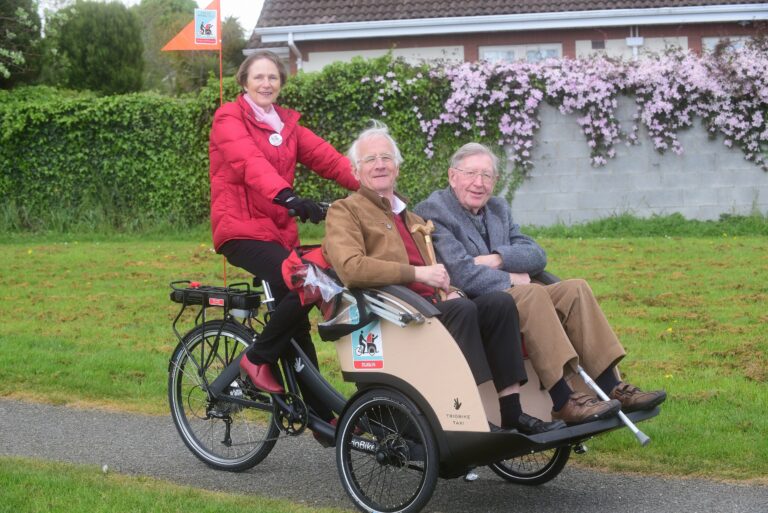
Founder and trishaw pilot Clara Clark, from Blackrock in Co Dublin, says the project reaps significant benefits for people’s mental wellbeing.

Clara first heard of the Cycling Without Age initiative through an Irish Times article in 2016. A year later she was pedalling people around in a trishaw – a bicycle with a sidecar.

She told Changing Ireland: “The idea was to take people who can’t walk or cycle for themselves for free, slow, cycling spins, piloted by volunteers. There’s a lot of people in care homes, and all kinds of places, who don’t get outdoors. They’re not getting out in the fresh air, and seeing things, feeling that sensation – the wind in your hair.

“I Googled it and I spoke to the founder, Ole Kassow; he set it up in Copenhagen in 2012,” she said. It is not a local transport initiative. “They’re not going to the bank or the shops. They’re just sitting on a trishaw, having this experience of cycling. Many older people will have been cyclists in their youth. Suddenly they’re back on a bike and they’re moving, they’re seeing things, and it’s the most freedom-giving sensation for people who physically aren’t able to do that for themselves. When I saw it, I said ‘I want that in Ireland’.”

After Clara and her husband Charles Mullan purchased their first trishaw, Clara decided to launch the first Irish Cycling Without Age initiative in the People’s Park in Dun Laoghaire, Co Dublin in 2017. The event caught the attention of radio stations and media outlets, and Clara suddenly found herself in the spotlight.

“The phone and the email started hopping with people asking: ‘Where do I get one? How does it all work?’ And I suddenly had a job. I’m not paid for it, but I run it like a business.” The first 35 trishaws were located in care homes, which so far had been the pattern in most of the 50 countries where Cycling Without Age operated.

A second model, featuring community or local authority-run trishaw schemes, developed here after Dun Laoghaire Rathdown Council approached Clara in 2020 seeking a trishaw for their new coastal mobility route. This led to the establishment of The Bike Hub in Dun Laoghaire, a separate social enterprise subsidised by the Local Sports Partnership.

Clara continued: “So suddenly we had a whole other model out of the nursing homes. And then other local authorities started popping up and started to order trishaws. “The other thing we discovered with The Bike Hub is that it’s not just for older people. It’s for kids with autism, kids with Down Syndrome, blind people, young people with intellectual disabilities. So we now say they are for all ages and abilities.”

From that first trishaw in 2017, the initiative has grown to 63 trishaws and counting. Cycling Without Age Ireland trishaws are now available in counties Dublin, Wicklow, Kildare Wexford, Waterford, Sligo, Leitrim, Clare, Louth, Kerry, Cork, Westmeath, Kilkenny, and Galway.

The vehicles don’t come cheap. A trishaw costs between €11,000 and €12,000 (including a spare battery). Clara is still at the helm, managing the website, marketing, pilot training and more, all on a voluntary basis. She charges a fee to carry out pilot training, just to cover her costs.

Meanwhile, The Bike Hub has created an online booking system for the trishaws, which they can sell to local authorities or other organisations. They then charge a fee for managing it.

Clara advises any care homes, local authorities or community organisations who may be interested in setting up a Cycling Without Age scheme to contact her directly. “I can tell them which trishaw to get, where to get it, what they need like an extra battery and a blanket, where and how it needs to be stored and insured. And I can come and do the pilot training there.”

She says the feedback from passengers has been “amazing”. “At a Dublin community hospital I talked to a couple of ladies who had been out (on a trishaw), both in their 80s, both in wheelchairs. ‘Freedom, we get out of here!’ one of them said, and that’s the response that we get all the time.

“Passengers are just blown away, and they can’t believe it’s free. We’re adding value to their lives, basically. We’re adding a bit of fun and craic to their lives.

“I’ve been doing this for six years, and that’s what gives me a buzz every single time. And I know from talking to the pilots that they get as much from it as they give.

“One thing I have noticed is that when you take out people with dementia, they start to notice things. They start to connect and ask questions in a way that they don’t when they’re sitting in a chair. They even start to speak, they start to smile, they start to relax,” revealed Clara.

Cycling Without Age Ireland has won a number of awards, including a Dun Laoghaire Local Sports Partnership Award, a Digital Towns Local Digital Hero award, a Nursing Homes Ireland volunteer award, and a Social Entrepreneurs Ireland Academy award. To find out more about Cycling Without Age Ireland, see: cyclingwithoutage.ie

Updated guide launched to assist inclusive community engagement 

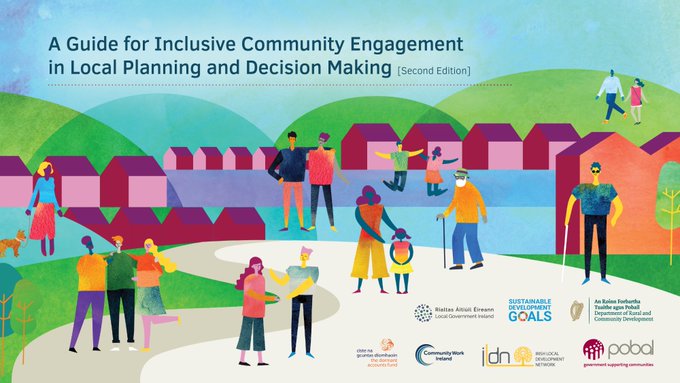
The guide includes resources to help local organisations to ensure that all voices are heard, with training to be provided to local authorities and other stakeholders.

The launch was held this week at an event showcasing the learnings from the project, which developed and tested strategies to assist marginalised and disadvantaged communities to be heard in local planning and decision-making processes.

The guide builds on the original version by using feedback from three pilot programmes.

It was also updated to include additional case studies and resources to support local authorities as well as any organisations engaged in planning and decision-making at a local level.

Minister of State, with responsibility for Community Development, Charities and Integration, Joe O’Brien commented: “I’ve said this before and will continue to say it – the best decisions are those we make together, where all are given the opportunity to share their perspectives and I am delighted that the process is dynamic and flexible so that we can adapt and improve as we learn what works best.

“I urge everyone here today to bring this guide back to their organisations, use it, champion it and embed it in your work.”

The guide builds on Ireland’s commitment to the Sustainable Development principle of ‘Leave no one behind’, and has been developed by the Department together with Pobal, Community Work Ireland, as well as members of the Irish Local Development Network and local government.

‘A Guide for Inclusive Community Engagement in Local Planning and Decision Making [Second Edition]’ is available here on gov.ie.

Take 6: Circular economy projects and businesses around Ireland

0


– Repurposed textile items for sale at Cycle Up’s shop in Athleague, Co Roscommon. Photo: Cycle Up Facebook

1. Roscommon Women’s Network CycleUp project

CycleUp featured in our Autumn 2019 edition (Issue 84) for being an example to others. It is run by Roscommon Women’s Network (RWN) and was established after members became concerned about textile waste. They were ahead of the EU in their outlook.

As a social enterprise, Cycle Up provides training in textile upcycling and creates new items from unwanted clothing. As well as the circular economy element, the project takes a community development approach, and seeks to “empower individuals through upcycling education and skills development while addressing the issue of textile waste”.

The organisation says it works to support the hardest to reach women and families to engage and participate. Today, CycleUp employs three part-time staff and five Community Employment workers, supported by a team of 14 volunteers. To date, they have upcycled more than 8,000kg of textiles resulting in a carbon saving of 65 tonnes. For more information, or to shop for products, see cycleup.ie

– An Mheitheal Rothar’s bicycle workshop in NUI Galway. Photo: An Mheitheal Rothar Facebook

2. An Mheitheal Rothar, Galway

The idea for An Mheitheal Rothar was born during a meeting of the NUIG Ecology Society. Members suggested establishing a space where students could repair their bikes “in an environment which encouraged peer-to-peer learning, civic and environmental responsibility and empowered people in their own abilities”.

After almost two years of groundwork and negotiations with the university, An Mheitheal Rothar’s ‘Ecospace’ workshop was established on the NUIG campus in August 2012.

The organisation now operates a second premises, Siopa Rothar at Galway Shopping Centre. An Mheitheal Rothar runs DIY bike repair workshops for the public at its NUIG premises, where participants carry out repairs on their own bicycles with guidance from volunteer mechanics. W: bikeworkshops.ie

– Instruments given to the Seamus Ennis Arts Centre, Naul to be used for music lessons. Photo: Fingal County Council

3. Fingal County Council’s musical instruments project

In 2019, Fingal County Council set up a musical instruments project, where instruments given to the council’s recycling facilities for disposal are cleaned and mended.

The refurbished instruments are then distributed to various organisations such as centres for autism, addiction and rehabilitation. The projects accepts all kinds of instruments, such as guitars, ukuleles, drums, violins, keyboards, electric guitars, and accordions.

Accessories such as amps and cables are also accepted at the council’s recycling centres in Estuary, Swords and Coolmine.

W: fingal.ie/instruments-project

– Recycle IT, a community recycling service in Clondalkin offers a pick-up service for electrical items

4. Recycle IT, Clondalkin, Dublin

Recycle IT, based in Clondalkin in Dublin, is a not for profit, social enterprise that creates sustainable local training and employment through electrical, electronic, and metal recycling for reuse.

It offers a drop off service, charity collection, a business or community collection service, and a home collection service for old, damaged or unused electrical, electronic or metal items.

Recycle IT will take any electrical items with a plug or a battery. It also accepts small battery-operated devices like electric toothbrushes, mobile phones and pocket radios.

In 2022, Recycle IT processed 833,000kgs of electrical, electronic and metal items for recycling. Income generated by collection and breakdown of waste is reinvested in training and employment and encourages environment awareness. W: recycleit.ie

– A clothes swap held by Change Clothes in Crumlin, Dublin. Photo: changeclothes.org

5. Change Clothes, Crumlin, Dublin

Change Clothes Crumlin (www.changeclothes.org) is a community-based clothing reuse hub, offering reuse solutions for clothes at all stages of their lifecycle. It holds clothing exchanges for unworn or lightly-worn clothes, a rental service for vintage occasion wear, and upcycling and repair workshops and services for clothes in need of some TLC.

Rags from clothing items that would otherwise go to landfill are repurposed into new products. Despite only coming into operation in the summer of 2022, by the end of the year Change Clothes facilitated 1,239 clothing swaps and upcycled 53 items, saving a total of 1,292 pieces of clothing from landfill.

– Oksana from Odesa was recently presented with a donated bicycle refurbished by The Good Bike Project. Photo: The Good Bike Project Instagram

6. The Good Bike Project, Ushers Island, Dublin 8

Since The Good Bike Project was set up by Paul McQuaid in 2022, more than 2,000 donated and refurbished bikes have been provided to refugees all over the country.

Paul was compelled to set up the project from his bicycle shop, River Cycles, after a friend told him of a Ukrainian mother and children who were in need of bikes to get to school.

He kindly gifted them bikes from his shop, but quickly realised that there was a great need for bicycles among the refugee community, so a larger scale response was needed.

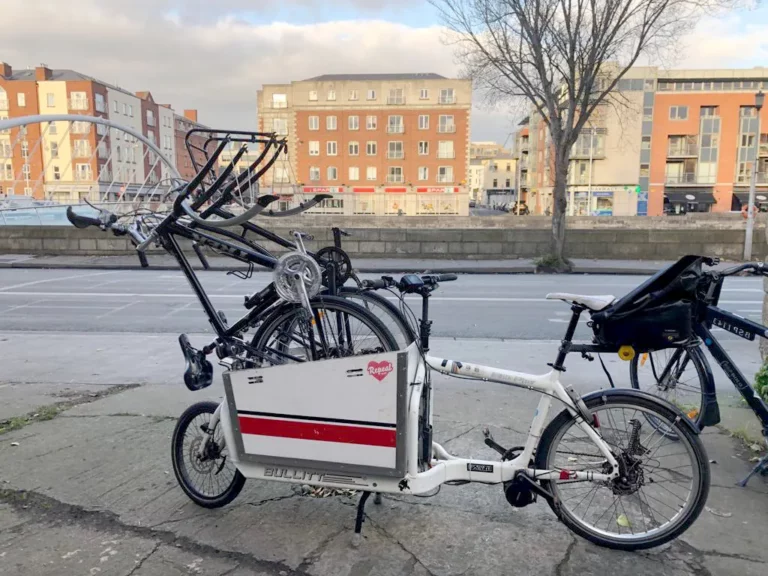
Courier company DPD soon offered their assistance, and now deliver three bikes daily to refugees across Ireland. W: thegoodbikeproject.com

Circular economy keeps the world going round

0

The economic model recognises that the Earth’s resources are finite, and that like in nature, there should be no waste – everything should be transformed into materials and products that can be used again.

Our current economic system is largely linear; natural resources are used to create products that are then used and thrown away. The circular economy ties in with the zero carbon movement, and aims to cut down on manufacturing, keep products in use for as long as possible, and reduce waste.

It does this through recycling, upcycling, repairing and reusing items, as well as sustainable design principles, and business models that offer products to share or rent rather than a one-off purchase.

Internationally, governments are beginning to recognise the importance of the circular economy model. Circular principles are central to the EU’s Industrial Strategy and the EU Green Deal, and Ireland’s first national circular economy strategy was launched in December 2021. A total of €110 million was allocated to the development of Ireland’s circular economy under Budget 2024.

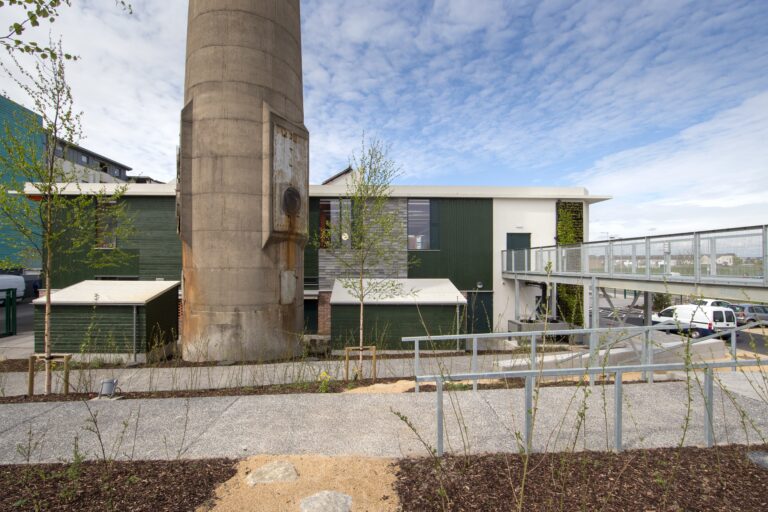
Ireland’s National Centre for the Circular Economy is located at the Rediscovery Centre in the repurposed Boiler House in Ballymun.

Describing itself as “a creative movement connecting people, ideas and resources to support greener low-carbon living”, the Rediscovery Centre brings together artists, scientists, designers and craftspeople through the common goal of promoting sustainability.

The centre also houses four circular economy social enterprises: Rediscover Furniture, Rediscover Fashion, Rediscover Paint and Rediscover Cycling.

It offers workshops and conducts research activities that support national waste prevention and climate action policies.

The Rediscovery Centre also houses an Eco Store selling sustainably made products from its own social enterprises, and more than 20 other independent Irish suppliers.


Sixth tranche of funding to assist community and voluntary groups with energy costs

0

A total of 876 groups have now benefited from the scheme, while more than €1.42 million has been disbursed.

The scheme was launched in response to the rising cost of energy and the impact it is having on the sector. It provides community and voluntary groups with a one-off contribution towards the increased energy costs they faced in 2022. Payments will issue to the organisations immediately.

 Among the successful applicants announced today are:

  • Donegal – Crossroads & Killygordon Enterprise Centre: €4,260
  • Dublin – Fettercairn Community and Youth Centre: €7,186
  • Roscommon – TSP Suil Ar Aghai CLG: €3,256
  • Whitechurch & Waterloo Community Association CLG: €3,286

Minister for Rural and Community Development Heather Humphreys said: “While the grants may be small in nature, I hope they will give valuable breathing space to groups that form the backbone of our communities, delivering essential services and supports and providing facilities to communities all over Ireland.”

 Minister of State Joe O’Brien added: “This scheme was about ensuring support to community and voluntary organisations of all shapes and sizes that might have fallen through the net of other schemes.  Over the course of the six tranches, the scheme has given tailored assistance to small local halls and to large, national organisations.  I hope that this announcement of funding will help these 30 organisations to continue their vital work.”

The government is also urging householders and businesses to ensure that they are availing of the supports that are in place. For more information on the supports available visit: the Reduce Your Use webpage.

Click here for information on the full list of successful applicants.

Ploughing Championships to help promote outdoor recreation, and responsible dog control

0

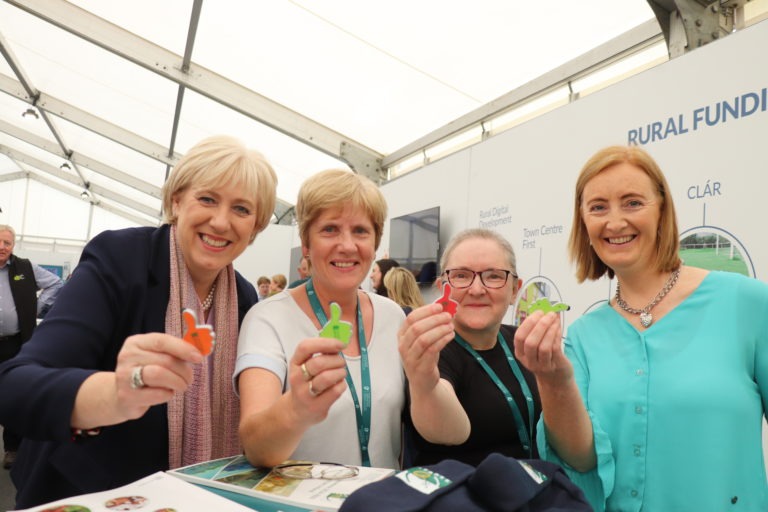
The sustainable development of outdoor recreation in rural areas will be a key focus for the Department of Rural and Community Development at this year’s National Ploughing Championships, commencing next Tuesday in Ratheniska, Co. Laois.

While the Department is encouraging people to embrace Ireland’s outdoors, it is highlighting the need for it to be done in a safe and respectful manner.

The Department’s exhibit will include Water Safety Ireland demonstrations, advice and support from Rural Recreation Officers and an area focusing on responsible dog ownership.

The Department says the issue of dog attacks on livestock “is of grave concern to the farming community”.

Local authority vets and dog wardens will be at the exhibit discussing the importance of keeping dogs under control, the issues of livestock worrying, the requirement to have a dog licence and general animal welfare.

Minister for Rural and Community Development Heather Humphreys commented: “Visitors to our exhibit will notice the focus on responsible dog ownership where we will be emphasising the importance of keeping dogs under control in rural areas and dog owners’ responsibilities.

“We will be reminding attendees of the need to respect landowners’ requests and about where dogs are welcome and where they are not. Attacks by dogs on livestock cause huge emotional and economic harm to our farming families.

“It is vital that we promote responsible behaviour so everyone can enjoy the countryside without causing harm to farmers’ livelihoods.”

The Department’s exhibit, ‘Our Rural Future – Supporting People and Communities’ will be located in the Government of Ireland Village (Block 3, Row 22, Stand 348).

It will also include information on rural and community funding, Public Participation Networks, Volunteer Ireland, coding demonstrations, and more.

In addition, there will be stands from:

  • Unfair Trading Practices,
  • Revenue Commissioners,
  • Competition and Consumer Protection Commission,
  • Workplace Relations Commission,
  • Department of Social Protection, and
  • Health Insurance Authority.

For further information visit gov.ie/ploughing

Follow the Department for regular Ploughing updates on Twitter, Instagram, Facebook and LinkedIn


Pride of Place is coming to Armagh

0

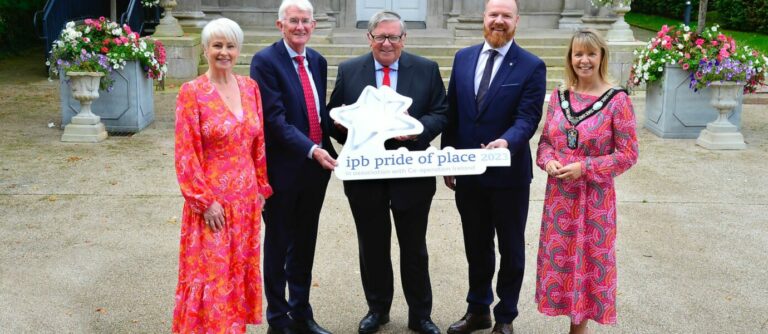
Hundreds of delegates from across the island of Ireland are expected to travel for the awards, which will name the winners of the annual competition organised by peacebuilding charity Co-operation Ireland and sponsored by IPB Insurance.

Established to promote and celebrate the best in community development, the awards recognise the selfless efforts of people in making their local neighbourhoods better places to live, work and socialise.

Pride of Place is an all-island competition, which sees local authorities nominate groups in their communities who they feel have made a significant contribution to improving their neighbourhood, working collectively.

The competition culminates with a Gala Awards Ceremony.

2023 marks the 21st year of the awards and the ceremony will be hosted by UTV’s Pamela Ballantine.

Speaking at the launch at The Palace Demesne this weekLord Mayor of Armagh City, Banbridge and Craigavon, Alderman Margaret Tinsley said: “We are delighted to host this year’s Pride of Place Awards Ceremony and we look forward to bringing community groups together, to recognise and celebrate the valuable impact volunteers make to community life. I’m looking forward to welcoming everyone to the historic city of Armagh as a special award evening awaits our wonderful guests.”

Peter Sheridan, chief executive officer, Co-operation Ireland added: “Co-operation Ireland is incredibly proud to be a part of Pride of Place as the awards enter their third decade.

“We work to build relationships across the island and Pride of Place plays a critical role in that work.  The impact the awards have had in towns and villages across the island since 2003 cannot be underestimated, and the continuing success of the awards is down to the dedicated volunteers and their love of where they live.”

The countdown is on to Make Way Day

0

Disability groups and activitists and local organisations around the country will be out and about highlighting obstacles and potential hazards on footpaths such as: illegally parked cars and vans blocking footpaths, bicycles or motorcycles chained to lamp posts that can create a trip hazard for a visually impaired person, illegally-placed sandwich boards, bins, barrels and other obstructions.

The Disability Federation of Ireland will also be carrying out an online survey again this year to gather information on the obstacles that people meet on their streets. The tool will be available on the Make Way Day website – www.makewayday.com.

For updates on the campaign, follow #MakeWayDay23 on social media or go to www.disability-federation.ie.

Culture Night is back and it’s turning 18

0

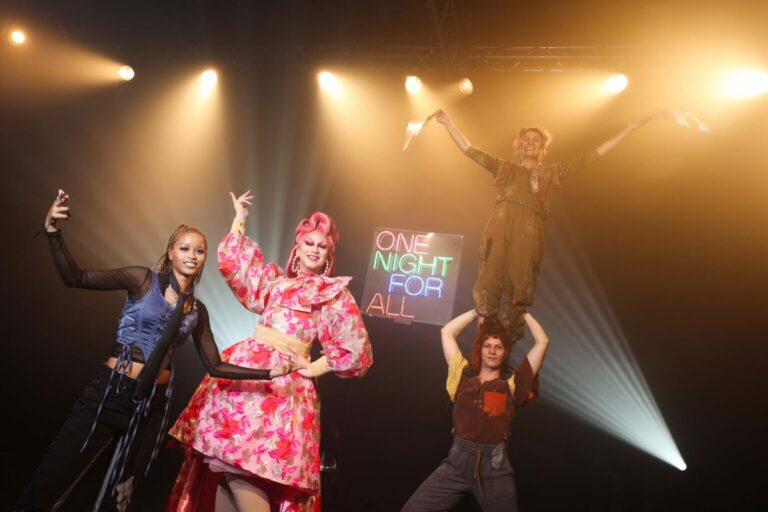
Organisers say: “Culture Night is about opening doors and inviting people in to experience a range of quality arts and cultural events for free. It is a chance for each one of us to connect with the arts and experience something new. Over the years special attention has been given to creating spaces that are inclusive and safe.

“Culture Night celebrates belonging and is for everyone, so no matter what your age or inclination, go check out the Culture Night programme (https://culturenight.ie/events/) to see what free events are happening in your area.”

Culture Night was conceived by Temple Bar Cultural Trust in 2006.

The initial intention with the project was to connect various cultural spaces in Dublin and open them up to later audiences.

During its first year, 40 cultural institutions took part. Now, stewarded by the Arts Council in collaboration with local authority arts offices, the initiative has grown into one of the country’s largest free cultural events.

Accessible events that are family-friendly and suitable for all ages have always been a priority for Culture Night, and this year is no different with a packed programme featuring something for everyone.

Culture Night Late is also back for its second year, thanks to an Arts Council funding programme of the same name. The fund was conceived as part of the Night-Time Economy Support Scheme, which was developed by The Department of Tourism, Culture, Arts, Gaeltacht, Sport and Media in 2022.

The Culture Night Late programme includes cabaret in Cork, a pop-up Gaeltacht in Galway, and a discussion on Buddhist sacred spaces in Dublin.

For those unable to take part in Culture Night due to illness, Read Mór, the Arts Council’s book-gifting project, will gift books from a list of 30 Irish titles to patients in seven hospitals around the country.

RTÉ will also stage a number of live broadcasts at various events nationwide.

For more information on Culture Night, go to www.culturenight.ie


Join the Climate Conversation to have your say on the future of the environment

According to the Department: “Government, communities, industry and individuals each have a part to play to help Ireland shift to a carbon-neutral future.

“The government want to hear how they can engage, enable and empower people to take action and realise the potential of moving towards carbon neutrality. Becoming a climate resilient society will help us to cope with the impacts of a changing climate and we are committed to achieving this future through a just transition, meaning all voices will be heard in a fair and equal manner, and new opportunities will mean no one is left behind.”

Climate Conversations 2023 will help to inform the Climate Action Plan 2024.

The Plan’s purpose is to set out a roadmap for meeting Ireland’s 2021-2025 legally binding carbon budget, that is, the total amount of emissions that may be emitted in the State during a five-year period.

Ireland remains the third worst emitter of greenhouse gas emissions in Europe.

The latest projections by the Environmental Protection Agency and An Taisce show that Ireland will fall significantly short of its 2030 legally binding emissions reduction targets.

An online questionnaire is now open where people can give their views on shopping, reuse and recycling, food and food waste, heating our homes and sustainable living, local environment and climate change.

The closing date for submissions is 5.30pm this Friday, September 8.

Anyone with any queries about the questionnaire can email ClimateConversation@decc.gov.ie


End Child Poverty Week – Call for Budget 2024 to be “Children’s Budget”

The week will place a spotlight on key thematic areas of child poverty, including early years, education, income, national action and local plans, child welfare and alternative care.

Ahead of the launch of Budget 2024 on October 10, the Children’s Rights Alliance is calling for “a Children’s Budget” – one that is designed to break the cycle of poverty affecting children, young people and families across the country.

Speaking in response to the publication of the Government’s Child Poverty and Wellbeing Unit Programme Plan earlier this month, Tanya Ward, Chief Executive of the Children’s Rights Alliance said:

“In the past few weeks, we have seen the publication of several seismic reports into children’s care and wellbeing along with a further increase in the number of children experiencing homelessness in Ireland.

“We need to see ambitious thinking and significant and strategic investment in children and young people to break the cycle of poverty that holds them back from reaching their full potential.

“Child poverty affects every aspect of a child’s life and the longer a child lives with the weight of poverty on their shoulders, the greater the risk of it casting a shadow over the rest of their future.”

Each day during End Child Poverty Week 2023, a event featuring a keynote speaker and expert panel discussion will take place both in person and online focusing on the each of the key themes.

Keynote speakers throughout the week include Senator Lynn Ruane; psychologist Dr Sharon Lambert; assistant secretary general for social policy, Elizabeth Canavan; social studies professor Hugh Frazer; and Professor Mathias Urban, of the Early Childhood Research Centre at DCU.

For more information on each of the daily events, or to register to attend online or in person, go to https://www.childrensrights.ie/content/end-child-poverty-week.

First Local Action Groups to deliver LEADER 2023-2027 funding announced

The LEADER programme promises to provide €180 million to support rural communities and enterprises between 2023 and 2027.

Carlow and Tipperary LAGs are the first two approved from an ongoing process to select the LAGs that will deliver this funding throughout rural Ireland.

The LAG in Carlow is led by the Local Community Development Committee (LCDC) in partnership with County Carlow Development Partnership and Carlow County Council and will receive €4.9 million in funding to support a range of activities in the county.

The LAG in Tipperary is led by the Tipperary LCDC in partnership with North Tipperary Development Company, South Tipperary Development Company and Tipperary County Council and will receive €7.8 million in funding to deliver its strategy.

South Tipperary Development Company commented on social media: “Delighted that Tipp is one of the the first two areas approved for the new LEADER Programme. Looking forward to working with communities and enterprises in the years ahead with our partners Tipperary LCDC, North Tipperary Development Company, and Tipperary County Council.”

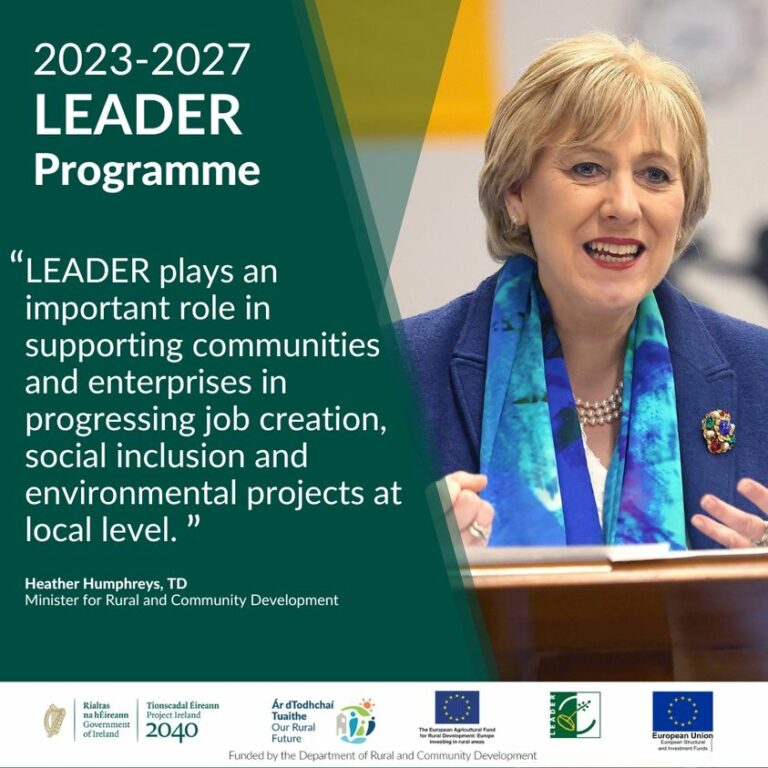
Speaking at today’s announcement, Minister for Rural and Community Development Heather Humphreys said: The LEADER Programme is based on a community-led, bottom-up approach to rural development right across the country. It plays an important role in supporting communities and enterprises in progressing job creation, social inclusion and environmental projects at local level.

“I look forward to seeing the impact of the implementation of the 2023-2027 programme and to ensuring that LEADER continues to play a central role in supporting rural communities into the future. As Local Development Strategies are approved across individual LEADER sub-regional areas, the LAGs can commence the process of seeking and approving applications for funding from communities.”

Further details of the appointment LAGs for the remaining sub-regional areas will be announced over the coming months as their local development strategies are approved.

The LEADER programme is co-funded by the EU under Ireland’s Common Agricultural Policy.


€3.5 million funding to maintain drugs services as C&V sector pay crisis continues

Minister for State for Public Health, Wellbeing and the National Drugs Strategy, Hildegarde Naughton announced this week that the funding will be distributed by community healthcare organisations (CHOs), based on guidance issued by the Department of Health.

Just last month, the Local Drug and Alcohol Task Forces (LDATFs) chairs network warned that community drug task forces were being forced to turn people away due to a staffing crisis in the sector.

The organisation said the task forces were unable to fill vital roles as potential employees instead opted for similar positions at the HSE with higher pay and benefits such as pensions.

The group stated that the sector was struggling due to a funding shortfall and an increased workload, largely driven by an almost 400% rise in the use of crack cocaine.

Ahead of a meeting in Dublin last month, the LDATF chairs network said it needed a €3 million increase in funding in Budget 2024.

Earlier this year, Changing Ireland reported on the recruitment and retention crisis in the community and voluntary sector, with The Wheel CEO Ivan Cooper stating that there was a pay disparity of 12-15 per cent compared with similar roles in the HSE.

He also stated that there were more than 1,000 unfilled posts in the sector.

The crisis continues as up to 5,000 workers in Section 39 community and voluntary organisations nationwide are expected to ballot on industrial action on September 4.

A SIPTU Health Division message sent to members this week said there had been a breakdown in talks between government departments and unions regarding “pay justice” for staff of state-funded Section 39 services.