Friday, July 3, 2026
Home Blog Page 58

Summer edition just PUBLISHED

The summer edition of ‘Changing Ireland‘ – marking 10 years in operation – will be available online from lunchtime today and in print next week! The lead story is about Community Resilience – download the magazine from our homepage: https://www.changingireland.ie/


This edition covers:

NEWS OF WORK ON THE GROUND
Mary Robinson, the Dalai Lama & Rita Fagan
Bofin shows community work can be fun
Crumlin projects open doors to public
Theory & practice ignored
Striking community workers
Limerick’s new one-stop shop for unemployed
Man in court over hatred charges
100 years of International Women’s Days
World Cup in Cavan
IN BRIEF: €2m for Travellers; Westmeath coverage; Galway tops for community development
Clondalkin helps asylum-seekers challenge deportation
Cork Travellers celebrate on the double
COMMUNITY SECTOR NEWS
Dublin jobs conference takes unusual approach
Galway: ‘Community Centre’ for sale
  
INTERVIEW: Minister PHIL HOGAN

SURPRISING INTEREST IN TÚS
3,000 groups apply, 1,200 people recruited
Tús uptake in Dublin, Mayo and Kilkenny
INTERGENERATIONAL WORK IN DUBLIN & CORK
ART & COMMUNITY WORK IN CORK
COMMUNITY & VOLUNTARY NEWS
Facing up to unfair salary differences
Mayor says work “bull” at Citizens Forum
21 COMMUNITY SECTOR / PROGRAMME UPDATE
63 bodies approved out of 149 hopefuls
IMPACT highlights 20% cuts

NATIONAL PROGRAMME TARGETS 2011
Jobs challenge being met, says Network
Island projects seek some independence
Programme takes shape
CONTROL OF HORSES ACT, 15 YEARS ON – PART 1
In focus: Cherry Orchard Equine Centre
HORACE, OUR GOOD NEWS CORRESPONDENT
COMMUNITY WORK ON FILM
Monaghan produces community work DVD
Community DVDs – Do’s and Don’ts!
RESOURCES: MAPPING COMMUNITIES
Social inclusion mapping now a reality
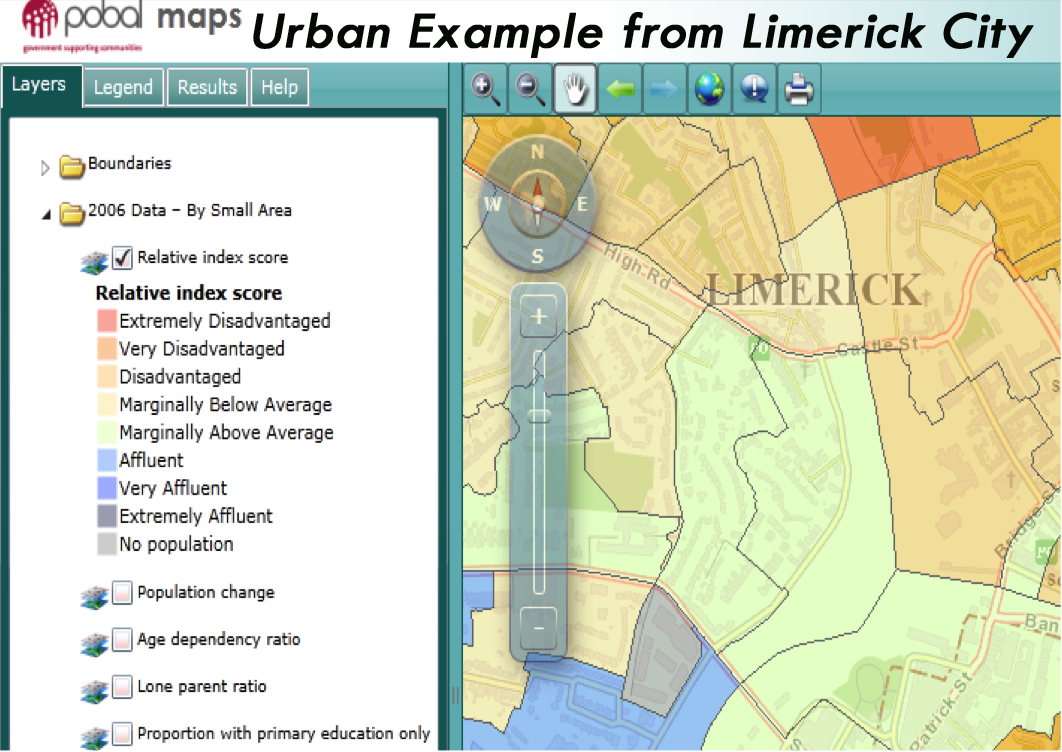
How to use Pobal Maps
LETTERS
Tús coverage disappoints
Happy birthday CWC!
Volunteers needed

MEN MATTER
A father’s story from the heart


Island projects seek some independence

English-speaking islands are moving closer to an agreement on a management structure for crucial projects funded through the Local and Community Development Programme. 

Negotiations are continuing with the Department of Environment, Community and Local Government on how best to manage the staff and work of five Community Development Projects.
Photo by ‘Changing Ireland’: the ferry to Inishbofin.
The five projects concerned are on Clare Island and Inishturk in Co. Mayo, Inishbofin in Co. Galway and Bere and Sherkin islands in Co. Cork which also provide support to the smaller Dursey, Whiddy, Long and Heir islands.
“We wanted to stay independent if we could, but that wasn’t a runner,” said Bere Island CDP co-ordinator John Walsh.

The proposal being currently looked at by the Department, said John, would see two companies manage the island projects, one dealing with with Cork, the other with Mayo and Galway.
The chairperson of the Federation of Irish Islands, Padraic O’Malley, stressed in June that islands needed an unique and innovative inter-departmental and local authority approach to the rationalisation and integration of CDPs, farm schemes, fire-fighting, primary school education and healthcare.

NEW RESOURCE: POBAL MAPS

– Social inclusion mapping now a reality

With the click of a mouse, you can now view levels of deprivation in your area under a range of categories and down to street level.
You don’t hear people saying ‘Thanks to Pobal’ everyday, but that’s where the credit is due and this is a free resource which people will tend to underestimate until they try it out.

As the CSO releases new information, the intention is to update the data, building up fresh layers on the map, where you can zoom right in on the community where you work and/or live to show where the needs are greatest.
The 2011 census information will bring us right up-to-date, since the country has entered recession territory since the last census in ’06.
Pobal’s John Manning reported: “Our new online mapping system went live on February 8th and we have seen a huge level of interest since then.”
An update in April added boundary information and street level mapping. 
“It is our intention to add datasets from other programmes to the system and build up a rich set of publically accessible information,” said John. “We will also seek to include additional functionality to the system as appropriate at regular intervals.”
CHILDCARE DATA NEXT
An update this summer will map more than 4,200 early education and childcare facilities that participate in the national childcare schemes funded by the Department of Children and Youth Affairs.
What it means for parents is that they will be able, for example, to access the free preschool year for their children. It will also allow city and county childcare committees, Pobal and the Department of Children and Youth Affairs to manage allocations, monitor changes in service and plan for future needs.
John said that Local Development Companies are going to find the mapping very useful as they engage in strategic planning for their areas.
“They can identify down to street level where the focus of their activities need to be,” said John.
Other groups will find it equally enlightening.
If you’re at a computer, you can try it out straight away at: https://maps.pobal.ie/
Pobal welcomes feedback and suggestions for improvements and additional functionality. Email John on: jmanning@pobal.ie
 
How to use Pobal Maps
You can use Pobal Maps for five minutes to get a picture of how your area measures up or spend time on it to help with strategic planning.


In technical terms, Pobal Maps is a new GIS (Geographical Information System) online application, as John Manning from Pobal explained it.
It allows users to easily compare and contrast electoral divisions and small area profiles in terms of their relative level of affluence or disadvantage.
WHAT’S A SMALL AREA?
Small areas, as defined by the map-makers and statisticians, have a minimum of 65 households, an average of 92 and a maximum of just over 900.
This is the first time that this small area dataset has been used on any GIS in Ireland.
Area profiles are available as spreadsheets and reports, downloadable from Pobal’s website in addition to Pobal Maps.
The maps system builds upon the Pobal-Haase Deprivation Index for Small Areas, which provides very detailed information on local areas and gives a score calculated against a national average.
HOW TO USE IT
The system is layer based. Users first mark off the boundaries around a geographical area they are interested in, for example: local authority, electoral division, townland, small area, city/county childcare committee, RAPID/CLAR Area etc.
MEASURE YOUR AREA
Data for that area can then be layered under the headings such as: population change, age dependency ratio, lone parent ratio, proportion with primary education only, gender-divided unemployment rates, proportion in local authority rented accommodation, and relative index score.
EXTREMELY RICH/POOR AREAS
Each data set can then be measured, by every electoral division or small area, on a seven point scale, ranging from extremely disadvantaged, to very affluent. The percentages of persons which fall into each of these categories can also be displayed.
CONFIDENTIALITY
To protect the confidentiality of individuals and households, the CSO decided that no data should be disclosed where a spatial unit comprises less than 65 households.


Community centre for sale in Galway

The summer edition of ‘Changing Ireland’ is about to be published. The magazine will be available through Eason outlets, by post to subscribers (free) and on our website homepageHere’s one of the more eye-catching stories that feature.


A community centre and sports hall is up for sale, possibly the first to go under the hammer since the recession struck.
Mervue Community Centre in Galway is on the market and four potential buyers were “in talks” about buying the property as ‘Changing Ireland’ went to press.
One of the trustees, parish priest Fr. Willie Cummins, said it was really a sports hall even though it was called a community centre.
The centre was built in the 1980s and is used by a local women’s club and an active retirement assocation. Fr. Cummins said that after the hall was built, the local soccer club and GAA developed their own facilities.
Three main factors have pushed the trustees to this point – high insurance costs, income-decline due to loss of tenants and a mounting list of costly repairs.

Now, the exterior and interior of the building has deteriorated in recent years and repairs could cost “up to €150,000”.
However, Fr. Cummins stressed that the centre will not change hands without consultation with, and the agreement of, the local community in Mervue.
He also confirmed that any organisation that has used the centre regularly, will be able to continue doing so, even if the property is sold.
“That’ll be written into the agreement,” said Fr. Cummins, adding that he was now “very hopeful” it will sell.
He was unaware of any other community centres or local sports halls for sale in the country.
Mervue had a population of 2,130 in the last census and a third of Mervue residents are aged over-55.
The LCDP is active in Mervue and Ballybane and provides a wide range of community services.

3,000 COMMUNITY GROUPS APPLY FOR TÚS WORKERS

BY ALLEN MEAGHER

Across the country, community groups are learning that they don’t have to be a registered charity or even have a bank account to apply for a Tús worker.
Over 3,000 groups had applied for a worker by July with 1,200 of those considered worthwhile placements.
By December of this year, there should be 5,000 people doing 19.5 hours a week in local communities through the Tús scheme and numbers may double or triple in the future.
Community groups that apply need to have a good, meaningful work placement available.
The groups don’t employ the worker and are not responsible for their supervision – that’s for their Local Development Company and across the country around 200 Tús scheme supervisors are currently being recruited to manage that work through the 52 LDCs in the Local and Community Development Programme.
Community groups in urban as well as rural areas can apply. After 12 months, when the worker’s placement finishes, the community group can apply for a new worker.
* * * * *
Rural Social Scheme workers in Co. Cork. Tús is similar.

TÚS FIGURES EAST TO WEST
The following are the figures in relation to the Tús Scheme up to July from six areas, urban and rural:
Clare: 300 letters sent out; 250 replied ‘Yes’ before the closing date; 10 no replies.
Offaly: 120 letters sent out; 82 replied ‘Yes’ before the closing date; 20 sought exclusions; 18 initially did not reply but all subsequently agreed to participate.
Laois: 30 letters sent out; 23 replied ‘Yes’ before the closing date; 2 sought exclusions; 5 no replies.
Finglas postal area: 77 letters sent out; two-thirds replied ‘Yes’ before the closing date; 12 sought exclusions.
Dublin Northside: 30 letters sent out; 21 replied ‘Yes’ before the closing date.
Meath: 45 letters sent out; 36 replied ‘Yes’ before the closing date.


SCHEME HAS CRITICS
Tús is attracting a high level of interest around the country, particularly in rural areas. It has also attracted criticism and has been labeled ‘workfare’ by some.
Other are concerned the Scheme risks displacing volunteers. However, there’s a lot of work in communities that no one volunteer has the time to do. Each Tús worker gives 19.5 hours a week for 12 months.
A frequent point of criticism is that individuals can’t apply for Tús placements. It’s a lottery.
However, there are five other schemes that people can apply for including for example the new Jobbridge work placement programme.
The Summer edition of ‘Changing Ireland’, currently being published, includes two letters from critics and one of those letters (overlong for full print publication) is accessible on our new OPINION BLOG.
* * * * *
FULL COVERAGE IN ‘CHANGING IRELAND’
Meanwhile, the Department of Social Protection has been upfront in saying it has twin objectives with the Scheme – to assist communities and to uncover people who are capable of work but unwilling. People’s welfare entitlements may come under scrutiny if they do not have a good reason for being unwilling to participate. 
Going on the high participation rates, however, it seems the Scheme has shown there is a hunger for work among the unemployed. Not surprising considering its scarcity.
Check out the upcoming issue of ‘Changing Ireland’ for full coverage, with interviews from Dublin, Mayo and Kilkenny with people running the Scheme.

Pobal to continue, despite pre-election talk of closure

Pobal looks likely to continue to be supported by the Government, despite pre-election talk of closure, Minister Phil Hogan has indicated to ‘Changing Ireland’.
The Government agency was listed as one of the 145 so-called “quangos” that the State could do without, with Fine Gael proposing the takeover of its functions by local authorities. The body handled €377m of national and EU funding in 2007 and is responsible for managing a range of community-related Government programmes.
Recently, ‘Changing Ireland’ asked Minister Phil Hogan about Pobal’s future.
Minister Hogan pointed out that it was a matter for Government and not for he alone to decide:
“While it is possible that the services provided by Pobal could be provided internally by my Department or other Departments, it is unlikely that significant savings would arise given that staff resources would need to be redeployed, systems would require development and the necessary expertise in providing advice to the sectors concerned may not be readily available. 
“Additionally, because Pobal delivers funding on behalf of a number of Departments involved in supporting services in the not-for-profit, community and voluntary sectors, the Company is in a unique position to bring considerable value-added because of its comprehensive knowledge of the sectors.  The central administration and integration of services offered by the Company across the various programmes and the fact that the same staff work on a number of programmes are considerable strengths which would not be easily replicated if Departments separately implemented programmes.”

‘Changing Ireland’ also asked about €750,000 which was recently cut from Pobal’s budget to manage the Dormant Accounts Fund. We asked was this re-distributed to community initiatives or sent to ‘Brussels’?

The Minister replied that “efficiency are retained as savings (and) are not redistributed.”

How do partners claim credit for community work in the LCDP?

‘Changing Ireland’ recently put a question to Minister Phil Hogan to end debate between projects that co-operate on a piece of work, but need clear direction on who claims the credit.
Q:        The evaluation reports for LCDP work don’t allow two companies/projects who collaborate to both claim involvement. Sometimes the minor partner gets the credit, while the lead partner looks like they’re sitting on their hands. Can you fix this? (E.g Where someone is supported/directed onto a training course).
A:         If two groups collaborate to provide supports to one person under the LCDP, it is quite valid for both of them to claim credit for their own part of the work. 
What should happen is that both clearly define the supports they provide and report this – the reporting systems allow this. Thus, if one group works with a client to provide them with training, and another then helps the client in job searches and with interviews, both can and should report this. 
If that results in a person getting a job, for example, the role that the LCDP played can be captured not as a person progressing into employment but that the LCDP made that individual better prepared for the labour market – which is a high priority outcome of the LCDP. 
Equally, if two groups come together to offer training, they can both record and claim their work and successes. What should not happen is that both groups record themselves as completing all of the work. 
For example, if two groups co-operate on training 10 people to gain a certificate, we cannot have each of them claim full credit, with a total claim made that 20 people were trained to certificate level – rather the groups must have broken down the work and claimed the proportion of the outputs associated with the actual work they provided.

Community development in Dublin 12

Keep an eye on what’s happening through the Programme in Dublin 12 via this blog from community workers with Rathmines Pembroke Community Partnership. The photo is taken from coverage on the blog about a ‘Strengthening Families Programme’, an internationally recognised parenting and family strengthening program for families. 

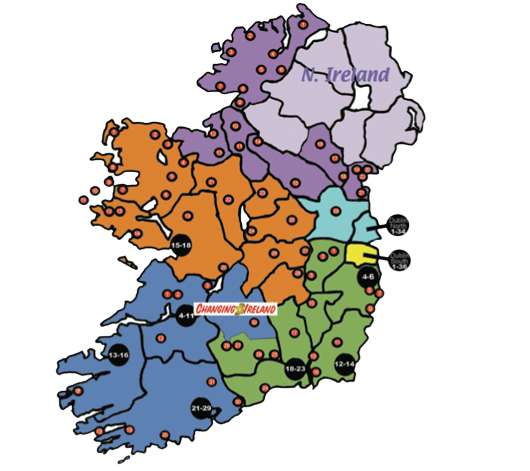
We’ve mapped 120+ projects in the LCDP

‘Changing Ireland’ has mapped over 120 projects in the Local and Community Development Programme.
We’ve pinpointed 95% of the locations to within metres and you can access the project/companies’ email, phone and website details through the map.
CLICK HERE TO SEE THE MAP AND ZOOM INYou can click on a location for full details.

A screenshot of the LCDP map by ‘Changing Ireland’

Viewers can see all the projects together OR choose to only view (a) Local Development Companies, (b) projects on islands, for women and for Travellers, (c) Projects that provide specialist or national expertise, (d) Community Development Projects that operate under new alternative arrangements.
The Department’s and Pobal’s locations are also mapped as are projects that receive Programme funding yet do not fit neatly under any label for now.

Limerick leads way with integrated service

Minister Joan Burton outside the new integrated office
Today, the Minister for Social Protection Joan Burton officially opened the new premises of Northside Local Employment Service at Watch House Cross, Moyross, Limerick.
“This approach very much fits with my Department’s policy of integration of services,” said the Minister,” adding that she was struck by the “enthusiastic and imaginative way Limerick LES” delivers their service.
The new office offers information and advice, job mediation, career guidance and job placement.
The premises are a result of the merging of two full time Outreach Offices of the Local Employment Service (LES) which were located in Moyross and St. Munchin’s Community Centres. 
“I recall planning meetings when we said that we’ll meet clients on the beach in Ballybunion if need be,” said Sexton Cahill of the PAUL Partnership.
The new location is beside a bookies and at the entrance to Moyross, at the Watch House Cross Shopping Centre.
Local people are saying the location couldn’t have been better chosen.
This blog posting will be updated with further details, including web links, later.

ISLANDS GET ASSURANCES; CWC GETS FUNDING CUT

Communities on Ireland’s offshore islands got a boost in recent days with the new Gaeltacht Minister Dinny McGinley assuring islanders the Government would continue to support their development.

He was speaking at the Cómdháil Oileáin na hÉireann (Federation of Irish Islands) agm, held on Clare Island. The Irish Times reported: “Noting that access and infrastructural issues had been addressed, he said the next focus for sustainable development was the creation of enterprise and employment.”
Photo by A Meagher: Clare Island as seen from the Newport-Mulranny side.
“He conceded that while islands had benefited from the fruits of the Celtic Tiger, there was no longer funding available for major expansion. However, the maintenance of such services as childcare, healthcare and waste management would be continued.”
Approx. 2,944 islanders live on our offshore islands.
CWC FUNDING
Meanwhile, the Community Workers Co-op has suffered a blow with news that funding it receives under the Scheme to Support National Organisations in the Community & Voluntary Sector will not be continued.
The CWC can appeal the decision and met last Friday to consider options.

QUESTION! Is Community Development better understood in Ireland today compared to 10 years ago?

INVITATION!

Click on this link and vote on our questionANSWER by clicking on one of the options (or add your own option for people to vote for).

  • No, because the term covers such a wide spectrum of activity
  • No, because Community Development work has declined because of Government cuts.
  • It’s complicated! It’s both up and down.
  • Yes, there is a better understanding of equality and collective action nowadays.

Update in relation to former CDPs and the LCDP

The Department’s statement reads:

“The latest phase of cohesion involves the integration of Community Development Projects (CDPs) with the 52 LDCs and the establishment of the approved alternative structures. At one stage there was a total of 185 CDPs/groups being funded under the [LCDP] programme, however this is now 153. The position of these is as follows:

13 are classified as groups of national/special innovation are not part of the integration process

49 form part of six approved alternative integration models:

  • 3 Northside CDPs
  • 17 Women’s CDPs
  • 6 Limerick CDPs
  • 14 Traveller CDPs
  • 2 Bray CDPs
  • 7 CDPs part of the HSE alternative model

71 have concluded with or in the final stages of the integration process with their aligned LDC.

15 remain outside the integration process for the moment but it is hoped that arrangements for these will be concluded later this year.

5 are part of an alternative model for the “Islands – non Gaeltacht” which is currently under consideration within the Department.”

– Map showing 180 CDPs in 2006. Source: Changing Ireland. Download as a high-res PDF with the full listing here: https://changingireland.ie/wp-content/uploads/2011/06/Iss-19-CDP-map-pages-180-projects-in-2006-high-res-NB.pdf

“The Local and Community Development Programme (LCDP), which was launched on 1st January 2010, superseded the Local Development Social Inclusion and the Community Development Programmes. The aim of the LCDP is to tackle poverty and social exclusion through partnership and constructive engagement between Government and its agencies and people in disadvantaged communities.

“The Programme is underpinned by four high level goals:

  • To promote awareness, knowledge and uptake of a wide range of statutory, voluntary and community services;
  • To increase access to formal and informal educational, recreational and cultural development activities and resources;
  • To increase peoples’ work readiness and employment prospects; and
  • To promote engagement with policy, practice and decision making processes on matters affecting local communities.

“A key difference between the LCDP and its predecessor programmes is that, when it is fully implemented, it will be delivered through an integrated delivery structure in each of the 52 Local Development Company (LDC) areas. While a national model involving full integration was set out by the Department, it was made clear that other options could be considered once they met a range of criteria including:

  • ·      Reduced structures;
  • ·      Better integrated delivery of services;
  • ·      Supporting efficiencies; and
  • ·      Reducing company law compliance requirements for projects.”

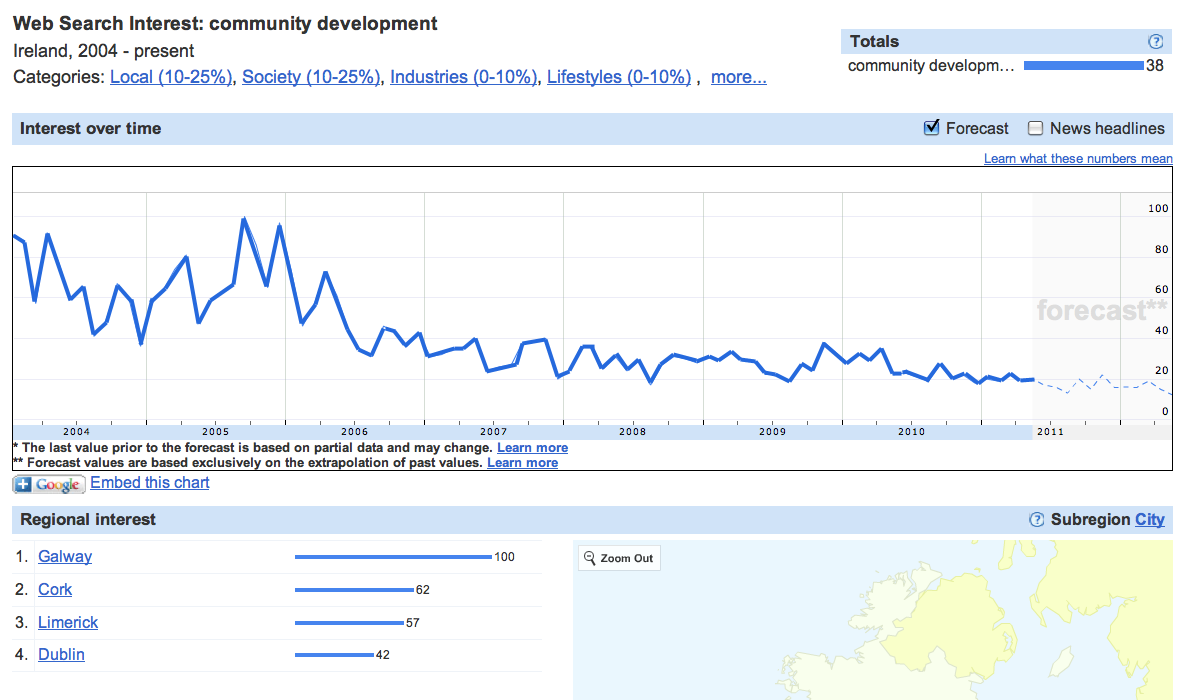
COMMUNITY DEVELOPMENT MOST POPULAR IN GALWAY – Google “Fact”

Is Community Development on the slippery slope in Ireland today?
It appears there is most interest in “community development” in Galway, with Cork and Limerick following next, followed oddly by the capital Dublin.
However, if ‘Google Analytics’ is any kind of reliable guide (and we’re not saying it is) the relative slide in Irish interest in the concept of community development may be a cause for concern.
CLICK IMAGE TO ENLARGE
According to Google’s chart here people are not looking it up online as much as before (as compared to people’s interest in other terms). Given how the statistics are devised, the interest level may actually have increased, but not relative to the interest-level in, let’s say the Heineken Cup or Jedward.

‘Changing Ireland’ also looked at the interest in googling for “community development” compared with the term “community work”. Here too, Galway people have the most interest.
Does this reflecting the fact that the likes of West Training, the National Traveller Women’s Forum and the Community Workers’ Co-op are based in Galway? Or is it because Galway people generally always have more interest in community?
Do you believe the statistics?

CLICK IMAGE TO ENLARGE

On a very positive note, the word “community” is now popping up increasingly in news reports. The terms appears twice as much in Irish news reports online in 2011 than it did seven years ago.

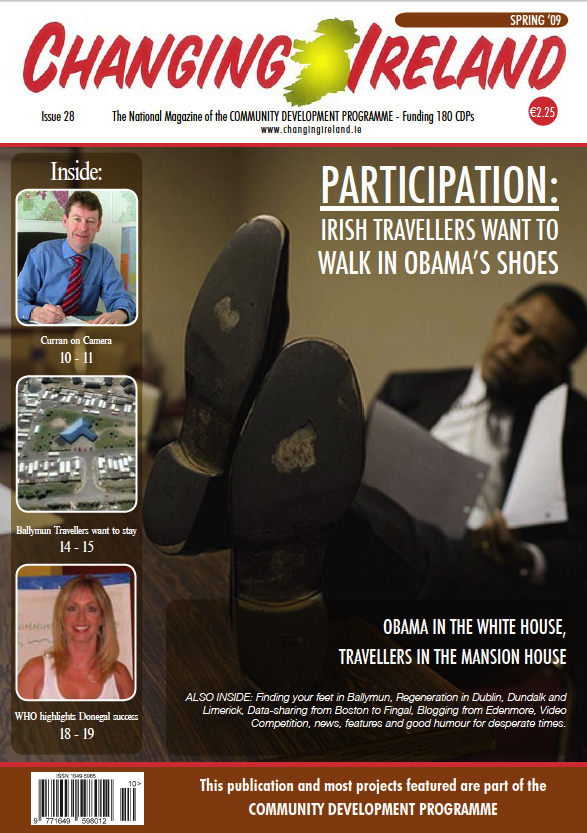
OBAMA, TRAVELLERS & ‘CHANGING IRELAND’

US President Barack Obama started out as a community worker and he’s here in Ireland today! His people hailed from Offaly.
Many see him as a true hero and an inspiration to members of minorities everywhere, others see him as a puppet of the military-industrial complex and Wall Street. The truth includes elements of both perspectives and some more.
However, it is due to his background as a community worker that we decided to feature him in Spring 2009 on our front cover after he was elected US President.


Obama is known to have an interest (to quote Jesse Jackson among others who know him well) in the issue of Traveller rights in Ireland and it was in connection with a Traveller story that we published his photo.
For the record, click here for a link to the full PDF edition of the Obama edition.