

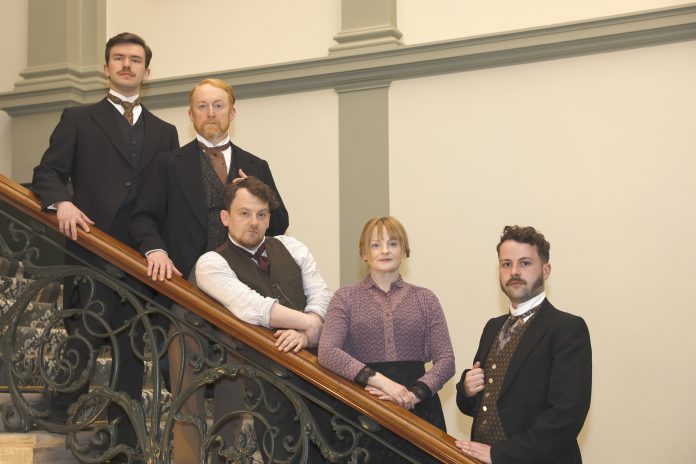
While set in the 19th century the topics covered in the one-hour play resonate today. The play is essentially a detective story about the fight against the cholera pandemic in 1840s–50s ‘Charles Dickens era’ London. It follows a pioneering outsider, Dr. John Snow, as he challenges medical orthodoxy and lays the foundations of modern data science and epidemiology – the study of how often diseases occur in different groups of people and why.
The story illuminates key challenges still at the heart of public health debates, such as “bad science”, groupthink and dissent, and the tensions between public health and personal rights.
Research Ireland grants
Caitlin White is the play’s engagement and outreach manager and she explained how a grant from Research Ireland’s Discover Programme meant they could cover the entry costs for schools and community groups. This proved popular.
“A Discover grant is about engaging with the sciences, in general. A key part of it is public engagement,” she said.
It has played in institutions that may be seen as elitist and in venues where plays are rarely if ever performed. For instance, it was performed in Tiglin Rehabilitation Centre in Co. Wicklow, in the IPAS Centre in City West, Dublin, in a room in Leinster House, the Royal College of Physicians, the Royal College of Surgeons, and the James Joyce Centre – as well as some traditional theatres.
Ms. White has enjoyed taking the play out of conventional theatres to new audiences, playing to “people who don’t normally engage with theatre.”
“This is what Research Ireland wanted – public engagement – and, rather unusually, every group that comes to see the play is also offered a workshop. This is to deepen their engagement with the material, give them a bit of context for the world of the play, and prepare them for what they’re going to see.”
“We’ve gone to groups like the IPAS Centre and the rehabilitation centre, and when we’ve been in those venues we’ve reached out to other groups in the locality – schools, book clubs, St Vincent De Paul, any group in the locality that might be interested,” she said.
Many of the groups who have come to see it have got much more out of it than they had expected.
“At times the groups thought it wouldn’t be of interest to them, but when they came they were surprised at how they felt about it or how relevant it felt to them. There were quite a few groups that didn’t think it would be of interest, weren’t too hopeful, but they were surprised by it. Again, not needing to make a profit is very important, it opens doors in terms of bringing different groups in,” she said.
Playwright’s delight
Playwright Colin Murphy said that the funding of the play was vital to bringing it out to the wider community.
“When I had the idea of the play rather than going through the usual route of a theatre company and the Arts Council, I’d heard that an organisation that used to be called Science Foundation Ireland, and is now called Research Ireland, had the Discover Programme, for public engagement. If your play was telling a story in science it was a way to get the play funded, which is an alternative to the more obvious funding options.
“What they wanted was to reach audiences who aren’t professionally or academically involved in science, technology, engineering and mathematics (STEM). That’s a lot of ordinary people, but they’re particularly interested in demographics that might be in some way out of the mainstream or marginalised, or just remote from scientific debate and discussion.”
He is delighted with how it has connected with large numbers of people who don’t normally go to plays.
“The community groups we’re playing to are often people who may not have much exposure to science or theatre. We’re bringing both to them, which is wonderful.
“If you were doing a show that was only going to schools and community groups it would be seen in the sector as educational theatre or community theatre or development theatre. But we’re also playing in theatres, we have a first class professional cast and director, it’s produced by Verdant Productions, a top class theatre company,” he said.
‘Miasma’ completed a month-long tour in June. Two more shows are scheduled for August and the play will also be performed in London.
“We are open to invites to do it again in Ireland. The script is also available for local groups to do themselves,” said Mr. Murphy. Contact him directly at: colinmurphy@me.com
Miasma play website:
https://projectvicteur.com/miasma/
Research Ireland Discover Programme:


