

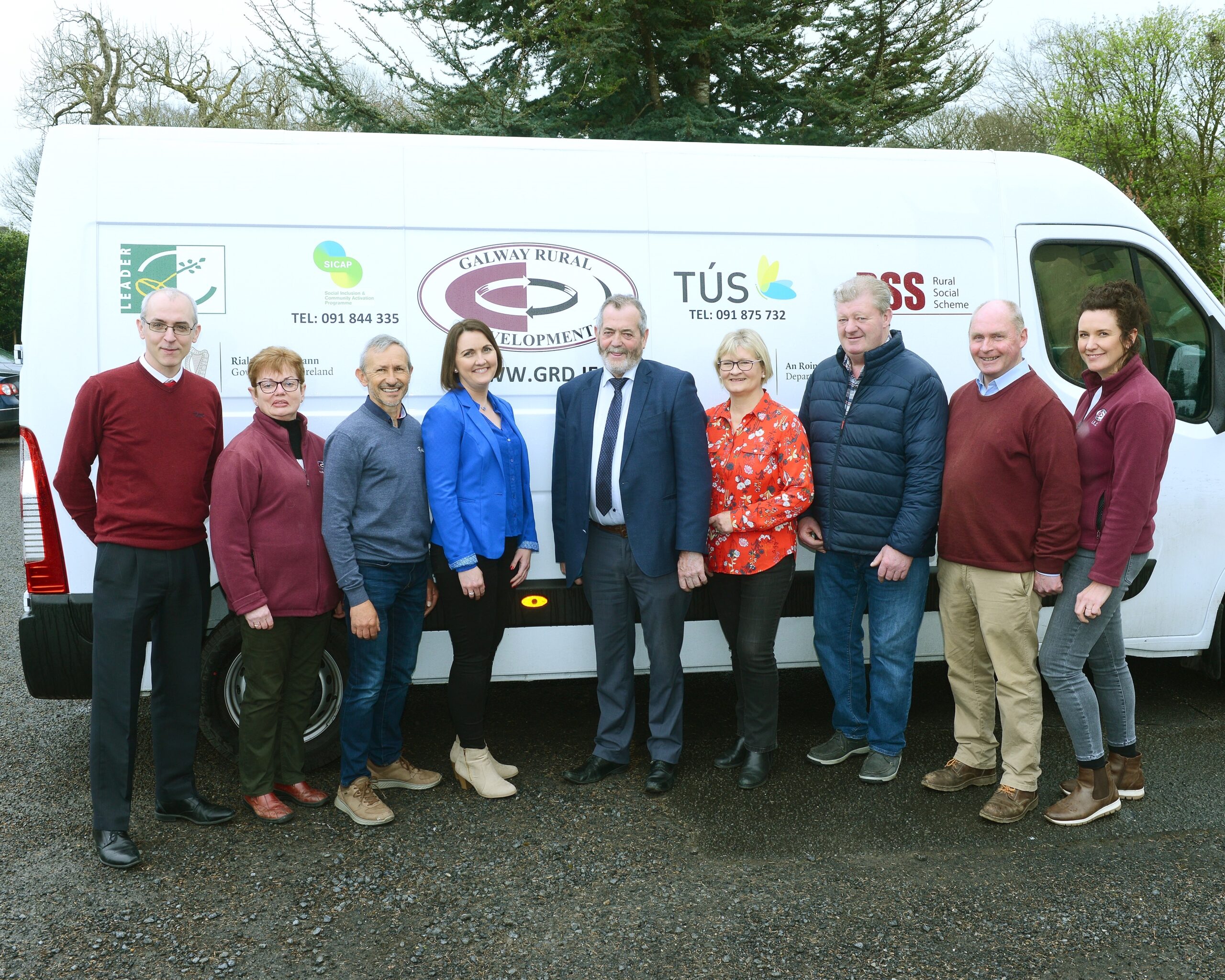
In 2022, GRD led a successful national campaign to seek to widen eligibility on both the RSS and the Tús Scheme so that participants continue to be available to the community groups.
The Rural Social Scheme (RSS) is now 20 years on the go while we in GRD are celebrating our 30th year supporting communities. A long-awaited review with recommendations has just been published, and there’s no better time to describe the impact of work done through the RSS and Tús schemes in East Galway.
It can transform a village, it can lift a county and, if the right changes are made to the scheme, we will have no trouble recruiting more participants.
Kilconnell Village Success
Kilconnell is a small village in East Galway and, over the past five years, with the assistance of participants on the RSS and Tús, the villagers have developed a stunning biodiversity garden. The community had a vision to develop a garden providing food and shelter, so that pollinators could survive and thrive. Now their vision is a reality.
As RSS supervisor Ita Kenny said: “In the early stages of the project, the focus was just on providing a safe pathway for community use. A path of 750m was constructed by our RSS team and then maintained by our participants. As the park became more popular however, the community group decided to manage the area in an environmentally friendly way.”
The area covers five acres and has mature native trees, and now also new saplings, fruit trees and willow domes. There is also a community field for recreation. The RSS participants manage all aspects – from pathway maintenance to hedge trimming, pruning, ‘dead hedge’ maintenance, meadow cutting, and seed harvesting.
As Ita says: “The park now provides a safe area for schoolchildren for nature walks. For the past two years the community group and the local schools, in collaboration with the Tree Council of Ireland, have participated in National Tree Week. This gave children the opportunity to learn about the importance of trees to our environment and biodiversity.”
County-wide Biodiversity
Additionally, GRD have worked with the local authority’s biodiversity officer to ensure that the participants and supervisors across East Galway are aligning their environmental maintenance work with local and national policies and plans. Training is provided in plant identification and in particular identifying invasive plant species. GRD also participate in the annual ‘No Mow May’ campaign.
Benefit to the Participant
As our senior manager Sean Broderick points out: “We are fortunate to have participants who have studied horticulture, with some gaining QQI Level 5 qualifications with GRD’s support. This knowledge is invaluable to the community and to other participants. In addition, projects like Kilconnell allow for peer-to-peer learning and encourage cooperation and social skills development.”
“Since the start of this project participants are always willing to learn new techniques, share their skills with new participants, and are genuinely interested in maintaining the park in an environmentally friendly fashion,” said Sean.
In a separate recent development, Galway Rural Development acquired a new van for use by our Tús and Rural Social Schemes workers. The van now delivers equipment under the SICAP ‘Loan Equipment Fund’ which has provided communities with long-term loans of equipment such as air purifiers, laptops, printers, and other items.
(SICAP is short for the Social Inclusion and Community Activation Programme).
Recruitment
In terms of recruiting new participants, we are doing all we can at our end. Where there are shortages of participants, rural charities and community groups do struggle. The different employment programmes need to be better appreciated nationally as a vital contributor to
rural life and its communities.
In recent months our team of RSS Supervisors attended the eight marts across East Galway to provide farmers with information about the contribution that the RSS makes. While these information days proved popular, the fact remains that rule changes are needed to address
shortages and encourage female participation.
We have previously laid out the need for a change in the criteria for participation in order to widen the potential participant pool in both RSS and Tús. Furthermore, along with the need to increase the financial benefit to participating farmers and unemployed persons, there is a need to properly compensate the supervisors. The recommendations recently published in the RSS review give us hope.

About the RSS
The Rural Social Scheme (RSS) provides supplementary income for farmers in receipt of certain social welfare payments who are willing to work 19.5 hours a week providing services that benefit their own local community.
The RSS has a variety of placements from administration, heritage, and social care roles to Tidy Towns, sport pitches, community centres, and more.
To qualify, participants must be part of an active farming or fishing family and be in receipt of a means tested payment such as a Jobseeker’s Allowance or Farm Assist.


