


The network wants the Government to commit to multi-annual funding for integration work to support refugees – first introduced in 2022 in response to Russia’s expanded war on Ukraine. The €10m in annual funding comes through the Social Inclusion and Community Activation Programme (SICAP) and the network wants the Government to “roll New Arrivals funding into the core SICAP budget”.
It said, “Fostering trust between new and host communities requires consistent, multi-year engagement, and funding arrangements need to reflect this.”
The call forms part of the LDCN’s overall Pre-Budget Submission for Budget 2027 and it was formally presented to senior Ministers and elected representatives in Buswells Hotel, Dublin, this morning. It was among a number of proposals described as “essential” to “translate policy commitments into tangible outcomes for individuals, families, and communities across Ireland”.
 Other priorities highlighted today include calls for:
– Increased funding of €6.1m for the Social Inclusion and Community Activation Programme (SICAP),
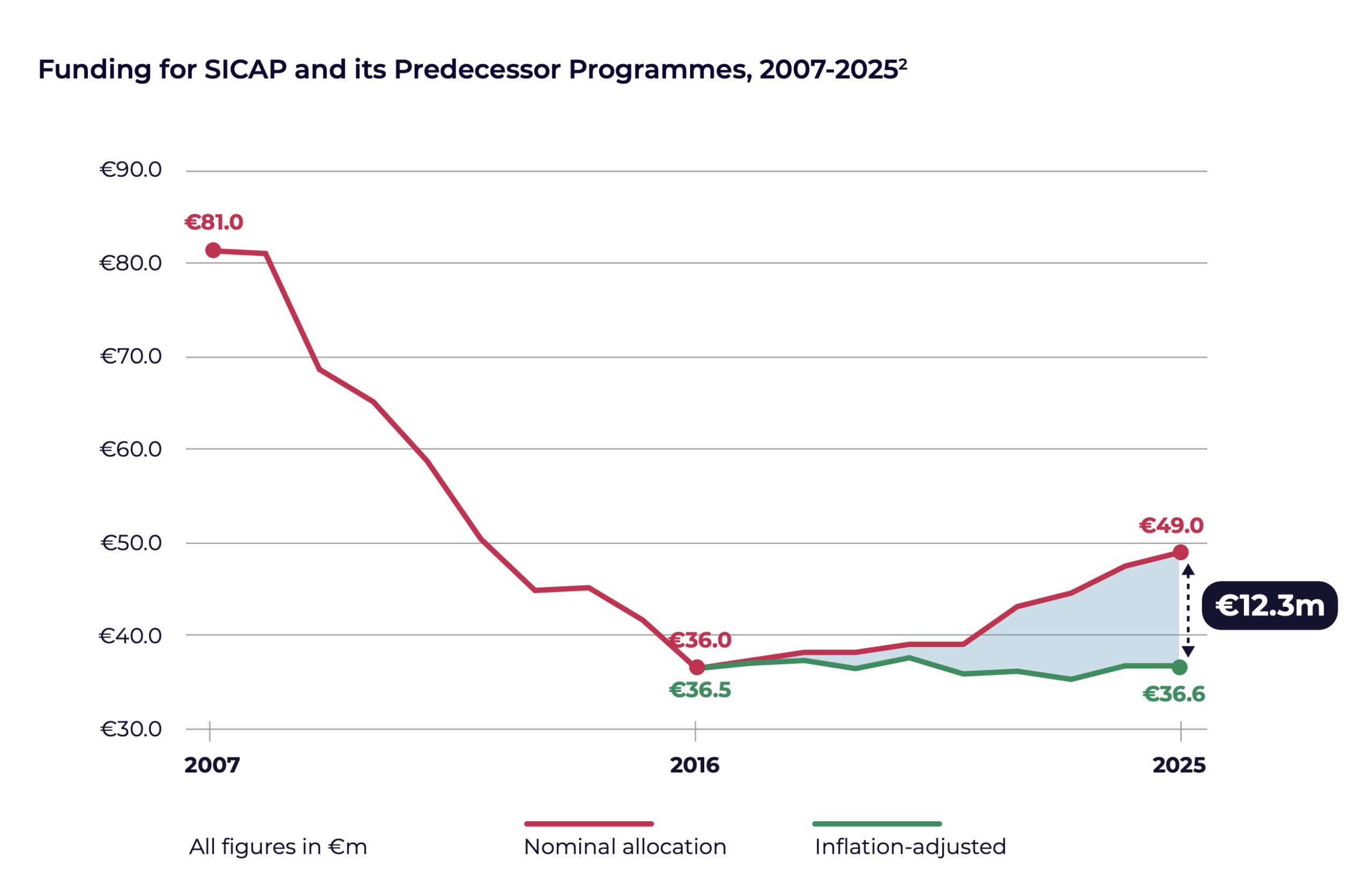
The submission says: “During the years of the recession, budgets for the flagship social inclusions programmes of the day – namely the Local Development Social Inclusion Programme and the Community Development Programme, followed by the Local Community Development Programme and then SICAP – fell by more than 55per cent, from €81.3m in 2007 to €36.5m in 2016.
“When inflation is factored in – SICAP’s budget remains at almost exactly the same level today as it was when it fell to its lowest point in 2016. In other words, the small, incremental increases to the SICAP budget that we have seen over the past ten years have been almost entirely wiped out by inflation.
“SICAP’s importance to rural development in Ireland was also made clear in the OECD’s Review of Rural Policy in Ireland.
“The 12.5 per cent increase (€6.1m) in SICAP funding that we recommend would serve
only to close the “inflation gap” by about half, but would provide an important and meaningful step towards restoring the programme’s capacity to deliver at the scale demanded by the ambitions of the Roadmap for Social Inclusion 2026-2030,” it says. For more, read the full document.
– €12 million to strengthen community employment schemes.
The submission says: “Increases in core social welfare rates, while welcome, do not incentivise participation in Community Employment (CE), Tús, or RSS. On the contrary, by reducing the relative value of the top-up compared to the base payment, they risk having the opposite effect.
We therefore recommend an increase in top-up payments for CE, Tús and RSS participants of €7.50 per week per year over the next three years (additional to any increases to underlying social welfare), at an annual cost to Government of €12m.”
– Measures to secure the long-term future of the LEADER programme,
The ILDN wants the Government to ensure LEADER funding is ringfenced
and expanded under the EU’s next Multiannual Financial Framework.
As its submission says: “LEADER remains Ireland’s most important instrument for bottom-up, community-led rural development. Over the past ten years, almost 7,000 different projects – spanning all 26 counties and a broad range of themes including enterprise, tourism, food, social inclusion, infrastructure and connectivity, and climate and environment – have been approved for LEADER funding.”
It also notes:
“Eighteen months out from the end of the current programme, several LDCs have now allocated their enterprise funding in its entirety, such is the level of grassroots activity and the appetite for funding support.”
The LDCN therefore calls on the Government to allocate additional funding, amounting to €10.2m (or 10 per cent of the exchequer contribution to the current programme to the LEADER programme), to ensure that it is resourced to deliver for communities through the end of the current programme period.
– Wider Sláintecare Healthy Communities rollout should be based on a strengthened implementation and funding model.
Sláintecare Healthy Communities was launched in 2021 and now provides support in 24 communities, where it is delivered by Local Development Companies, Family Resource Centres, and a number of other community-based organisations. However, employment, administrative and governance challenges should be addressed, and the submission describes these in detail.

Thomas Fitzpatrick, chairperson of the LDCN, said, “Presenting this submission to policymakers today was about ensuring that the systems required to deliver these ambitions are recognised, resourced, and strengthened.”
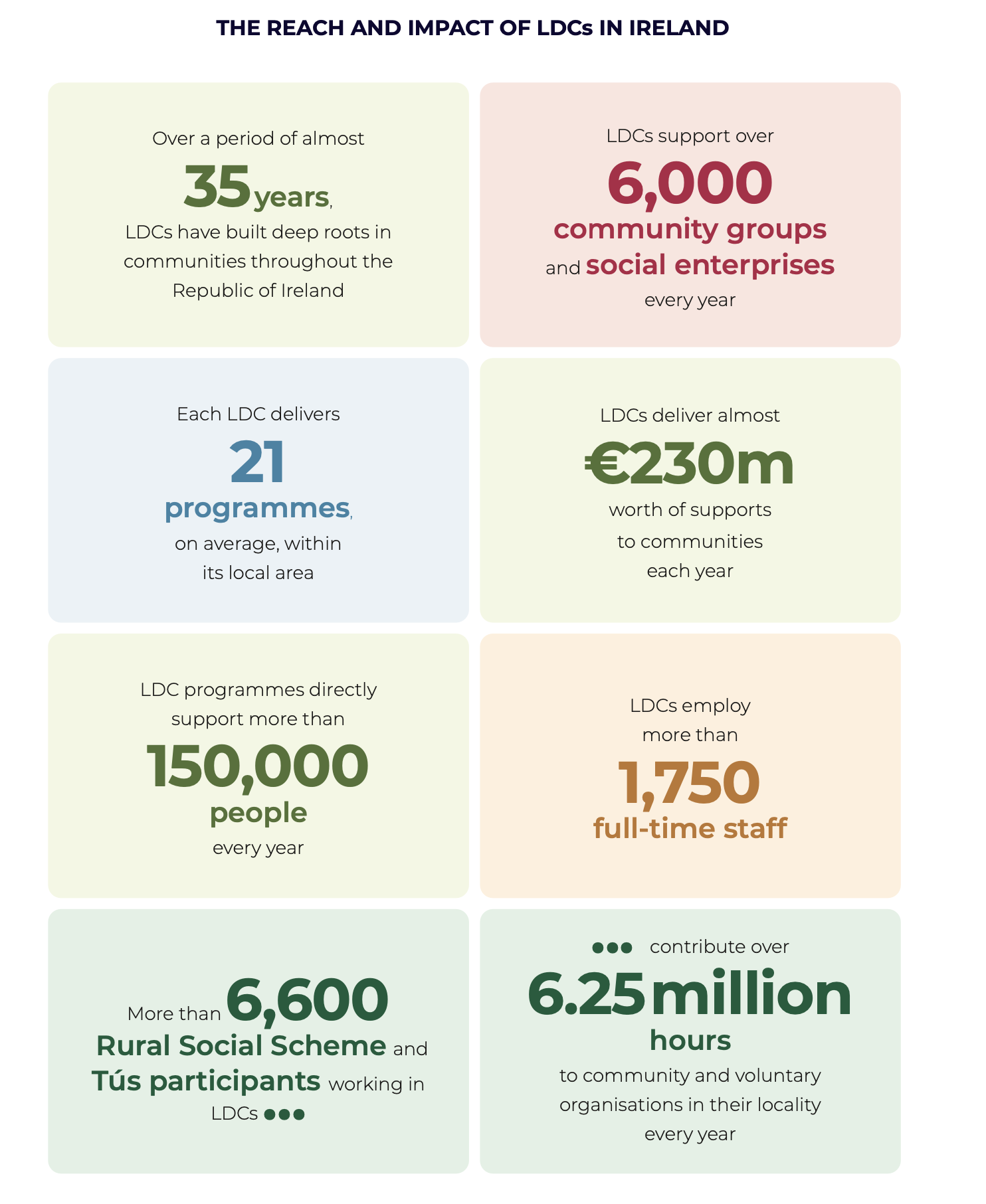
The submission highlights both the scale and reach of Local Development Companies, which support more than 150,000 people and 6,000 community groups annually, employ over 1,750 staff, and deliver approximately €230 million in supports each year in communities across the country.

Máirín Ó Cuireáin, CEO of the Local Development Companies Network, said, “Local Development Companies are a trusted bridge between policy, people and place. Today’s presentation to elected representatives reinforces a central message — that ambition at national level must be matched by investment in the structures that deliver real change in communities.”
She said that without appropriate resourcing, key national strategies risk underperformance:
“We have seen from previous policy cycles that ambition on its own is not enough. If Government is to meet its targets on social inclusion, rural development, and integration, it must ensure that community-led delivery systems are properly resourced, sustained, and supported to respond to increasingly complex needs,” she added.
The submission also highlights challenges in meeting national social targets, noting that child poverty increased to 7.8% (95,167 children) by 2025, while consistent poverty rose to 4.7% (256,554 people) – indicating a widening gap between policy targets and outcomes.
The network said, “These trends underline the need for a more integrated, place-based approach to policymaking – one that connects social inclusion, economic development, and community resilience, and is grounded in the lived experience of communities.”
The submission comes as Government prepares to implement major strategic frameworks, including the Roadmap for Social Inclusion 2026–2030 and the OECD Rural Policy Review. The LDCN said Budget 2027 represents a critical opportunity to ensure these policies are adequately resourced and positioned for success.
You can download the full submission here: https://changingireland.ie/wp-content/uploads/2026/06/LDCN-Pre-Budget-Submission-2027-FINAL.pdf


